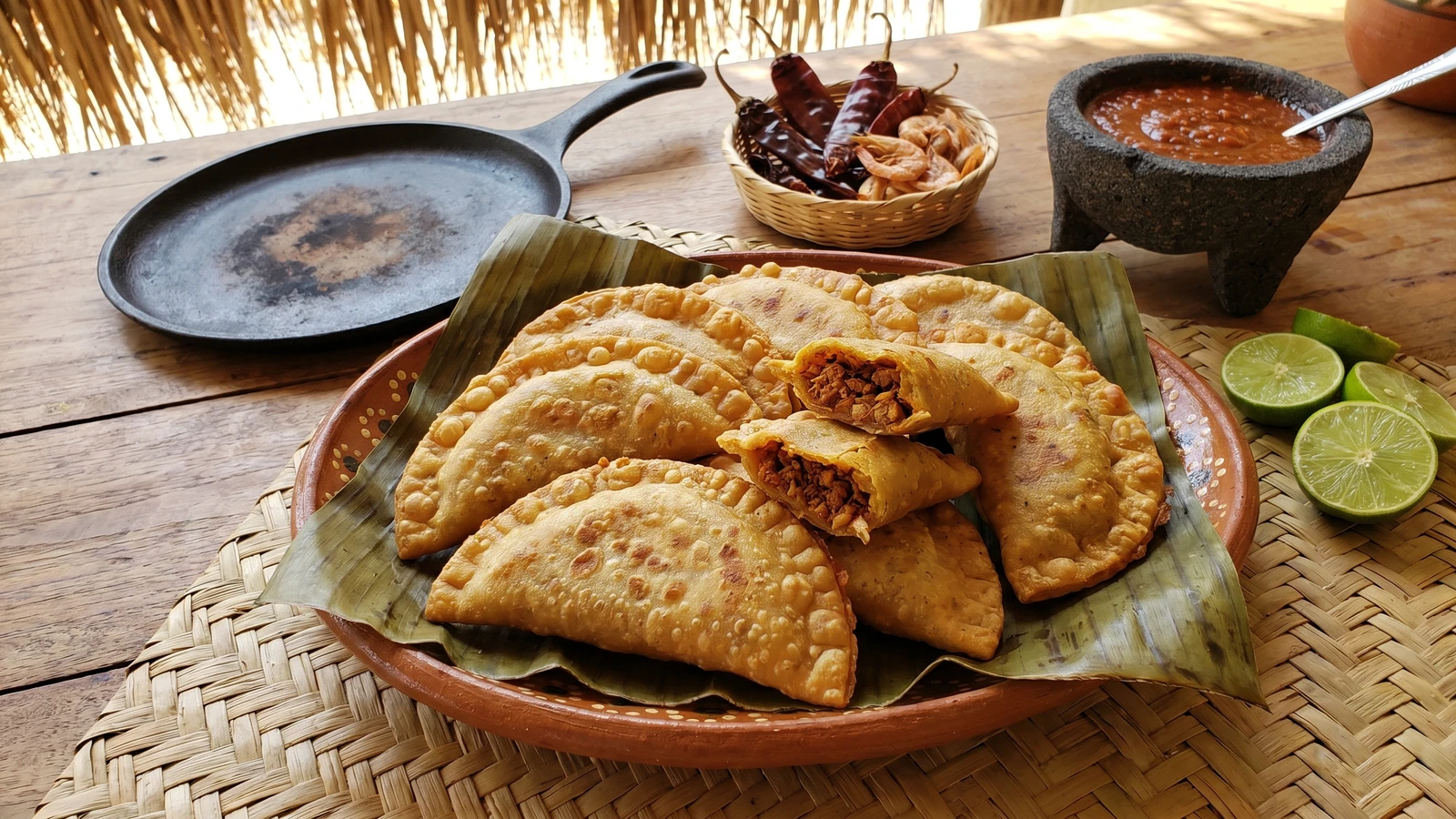
Guerrero and Oaxaca's Costa Chica empanadas fold fresh masa around dried shrimp, chile costeño, tomate, and epazote, then fry them until the edges turn crisp and golden.
Appetizers & Snacks
Mexican
Make Ahead
Potluck
Outdoor Dining
50 min
Active Time
35 min cook•1 hr 25 min total
Yield14 to 16 empanadas
Guerrero's Costa Chica, crossing into Oaxaca around Pinotepa Nacional and Chacahua, is where these empanadas live. Cuajinicuilapa, the Perla Negra del Pacifico, knows dried shrimp because the coast knows salt, sun, lagoons, and work. This is Afro-Mexican food. Not a footnote. Not a curiosity. A community kitchen that has been here for 400 years.
The filling is camarón seco ground with chile costeño, tomate, onion, garlic, and epazote. The chile costeño matters because it belongs to this coast. It gives heat, yes, but also a sharp red fruitiness that a guajillo cannot pretend to give. The shrimp must be rinsed and toasted, then ground until it smells like the market stalls near the coast, salty and deep, not fishy.
The women who make these well know the engineering. Masa has to be soft enough to fold and strong enough to hold the filling. The edge must be sealed tight, because oil finds laziness fast. Fry in manteca de cerdo if you have it. La manteca es el sabor. If you fry in neutral oil, the empanada will still feed people, but it will not taste like the ones passed across a palm mat under a palapa awning.
Serve them with lime, salsa de chile costeño, and nothing that does not belong there. No cheese. No sour cream. No flour tortilla thinking. This is a 32-state cuisine, and the Costa Chica has its own hands, its own chile, its own hunger. Cada estado, su propia cocina.
The Costa Chica of Guerrero and Oaxaca has one of Mexico's strongest Afro-Mexican culinary identities, rooted in communities such as Cuajinicuilapa, San Nicolas Tolentino, Pinotepa Nacional, and Chacahua. Afro-Mexican people received constitutional recognition in 2020, but their foodways, including dried seafood, coconut, plantain, rice, and coastal chiles, have shaped regional cooking since the colonial period. Dried shrimp empanadas show the practical coastal logic of preserving seafood with salt and sun, then stretching it through masa for market snacks, family gatherings, and outdoor eating.
The technique, the tradition, and the story behind every dish.
preferably white or yellow nixtamalized corn masa harina
warm water
Quantity
1 1/2 cups, plus more as needed
manteca de cerdo
Quantity
1 tablespoon
softened, for the masa
fine sea salt
Quantity
3/4 teaspoon
camarón seco (Mexican dried shrimp)
Quantity
5 ounces
heads and legs picked over
dried chile costeño
Quantity
4
stemmed and seeded
ripe tomate rojo
Quantity
2 medium
charred on a comal
white onion
Quantity
1/2 medium
charred on a comal
garlic cloves
Quantity
2
unpeeled and charred, then peeled
manteca de cerdo
Quantity
1 tablespoon
for the filling
dried Mexican oregano
Quantity
1/2 teaspoon
fresh epazote
Quantity
1 large sprig
leaves chopped
black pepper
Quantity
1/4 teaspoon
water or shrimp soaking liquid
Quantity
1/2 cup, as needed
manteca de cerdo or neutral oil
Quantity
2 cups
for frying
lime halves (optional)
Quantity
for serving
salsa de chile costeño (optional)
Quantity
for serving
Ingredient
Quantity
masa harina for corn tortillaspreferably white or yellow nixtamalized corn masa harina
2 cups
warm water
1 1/2 cups, plus more as needed
manteca de cerdosoftened, for the masa
1 tablespoon
fine sea salt
3/4 teaspoon
camarón seco (Mexican dried shrimp)heads and legs picked over
5 ounces
dried chile costeñostemmed and seeded
4
ripe tomate rojocharred on a comal
2 medium
white onioncharred on a comal
1/2 medium
garlic clovesunpeeled and charred, then peeled
2
manteca de cerdofor the filling
1 tablespoon
dried Mexican oregano
1/2 teaspoon
fresh epazoteleaves chopped
1 large sprig
black pepper
1/4 teaspoon
water or shrimp soaking liquid
1/2 cup, as needed
manteca de cerdo or neutral oilfor frying
2 cups
lime halves (optional)
for serving
salsa de chile costeño (optional)
for serving
Equipment Needed
•Cast iron comal or heavy skillet
•Tortilla press lined with plastic
•Volcanic stone molcajete or food processor
•Heavy 10-inch skillet for frying
•Wire rack set over a sheet pan
Instructions
1
Make the masa
In a bowl, mix the masa harina, salt, softened manteca, and warm water until a soft dough forms. Knead for three minutes. The masa should feel like a soft earlobe, not cracked and not sticky. Cover with a damp towel and let it rest 25 minutes. Resting gives the corn time to drink the water. Rush it and the empanadas crack when you fold them.
2
Rinse the shrimp
Pick through the camarón seco and remove any hard bits of shell, heads, or legs that look too sharp. Rinse quickly under cold water, then soak in warm water for 10 minutes. Drain well and save 1/2 cup of the soaking liquid only if it tastes clean and pleasantly salty. If it tastes bitter or dusty, throw it out. Pregúntale a las señoras del mercado. Good dried shrimp smells like the sea, not like an old cupboard.
3
Toast the shrimp
Heat a dry comal over medium. Toast the drained shrimp for three to five minutes, stirring often, until they dry back out and smell concentrated. Do not blacken them. This step wakes up the shrimp and removes that flat storage taste. Transfer to a molcajete or food processor and grind to a coarse powder with some small pieces left.
4
Toast the chiles
On the same comal, toast the chile costeño for about 15 to 20 seconds per side. It is small and thin, so watch it. The skin should darken slightly and smell fruity, not burned. Cover with hot water and soak for 10 minutes, then drain. Burned chile makes bitter filling. There is no good speech that fixes burned chile.
If you cannot find chile costeño, chile guajillo with one chile de arbol is a compromise. It will not taste like Costa Chica. Use chile costeño when you can find it.
5
Char the vegetables
Place the tomatoes, onion, and unpeeled garlic on the comal. Turn them until the tomatoes blister and slump, the onion gets dark spots, and the garlic softens inside its skin. Peel the garlic. Blend the tomatoes, onion, garlic, and soaked chile costeño until you have a thick red sauce. Do not add too much liquid. This filling has to sit inside masa, not run away from it.
6
Cook the filling
Melt 1 tablespoon manteca de cerdo in a skillet over medium heat. Add the chile-tomate sauce and fry for five minutes, stirring, until it darkens and thickens. Stir in the ground shrimp, Mexican oregano, black pepper, and chopped epazote. Add a few spoonfuls of water or clean shrimp soaking liquid only if the mixture is too dry to come together. Cook until the filling is thick, salty, and spoonable. Taste before adding salt. The shrimp usually brings enough.
7
Press the rounds
Divide the rested masa into 14 to 16 balls, each about the size of a small lime. Line a tortilla press with plastic cut from a clean bag. Press each ball into a round about 5 inches wide and a little thicker than a tortilla. Too thin and the filling breaks through. Too thick and you get a heavy empanada. Balance, comadre. The masa tells you.
8
Fill and seal
Place 1 heaping tablespoon of shrimp filling on one half of each masa round, leaving a clean border. Fold the plastic over to close the empanada into a half-moon. Press the edge firmly through the plastic, then crimp with your fingers or the tines of a fork. If the edge cracks, dab it with a little water and press again. Oil finds every loose seam. No me vengas con atajos.
9
Fry until crisp
Heat the manteca de cerdo or oil in a heavy skillet to 350F. Fry the empanadas in batches, two to three minutes per side, until golden with crisp bubbled edges. Keep the heat steady. If the fat is too cool, the masa drinks it. If it is too hot, the outside browns before the center is ready. Drain on a rack or brown paper, not a stack of paper towels that traps the crust.
10
Serve with lime
Serve warm or at room temperature with lime halves and salsa de chile costeño. These are botanas for the afternoon, for a potluck table, for eating under shade while someone argues about whose aunt folds them better. That argument is allowed. The sour cream is not. Así se hace y punto.
Chef Tips
•Buy camarón seco at a Mexican market with turnover. The shrimp should be dry, firm, and ocean-salty, never damp or ammoniated. If the bag smells stale before you open it, leave it there.
•Chile costeño is the regional spine of this dish. It is common in Guerrero and Oaxaca markets and harder to find outside Mexico. Look at Mexican grocers, Oaxacan markets, or online chile vendors before you substitute.
•Fresh masa from a tortilleria is better than masa harina. Ask for masa para tortillas, not masa preparada for tamales. If using fresh masa, use about 1 3/4 pounds and knead in the salt and manteca.
•Do not overfill the empanadas. One generous spoonful is enough. A burst empanada wastes filling and dirties the frying fat.
•These are not sweet wheat empanadas. They are corn masa empanadas from the Costa Chica. Flour tortillas are a northern tradition, not the structure for this dish.
Advance Preparation
•The shrimp filling can be made two days ahead and refrigerated. Let it come to room temperature before filling so it spreads without tearing the masa.
•The masa can be mixed four hours ahead and held covered with a damp towel. Knead in a spoonful of warm water if it feels dry before pressing.
•The formed empanadas can be held covered in the refrigerator for up to six hours before frying. Separate layers with plastic so the masa does not stick.
•Fried empanadas hold well at room temperature for a potluck or outdoor table. Recrisp on a hot comal or in a 375F oven for eight minutes.
Frequently Asked Questions
Nutrition Information
1 serving (about 70g)
Calories
175 calories
Total Fat
10 g
Saturated Fat
4 g
Trans Fat
0 g
Unsaturated Fat
5 g
Cholesterol
55 mg
Sodium
570 mg
Total Carbohydrates
15 g
Dietary Fiber
2 g
Sugars
1 g
Protein
7 g
Where cooking meets culture.
Culinary guides, cultural storytelling, and the editorial depth that makes cooking meaningful.