Culinary Explorer

A cooking platform built around craft, culture, and the stories behind what we eat.
Discover Culinary Explorer
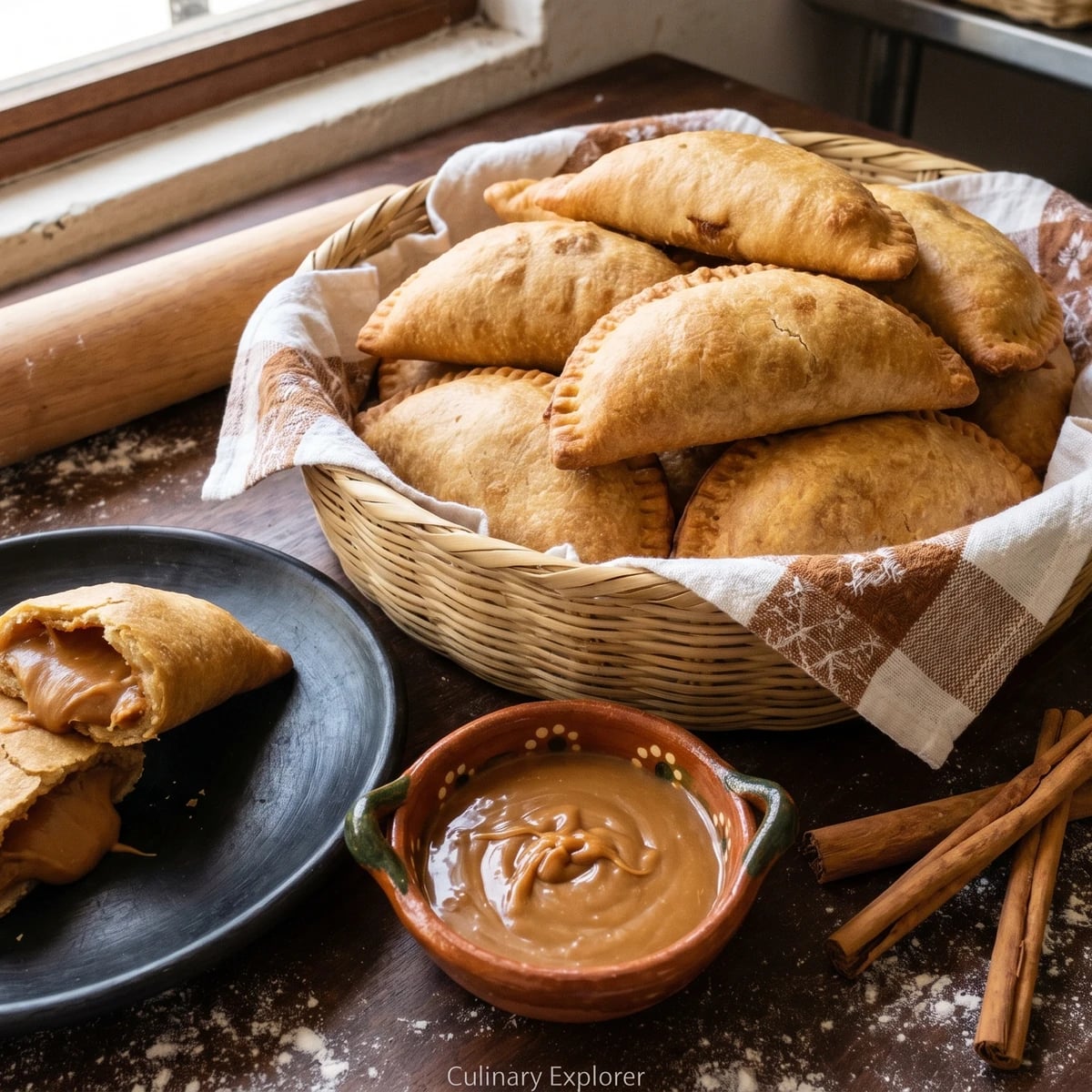
Empanadas de Cajeta de Comitán

Empanadas de Cajeta de Comitán

Created by

Chiapas highland empanadas from Comitán, baked with a tender wheat and lard dough wrapped around slow-cooked cajeta de leche quemada, made for panadería trays and afternoon coffee.

Pastries & Cookies
Mexican
Comfort Food
Make Ahead
1 hr
Active Time
1 hr 45 min cook2 hr 45 min total
Yield18 small empanadas

Chiapas, the Comitán highlands, near the Guatemalan border. That is where these empanadas live. Not in the north with flour tortillas, not in a sweet shop pretending every caramel is the same. In Comitán de Domínguez, a panadería tray of empanadas de cajeta belongs beside turuletes, marquesote, and the breads people carry home under a cloth napkin before the afternoon coffee.

The filling is cajeta de leche quemada. Milk, sugar, canela, patience. In other parts of Mexico, cajeta often means goat milk from Celaya. In Comitán, the name can point to this darker cooked milk sweet, thick enough to stay inside a folded wheat dough while it bakes. The flavor is not just sweet. It tastes like milk taken seriously, cooked until it turns tan and deep and a little toasted at the edges.

I learned this style from women who worked the bakery tables with flour on their wrists and no drama in their hands. Roll thin. Fill modestly. Seal well. Bake until golden. The work looks small, but the technique is exact. If you rush the cajeta, it burns. If you overwork the dough, it toughens. If you overfill, it leaks. La cocina no es decoración, es trabajo.

Cada estado, su propia cocina. Chiapas gives you cacao, coffee, cane sugar, highland dairy, and wheat breads shaped by convent kitchens and market bakeries. These empanadas carry that geography in one small half-moon. Saber cocinar es saber vivir.

Comitán de Domínguez sits in the Chiapas highlands on an old trade corridor between central Chiapas and Guatemala, which helped make wheat breads, milk sweets, cacao drinks, and cane sugar confections part of its daily food culture. Baked empanadas filled with cooked milk sweets reflect colonial-era pastry techniques adapted to local panaderías, where wheat flour, lard, eggs, and dairy were worked into portable sweets sold by the piece. The name cajeta varies by region in Mexico: Celaya's famous cajeta is usually goat milk, while Chiapas panadería cajeta de leche quemada is commonly understood as a dark cooked milk filling used for breads and empanadas.

The technique, the tradition, and the story behind every dish.

Discover Culinary Explorer

Ingredients

whole milk

Quantity

4 cups

granulated sugar

Quantity

1 1/4 cups

Mexican canela

Quantity

1 small stick

baking soda

Quantity

1/4 teaspoon

fine sea salt

Quantity

1/4 teaspoon

for the cajeta

all-purpose wheat flour

Quantity

3 cups

plus more for rolling

pork lard (manteca de cerdo)

Quantity

1/2 cup

chilled

unsalted butter

Quantity

1/4 cup

chilled and cubed

granulated sugar

Quantity

1/3 cup

fine sea salt

Quantity

1/2 teaspoon

for the dough

baking powder

Quantity

1 teaspoon

large egg yolks

Quantity

2

whole milk

Quantity

1/2 cup

cold, plus more if needed

vanilla extract

Quantity

1 teaspoon

large egg beaten with milk

Quantity

1 egg plus 1 tablespoon milk

for brushing

granulated sugar

Quantity

2 tablespoons

for sprinkling

Equipment Needed

  • Heavy 3-quart saucepan for the cajeta
  • Wooden spoon with a flat edge for scraping the pot
  • Rolling pin
  • 5-inch round cutter or overturned bowl
  • Two heavy baking sheets

Instructions

  1. 1

    Start the cajeta

    Combine the milk, sugar, canela, baking soda, and salt in a heavy saucepan. Use a pot larger than you think you need because the milk foams when the baking soda wakes it up. Bring it to a gentle simmer over medium heat, stirring until the sugar dissolves. This is cajeta de leche quemada, not syrup from a squeeze bottle.

  2. 2

    Cook it slowly

    Lower the heat and simmer, stirring often with a wooden spoon, for 60 to 80 minutes. The milk will move from white to beige to deep tan, and the bubbles will turn slow and thick. Scrape the corners of the pot every few minutes so the milk solids do not scorch in one bitter patch. You want a spoonable caramel that holds a line for a second when you drag the spoon through it.

    If the cajeta darkens too fast before it thickens, your heat is too high. Comitán's empanadas need cajeta with depth, not burned sugar pretending to be patience.
  3. 3

    Cool the filling

    Remove the canela stick and scrape the cajeta into a shallow bowl. Let it cool completely. It will thicken as it sits. Do not fill the empanadas with warm cajeta. Warm filling melts the fat in the dough and leaks on the tray. No me vengas con atajos.

  4. 4

    Mix the dough

    Whisk the flour, sugar, salt, and baking powder in a wide bowl. Rub in the chilled lard and butter with your fingertips until the mixture looks like coarse meal with a few pea-sized pieces left. La manteca es el sabor. The butter gives aroma, but the lard gives the tender bite that a good panadería empanada needs.

  5. 5

    Bring it together

    Beat the egg yolks, cold milk, and vanilla together. Pour into the flour mixture and stir with your hand until a soft dough forms. If dry flour remains, add cold milk one tablespoon at a time. Knead only five or six turns on the counter. This is pastry, not bolillo dough. Too much work makes it tough.

  6. 6

    Rest the dough

    Pat the dough into a disk, wrap it, and rest it in the refrigerator for 30 minutes. Resting lets the flour hydrate and the fat firm up again. The dough should roll without cracking at the edges and without sticking to the table like paste.

  7. 7

    Roll and cut

    Heat the oven to 375F. Line two baking sheets with parchment. Roll the dough on a lightly floured surface to about 1/8 inch thick. Cut 5-inch rounds with a cutter or an overturned bowl. Gather scraps once and reroll them. Twice is asking for tough empanadas.

  8. 8

    Fill and seal

    Place 1 generous tablespoon of cooled cajeta slightly off center on each round. Fold the dough over into a half-moon and press the edges firmly with your fingers, then crimp with a fork. Do not overfill. The señora at the panadería knows this because she has cleaned enough burned cajeta off trays to remember.

  9. 9

    Brush and bake

    Set the empanadas on the prepared sheets with a little space between them. Brush lightly with the beaten egg and milk, then sprinkle with sugar. Cut one tiny slit in the top of each empanada so the filling has somewhere to breathe. Bake 22 to 26 minutes, rotating the trays halfway through, until the edges are golden and the tops show small browned freckles.

  10. 10

    Cool before serving

    Let the empanadas cool on the tray for 10 minutes, then move them to a rack. The cajeta inside will be very hot and thick. Eat them warm or at room temperature with coffee, chocolate, or a glass of cold milk. Recetas probadas y garantizadas.

Chef Tips

  • Use real Mexican canela, the soft Ceylon-style cinnamon sold in rolled sticks at Mexican markets. Hard cassia cinnamon gives a sharper flavor and does not belong here if you can avoid it.
  • Manteca de cerdo gives the dough its short, tender bite. All butter tastes good, yes, but it makes a different pastry. A substitution is a compromise, not an upgrade.
  • Do not buy thin caramel sauce and call it cajeta. The filling must be thick enough to mound on a spoon when cool. If it runs, it will escape in the oven.
  • If you make the cajeta one day ahead, the work becomes calm. The panadería women know this. Divide the labor and the dough behaves better.

Advance Preparation

  • The cajeta can be made up to 5 days ahead and refrigerated in a covered jar. Bring it to room temperature before filling so it spreads without tearing the dough.
  • The dough can be made 1 day ahead and kept wrapped in the refrigerator. Let it sit at room temperature for 10 minutes before rolling.
  • Baked empanadas keep 3 days in a covered tin at room temperature. Rewarm in a 300F oven for 6 to 8 minutes if you want the pastry to taste fresh again.

Frequently Asked Questions

Nutrition Information

1 serving (about 70g)

Calories
275 calories
Total Fat
11 g
Saturated Fat
5 g
Trans Fat
0 g
Unsaturated Fat
6 g
Cholesterol
50 mg
Sodium
175 mg
Total Carbohydrates
39 g
Dietary Fiber
1 g
Sugars
22 g
Protein
5 g

Note: Chef personas and recipes are created with AI assistance. Cook with care: follow safe food-handling practices, check doneness with a thermometer when needed, and adapt for allergies and your kitchen.

Where cooking meets culture.

Culinary guides, cultural storytelling, and the editorial depth that makes cooking meaningful.

Discover Culinary Explorer

More from Chiapas & Tabasco Pastries & Cookies

Browse the full collection