
Chef Lupita
Almendrados Conventuales Poblanos
Puebla's convent almond cookies, made from blanched almonds, sugar syrup, egg yolks, canela, and patient hands, the kind of sweet that belongs beside coffee in talavera, not in a plastic bakery box.
A cooking platform built around craft, culture, and the stories behind what we eat.
Created by
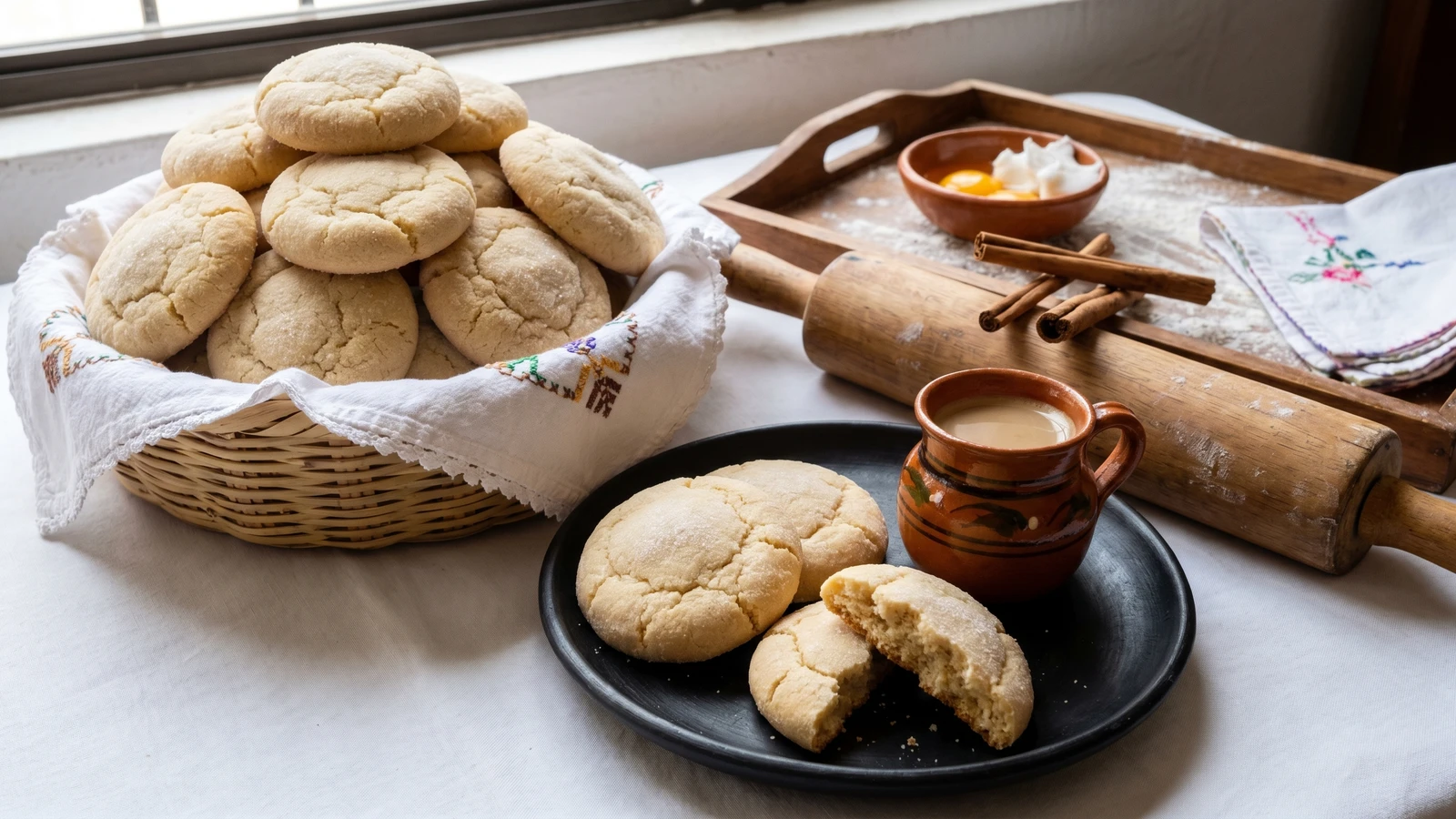
Chiapas highland biscuits from Comitán, tender with egg yolk and manteca de cerdo, baked pale blond and sturdy enough for coffee, the kind sold from Pilita Seca's wooden trays.
Chiapas, in the Meseta Comiteca, gives you these galletas from Comitán de Domínguez, a highland city close to the Guatemalan border, with cool mornings, dark bakery counters, and baskets lined with cloth. This is not coastal Chiapas and it is not San Cristóbal speaking for the whole state. Comitán has its own panadería voice. Cada estado, su propia cocina.
At Pilita Seca, the Torres family has sold these tender egg-yolk biscuits from a wood oven for generations. The ingredients tell you where you are: wheat flour from the highland bakery tradition, yolks for color and softness, canela for warmth, and manteca de cerdo for the crumb. There is no chile here. Do not hunt for one. Mexican food also speaks through wheat, eggs, lard, sugar, and the hands of women who learned dough by touch before anyone wrote grams on a page.
The technique is in restraint. Rub the lard into the flour until it feels like damp sand, work in the yolks, rest the dough, and roll it thick. Knead like you are making bolillo and you will toughen it. My mother had no recipe for galletas comitecas, she was from Jalisco, but in her notebook after a trip through Chiapas she wrote one line: las de yema se quiebran suave. Egg-yolk cookies should break softly. That is the test. Saber cocinar es saber vivir.
Galletas comitecas belong to the panadería tradition of Comitán de Domínguez, Chiapas, a highland city where colonial wheat baking grew beside Indigenous corn cooking after Spanish wheat reached the region in the 16th century. By the 19th and 20th centuries, family bakeries in Comitán and nearby San Cristóbal de las Casas were known for egg-yolk breads, biscochos, and dry biscuits built to keep well in cool mountain weather. The Torres family's Pilita Seca oven is part of that local bakery memory: these cookies are identified less by decoration than by their tender yolk crumb, pale golden surface, and the way they travel home wrapped in cloth inside a basket.
Quantity
4 cups (500 g)
plus more for dusting
Quantity
3/4 cup (150 g), plus 2 tablespoons
extra sugar reserved for topping
Quantity
1 teaspoon
Quantity
1/2 teaspoon
Quantity
1/2 teaspoon
Quantity
3/4 cup (155 g)
cool room temperature, soft but not melted
Quantity
6
room temperature
Quantity
1/4 cup, plus 1 to 2 tablespoons as needed
room temperature
Quantity
1 egg yolk mixed with 1 tablespoon whole milk
| Ingredient | Quantity |
|---|---|
| all-purpose wheat flourplus more for dusting | 4 cups (500 g) |
| granulated sugarextra sugar reserved for topping | 3/4 cup (150 g), plus 2 tablespoons |
| baking powder (polvo para hornear) | 1 teaspoon |
| fine sea salt | 1/2 teaspoon |
| ground Mexican canela (Ceylon cinnamon) | 1/2 teaspoon |
| clean pork lard (manteca de cerdo)cool room temperature, soft but not melted | 3/4 cup (155 g) |
| large egg yolksroom temperature | 6 |
| whole milkroom temperature | 1/4 cup, plus 1 to 2 tablespoons as needed |
| egg yolk and whole milk for brushing | 1 egg yolk mixed with 1 tablespoon whole milk |
Heat the oven to 350F. Line two sheet pans with parchment or grease them lightly with manteca de cerdo. In Comitán, the old bakeries know their wood ovens by smell and by the color of flour tossed on the oven floor. At home, use a steady moderate oven. These cookies should bake pale blond, not dark brown.
In a wide bowl, whisk the wheat flour, sugar, baking powder, salt, and ground canela. Break up any hard bits with your fingers. The canela should be quiet, not perfume-shop loud. This is an egg-yolk biscuit from the Chiapas highlands, not a cinnamon cookie pretending to be regional.
Add the manteca de cerdo in small pieces. Rub it into the flour with your fingertips until the mixture looks like damp sand and holds together when squeezed in your palm. This is where the tenderness is built. La manteca es el sabor. Vegetable shortening gives you a flatter taste and a bakery shelf texture. That is a compromise, not an upgrade.
Beat the 6 egg yolks with 1/4 cup whole milk until smooth. Pour this into the flour mixture and work it in with one hand, turning the bowl with the other. The dough should come together as a soft, slightly dry mass with small cracks at the edges. If loose flour remains at the bottom, add milk 1 teaspoon at a time. Do not drown it. The dough needs just enough moisture to roll.
Press the dough into a thick disk, wrap it, and let it rest at room temperature for 30 minutes. This rest is not decoration. The flour hydrates, the lard firms slightly, and the dough stops fighting you. The señoras who perfected these did not rush the bowl to the table because a clock told them to. They waited until the dough behaved.
Dust the counter lightly with flour. Roll the dough to 1/2 inch thick. Cut into 2 1/2-inch rounds or ovals with a cutter or the rim of a glass, pressing straight down without twisting. Gather scraps and reroll once. Too much rerolling makes tough galletas, and a tough galleta comiteca is a failure you can feel under your teeth.
Move the cut cookies to the prepared pans, leaving about 1 inch between them. Brush the tops lightly with the egg yolk and milk mixture. Make three shallow fork marks across each cookie or leave them plain, then sprinkle with the reserved sugar. The mark is not fancy. It tells the hand that made it.
Bake for 16 to 20 minutes, rotating the pans once, until the tops are pale golden and the undersides are honey-colored. Do not wait for dark edges. Egg-yolk dough turns dry when overbaked. Let the cookies cool on the pan for 5 minutes, then move them to a rack. They should break softly, with a tender crumb and a clean taste of yolk, wheat, lard, and canela. Así se hace y punto.
Serve the galletas at room temperature in a basket lined with a clean servilleta, with coffee, atole, or a small cup of milk. They keep well because that is what a panadería biscuit is supposed to do. Store them in a tin for up to 5 days. Recetas probadas y garantizadas.
1 serving (about 41g)
Culinary guides, cultural storytelling, and the editorial depth that makes cooking meaningful.
Discover Culinary ExplorerChef Lupita
Puebla's convent almond cookies, made from blanched almonds, sugar syrup, egg yolks, canela, and patient hands, the kind of sweet that belongs beside coffee in talavera, not in a plastic bakery box.

Chef Lupita
Ciudad de Mexico's panaderia banderillas are long sticks of hojaldre pressed with sugar, baked until amber, and finished with a hard glaze for coffee at the kitchen table.

Chef Lupita
Mérida's pale egg-yolk-and-vanilla kisses, tiny cookies built on eight yolks and a perfume of orange blossom, sandwiched with guava paste and dusted heavy with powdered sugar.

Chef Lupita
Hidalgo's bisquet de nata carries Pachuca's mining history into the breakfast table: a Cornish-style bread softened by Mexican nata, split warm and eaten with café de olla.