Culinary Explorer

A cooking platform built around craft, culture, and the stories behind what we eat.
Discover Culinary Explorer
Bajio Cream of Squash Blossom (Crema de Flor de Calabaza)

Bajio Cream of Squash Blossom (Crema de Flor de Calabaza)

Created by

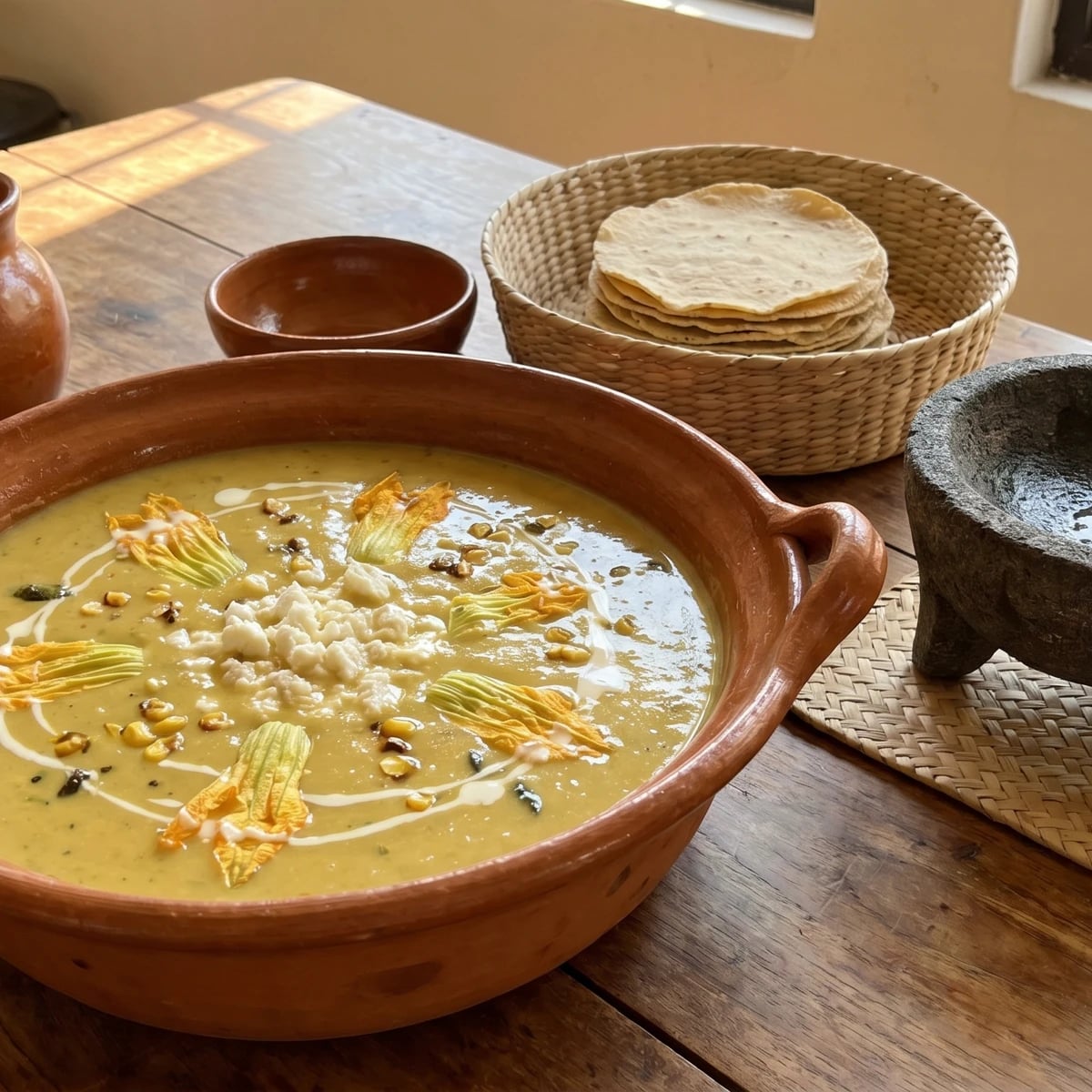
Guanajuato and Queretaro's Bajio soup, where squash blossoms from the milpa meet roasted chile poblano, epazote, corn, and the thick crema of the dairy hacienda.

Soups & Stews
Mexican
Dinner Party
Special Occasion
25 min
Active Time
35 min cook1 hr total
Yield6 servings

Guanajuato and Queretaro, in the Bajio, own this version of crema de flor de calabaza. You find the flowers in the morning at Mercado Hidalgo in Guanajuato, Mercado de la Cruz in Queretaro, and in the baskets of women who still sell what the milpa gave them before the sun got cruel. The flower is delicate. The soup is not weak.

This dish lives between the Otomi milpa and the hacienda lechera. Squash blossom, corn, epazote, chile poblano, onion, ajo, caldo. Then comes crema, thick enough to coat the spoon. That is the Bajio speaking: criollo and mestizo, field and dairy, Camino Real de Tierra Adentro on the table. Not all Mexican food is hot. This soup is green, fragrant, gentle, and serious.

Do not boil the blossoms to death. You sweat the onion and garlic, roast the poblano, simmer the corn, then add the flowers near the end so their flavor survives. The women who taught me this in Leon and Queretaro did not measure with drama. They watched the pot. They knew when the epazote had given enough. Saber cocinar es saber vivir.

Squash blossoms have been eaten in central Mexico since pre-Columbian milpa agriculture joined corn, beans, squash, and herbs in the same field system. The cream-soup format came later, after Spanish cattle and dairy haciendas took root across the Bajio along the Camino Real de Tierra Adentro between the 16th and 18th centuries. In Guanajuato and Queretaro, crema de flor de calabaza shows that regional Mexican cooking is not only chile-heavy stews and moles: it can also be milk, flower, corn, and epazote in one quiet bowl.

The technique, the tradition, and the story behind every dish.

Discover Culinary Explorer

Ingredients

fresh squash blossoms

Quantity

4 cups

stems and pistils removed, blossoms gently torn

fresh chile poblano

Quantity

2

unsalted butter

Quantity

2 tablespoons

manteca de cerdo

Quantity

1 tablespoon

white onion

Quantity

1 medium

finely chopped

garlic cloves

Quantity

3

finely chopped

fresh corn kernels

Quantity

2 cups

preferably white field corn or tender elote

light chicken broth or vegetable broth

Quantity

5 cups

ramita de epazote

Quantity

1 small

kosher salt

Quantity

1 teaspoon, plus more to taste

freshly ground black pepper

Quantity

1/4 teaspoon

Mexican crema from cow's milk

Quantity

1 cup

room temperature

whole milk

Quantity

1/2 cup

warm

queso ranchero (optional)

Quantity

1/2 cup

crumbled, for serving

reserved squash blossoms (optional)

Quantity

for serving

thinly sliced

hand-pressed corn tortillas (optional)

Quantity

for serving

warmed

Equipment Needed

  • Comal or open flame for roasting chile poblano
  • Heavy clay cazuela from the Bajio or a Dutch oven
  • High-powered blender
  • Wooden spoon
  • Warm clay bowls for serving

Instructions

  1. 1

    Clean the blossoms

    Open each squash blossom gently and remove the stem and pistil. Shake out any dirt or small insects, then wipe with a barely damp cloth if needed. Do not soak them. These flowers bruise like herbs, and water steals their perfume before the pot even sees them. Reserve a small handful of the prettiest petals for serving.

  2. 2

    Roast the poblanos

    Roast the chile poblanos directly over a gas flame, on a comal, or under a broiler until the skins blister and blacken in patches. Put them in a covered bowl for 10 minutes, then peel, seed, and chop them. Poblano is the correct chile here: green, mild, a little grassy. Do not replace it with jalapeno and then complain that the soup lost its manners.

    Leave a few dark specks of roasted skin if they cling. They give the soup a quiet roasted flavor. Big sheets of burned skin make the crema bitter.
  3. 3

    Sweat the base

    In a heavy clay cazuela or Dutch oven, melt the butter with the manteca de cerdo over medium-low heat. Add the onion and cook for 8 minutes, stirring often, until soft and translucent but not browned. Add the garlic and cook for 1 minute more. The fat carries the sweetness of the onion into the soup. La manteca es el sabor, even when the dish is gentle.

  4. 4

    Simmer the corn

    Add the corn kernels and chopped roasted poblanos. Stir until the corn looks glossy and the poblano stains the fat green. Pour in the broth, add the ramita de epazote, salt, and black pepper, then bring to a low simmer. Cook for 12 to 15 minutes, until the corn is tender but still has a little bite. Epazote is not parsley. It is epazote. Use the right herb.

  5. 5

    Add the flowers

    Add the squash blossoms and stir just until they collapse into the broth, 3 to 4 minutes. The color will soften from bright yellow-orange to a deep milpa green-gold. Remove the epazote stem. If you cook the flowers for half an hour, you will have a beige soup that tastes like regret. No me vengas con atajos.

  6. 6

    Blend the crema

    Transfer about two-thirds of the soup to a blender and blend until smooth, holding the lid firmly with a towel. Return it to the pot with the remaining chunky third. This gives body without erasing the corn and blossoms completely. A Bajio home cook still wants to see what the field gave her.

  7. 7

    Temper the dairy

    Lower the heat. Whisk the room-temperature crema with the warm milk in a bowl, then ladle in a little hot soup while whisking. Stir this mixture back into the pot. Keep the soup below a boil for 5 minutes. Boiling splits the crema, and then the soup looks tired. Taste for salt. It should be creamy, floral, gently green, and clean.

  8. 8

    Serve in clay

    Ladle into warm clay bowls. Finish with crumbled queso ranchero and a few thin strips of raw squash blossom. Set warm corn tortillas on the table in a cloth-lined chiquihuite. This is not a soup for cheddar, sour cream, or flour tortillas. Cada estado, su propia cocina. Asi se hace y punto.

Chef Tips

  • Buy squash blossoms early in the morning. By noon they are tired. At Mercado Hidalgo in Guanajuato or Mercado de la Cruz in Queretaro, ask the women which flowers came in that day. Preguntale a las senoras del mercado.
  • If squash blossoms are not in season, do not make this soup right now. Cook quelites, calabacitas, or a mild sopa queretana instead. Mexican grandmothers cook with what the mercado is selling today.
  • Chile guajillo, chilcuague, xoconostle, and cacahuazintle all belong to the broader Bajio and central Mexican pantry, but not every ingredient belongs in every pot. This crema needs chile poblano, epazote, corn, and dairy crema. Forcing guajillo into it would turn a flower soup into a different dish.
  • Use real Mexican crema from cow's milk, not sour cream. Sour cream is sharper and heavier. A substitution is a compromise, not an upgrade.
  • For a dinner party, serve small portions first. This soup is rich. Follow it with something from the same region: enchiladas mineras from Guanajuato, mole de conejo from the Sierra Gorda, or borrego al vapor if you have the patience.

Advance Preparation

  • The poblano chiles can be roasted, peeled, seeded, and chopped one day ahead. Refrigerate them covered.
  • The soup base can be made through the corn simmer up to one day ahead. Add the squash blossoms and crema only on serving day.
  • Do not freeze this soup. Dairy crema and squash blossoms both suffer in the freezer.

Frequently Asked Questions

Nutrition Information

1 serving (about 410g)

Calories
360 calories
Total Fat
19 g
Saturated Fat
11 g
Trans Fat
0 g
Unsaturated Fat
8 g
Cholesterol
50 mg
Sodium
860 mg
Total Carbohydrates
39 g
Dietary Fiber
5 g
Sugars
8 g
Protein
10 g

Note: Chef personas and recipes are created with AI assistance. Cook with care: follow safe food-handling practices, check doneness with a thermometer when needed, and adapt for allergies and your kitchen.

Where cooking meets culture.

Culinary guides, cultural storytelling, and the editorial depth that makes cooking meaningful.

Discover Culinary Explorer

More from Bajío Soups & Stews

Browse the full collection