Culinary Explorer

A cooking platform built around craft, culture, and the stories behind what we eat.
Discover Culinary Explorer
Carnitas estilo CDMX

Carnitas estilo CDMX

Created by

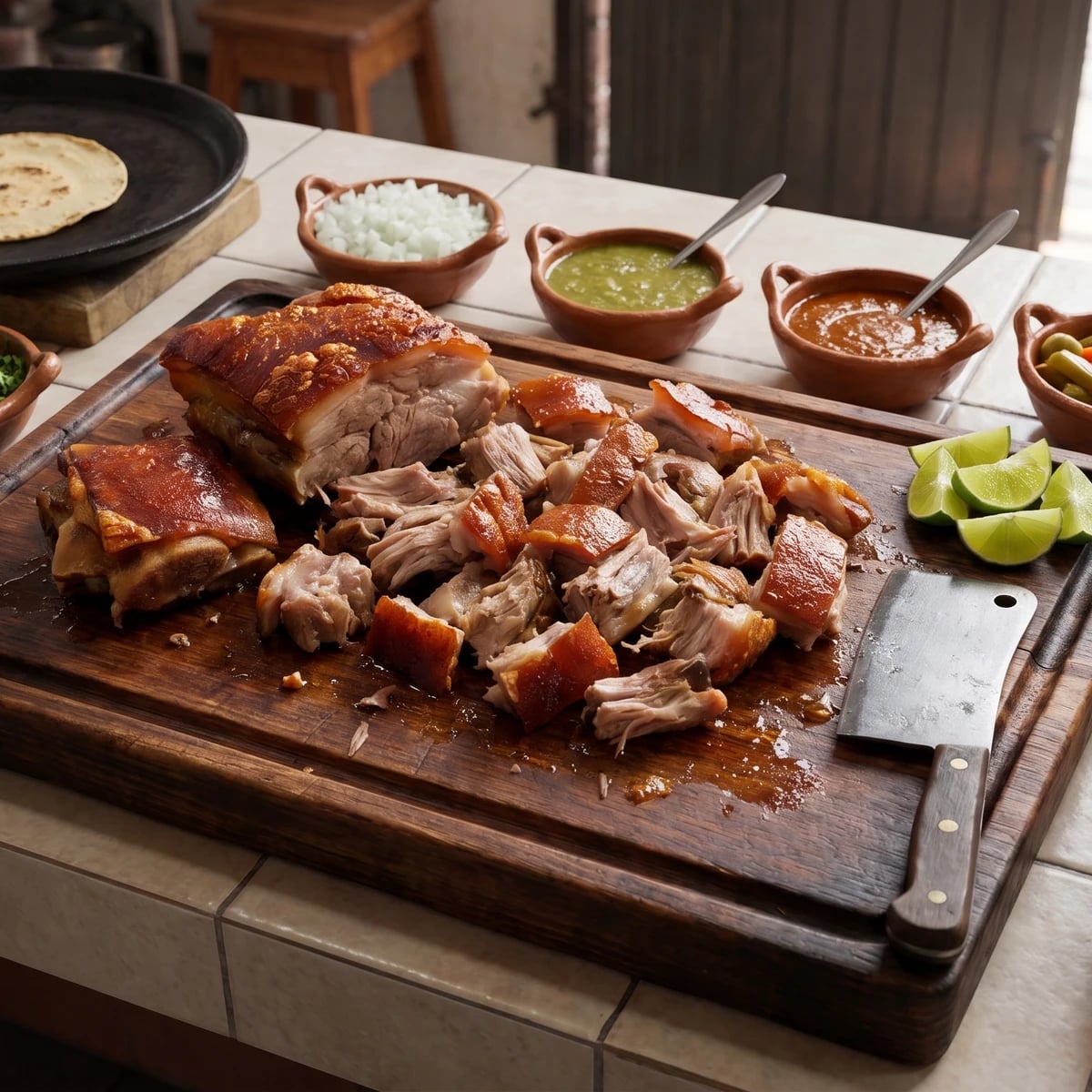
Mexico City taqueria-style carnitas, pork shoulder and belly confited slow in their own lard with orange, milk, and a splash of Mexican cola, then chopped to order on a wooden board for the tacos.

Main Dishes
Mexican
Comfort Food
Make Ahead
Potluck
20 min
Active Time
3 hr cook3 hr 20 min total
Yield8 to 10 servings

Carnitas were born in Michoacán. Anyone who tells you different is wrong. But Ciudad de México took them in, set up a counter on every other corner, and made them part of the city's daily life. This is the CDMX version: faster than Quiroga's all-day cazo de cobre, leaner on the showmanship, heavier on the chop. The taqueros at Mercado de San Juan, at El Cuadrilatero, at the carnitas stands in Coyoacán and Colonia Roma, all build their tacos the same way. Two tortillas. A rough chop that mixes mahogany crust with soft interior. Onion, cilantro, lime. Salsa to taste.

The shoulder gives you the meat. The belly gives you the fat and the skin that crackles. Both go into the pot together. La manteca es el sabor, and in this dish, the lard is not a cooking medium, it is half the recipe. The milk and the Mexican Coca-Cola are not American additions. They are how it has been done in Mexico City taquerias since at least the 1970s. The lactose and the cane sugar caramelize the edges in the last fifteen minutes when the liquid cooks off and the lard alone takes over. Skip them and your carnitas will be pale.

My mother bought carnitas on Saturday afternoons from a man with a cazo on the corner of Avenida Alvaro Obregon. He chopped them on a wooden board so worn the grain had become smooth as glass. He never weighed anything. He looked at how many people were in your group and pulled meat from the pot accordingly. That is the spirit of CDMX carnitas, fast, generous, chopped to order, eaten standing up at the counter or wrapped in butcher paper to take home. Cada estado, su propia cocina, and the capital learned this one from Michoacán and made it her own.

Carnitas migrated to Ciudad de México from Michoacán in the mid-20th century as part of the broader internal migration that brought rural Bajio cooks to the capital looking for work. Where the Michoacán original is a market-day spectacle cooked in large copper cazos over wood fire, the Mexico City adaptation reformatted carnitas as a fast taqueria food: smaller batches, faster turnover, chopped to order on a wooden block in front of the customer. The use of milk and refresco (Mexican Coca-Cola or, in some stands, Boing! orange soda) to accelerate caramelization is a distinctly capital-city refinement, debated by purists in Quiroga but defended by every taquero from Tepito to Coyoacán.

The technique, the tradition, and the story behind every dish.

Discover Culinary Explorer

Ingredients

bone-in pork shoulder with skin on

Quantity

4 pounds

cut into fist-sized pieces

pork belly with skin on

Quantity

1 pound

cut into 3-inch pieces

pork lard (manteca de cerdo)

Quantity

2 pounds

white onion

Quantity

1 medium

halved

head of garlic

Quantity

1

halved crosswise

bay leaves

Quantity

3

orange

Quantity

1

halved

whole milk

Quantity

1 cup

Mexican Coca-Cola

Quantity

1/2 cup

kosher salt

Quantity

1 tablespoon

dried Mexican oregano

Quantity

1 teaspoon

hand-pressed corn tortillas (optional)

Quantity

2 dozen

warmed on a comal

white onion (for serving) (optional)

Quantity

1 medium

finely diced

cilantro (optional)

Quantity

1 large bunch

finely chopped

limes (optional)

Quantity

6

cut into wedges

salsa verde cruda (optional)

Quantity

for serving

salsa de chile de arbol (optional)

Quantity

for serving

pickled jalapenos and carrots (optional)

Quantity

for serving

Equipment Needed

  • Heavy 8-quart Dutch oven or wide barro cazuela
  • Slotted spoon or kitchen spider
  • Wire rack set over a sheet pan
  • Fine-mesh strainer for the rendered lard
  • Heavy chef's knife or cleaver for chopping
  • Wooden cutting board
  • Cast iron comal for warming the tortillas

Instructions

  1. 1

    Melt the lard

    In a heavy 8-quart Dutch oven or a wide cazuela de barro, melt the lard over medium-low heat. You need enough to come halfway up the meat once you add it. Yes, that much. La manteca es el sabor. The taqueros at the carnitas stands in Mercado de San Juan and Mercado Jamaica do not measure the lard with a cup. They measure it with the height of the meat.

    Do not substitute vegetable oil. The pork confits in pork fat. Anything else changes the flavor and the texture, and you are no longer making carnitas. No me vengas con atajos.
  2. 2

    Add the pork and aromatics

    Lower the pork shoulder and belly pieces into the warm lard, skin side down where you can fit them. Add the halved onion, garlic head, bay leaves, salt, and oregano. Squeeze the orange halves over the pot, then drop the spent halves in. Pour in the milk and the Coca-Cola. The milk tenderizes the proteins. The cane sugar in the cola caramelizes the edges as the liquid cooks off. This is how the Mexico City taqueros build the dark crust their customers come for.

  3. 3

    Simmer low and slow

    Bring the pot to a gentle simmer. The lard should bubble lazily around the meat, not rage. Cook uncovered for two hours, stirring every 20 minutes so nothing sticks to the bottom. The kitchen will smell like a Sunday morning in Colonia Roma. The meat is ready for the next step when a fork slides in and out without resistance, but the chunks still hold their shape.

  4. 4

    Crisp the edges

    Raise the heat to medium-high. The remaining milk, cola, and orange juice will cook off, and the lard alone will begin to fry the meat. Stir more often now, every few minutes. Watch the edges turn from gold to dark mahogany. The skin will crackle and bubble. Pull the pot off the heat the moment the outside is dark and crisp but the inside still pulls apart with a fork. Past this point and the meat goes dry. Así se hace y punto.

    If you walk away during this step, you will lose the carnitas. Stay at the stove. This is the 15 minutes that separates a good batch from a great one.
  5. 5

    Drain and chop

    Lift the carnitas out with a slotted spoon and let them drain on a wire rack set over a sheet pan. Discard the spent onion, garlic, orange, and bay leaves. Strain the rendered lard through a fine-mesh sieve into a jar and save it. It is more valuable than the meat. Once the chunks have rested for a few minutes, take a sharp cleaver or a heavy knife and chop them on a wooden board the way the taqueros do: a quick rough chop that mixes the dark crisp edges with the soft inside meat and the bits of skin and fat. Every taco should have all three.

  6. 6

    Build the tacos

    Warm the corn tortillas on a hot comal until they puff and pick up dark spots, about 30 seconds per side. Stack two tortillas per taco, the way they do at every carnitas counter in the city. Pile a generous mound of chopped carnitas on top. Finish with diced raw white onion, chopped cilantro, a squeeze of lime, and the salsa of your choice. Eat standing up if you can. That is how this dish was meant to be eaten. Recetas probadas y garantizadas.

Chef Tips

  • Buy the pork shoulder with the skin on and ask your butcher to cut it into fist-sized pieces. Do not let them trim the fat. The fat is the carnitas. Lean carnitas is a contradiction. The added belly is the CDMX move, it gives you more chicharron-like bits in the chop.
  • Save the rendered lard. Strain it, jar it, refrigerate it. It will keep for months and you can use it to fry beans, brown chorizo, or build the next pot. The taqueros do not throw it out. Neither should you.
  • If you cannot find Mexican Coca-Cola made with cane sugar, leave it out. High fructose corn syrup does not caramelize the same way and the flavor will be off. Better an honest substitution than a bad approximation.
  • The chop matters. Use a heavy knife or cleaver and chop on a wooden board, not in a bowl. Mix the crisp edges with the soft middle and the bits of skin. A taco of only crispy meat is dry. A taco of only soft meat is one-dimensional. The taquero chops them together so every bite has both.

Advance Preparation

  • Carnitas can be made one day ahead. Refrigerate the chopped meat with a few spoonfuls of the rendered lard poured over the top to keep it moist.
  • To reheat, spread the carnitas on a sheet pan and warm in a 425F oven for 8 to 10 minutes, until the edges crisp back up. Do not microwave them. The skin goes rubbery.
  • The rendered lard, strained and refrigerated, lasts for several months in a sealed jar. It is the working capital of a Mexican kitchen.

Frequently Asked Questions

Nutrition Information

1 serving (about 280g)

Calories
680 calories
Total Fat
42 g
Saturated Fat
14 g
Trans Fat
0 g
Unsaturated Fat
26 g
Cholesterol
120 mg
Sodium
780 mg
Total Carbohydrates
38 g
Dietary Fiber
5 g
Sugars
3 g
Protein
38 g

Note: Chef personas and recipes are created with AI assistance. Cook with care: follow safe food-handling practices, check doneness with a thermometer when needed, and adapt for allergies and your kitchen.

Where cooking meets culture.

Culinary guides, cultural storytelling, and the editorial depth that makes cooking meaningful.

Discover Culinary Explorer

More from Central Mexican Main Dishes

Browse the full collection