
Chef Graziella
Abbacchio a Scottadito
Roman lamb chops grilled over scorching heat, seasoned with nothing but salt, rosemary, and fire. You eat them with your hands, straight from the grill, burning your fingers because you cannot wait.
A cooking platform built around craft, culture, and the stories behind what we eat.
Created by
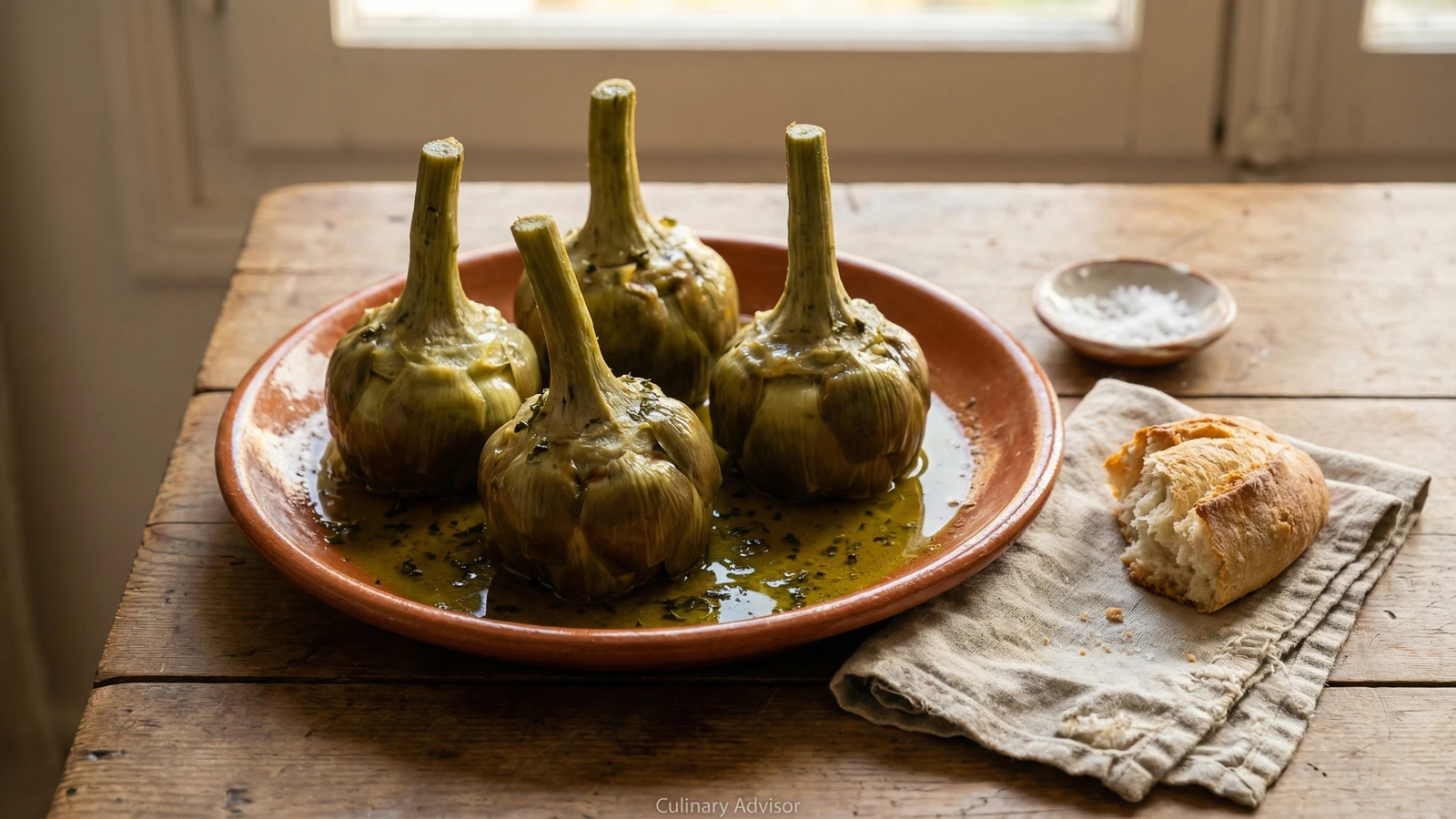
The great spring dish of the Roman table, where artichokes stuffed with wild mint and garlic surrender to a slow braise until they yield completely. The perfumed cooking liquid is not sauce. It is the point.
In Rome, the arrival of artichokes signals that winter has finally loosened its grip. The markets in Campo de' Fiori and Testaccio pile them high, their stems intact, their leaves still tight. Roman cooks know these artichokes by variety and by source. They know that the carciofo romanesco, round and thornless, is bred for this preparation. They know that the stems, which Americans discard, contain the same sweet flesh as the heart.
Carciofi alla Romana requires a specific herb that grows wild in the Roman countryside: mentuccia, a variety of mint with smaller leaves and a more delicate flavor than the mint sold in American markets. I have made this dish for fifty years, and I will tell you the truth. Regular mint combined with parsley comes close enough. Do not let the absence of mentuccia stop you from making this dish.
The technique is unusual. The artichokes braise stem-up, inverted from how they grow. This allows the leaves to open gently, the filling to penetrate, and the heart to cook through without the outer leaves turning to mush. The braising liquid, reduced to an intensely flavored oil, is meant to be spooned over each artichoke and soaked up with bread. What remains on the plate matters as much as what you put there.
Carciofi alla Romana belongs to the cucina povera of the Roman Jewish ghetto, where cooks transformed humble vegetables into dishes of remarkable depth. The technique of braising artichokes stem-up appears in Roman cookbooks from the 19th century, though the dish is certainly older. It remains inseparable from the spring markets of Rome, where vendors will clean your artichokes for you if you ask.
Quantity
4 large
with stems attached
Quantity
2
halved
Quantity
1/4 cup
chopped fine
Quantity
2 tablespoons
chopped fine
Quantity
3
minced
Quantity
1/2 teaspoon, plus more for seasoning
Quantity
to taste
freshly ground
Quantity
3/4 cup
Quantity
1 cup
| Ingredient | Quantity |
|---|---|
| globe artichokeswith stems attached | 4 large |
| lemonshalved | 2 |
| fresh mint leaveschopped fine | 1/4 cup |
| fresh flat-leaf parsleychopped fine | 2 tablespoons |
| garlic clovesminced | 3 |
| kosher salt | 1/2 teaspoon, plus more for seasoning |
| black pepperfreshly ground | to taste |
| extra virgin olive oil | 3/4 cup |
| water | 1 cup |
Fill a large bowl with cold water and squeeze in the juice of one lemon, dropping the halves into the bowl. This prevents the artichokes from blackening the moment air touches the cut surfaces. You will work quickly, but the lemon water forgives hesitation.
Snap off the dark outer leaves until you reach the pale yellow-green inner leaves. This takes courage. You will remove more than seems reasonable. Continue until the leaves you expose are tender enough to eat. Cut one inch off the top with a sharp knife. Trim the stem, leaving three to four inches attached, then peel away the fibrous outer layer with a vegetable peeler or paring knife until you reach the pale green core. Rub all cut surfaces with the remaining lemon half. Submerge immediately in the acidulated water.
Working with one artichoke at a time, spread the inner leaves apart gently with your fingers to expose the fuzzy choke at the center. Use a small spoon or melon baller to scrape out the choke completely. It should come away in fibrous clumps. If any purple-tipped leaves surround the choke, remove those as well. They are bitter. Return the cleaned artichoke to the lemon water while you prepare the others.
In a small bowl, combine the chopped mint, parsley, minced garlic, half teaspoon of salt, and several grindings of black pepper. Mix thoroughly. The filling should be fragrant and assertive. It will mellow during cooking.
Remove the artichokes from the water and shake off excess liquid. Do not pat dry. Gently spread the leaves apart and press the herb mixture into the cavity and between the inner leaves. Use your fingers. Distribute the filling evenly among all four artichokes, pressing it firmly into the center and tucking it between the leaves where it will perfume the entire vegetable during braising.
Choose a heavy pot just wide enough to hold all four artichokes snugly, stems pointing upward. This position is essential. The artichokes braise upside down from how they grow, allowing the leaves to open slightly and the filling to penetrate. Place them in the pot stem-side up. Pour the olive oil over and around them. Add the water to the pot. Season the artichokes with additional salt.
Bring the liquid to a gentle simmer over medium heat. Cover the pot and reduce heat to maintain the laziest bubble. Braise for 35 to 45 minutes, checking occasionally. The artichokes are done when a knife slides easily into the base and the outer leaves pull away without resistance. The braising liquid should reduce to a few tablespoons of intensely flavored oil. If it evaporates too quickly, add water by the tablespoon.
Transfer the artichokes to a serving platter, stems still pointing up. Spoon the remaining braising liquid over each one. Serve warm or at room temperature. Never cold from the refrigerator. Romans eat these with their hands, pulling off leaves and dragging them through the fragrant oil pooled on the plate. The heart and stem are the final reward.
1 serving (about 180g)
Culinary guides, cultural storytelling, and the editorial depth that makes cooking meaningful.
Discover Culinary ExplorerChef Graziella
Roman lamb chops grilled over scorching heat, seasoned with nothing but salt, rosemary, and fire. You eat them with your hands, straight from the grill, burning your fingers because you cannot wait.

Chef Graziella
Roman milk-fed lamb cut like a chicken, braised with wine, rosemary, and anchovy until the meat surrenders to the fork. The anchovy disappears. The flavor does not.

Chef Graziella
The true sauce of Amatrice: guanciale rendered to gold, tomatoes barely simmered, pecorino melted into silk. Three ingredients that tolerate no substitution and no addition.

Chef Graziella
Three ingredients expose every flaw and reward every success. The silky emulsion of pecorino and pasta water, studded with cracked black pepper, is Rome's gift to cooks who understand that simple does not mean easy.