Culinary Explorer

A cooking platform built around craft, culture, and the stories behind what we eat.
Discover Culinary Explorer
Camellia Leaf Mochi (椿餅, Tsubaki Mochi)

Camellia Leaf Mochi (椿餅, Tsubaki Mochi)

Created by

The first February sweet: tender dōmyōji rice around anko, pressed between two camellia leaves. The work is small, but the season announces itself clearly.

Desserts
Japanese
Special Occasion
Celebration
25 min
Active Time
20 min cook45 min total
Yield8 pieces

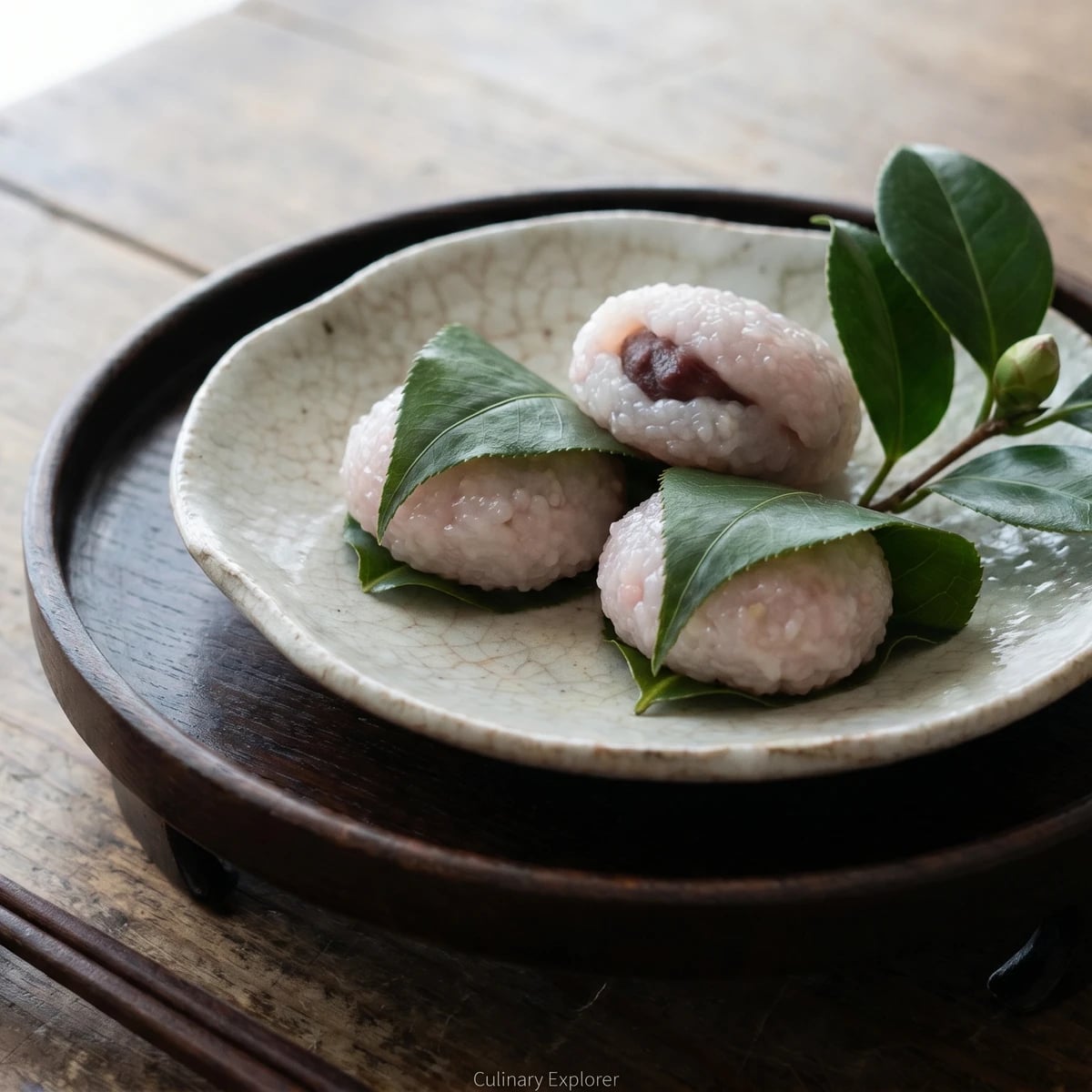
Tsubaki mochi begins with the leaves. Two glossy camellia leaves hold a pale rice cake between them, and before you taste anything you already know the month has turned. This is the first signal that spring is coming, not loudly, which is just as well. February is not a month for shouting.

The sweet itself is simpler than its age suggests. Dōmyōji-ko, coarse grains of steamed and dried glutinous rice, is softened with water and sugar, then steamed until each grain turns tender and faintly translucent. You fold it around anko, sweet red bean paste, and press it lightly between the leaves. That is the dish. The one detail that decides it is water: too little and the grains stay chalky, too much and they lose their clean shape.

Use food-safe, unsprayed camellia leaves, and don't eat them. They are the vessel, the season, and the name. If you cannot find them, make the dōmyōji mochi by all means, but call it what it is. Honmono asks for very little here, so we should give it the one thing it asks for.

Tsubaki mochi is often described as the oldest Japanese rice-cake sweet recorded in literature, appearing in The Tale of Genji, written in the early eleventh century. The Heian-period form was likely simpler than the modern wagashi, made from glutinous rice and sweetened with amazura, a plant-derived syrup used before refined sugar became common. The contemporary version with anko reflects later confectionery practice, but the camellia leaves preserve the old seasonal signal.

The technique, the tradition, and the story behind every dish.

Discover Culinary Explorer

Ingredients

dōmyōji-ko (coarse glutinous rice flour)

Quantity

100g

water

Quantity

150ml

granulated sugar

Quantity

35g

fine sea salt

Quantity

1 pinch

koshian or tsubuan (sweet red bean paste)

Quantity

160g

food-safe unsprayed camellia leaves

Quantity

16 leaves

washed and dried

potato starch or cornstarch (optional)

Quantity

as needed

for dusting hands

Equipment Needed

  • Steamer basket or bamboo seiro
  • Heatproof bowl
  • Clean kitchen cloth for wrapping the steamer lid
  • Small scale for portioning

Instructions

  1. 1

    Prepare the leaves

    Wash the camellia leaves gently and dry them completely. Choose pairs close in size, glossy side facing out when you assemble the sweets. The leaves are not eaten, but they touch the mochi, so they must be clean, unsprayed, and food-safe.

  2. 2

    Portion the anko

    Divide the anko into 8 balls of about 20g each. Keep them covered so they don't dry at the surface. A smooth filling wraps cleanly, and a dry one cracks just when you want it to behave.

  3. 3

    Soak the dōmyōji

    Put the dōmyōji-ko in a heatproof bowl. Warm the water, sugar, and salt just until the sugar dissolves, then pour it over the grains and stir once or twice. Let it stand for 15 minutes. This rest gives the grains time to drink evenly before heat sets their texture.

  4. 4

    Steam the rice

    Set the bowl in a steamer and steam over medium heat for 15 to 18 minutes, covering the lid with a cloth so droplets don't fall back onto the rice. The grains should look plump and faintly translucent, still distinct rather than mashed into paste.

    Dōmyōji mochi should show its grains. If you stir hard after steaming, you erase the texture that makes this sweet itself.
  5. 5

    Rest and fold

    Take the bowl from the steamer, cover it, and let it rest for 5 minutes. Then fold gently with a wet spatula to even out the moisture. The rest matters because the center finishes softening off the heat, without turning the outside wet.

  6. 6

    Wrap the filling

    Dust your hands very lightly with potato starch, or wet them if you prefer a cleaner finish. Divide the rice into 8 portions. Flatten one portion in your palm, set an anko ball in the center, and bring the edges up around it. Pinch closed, then shape into a low oval. Work while the rice is warm, because warm mochi listens better.

  7. 7

    Sandwich with leaves

    Set each mochi between two camellia leaves, with the leaf tips pointing in opposite directions or slightly offset. Press lightly, just enough for the leaves to hold the sweet. Don't flatten it into a pancake. It should look held, not trapped.

  8. 8

    Serve the same day

    Serve at room temperature the day it is made. Tell guests to lift away the leaves before eating. The rice is best while tender and the grains still read clearly, which is why this old sweet is a same-day pleasure.

Chef Tips

  • Buy dōmyōji-ko, not shiratamako or mochiko. Those fine flours make smooth mochi, but tsubaki mochi wants the tender grain of dōmyōji rice. The texture is the character of the sweet.
  • Use camellia leaves only if you know they are unsprayed and safe for food contact. Florist leaves often carry chemicals. If the leaves are doubtful, leave them out and don't pretend. Nothing hidden.
  • Koshian gives a refined, smooth center; tsubuan gives a more rustic bite. Both are proper choices. Keep the filling modest so the rice and leaves still have something to say.
  • Leave space on the plate. Three small sweets on a quiet tray say more than eight crowded together. Ma, the empty room around the food, is doing its share of the work.

Advance Preparation

  • The anko can be portioned a day ahead and kept covered in the refrigerator. Bring it back to cool room temperature before wrapping.
  • The camellia leaves can be washed and dried several hours ahead, then kept between clean towels.
  • Do not make the finished mochi far ahead. Dōmyōji rice firms as it sits, and refrigeration makes it hard faster.

Frequently Asked Questions

Nutrition Information

1 serving (about 55g)

Calories
115 calories
Total Fat
0 g
Saturated Fat
0 g
Trans Fat
0 g
Unsaturated Fat
0 g
Cholesterol
0 mg
Sodium
25 mg
Total Carbohydrates
26 g
Dietary Fiber
1 g
Sugars
13 g
Protein
2 g

Note: Chef personas and recipes are created with AI assistance. Cook with care: follow safe food-handling practices, check doneness with a thermometer when needed, and adapt for allergies and your kitchen.

Where cooking meets culture.

Culinary guides, cultural storytelling, and the editorial depth that makes cooking meaningful.

Discover Culinary Explorer

More from Wagashi: Traditional Japanese Sweets

Browse the full collection