Culinary Explorer

A cooking platform built around craft, culture, and the stories behind what we eat.
Discover Culinary Explorer
Black Sugar and Kinako Shaved Ice (黒蜜きなこかき氷, Kuromitsu Kinako Kakigōri)

Black Sugar and Kinako Shaved Ice (黒蜜きなこかき氷, Kuromitsu Kinako Kakigōri)

Created by

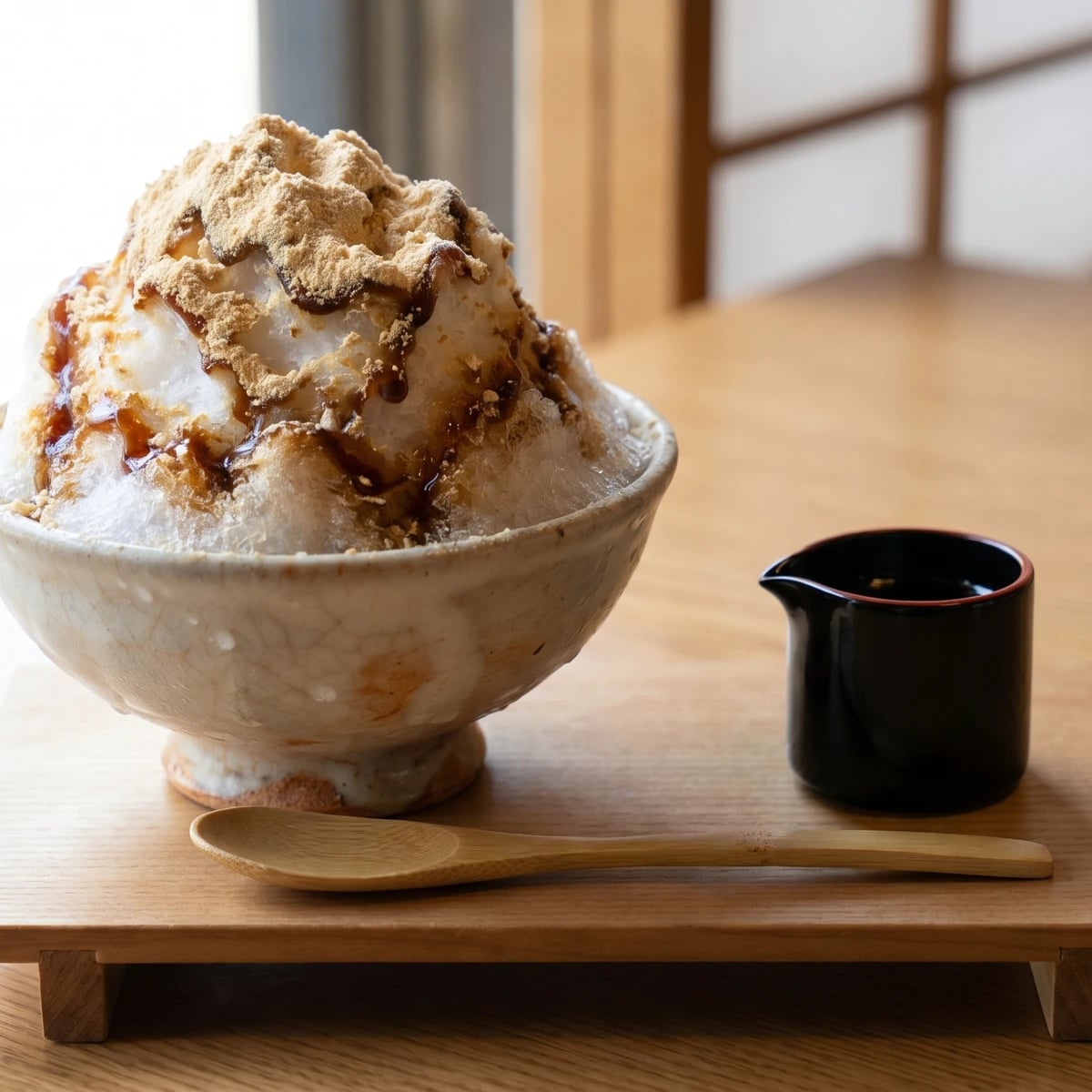
Kuromitsu kinako kakigōri is summer pared down: ice shaved fine, black-sugar syrup poured slowly, and roasted soybean flour settling over the top like toasted snow.

Desserts
Japanese
Outdoor Dining
Comfort Food
20 min
Active Time
10 min cook8 hr 30 min total
Yield2 servings

This is summer wagashi turned cold. Kuromitsu, the dark syrup made from kokutō black sugar, runs into shaved ice with the taste of molasses, minerals, and a little bitterness at the edge. Kinako follows, roasted and nutty, the same pairing that finishes warabimochi. Nothing hidden. Just sugar, soybean, and ice.

The part that worries people is the ice. It shouldn't. You need a kakigōriki, a shaved-ice machine, or a good home ice shaver, and you need the patience to let the ice temper for a few minutes before shaving. That is the detail that decides the bowl. Too hard and the ice breaks into grit. Too wet and it collapses under the syrup. Just softened at the surface, it falls like clean snow and drinks the kuromitsu without turning heavy.

We eat kakigōri when the heat has made appetite lazy, which is why restraint matters. Don't bury it under too many toppings. A little syrup between layers, a final dusting of kinako, and room in the bowl for the mound to breathe. The real thing is not grand. It is cold, quick, and exact in the one place it must be exact.

The most famous early reference to kakigōri appears in Sei Shōnagon's Makura no Sōshi, completed in the early eleventh century, where shaved ice is dressed with amazura syrup in a new metal bowl. It remained a luxury until Meiji-era ice making and hand-cranked shaving machines brought shaved ice within reach of city stalls. Kuromitsu points south: Okinawan kokutō, made from sugarcane in the Ryukyu Islands from the seventeenth century, became one of the dark syrups of wagashi, especially with roasted kinako.

The technique, the tradition, and the story behind every dish.

Discover Culinary Explorer

Ingredients

filtered water

Quantity

4 cups

frozen in ice-shaver molds or a shallow block

kokutō (Okinawan black sugar)

Quantity

120g

chopped if in blocks

water

Quantity

1/2 cup

for the syrup

fine sea salt

Quantity

1 small pinch

for the syrup

kinako (roasted soybean flour)

Quantity

6 tablespoons

fine sugar

Quantity

1 tablespoon

fine sea salt

Quantity

1 small pinch

for the kinako

Equipment Needed

  • Kakigōriki (shaved-ice machine), or a manual or electric home ice shaver
  • Small saucepan
  • Fine-mesh sieve
  • Chilled serving bowls
  • Small syrup pitcher

Instructions

  1. 1

    Freeze the ice

    Freeze the filtered water in your ice-shaver molds, or in a shallow block that fits your machine, until solid, at least eight hours. Clear, hard ice shaves cleaner than half-frozen ice, which breaks into wet chips and melts before the syrup has a chance to settle.

  2. 2

    Make kuromitsu

    Put the kokutō, 1/2 cup water, and a pinch of salt in a small saucepan. Warm over low heat, stirring until the sugar dissolves, then simmer quietly for six to eight minutes, until glossy and just thick enough to coat a spoon. Don't boil it hard. Kokutō has a deep mineral sweetness, and rough heat turns that depth bitter.

    The syrup should be cold and pourable when it meets the ice. If it thickens too much after cooling, stir in water a teaspoon at a time.
  3. 3

    Sift the kinako

    Sift the kinako with the sugar and salt. Kinako clumps easily, and those clumps taste dusty on the tongue. Sifting makes it fall lightly over the ice, while the small pinch of salt sharpens the roasted soybean aroma without making itself known.

  4. 4

    Temper the ice

    Take the ice from the freezer and let it stand five to ten minutes, just until the surface loses its hard frost. This sounds like fussing. It isn't. Rock-hard ice fractures into grit, while slightly tempered ice shaves into soft flakes that hold kuromitsu instead of shedding it.

  5. 5

    Build the bowl

    Chill two bowls. Shave a loose first layer of ice into each bowl, spoon over a little kuromitsu, and dust with kinako. Shave the rest of the ice on top in a small mound, never pressing it down. The layering matters because syrup poured only on the peak leaves the bottom plain and watery.

  6. 6

    Finish and serve

    Drizzle the remaining kuromitsu in thin dark ribbons and sift the remaining kinako over the top. Serve at once, with extra syrup beside it if you like. Kinako needs the syrup to cling, and shaved ice waits for no one, a very small tyrant in a bowl.

Chef Tips

  • Use kokutō if you can find it. Dark muscovado is a sensible stand-in, but say what it is: close in mood, not the same in flavor. Kokutō has a mineral edge that makes kuromitsu taste alive.
  • A kakigōriki is the proper tool. A manual or electric home ice shaver is the reachable one. A blender gives crushed ice, not kakigōri, and the syrup will run straight through it.
  • Keep the bowls, syrup, and even the serving spoon cold. This isn't vanity. Every warm surface steals height from the ice before it reaches the table.
  • Sift kinako at the last moment. Its roasted aroma fades and its powdery texture turns heavy if it sits damp on the ice.

Advance Preparation

  • Freeze the ice molds the night before. If using a block, make sure it fits your shaver before it freezes solid.
  • Kuromitsu keeps for two weeks in the refrigerator. Warm it gently or loosen it with a few drops of water if it becomes too thick to pour.
  • The kinako mixture can be sifted a day ahead and kept airtight, but it is best within a day or two while the roasted aroma is still clear.

Frequently Asked Questions

Nutrition Information

1 serving (about 620g)

Calories
335 calories
Total Fat
4 g
Saturated Fat
1 g
Trans Fat
0 g
Unsaturated Fat
3 g
Cholesterol
0 mg
Sodium
150 mg
Total Carbohydrates
77 g
Dietary Fiber
4 g
Sugars
65 g
Protein
8 g

Note: Chef personas and recipes are created with AI assistance. Cook with care: follow safe food-handling practices, check doneness with a thermometer when needed, and adapt for allergies and your kitchen.

Where cooking meets culture.

Culinary guides, cultural storytelling, and the editorial depth that makes cooking meaningful.

Discover Culinary Explorer

More from Kakigori & Frozen Sweets

Browse the full collection