
Chef Makoa
Baked ʻUala (Hawaiian Sweet Potato in the Embers)
Whole Hawaiian ʻuala baked in embers or a hot oven until the skins char and the flesh goes honey-soft, finished plain with paʻakai so the canoe crop tastes like itself.
A cooking platform built around craft, culture, and the stories behind what we eat.
Created by
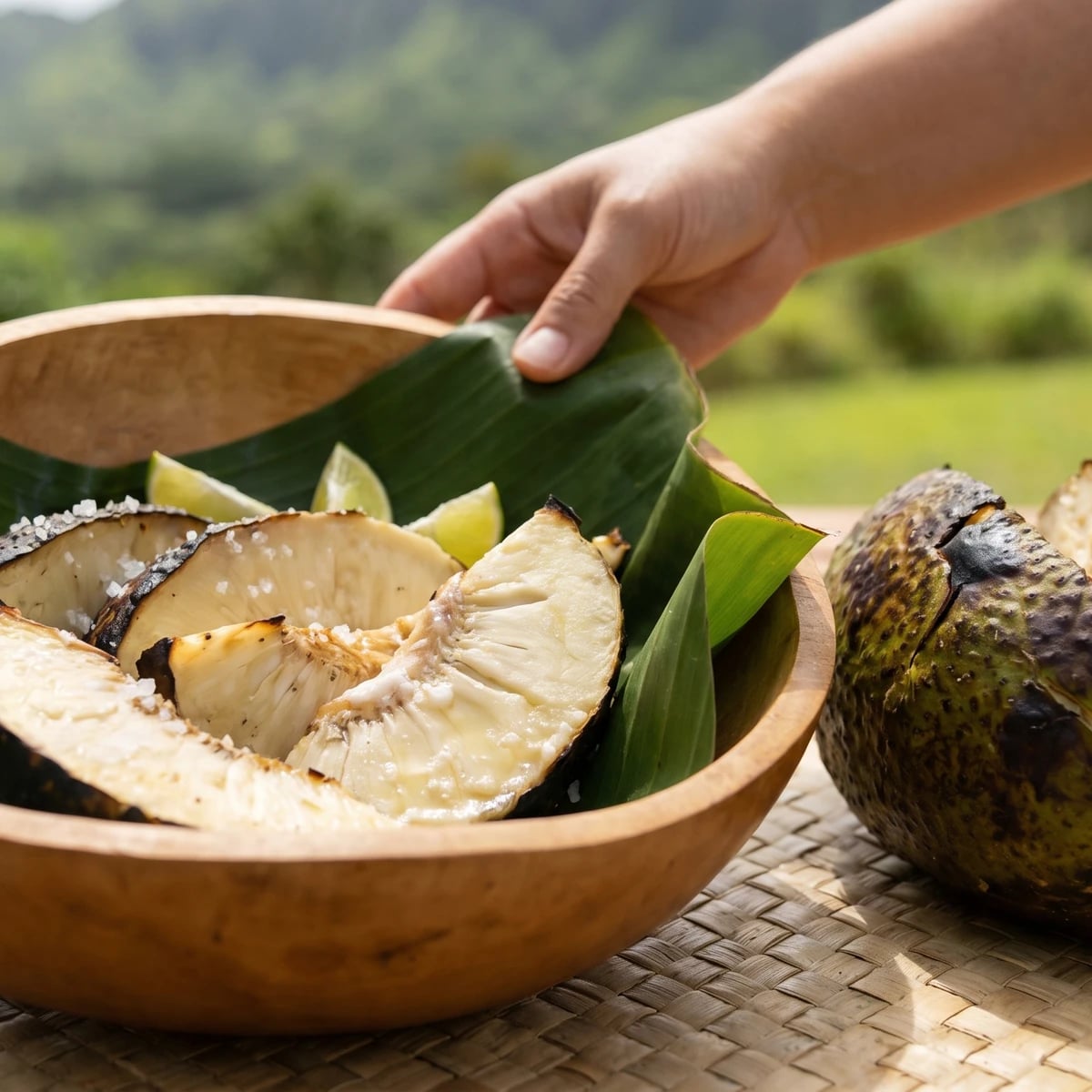
Hawaiʻi's ʻulu, breadfruit, roasted whole until the skin blackens and the inside turns soft and bread-like, the old canoe crop made real for a weeknight oven.
My kumu used to say, eat what you have, and when the ʻulu tree is giving, you listen. In Hawaiʻi, ʻulu, breadfruit, is not just something filling to put beside the fish. It's a canoe crop, a relative carried over salt water, planted so the people could stay fed after the canoe was pulled up on shore.
This is the Hawaiian hand with it: roast the whole fruit until the green skin goes dark and tight, then split it open and let the soft starch show itself. In Sāmoa and Tonga the cousins know ʻulu too, Tahiti calls it ʻuru, the Marquesas keep mei close to the heart, and the Cook Islands have kuru. One ocean, one canoe, one root, even when each island cooks it in its own way.
For a real imu, the Hawaiian earth oven, the fruit would sit near the heat with leaf and stone doing the slow work. Most of us are in a kitchen tonight, so the oven does the job. No shame in that. You still give it time, you still turn it once, and you still wait until a knife slides in without argument.
Serve it plain with paʻakai, sea salt, and butter if that's what the table wants. Coconut cream is good too. Next to kālua puaʻa, fish, stew, eggs, or just by itself, ʻulu feeds you steady. Deep food is not fancy. It's faithful.
Breadfruit was one of the great Polynesian canoe crops, moved by voyagers across the Pacific and established through much of the Triangle, especially in Hawaiʻi, Sāmoa, Tonga, Tahiti, the Marquesas, and the Cook Islands. In Hawaiʻi, famous groves such as the Kona field system fed dense communities before imported wheat and rice pushed many deep foods to the side. Roasting ʻulu whole keeps an older starch practice alive in a modern kitchen: bread off the tree, not from a bag.
Quantity
1 (2 to 3 pounds)
stem trimmed
Quantity
1 tablespoon
for rubbing the skin
Quantity
1 to 2 tablespoons
for serving
Quantity
to taste
Quantity
to taste
Quantity
1
for serving
| Ingredient | Quantity |
|---|---|
| mature firm ʻulu (breadfruit)stem trimmed | 1 (2 to 3 pounds) |
| neutral oil or melted coconut oil (optional)for rubbing the skin | 1 tablespoon |
| butter or coconut cream (optional)for serving | 1 to 2 tablespoons |
| paʻakai (sea salt) | to taste |
| freshly cracked black pepper (optional) | to taste |
| lime wedge (optional)for serving | 1 |
Pick a mature firm ʻulu, green to yellow-green, heavy for its size, with the little skin segments filled out and only a slight give under your thumb. If it's rock hard, it needs more days. If it's very soft and sweet-smelling, save that one for dessert or mash, because this roasting wants starch, not sugar.
Heat the oven to 400F. Rinse the ʻulu and dry it well. Rub the skin lightly with oil if you want a cleaner, glossier roast, then set it on a rimmed baking sheet. Prick it 6 to 8 times with a small knife so pressure has somewhere to go.
Roast the ʻulu whole for 60 to 80 minutes, turning once halfway through, until the skin darkens, tightens, and blackens in patches. Don't panic at the color. That's the outside doing its work while the inside turns soft and bread-like.
Slide a thin knife through the side toward the center. It should go in easy, with the same give as a baked potato, no hard core fighting you. If the knife catches, give it another 10 to 15 minutes. No blame the ʻulu. It just wasn't done yet.
Let the ʻulu rest 10 minutes so the starch settles. Split it lengthwise, pull out the central core, and peel away the dark skin. The flesh should be pale cream to warm yellow, soft enough to break apart in big wedges, with a light sheen where the heat opened it.
Cut the warm ʻulu into wedges or rough chunks. Dress it simply with butter or coconut cream, paʻakai, and pepper if you like. A squeeze of lime wakes it up, but don't bury it. Let the breadfruit taste like itself, steady and quiet, the way good starch should.
1 serving (about 160g)
Culinary guides, cultural storytelling, and the editorial depth that makes cooking meaningful.
Discover Culinary Explorer
Chef Makoa
Whole Hawaiian ʻuala baked in embers or a hot oven until the skins char and the flesh goes honey-soft, finished plain with paʻakai so the canoe crop tastes like itself.

Chef Makoa
Roasted kukui nut pounded soft with paʻakai ʻalaea, the salty, oily Hawaiian relish that makes poke taste like home and carries the old hand into a weeknight kitchen.

Chef Makoa
Hawaiʻi's koʻele pālau turns steamed ʻuala into a soft coconut-cream pudding, sweet but grounded, the canoe crop brought forward for a celebration table or a quiet bowl at home.

Chef Makoa
Kauaʻi's kalo country gives us kūlolo: grated taro, coconut cream, and sugar baked slow in ti leaves until dark, glossy, and firm enough to slice.