Culinary Explorer

A cooking platform built around craft, culture, and the stories behind what we eat.
Discover Culinary Explorer
Baek-oi-sobagi (White Stuffed Cucumber Kimchi)

Baek-oi-sobagi (White Stuffed Cucumber Kimchi)

Created by

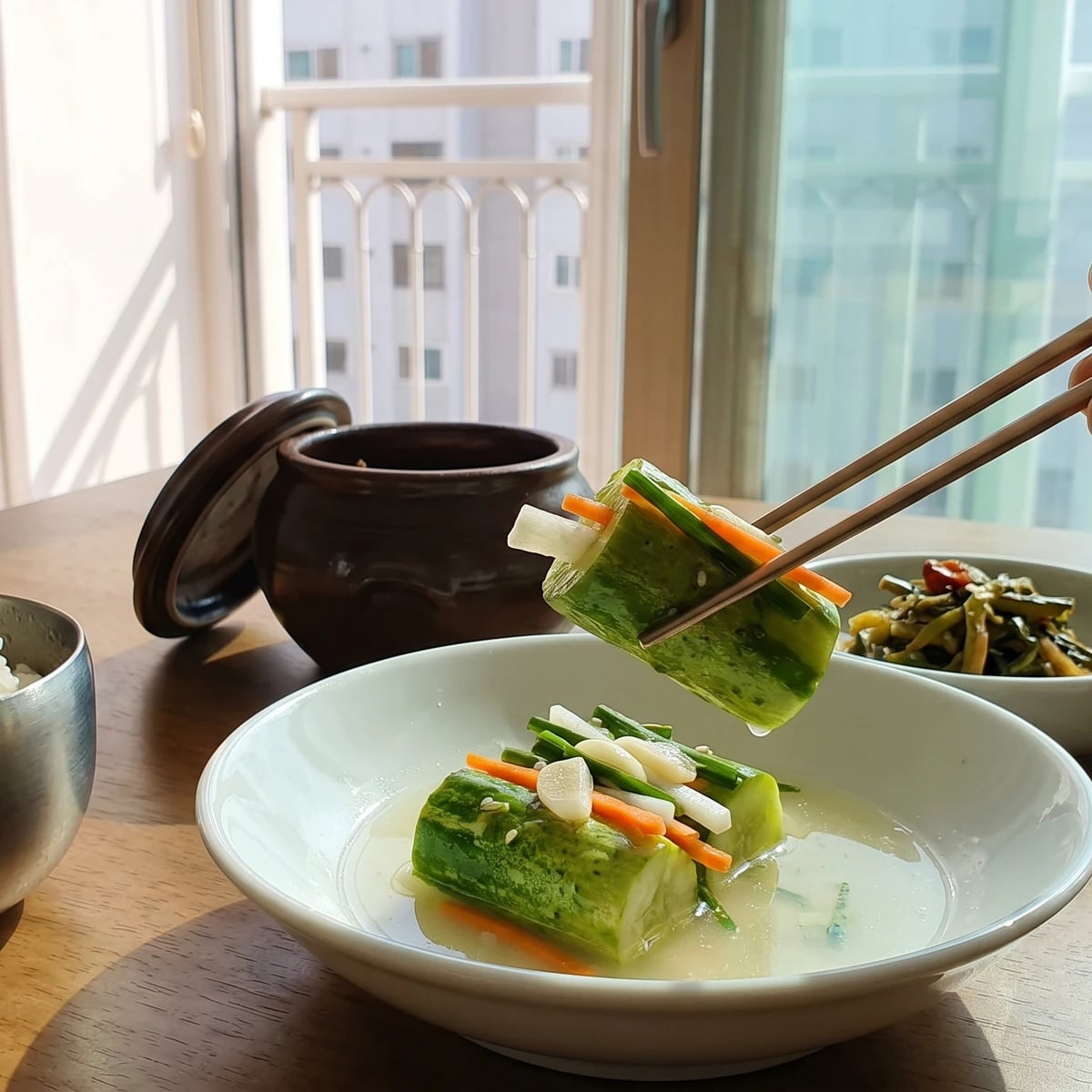
A pale summer cucumber kimchi, split and stuffed with radish and chives, then held in a cool pear brine so the cucumber stays clean, crunchy, and plainly itself.

Sauces & Condiments
Korean
Weeknight
Make Ahead
45 min
Active Time
5 min cook3 hr 20 min total
Yield6 to 8 banchan servings, about 16 stuffed cucumber pieces

At the summer market, I buy cucumbers by weight and judge them with my thumb. A good one for baek-oi-sobagi is narrow, heavy, thin-skinned, and prickly enough to complain. Cook the month you're standing in. This dish belongs to the stretch of heat when cucumbers are cheap, radish is sharp, and a cold bowl of brine on the table does more work than another hot soup.

Baek means white here: no gochugaru, no red paste, no hiding the cucumber under heat. It asks for cleaner hands than the red version, not lazier ones. Salt the cucumber just enough to bend around its stuffing, cut the radish fine enough to slip into the cross, and make the brine clear by straining the pear, onion, garlic, and ginger. If the brine is cloudy from carelessness, the dish tells on you.

Notebook 53 says 35 minutes in hot salt water for the cucumbers I buy in June. Longer made them tired; shorter left them raw at the center. Your cucumbers will have their own stubbornness, so taste a sliver after salting. It should be seasoned to the middle but still crack under the teeth.

This is kimchi for tonight and tomorrow, not a crock for winter. Stuff it, chill it, let the brine settle into the cuts, and bring it out with rice, grilled fish, or a bowl of noodles. Write it down. Memory is a borrowed bowl.

Oi-sobagi is part of Korea's summer oi-kimchi family, made when thin-skinned cucumbers are cheap, crisp, and too watery to keep for long storage. The white, water-brined version sits beside baek-kimchi and nabak-kimchi, clear kimchi styles that preserve the older no-chili logic of Korean pickling, since peppers became common in Korean cooking only after their arrival from the Americas through Japan in the late sixteenth and seventeenth centuries. This is a home banchan more than a restaurant dish, made to be eaten young before the cucumber softens.

The technique, the tradition, and the story behind every dish.

Discover Culinary Explorer

Ingredients

Korean baekdadagi or Persian cucumbers

Quantity

8, about 1 kg

firm, thin-skinned

water

Quantity

6 cups

for hot salting brine

Korean coarse sea salt (cheonilyeom)

Quantity

60g

for hot salting brine

Korean radish (mu)

Quantity

120g

peeled and cut into 2-inch matchsticks

carrot

Quantity

50g

cut into 2-inch matchsticks

garlic chives (buchu)

Quantity

45g

cut into 2-inch lengths

scallions

Quantity

2

white and light green parts cut into 2-inch lengths

fine sea salt

Quantity

1/2 teaspoon

for the stuffing

Korean pear

Quantity

1/2, about 180g peeled

cored and chopped

small onion

Quantity

1/4, about 40g

chopped

garlic

Quantity

2 small cloves

lightly crushed

ginger

Quantity

1 teaspoon

peeled and chopped

cold filtered water

Quantity

4 cups

for the kimchi brine

Korean coarse sea salt

Quantity

1 tablespoon, about 18g

for the kimchi brine

saeujeot brine or clear fish sauce (optional)

Quantity

2 teaspoons

sugar (optional)

Quantity

1 teaspoon

only if the pear is not sweet

Equipment Needed

  • Large heatproof bowl
  • Small pot for boiling the salting brine
  • Fine sieve or cheesecloth
  • 2-liter glass, ceramic, or onggi container with lid
  • Small saucer or fermentation weight

Instructions

  1. 1

    Cut the cucumbers

    Wash the cucumbers well and trim 1/4 inch from both ends. Cut each cucumber crosswise into pieces about 2 1/2 inches long. Stand one piece upright and cut an X down from the top, stopping 1/2 inch before the bottom, so the four arms stay attached. Do not cut through. The uncut base is the hinge that holds the stuffing and keeps the brine from washing it away.

    Choose cucumbers that feel heavy for their size. If the seed core is already soft and watery, cook something else from the market today.
  2. 2

    Hot salt them

    Bring 6 cups water to a boil and dissolve the 60g coarse sea salt in it. Put the cut cucumbers in a large heatproof bowl and pour the hot salt water over them. Press them down with a plate and let them stand 35 minutes, turning once. This fast salting seasons the middle, softens the cuts just enough for stuffing, and keeps the skin lively. Rinse once under cold water for 5 seconds, then drain cut-side down for 15 minutes.

    Taste a thin slice from one cucumber after salting. It should be seasoned but still crisp. If it tastes sharply salty, rinse 10 seconds more and drain again.
  3. 3

    Make the brine

    Blend the pear, onion, garlic, ginger, and 1 cup of the cold filtered water until smooth. Strain through a fine sieve or cheesecloth into a bowl, pressing gently but not forcing the pulp through. Stir in the remaining 3 cups cold water, 1 tablespoon coarse sea salt, and the saeujeot brine or fish sauce if using. Add the sugar only if the pear was flat. Taste the brine. It should be a little saltier than you want to drink, because the cucumbers will water it down.

  4. 4

    Season the filling

    Toss the radish and carrot matchsticks with 1/2 teaspoon fine sea salt and let them stand 10 minutes. Add the garlic chives, scallions, and 2 tablespoons of the prepared brine, then fold everything together with your fingers. Do not pound it. Radish needs a little salt so it bends; chives bruise easily and turn harsh when crushed.

  5. 5

    Stuff each cross

    Open each cucumber gently and tuck in about 1 tablespoon of filling. Use less than you want. If the cucumber cannot close around the filling, it is overstuffed and will split as it sits. Lay the stuffed cucumbers snugly in a clean glass, ceramic, or onggi container just large enough to hold them.

  6. 6

    Brine and settle

    Pour the clear brine over the cucumbers until they are covered. If they float, press them down with a clean small saucer or fermentation weight. Leave at cool room temperature for 1 hour, then refrigerate at least 2 hours before serving. For a light tang, leave them at room temperature 6 to 8 hours with the lid loose, then refrigerate. If your kitchen is hotter than 24C or 75F, move them to the refrigerator after the first hour.

    This is a young cucumber kimchi. Do not treat it like winter cabbage kimchi and leave it out for days.
  7. 7

    Serve cold

    Serve the cucumbers cold in a small bowl with enough brine to spoon over them. Eat them the day they are made for the best crunch, or within 3 days. Use clean chopsticks each time. If the brine turns ropy, smells spoiled, or grows mold, throw the batch away.

Chef Tips

  • Baek-oi-sobagi is plain in the dangerous way. There is no chili to distract the mouth, so the cucumber, salt, and brine have to be right. Let it taste like itself.
  • Korean baekdadagi cucumbers are best here: short, pale green, thin-skinned, and made for kimchi. Persian cucumbers are the easiest substitute. Long English cucumbers work only if they are firm; cut them shorter and salt 25 minutes, because they soften faster.
  • The hot salting brine looks severe, but it is measured. Thirty-five minutes seasons the cucumber without making it limp. An hour gives you tired cucumber, and tired cucumber does not recover in the refrigerator.
  • For a meatless version, omit the saeujeot brine or fish sauce and add another 1/4 teaspoon salt to the kimchi brine if it tastes flat. For temple-style cooking, you would also remove garlic, onion, and chives, but then the dish changes honestly into another branch of the same family.
  • Do not make a large batch unless the table is large. Cucumbers continue releasing water and soften quickly, so two or three days is the proper life of this kimchi.

Advance Preparation

  • The pear brine can be blended, strained, and refrigerated 1 day ahead. Stir it before using, because the fine fruit sediment settles at the bottom.
  • The radish, carrot, chives, and scallions can be cut up to 6 hours ahead and kept covered in the refrigerator. Salt the radish and carrot only when you are ready to stuff.
  • Finished baek-oi-sobagi is best after 2 hours of chilling and within 24 hours. It remains good up to 3 days if kept cold and submerged.

Frequently Asked Questions

Nutrition Information

1 serving (about 190g)

Calories
45 calories
Total Fat
0 g
Saturated Fat
0 g
Trans Fat
0 g
Unsaturated Fat
0 g
Cholesterol
0 mg
Sodium
1450 mg
Total Carbohydrates
10 g
Dietary Fiber
2 g
Sugars
5 g
Protein
2 g

Note: Chef personas and recipes are created with AI assistance. Cook with care: follow safe food-handling practices, check doneness with a thermometer when needed, and adapt for allergies and your kitchen.

Where cooking meets culture.

Culinary guides, cultural storytelling, and the editorial depth that makes cooking meaningful.

Discover Culinary Explorer

More from White & Water Kimchi

Browse the full collection