
Chef Jeong-sun
Albaechu-mul-kimchi (Baby Cabbage Water Kimchi)
Tender baby napa cabbage in a clear pear-garlic brine, lightly fermented until the broth turns clean and bright, the summer kimchi a beginner can make without a kimjang floor.
A cooking platform built around craft, culture, and the stories behind what we eat.
Created by
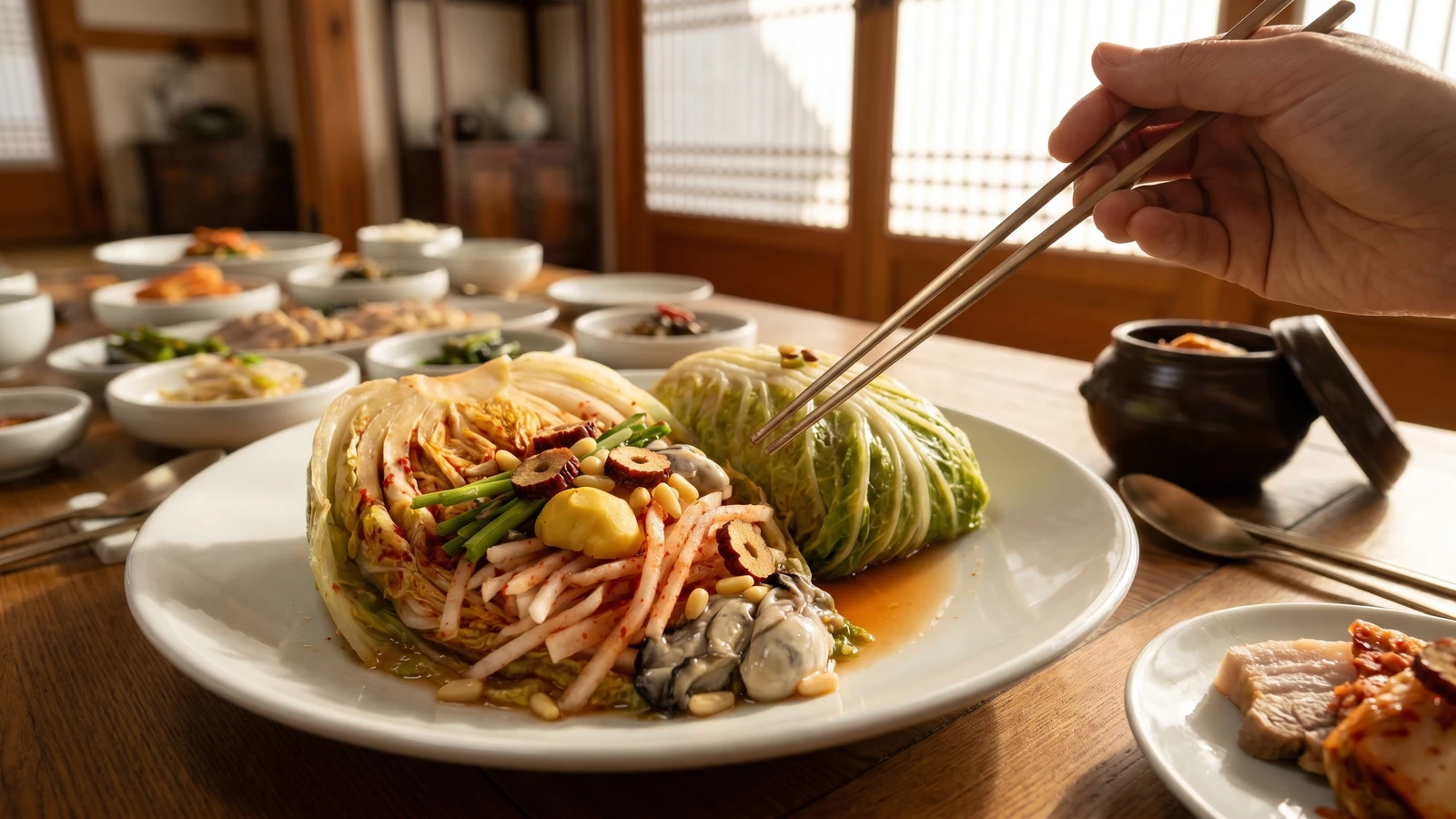
A festive Gaeseong kimchi parcel, packed with crisp radish, pear, chestnut, jujube, pine nuts, and oyster, then opened at the table like a gift made to be shared.
Bossam-kimchi lives or dies by the wrap. The cabbage leaf must be salted until it bends like cloth, not until it collapses, because it has to hold the filling cleanly and open at the table with some dignity. Too stiff and it cracks. Too soft and you have made a wet bundle, not kimchi.
This is not a weeknight cabbage kimchi made by the crockful. It is Gaeseong's feast kimchi, generous because that city was generous in its trade and ingredients: radish, pear, chestnut, jujube, pine nuts, minari, mustard greens, sometimes oysters when the sea and the season allow it. Each piece should still taste like itself. Let the chili season, not bury. Let the pear stay pear.
I learned this one from Master Seong-nyeo with my hands quiet and my eyes working. 눈동냥, 귀동냥, borrowing with the eyes and ears. She made us cut the radish matchsticks twice when they were uneven, because the filling settles only when the knife work is steady. I won't tell you this is quick. Tonight it asks for salting, draining, careful cutting, and a clean table. In return, you get a kimchi that arrives like a small wrapped table of its own.
Bossam-kimchi is closely associated with Gaeseong, the old Goryeo capital, where courtly habits, merchant wealth, and access to varied ingredients shaped a more elaborate kimchi than ordinary winter cabbage kimchi. The name comes from bossam, meaning wrapped or bundled, because the seasoned filling is enclosed inside salted cabbage leaves and opened before eating. Oysters and pine nuts show the dish's festive character, but many homes omit the oysters when the kimchi must keep longer.
Quantity
1 large, about 1.5kg
Quantity
1/2 cup
divided
Quantity
8 cups
for brining
Quantity
450g
peeled and cut into fine matchsticks
Quantity
1 teaspoon
for radish
Quantity
1, about 300g
peeled, cored, and cut into fine matchsticks
Quantity
8
peeled and sliced thin
Quantity
6
pitted and sliced thin
Quantity
3 tablespoons
dark tips removed if needed
Quantity
80g
cut into 2-inch lengths
Quantity
80g
cut into 2-inch lengths
Quantity
4
cut into 2-inch lengths
Quantity
120g
rinsed gently and drained
Quantity
4 tablespoons
preferably medium-coarse
Quantity
2 tablespoons
finely minced
Quantity
2 tablespoons
Quantity
1 tablespoon
minced
Quantity
1 teaspoon
minced
Quantity
1 tablespoon
Quantity
1 tablespoon
cooled
Quantity
1/4 cup
for moistening the filling
| Ingredient | Quantity |
|---|---|
| napa cabbage | 1 large, about 1.5kg |
| coarse sea saltdivided | 1/2 cup |
| cold waterfor brining | 8 cups |
| Korean radish (mu)peeled and cut into fine matchsticks | 450g |
| fine sea saltfor radish | 1 teaspoon |
| Korean pearpeeled, cored, and cut into fine matchsticks | 1, about 300g |
| fresh chestnutspeeled and sliced thin | 8 |
| dried jujubespitted and sliced thin | 6 |
| pine nutsdark tips removed if needed | 3 tablespoons |
| minari (Korean water dropwort)cut into 2-inch lengths | 80g |
| gat (Korean mustard greens)cut into 2-inch lengths | 80g |
| scallionscut into 2-inch lengths | 4 |
| fresh oysters (optional)rinsed gently and drained | 120g |
| gochugaru (Korean chili flakes)preferably medium-coarse | 4 tablespoons |
| saeujeot (salted shrimp)finely minced | 2 tablespoons |
| fish sauce | 2 tablespoons |
| garlicminced | 1 tablespoon |
| gingerminced | 1 teaspoon |
| sugar | 1 tablespoon |
| glutinous rice pastecooled | 1 tablespoon |
| cold water or mild beef brothfor moistening the filling | 1/4 cup |
Separate 8 large outer cabbage leaves and keep them whole for wrapping. Cut the remaining cabbage heart into 2-inch pieces. Dissolve 1/4 cup coarse sea salt in 8 cups cold water, then dip the whole leaves and cut cabbage in the brine. Sprinkle the remaining 1/4 cup salt mostly over the thick white ribs. Salt 5 to 6 hours, turning once halfway. The leaves are ready when the rib bends without snapping.
Rinse the salted cabbage in cold water 3 times, lifting between the leaves so no salt pockets remain. Drain the whole leaves and cut cabbage in a colander for 1 hour, cut side down where you can. Too much surface water makes the seasoning slide off and weakens the parcel.
Toss the radish matchsticks with 1 teaspoon fine sea salt and let them stand 20 minutes. Squeeze gently, not dry as laundry, just enough to remove excess water. This keeps the filling crisp instead of flooding the kimchi by morning.
In a large bowl, mix the gochugaru, minced saeujeot, fish sauce, garlic, ginger, sugar, cooled rice paste, and 1/4 cup cold water or mild beef broth. Let it stand 10 minutes so the chili blooms and turns supple. Taste it now. It should be salty and rounded, but not harsh, because the cabbage and radish will soften it.
Add the drained radish, cut cabbage, pear, chestnut, jujube, pine nuts, minari, gat, and scallions to the seasoning. Toss with your hands lightly, lifting rather than crushing. Add the oysters last, if using, and fold only 3 or 4 times so they stay whole. 손맛 is real. I still measure it, so it can be handed on.
Lay one whole cabbage leaf in a small bowl, rib end toward you and edges hanging over. Spoon about 3/4 cup filling into the center. Fold the sides over, then fold the rib end up and roll into a tight bundle. Set it seam side down in a glass or ceramic container. Repeat with the remaining leaves and filling. Pack snugly, not crushed.
Press a piece of food-safe wrap or a clean inner lid directly against the parcels to limit air, then cover. Leave at cool room temperature for 6 to 12 hours if your kitchen is below 20 C, then refrigerate. If you used oysters, refrigerate after 2 hours and eat within 3 days. Without oysters, it keeps 7 to 10 days, becoming sharper each day.
Serve one parcel per small plate or cut each bundle crosswise into quarters. Open it at the table so the filling shows: white cabbage, red seasoning, pale pear, brown jujube, yellow chestnut, green minari. Bossam-kimchi is made for a holiday table, but it should still taste clean enough to sit beside rice and soup.
1 serving (about 300g)
Culinary guides, cultural storytelling, and the editorial depth that makes cooking meaningful.
Discover Culinary ExplorerChef Jeong-sun
Tender baby napa cabbage in a clear pear-garlic brine, lightly fermented until the broth turns clean and bright, the summer kimchi a beginner can make without a kimjang floor.

Chef Jeong-sun
The kimchi from before chili, salted napa cabbage packed with radish, pear, jujube, and pine nuts in a clear brine that turns quietly tart in the jar.

Chef Jeong-sun
A pale summer cucumber kimchi, split and stuffed with radish and chives, then held in a cool pear brine so the cucumber stays clean, crunchy, and plainly itself.

Chef Jeong-sun
Flat spring bomdong cabbage, lightly brined and tucked into a clear pear-radish kimchi broth, made without chili and eaten young while the leaves still taste like spring.