
Chef Joost
Bawang Goreng (Crisp Fried Shallots)
Bawang goreng means fried onion, but on the Indo-Dutch table it is far more precise: the crisp golden shallot that makes nasi, soto, and sajoer taste finished.
A cooking platform built around craft, culture, and the stories behind what we eat.
Created by
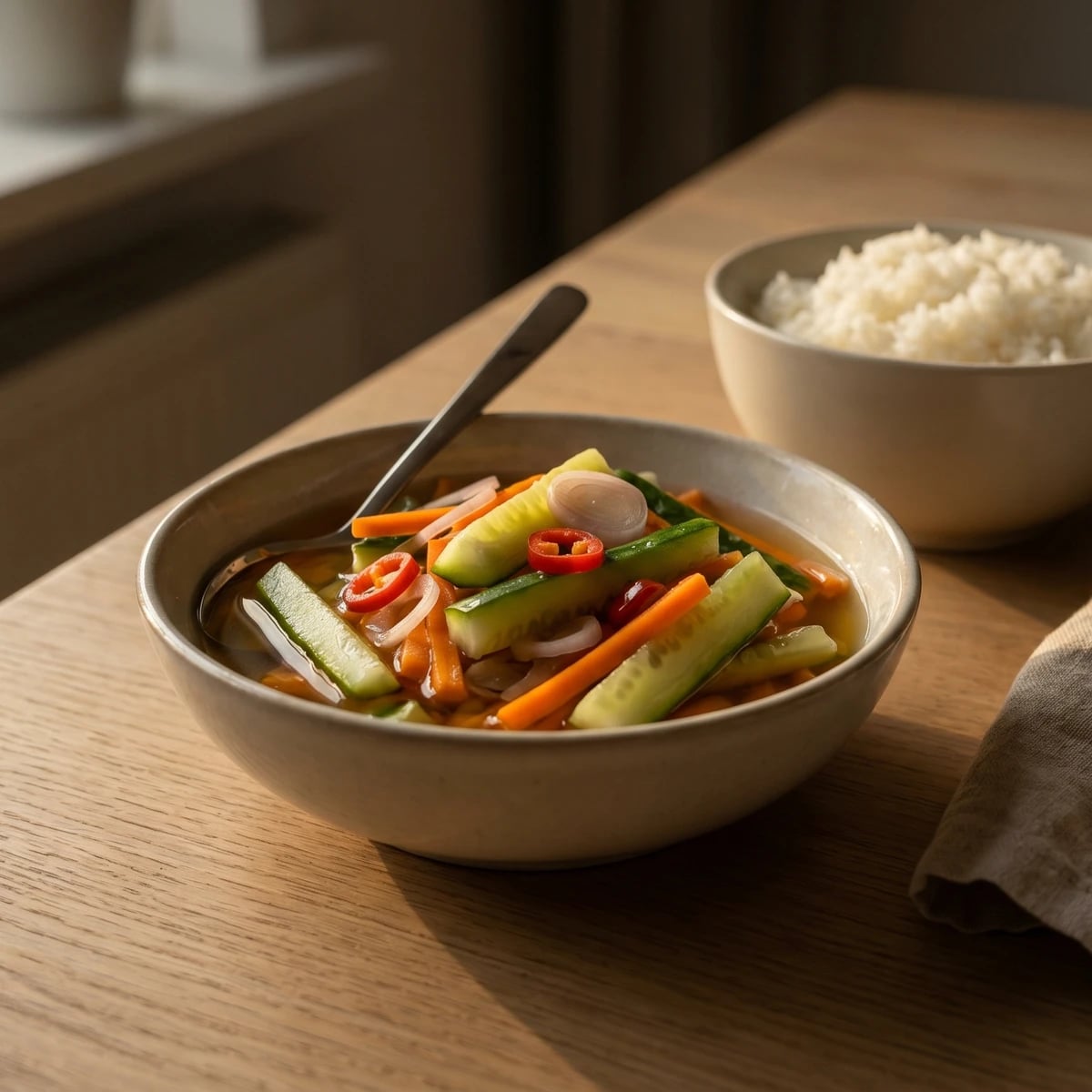
Acar means pickle, ketimun means cucumber, and this little bowl of sweet vinegar, chilli, and crunch is the cool note that lets an Indo-Dutch rijsttafel keep its balance.
The smallest bowl on the rijsttafel is often the one doing the most work. I learned this not in a grand hotel dining room, but at an Indo-Dutch family table where the rice arrived in a plain white bowl, the sambal sat there looking innocent, and a dish of acar ketimun waited beside it like a cool hand on the wrist. But let me tell you a secret: without that little sweet-sour crunch, the whole table leans too far into heat and fat.
The name already tells you what matters. Acar is the pickle, a word that belongs to the old Indian Ocean traffic of vinegar, salt, fruit, and vegetables; ketimun is cucumber, though in many Indonesian kitchens you will also hear mentimun. This is not a garnish borrowed for prettiness. It is table architecture. Vinegar cuts the chilli. Sugar rounds the vinegar. Salt wakes the cucumber. The carrot is there for bite and colour, the shallot for a clean little sting.
History and cookery, they cannot be separated, but the cooking here is almost laughably simple. Salt the cucumber first so it gives up its water, then give it vinegar sweetened just enough to smile, not enough to become syrup. I prefer to keep it a bit more relaxed, in the Dutch way: make it before the guests come, set it in a small bowl, and let everyone discover that the sharpest memory of a feast can be a pickle.
Acar ketimun entered Dutch home cooking through the Indo-Dutch table and the rijsttafel, the colonial-era rice table that developed in the Dutch East Indies during the nineteenth century and later became a restaurant and family tradition in the Netherlands. The word acar is related to the wider Indian Ocean vocabulary of pickles, including Hindi and Urdu achar and Persian achar, while ketimun means cucumber in Indonesian, alongside mentimun in common speech. After Indonesian independence in 1945 and the migration of Indo-European and Moluccan families to the Netherlands, small bowls of cucumber acar became familiar beside nasi goreng, satay, and other dishes that now sit firmly inside Dutch food memory.
Quantity
2, about 600g
halved lengthwise and cut into small batons or half moons
Quantity
1 medium
peeled and cut into matchsticks
Quantity
3 small
thinly sliced
Quantity
1 to 2
thinly sliced
Quantity
1 teaspoon
for drawing out the cucumber
Quantity
120ml
Quantity
60ml
Quantity
50g
Quantity
1/2 teaspoon
for the brine
| Ingredient | Quantity |
|---|---|
| firm cucumbershalved lengthwise and cut into small batons or half moons | 2, about 600g |
| carrotpeeled and cut into matchsticks | 1 medium |
| shallotsthinly sliced | 3 small |
| red chilliesthinly sliced | 1 to 2 |
| fine sea saltfor drawing out the cucumber | 1 teaspoon |
| mild white vinegar or rice vinegar | 120ml |
| hot water | 60ml |
| sugar | 50g |
| fine sea saltfor the brine | 1/2 teaspoon |
Put the cucumber pieces in a colander and toss them with 1 teaspoon fine sea salt. Leave them for 20 minutes while they give up their excess water. This is not fussing. Cucumber is mostly water, for obvious reasons, and if you skip this little wait it will thin the brine before the vinegar has done its work.
Rinse the salted cucumber quickly under cold water, then pat it dry with a clean towel. Do this briskly. You are removing harsh surface salt, not giving the cucumber a second bath.
Stir the vinegar, hot water, sugar, and 1/2 teaspoon salt together until the sugar dissolves. Taste it. It should strike sharp first, then sweet, with enough salt to make the cucumber taste more like itself. If your vinegar is fierce, add a spoonful more water; if it is sleepy, add a splash more vinegar.
Put the cucumber, carrot, shallots, and chilli into a clean 750ml jar or a small glass bowl. Pour over the brine and press the vegetables down so they sit in it. They may look a little crowded at first. Good. After half an hour they relax and the brine finds every corner.
Cover and refrigerate for at least 1 hour, though 4 hours is better. The cucumber stays bright, the shallot loses its raw shout, and the chilli moves through the vinegar instead of sitting in one angry slice. Hou het altijd simpel, always keep it simple: make the pickle, leave it alone, serve it cold.
Lift the acar from the brine with a slotted spoon and serve it in a small bowl beside nasi goreng, satay, grilled fish, or a full rijsttafel, the Dutch rice table. Do not drown the plate with the brine. Acar is there to cut richness and heat, not to flood the rice.
1 serving (about 70g)
Culinary guides, cultural storytelling, and the editorial depth that makes cooking meaningful.
Discover Culinary Explorer
Chef Joost
Bawang goreng means fried onion, but on the Indo-Dutch table it is far more precise: the crisp golden shallot that makes nasi, soto, and sajoer taste finished.

Chef Joost
The connoisseur's cracker of the Indo-Dutch table: bitter, crisp, pounded from melinjo seeds, and fried so quickly that hesitation is the only real danger.

Chef Joost
The name means a jumble, and the plate proves it: green beans, cabbage, egg, potatoes, and tofu gathered under pindasaus, Java carried into the Dutch rijsttafel.

Chef Joost
The crackle at the start of a Dutch rijsttafel is Indonesian in name and memory: cassava starch, prawn, hot oil, and a whole colonial table speaking at once.