
Chef Juliette
John Dory (St. Pierre)
John Dory has the delicacy of sole and the firmness of turbot. A light flouring, a quick butter sauté, and nut-brown beurre noisette show exactly why looks never mattered.
A cooking platform built around craft, culture, and the stories behind what we eat.
Created by Chef Juliette
Based on No. 973, Soufflé d’Écrevisses Léopold de Rothschild, from Le Guide Culinaire (1907) by Auguste Escoffier
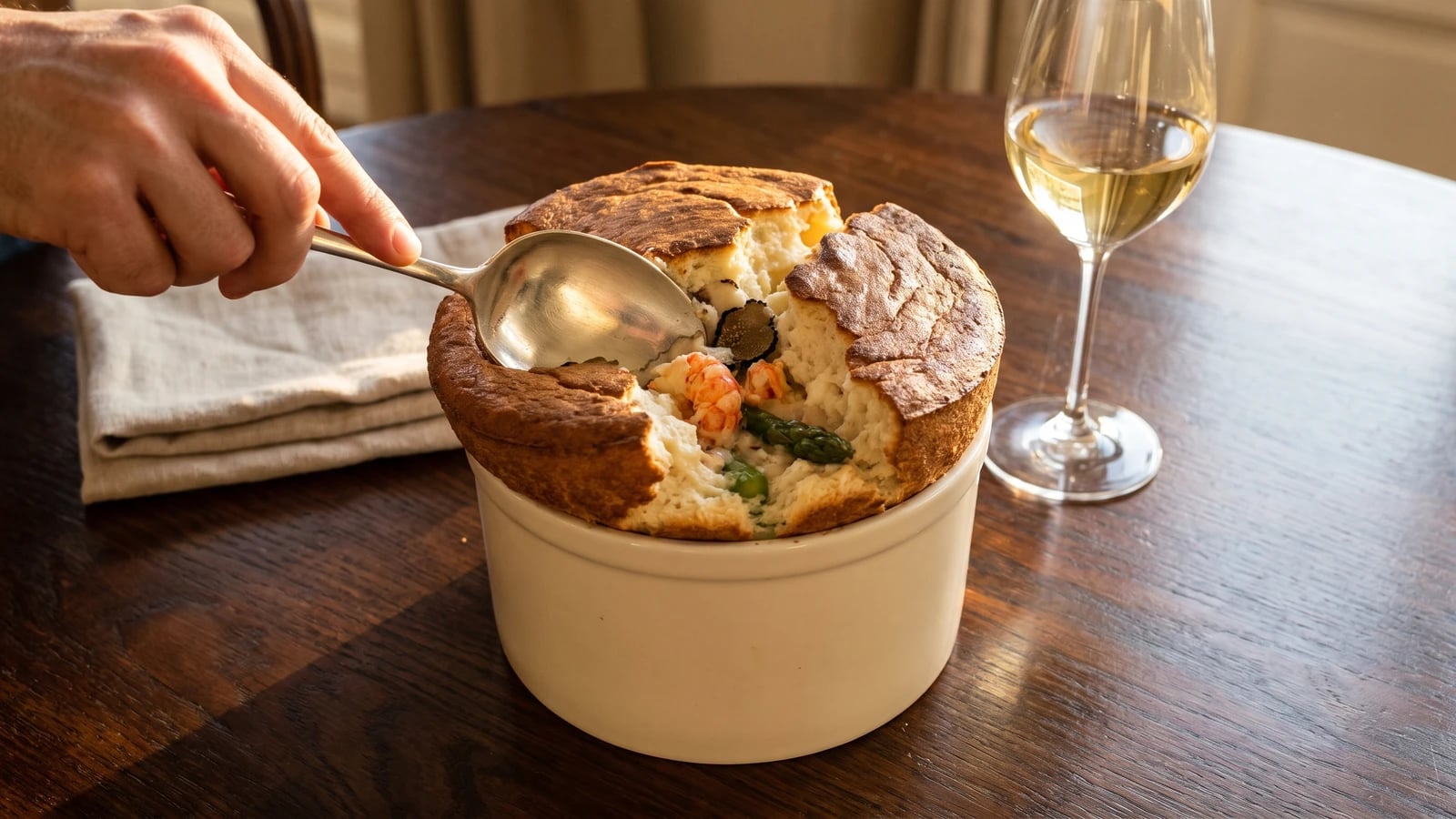
A savory soufflé of crayfish and Parmesan, layered with tender tails and threaded with asparagus and black truffle, risen high and bronzed for the table the instant the oven releases it.
Soufflé d’Écrevisses Léopold de Rothschild (crayfish soufflé with asparagus and truffle) teaches the discipline of readiness. The oven gives you its rise only when the mould is prepared, the garnish is dry, and the table is waiting. The one true thing to know before touching a pan is this: finish every other task before you whisk the whites.
The brigade formula assumed a saucier on staff, a stock never off the fire, cooked crayfish and garnishes waiting at the station, and a salamander ready whenever fierce top heat was wanted. Your honest equivalents are one small saucepan, good unsalted shellfish stock reduced for concentration, and an ordinary oven supplying steady heat from all sides. The broiler stays off because it would set the crown before the centre could rise. I have scaled the brigade mould to one 1½-quart dish for four and made the shorthand soufflé base explicit. The station work is scaffolding and can go; the pale roux, Parmesan, scant spoonful of asparagus, truffle slices, crayfish tails between the layers, and immediate baking are the dish and must stay.
The finished soufflé stands tall and bronze above its dish, with an ivory interior hiding coral tails and dark slips of truffle. Fold until no large pockets of white remain, then stop while the mixture still holds its billowing shape. That fold decides the dish.
Soufflé d’Écrevisses Léopold de Rothschild belongs to the cosmopolitan grand cuisine of Paris and the private dining rooms where a named garnish signaled a precise composition. Its crayfish, asparagus, truffle, and Parmesan are not a regional crayfish custom but a grand-kitchen arrangement later made practical at bourgeois tables through smaller moulds and domestic ovens. Soufflé names the method, a savory preparation lifted by egg whites as readily as a sweet one, and the word carries the technique.
Quantity
4 tablespoons (60 ml / 56 g)
softened and divided
Quantity
⅔ cup (160 ml / 60 g)
divided
Quantity
1 cup (240 ml / 240 g)
Quantity
½ cup (120 ml / 123 g)
Quantity
¼ cup (60 ml / 60 g)
Quantity
6 tablespoons (90 ml / 48 g)
Quantity
6
separated
Quantity
1½ cups (360 ml / 225 g)
drained and thoroughly dried
Quantity
1 scant tablespoon (15 ml / 12 g)
finely diced, cooled, and dried
Quantity
1 tablespoon (15 ml / 10 g)
drained if preserved
Quantity
½ teaspoon (2.5 ml / 3 g)
Quantity
¼ teaspoon (1.25 ml / 0.6 g)
| Ingredient | Quantity |
|---|---|
| unsalted buttersoftened and divided | 4 tablespoons (60 ml / 56 g) |
| finely grated Parmesandivided | ⅔ cup (160 ml / 60 g) |
| unsalted shellfish stock | 1 cup (240 ml / 240 g) |
| whole milk | ½ cup (120 ml / 123 g) |
| heavy cream | ¼ cup (60 ml / 60 g) |
| plain flour | 6 tablespoons (90 ml / 48 g) |
| large eggsseparated | 6 |
| cooked peeled crayfish tailsdrained and thoroughly dried | 1½ cups (360 ml / 225 g) |
| freshly cooked asparagus tipsfinely diced, cooled, and dried | 1 scant tablespoon (15 ml / 12 g) |
| thin black truffle slicesdrained if preserved | 1 tablespoon (15 ml / 10 g) |
| fine sea salt | ½ teaspoon (2.5 ml / 3 g) |
| ground white pepper | ¼ teaspoon (1.25 ml / 0.6 g) |
Set a rack in the lower third of the oven and heat it to 375°F (190°C), using conventional heat if you have the choice. Set the table now and have four warmed plates waiting. A soufflé waits for no one, and once the whites are folded there will be no useful pause.
Brush a 1½-quart (1.4-litre) straight-sided soufflé dish with 1 tablespoon (15 ml / 14 g) of the softened butter, working from bottom to rim in vertical strokes. Coat the inside with 3 tablespoons (45 ml / 15 g) of the Parmesan and tap out the excess. Wrap a buttered parchment collar around the outside so it stands about 2 inches (5 cm) above the rim, secure it with kitchen twine, and chill the prepared dish while you make the base.
Spread the cooked crayfish tails, diced asparagus, and truffle slices separately on clean towels. Blot them until no moisture marks the towel, leaving the small crayfish tails whole. Wet garnish leaks into the foam and makes a heavy band, so this quiet preparation matters more than any flourish at the finish.
Boil the shellfish stock in a small saucepan until reduced by half to ½ cup (120 ml / 120 g), about 8 to 10 minutes. Measure it if your eye is uncertain. Stir in the milk and cream, warm the mixture just until bubbles gather at the edge, then take it off the heat. Reduction supplies the depth once provided by the stockpot that never went cold.
Melt the remaining 3 tablespoons (45 ml / 42 g) butter in a heavy saucepan over medium-low heat. Stir in the flour and cook this roux for 2 minutes without letting it color. Add the warm stock mixture in four additions, whisking each one smooth before the next, then cook for 3 to 4 minutes until the base is glossy, very thick, and pulling cleanly from the saucepan. If it forms lumps, don't throw it out. Ça se rattrape: work it through a fine sieve while hot, then return it to gentle heat for one minute.
Transfer the roux base to a broad mixing bowl and let it cool for 5 minutes, until warm rather than fiercely hot. Beat in the yolks one at a time, followed by the remaining Parmesan, salt, and white pepper. Fold in the scant tablespoon of asparagus and the truffle slices. Keep the crayfish tails aside, exactly as the preparation requires, because they belong between the layers rather than beaten through the foam.
Whisk the egg whites in a perfectly clean bowl until they form glossy medium-firm peaks that bend slightly at their tips. Stop before they turn dry or clotted. Whites with a little suppleness fold around the base; overbeaten whites break into stubborn lumps and carry less air into the oven.
Whisk one-quarter of the whites firmly into the warm base to loosen it. Add the remainder in two batches, cutting down through the centre with a broad spatula, sweeping along the bottom, and turning the mixture over itself. Rotate the bowl as you work. If a few white islands remain, press them gently through with the edge of the spatula instead of stirring on and on. The mixture is ready when it looks billowing and evenly pale, not perfectly polished.
Spoon one-third of the soufflé preparation into the chilled dish and scatter over half the dried crayfish tails, keeping them away from the outer edge. Add another third of the preparation, the remaining tails, and then the final third. Smooth the surface lightly without pressing. Run a clean thumb around the inner rim to make a shallow channel, which helps the crown rise straight, and put the dish in the oven immediately.
Bake for 30 to 35 minutes without opening the oven during the first 25. The soufflé is ready when it stands high above the rim, the crown is deeply bronzed, and the centre still gives a slight tremble; an instant-read thermometer inserted through the side should register at least 160°F (71°C). Steady oven heat does the work. A broiler or salamander would color the top too fiercely and leave the middle behind.
Remove the collar carefully and carry the soufflé directly to the table. Break through the crown with a broad serving spoon, reaching to the bottom so every portion receives airy Parmesan base, crayfish tails, asparagus, and truffle. Serve at once. À table!
1 serving (about 220g)
Culinary guides, cultural storytelling, and the editorial depth that makes cooking meaningful.
Discover Culinary ExplorerChef Juliette
John Dory has the delicacy of sole and the firmness of turbot. A light flouring, a quick butter sauté, and nut-brown beurre noisette show exactly why looks never mattered.

Chef Juliette
Fresh haddock proves its delicacy in the meunière pan: a fine flour crust, moist pearly flakes, and beurre noisette sharpened with lemon and parsley, ready from one skillet in half an hour.

Chef Juliette
Éperlans à l’Anglaise turns small fish into a lesson in disciplined coating: boned smelts under a close, crisp crumb, pan-fried in clarified butter and finished with bright, half-melted maître d’hôtel butter.

Chef Juliette
Tiny smelts, shallot, mushrooms, white wine, gratin sauce, and fine bread raspings meet a fierce oven, where the fish must turn tender in the same breath the buttered crust bronzes.