Culinary Explorer

A cooking platform built around craft, culture, and the stories behind what we eat.
Discover Culinary Explorer
Écrevisses à la Liégeoise

Écrevisses à la Liégeoise

Created by Chef Juliette

Based on No. 969, Écrevisses à la Liégeoise, from Le Guide Culinaire (1907) by Auguste Escoffier

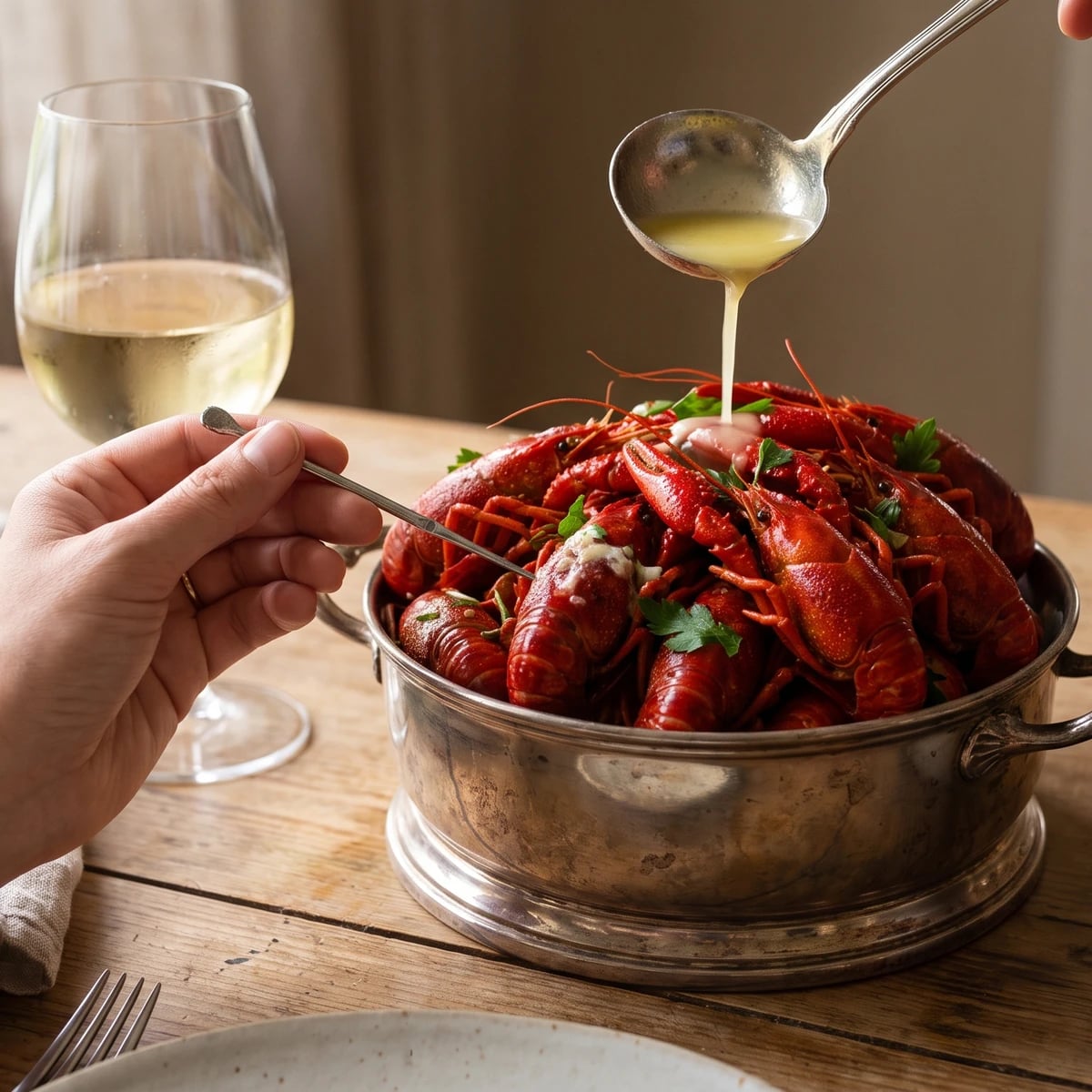
Écrevisses à la Liégeoise turns one court-bouillon into both cooking medium and sauce: crayfish served shell-on beneath their strained liquor, reduced by a quarter, glossed with butter, and marked with parsley.

Main Dishes
French
Dinner Party
Special Occasion
30 min
Active Time
45 min cook1 hr 15 min total
Yield4 servings

Écrevisses à la Liégeoise (Liège-style crayfish) teaches one exact lesson: the cooking liquor is the sauce. The crayfish season their court-bouillon as they cook, and that liquor is strained, reduced by one quarter, then rounded with a single ounce of butter. Reduce it to one quarter and you have missed the dish entirely. It should remain generous and pourable, tasting first of crayfish, then wine and aromatics.

The original line assumed a fish kettle, a warmed timbale waiting beside the stove, and a saucier free to strain and reduce while another pair of hands kept the crayfish hot. This version fixes the open-ended service quantity at forty medium crayfish, enough for four as a main, then replaces the fish kettle with a lidded stockpot and the saucier's station with a wide sauté pan. The extra hands were brigade scaffolding and can go. The court-bouillon, the exact reduction, and the stated ounce of real butter are the dish and must stay. One cook, one stove, one evening.

Have a measuring jug ready before the crayfish enter the pot. Measuring the strained liquor and stopping when three-quarters remains is the step that decides everything.

Écrevisses à la Liégeoise takes its geographic name from Liège in Wallonia, Belgium, not from a French region, although French classical manuals absorbed the preparation into their crayfish repertoire. In this form, the crayfish pass from an aromatic court-bouillon to a timbale while that same liquor is strained, reduced only by a quarter, and finished with butter. Its restraint is the point: unlike richer crayfish preparations, it relies on no cream, roux, or separate mother sauce.

The technique, the tradition, and the story behind every dish.

Discover Culinary Explorer

Ingredients

live medium freshwater crayfish

Quantity

40 (about 4 lb / 1.8 kg)

lively and thoroughly rinsed

water

Quantity

4 cups (950 ml / 950 g)

dry white wine

Quantity

3 cups (710 ml / 710 g)

white wine vinegar

Quantity

1/2 cup (120 ml / 120 g)

yellow onion

Quantity

1 1/2 cups (350 ml / 225 g)

thinly sliced

carrot

Quantity

1 cup (240 ml / 130 g)

thinly sliced

bouquet garni

Quantity

1

made with 6 parsley stems, 2 thyme sprigs, and 1 bay leaf

black peppercorns

Quantity

1 teaspoon (5 ml / 3 g)

lightly crushed

fine sea salt

Quantity

1 tablespoon (15 ml / 18 g)

cold unsalted butter

Quantity

2 tablespoons (30 ml / 28 g)

cut into 3 pieces

flat-leaf parsley

Quantity

1 tablespoon (15 ml / 4 g)

concassed (roughly chopped)

Equipment Needed

  • 8-quart (7.5 L) lidded stockpot
  • 12-inch (30 cm) wide sauté pan
  • Fine-mesh strainer
  • Heatproof measuring jug
  • Large spider or slotted spoon
  • 3-quart (2.8 L) deep serving bowl or timbale

Instructions

  1. 1

    Build the court-bouillon

    Combine the water, wine, vinegar, onion, carrot, bouquet garni, peppercorns, and salt in an 8-quart (7.5 L) lidded pot. Bring to a full boil, then simmer uncovered for 20 minutes, until the onion is soft and the liquor smells distinctly of wine, herbs, and pepper. This is the court-bouillon, an aromatic poaching liquor, and it should taste more assertive than a table broth because it must season through the shells.

  2. 2

    Ready the crayfish

    Sort the crayfish while the court-bouillon simmers. Discard any that have died before cooking, rinse the lively ones well under cold running water, and keep them cold until the pot is ready. Follow the humane handling requirements where you live immediately before cooking. Fill a deep 3-quart (2.8 L) serving bowl or timbale with hot water so it will be warm when the crayfish leave the pot.

    Never soak live crayfish in fresh water while you work. Keep them cold and damp, then rinse just before cooking.
  3. 3

    Cook at a boil

    Bring the court-bouillon back to a rolling boil. Add the crayfish in several swift additions, lowering them away from you to prevent splashing, then cover the pot. Once the liquid returns to the boil, cook for 6 to 8 minutes, turning the crayfish through the liquor once, until the shells are vivid red and the flesh in the thickest tail is opaque and firm. If the pot is too crowded to regain its boil promptly, cook in two batches using the same liquor. Empty and dry the warmed serving bowl, transfer the crayfish with a spider or slotted spoon, and cover them.

  4. 4

    Strain and measure

    Pour the court-bouillon through a fine-mesh strainer into a heatproof measuring jug. Let it drain freely without pressing the vegetables, which would cloud the liquor. Note the exact volume, then calculate three-quarters of that amount. If you have 6 cups, for example, your finishing mark is 4 1/2 cups.

  5. 5

    Reduce by one quarter

    Transfer the strained liquor to a wide sauté pan and boil it steadily until only three-quarters of the measured starting volume remains, usually 10 to 15 minutes. Reduce it by one quarter, not to one quarter. The aroma will sharpen and the colour deepen slightly, but this remains a light, abundant sauce rather than a glaze. If you pass the finishing mark, ça se rattrape: add boiling water a tablespoon at a time until the measured volume and balanced taste return.

  6. 6

    Monter au beurre

    Remove the pan from the heat. Monter au beurre, finish with cold butter, by whisking in the three pieces one at a time until each disappears. The liquor should gleam and feel lightly rounded on the tongue without becoming thick. Do not boil it after the butter goes in. If oily beads gather across the surface, keep the pan off the heat and whisk in 1 tablespoon of cold water; the emulsion will come back together.

  7. 7

    Sauce and serve

    Pour the buttered reduction evenly over the hot crayfish, turning the top few so their shells catch its gloss. Scatter over the concassed parsley and carry the timbale straight to the table with picks, napkins, and a bowl for the shells. À table!

Chef Tips

  • Live crayfish give the court-bouillon its full shellfish sweetness. Buy them from a legal, responsible source and cook them the day they arrive. If live crayfish aren't available, uncooked frozen whole crayfish can follow the same method after thawing in the cold, though the sauce will be less vivid; already cooked crayfish cannot give you the same liquor.
  • Choose a dry, clean white wine without obvious sweetness or heavy oak. The reduction concentrates whatever the bottle brings, both its virtues and its bad manners.
  • The source gives one ounce of butter, and that is enough. Cold real butter lends gloss and a gentle body without disguising the crayfish; margarine or fat substitutes won't form the same finish.
  • Serve the same dry white wine used in the pot, with plain bread for the liquor. Set out shell bowls, picks, and generous napkins before everyone sits down. Crayfish are splendid dinner-party food precisely because nobody can eat them with solemn dignity.
  • Refrigerate leftovers within two hours and pick the meat from the shells while it is still easy to handle. Eat it cold the next day; reheating the whole crayfish makes the tail meat tough.

Advance Preparation

  • The court-bouillon can be simmered the day before without the crayfish, then strained, cooled, covered, and refrigerated. Return it to a full boil before cooking the crayfish.
  • Slice the vegetables, tie the bouquet garni, concass the parsley, and set out the serving bowl and shell dishes earlier in the day. Cook the crayfish and mount the sauce only when the table is ready; neither waits gracefully.

Frequently Asked Questions

Nutrition Information

1 serving (about 180g)

Calories
150 calories
Total Fat
7 g
Saturated Fat
4 g
Trans Fat
0 g
Unsaturated Fat
3 g
Cholesterol
105 mg
Sodium
1850 mg
Total Carbohydrates
7 g
Dietary Fiber
0 g
Sugars
2 g
Protein
12 g

Note: Chef personas and recipes are created with AI assistance. Cook with care: follow safe food-handling practices, check doneness with a thermometer when needed, and adapt for allergies and your kitchen.

Where cooking meets culture.

Culinary guides, cultural storytelling, and the editorial depth that makes cooking meaningful.

Discover Culinary Explorer

More from Fish - Lobster (Homard)

Browse the full collection