Culinary Explorer

A cooking platform built around craft, culture, and the stories behind what we eat.
Discover Culinary Explorer
Écrevisses à la Marinière

Écrevisses à la Marinière

Created by Chef Juliette

Based on No. 967, Écrevisses à la Marinière, from Le Guide Culinaire (1907) by Auguste Escoffier

Crayfish turn scarlet in butter and wine, then return beneath a glossy sauce of reduced cooking liquor, fish velouté, and cold butter: a swift lesson in cooking shellfish once and sauce twice.

Main Dishes
French
Dinner Party
Special Occasion
35 min
Active Time
25 min cook1 hr total
Yield4 servings

Écrevisses à la Marinière (crayfish the mariner's way) teaches one clean sequence: cook the shellfish once, then finish the sauce without cooking them twice. The shells must turn a fine red in butter before the wine enters; that quick coloring and the liquor they release are the dish's foundation.

The original assumed an open fire, a saucier to reduce the liquor, and Fish Velouté waiting beside a stockpot never off the fire. At home, one wide lidded pan supplies both fierce heat and controlled reduction, a measured portion of finished Fish Velouté comes from the refrigerator or freezer, and a warmed deep bowl replaces the formal timbale. Those extra pans and hands were brigade scaffolding. The butter toss, ten-minute wine cook, halved liquor, velouté thickening, and monter au beurre, the off-heat finish with cold butter, are the dish, so they stay.

The source's twelve-crayfish formula made a smaller fish course. Here it is doubled into a generous main for four, with every sauce ratio kept intact; the crayfish are also humanely dispatched before meeting the pan rather than sent live to the fire. Have everything measured before you begin, because the cooking moves quickly. The moment that matters most is lifting the crayfish before reducing their liquor: leave them in, and the sauce improves while the flesh does not.

Écrevisses à la Marinière belongs to the Parisian classical table, which applied the marinière method of white wine, shallot, herbs, and reduced cooking liquor to freshwater crayfish arriving from France's river markets. Marinière names the cooking method, not a seaside origin: crayfish live in fresh water, and this disciplined wine reduction moved readily from market cooking into grand kitchens. Unlike the crayfish-rich sauces of Nantua in Bugey, this preparation keeps the shellfish whole and the sauce pale, spare, and butter-finished.

The technique, the tradition, and the story behind every dish.

Discover Culinary Explorer

Ingredients

medium whole raw crayfish

Quantity

24, about 3½ lb (1.6 kg)

just dispatched or thawed from raw-frozen

unsalted butter

Quantity

2 tablespoons plus 2 teaspoons (40 ml / 38 g)

fine salt

Quantity

1 teaspoon (5 ml / 6 g)

freshly ground black pepper

Quantity

½ teaspoon (2.5 ml / 1 g)

medium shallots

Quantity

4, about ½ cup (120 ml / 100 g)

finely chopped

thyme

Quantity

2 small sprigs

bay leaf

Quantity

1 small leaf

dry white wine

Quantity

1½ cups plus 1 tablespoon (375 ml / 375 g)

finished Fish Velouté

Quantity

¼ cup (60 ml / about 60 g)

cold unsalted butter

Quantity

4 tablespoons (60 ml / 57 g)

cut into small cubes

flat-leaf parsley

Quantity

2 teaspoons (10 ml / 3 g)

finely chopped

water (optional)

Quantity

Up to 3 tablespoons (45 ml / 45 g)

hot for an over-reduced sauce or cold for a broken butter finish

Equipment Needed

  • Wide 7-quart (6.5-liter) sauté pan or rondeau with a tight lid
  • Large skimmer or slotted spoon
  • Small whisk
  • Deep warmed serving bowl

Instructions

  1. 1

    Ready the crayfish

    Keep the just-dispatched crayfish well chilled until the pan is ready. Rinse them quickly under cold running water, brushing away any grit around the legs and shell joints, then drain and dry them thoroughly. Do not soak them; fresh water washes away flavor, and water clinging to the shells weakens the butter toss. Warm a deep serving bowl with hot water, dry it, and keep it close to the stove.

    If live crayfish are your only choice, arrange humane dispatch with the fishmonger as close to cooking as possible. Raw-frozen whole crayfish are the honest alternative; thaw them in the refrigerator and dry them well.
  2. 2

    Turn the shells red

    Melt the first measure of butter in a wide, heavy lidded pan over high heat. When it foams vigorously, add the crayfish and toss them constantly for 3 to 4 minutes, using the high burner as the home equivalent of the original open fire. The shells should change from dark and mottled to a fine lacquered red. Season with the salt and pepper, add the shallots, thyme, and bay, then toss for 1 minute longer, just until the shallots smell sweet without taking color.

  3. 3

    Cook in white wine

    Pour in the white wine, cover at once, and let it come rapidly to a lively simmer. Cook covered for 10 minutes, shaking the pan firmly two or three times so the crayfish exchange places in the liquor. Their tail meat should be opaque and just firm. Lift the crayfish immediately into the warmed serving bowl with a skimmer, cover loosely, and keep them beside the stove. They are cooked now; returning them to the boiling sauce would only make them tough.

  4. 4

    Reduce the liquor

    Remove the thyme and bay, then boil the uncovered cooking liquor briskly until its depth falls by half and its flavor becomes concentrated but still clean, about 5 to 7 minutes. Stir in the finished Fish Velouté and simmer for 1 to 2 minutes, until the sauce lightly coats a spoon rather than running like wine. If it becomes salty, sticky, or too thick, add hot water 1 tablespoon at a time and return it briefly to the simmer. Ça se rattrape. If it remains thin, keep reducing; flour or starch added here would muddy a sauce that should stay light.

  5. 5

    Monter au beurre

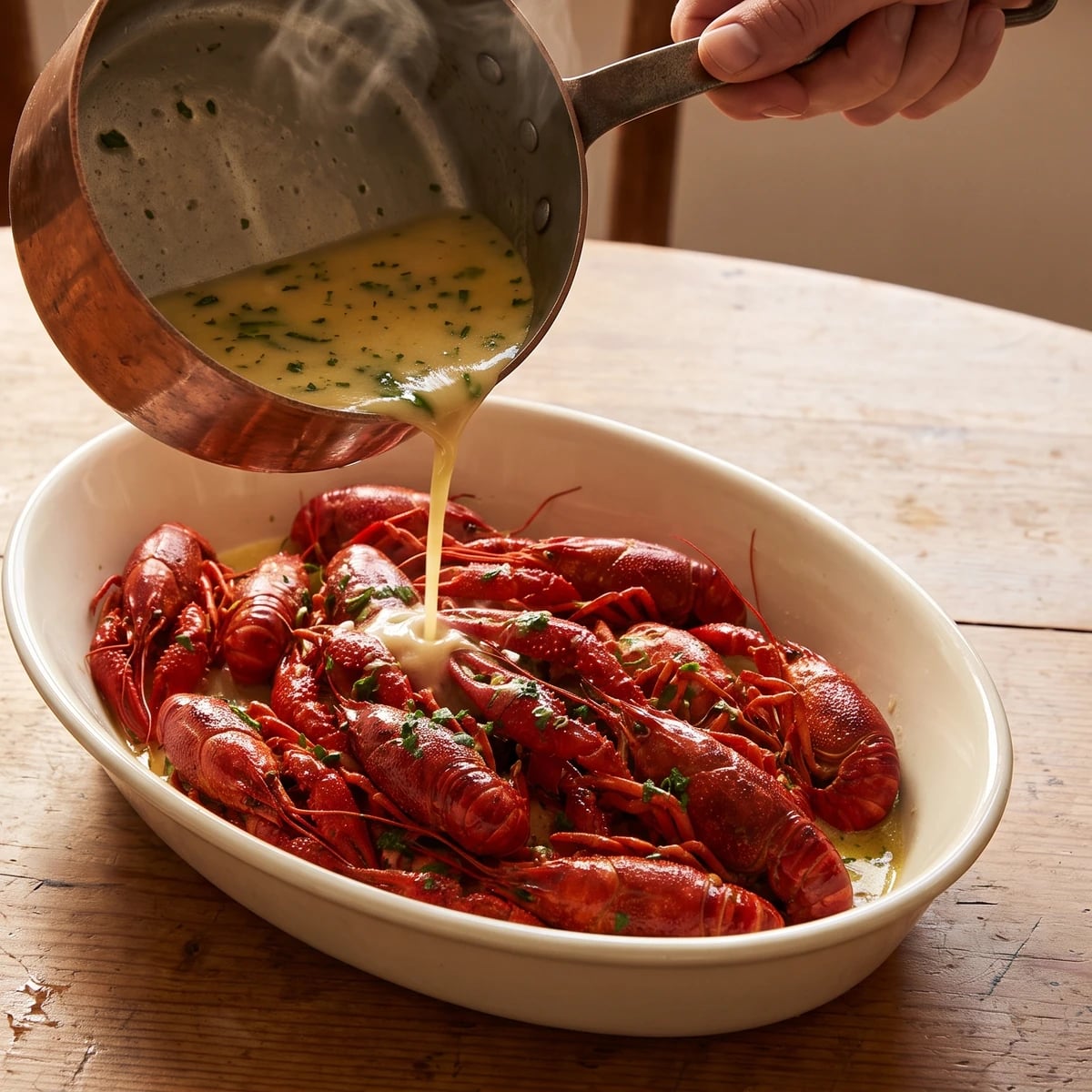
    Take the pan completely off the heat. Add the cold butter a few cubes at a time, swirling or whisking until each addition disappears before adding the next. The finished sauce should be pale gold, glossy, and fluid enough to run between the shells. Never let it boil after the butter enters. If oily beads gather at the edge, stop; whisk 1 teaspoon of cold water into a clear side of the pan until creamy, then draw the broken sauce into it gradually before adding the remaining butter. Taste for seasoning, pour the sauce over the crayfish, scatter with parsley, and serve at once. À table!

    A warm serving bowl protects the sauce without continuing to cook the crayfish. A blazing-hot vessel does the opposite, so warm it gently.

Chef Tips

  • Buy whole raw crayfish with intact shells. Pre-cooked frozen crayfish turn rubbery during the wine cook and contribute little to the cooking liquor; raw-frozen whole crayfish, thawed slowly in the refrigerator, are a much better substitute when live ones are unavailable.
  • Use a dry, unoaked white wine with bright acidity. The wine reduces hard, so sweetness and heavy oak become louder in the pan. Pour the same bottle at the table.
  • The Fish Velouté must be finished before the crayfish enter the pan. Keep small portions frozen if you cook from the canon often; a stockpot and a saucier on duty are unnecessary, but the real sauce foundation is not.
  • Do not peel the crayfish before serving. The shells protect the flesh during cooking and give the liquor its character. Set down a bowl for discarded shells, plenty of napkins, and bread for the sauce. Cooking well is not cooking fancy.
  • This dish waits for nobody. Once mounted with butter, the sauce loses its fine emulsion if held or reheated, so gather the guests before the final cubes go into the pan.

Advance Preparation

  • Prepare the Fish Velouté up to 2 days ahead and keep it covered in the refrigerator, or freeze a measured ¼-cup portion for a later dinner. Bring it out while organizing the other ingredients.
  • Chop the shallots and parsley, measure the wine and butter, and set the serving bowl several hours ahead. Keep each covered and chilled where appropriate.
  • Cook the crayfish only when everyone is ready to eat. The complete dish cannot be made ahead without toughening the flesh and dulling the butter emulsion.

Frequently Asked Questions

Nutrition Information

1 serving (about 155g)

Calories
290 calories
Total Fat
21 g
Saturated Fat
13 g
Trans Fat
1 g
Unsaturated Fat
7 g
Cholesterol
130 mg
Sodium
670 mg
Total Carbohydrates
8 g
Dietary Fiber
1 g
Sugars
3 g
Protein
11 g

Note: Chef personas and recipes are created with AI assistance. Cook with care: follow safe food-handling practices, check doneness with a thermometer when needed, and adapt for allergies and your kitchen.

Where cooking meets culture.

Culinary guides, cultural storytelling, and the editorial depth that makes cooking meaningful.

Discover Culinary Explorer

More from Fish - Lobster (Homard)

Browse the full collection