
Chef Juliette
John Dory (St. Pierre)
John Dory has the delicacy of sole and the firmness of turbot. A light flouring, a quick butter sauté, and nut-brown beurre noisette show exactly why looks never mattered.
A cooking platform built around craft, culture, and the stories behind what we eat.
Created by Chef Juliette
Based on No. 952, Soufflés de Homard, from Le Guide Culinaire (1907) by Auguste Escoffier
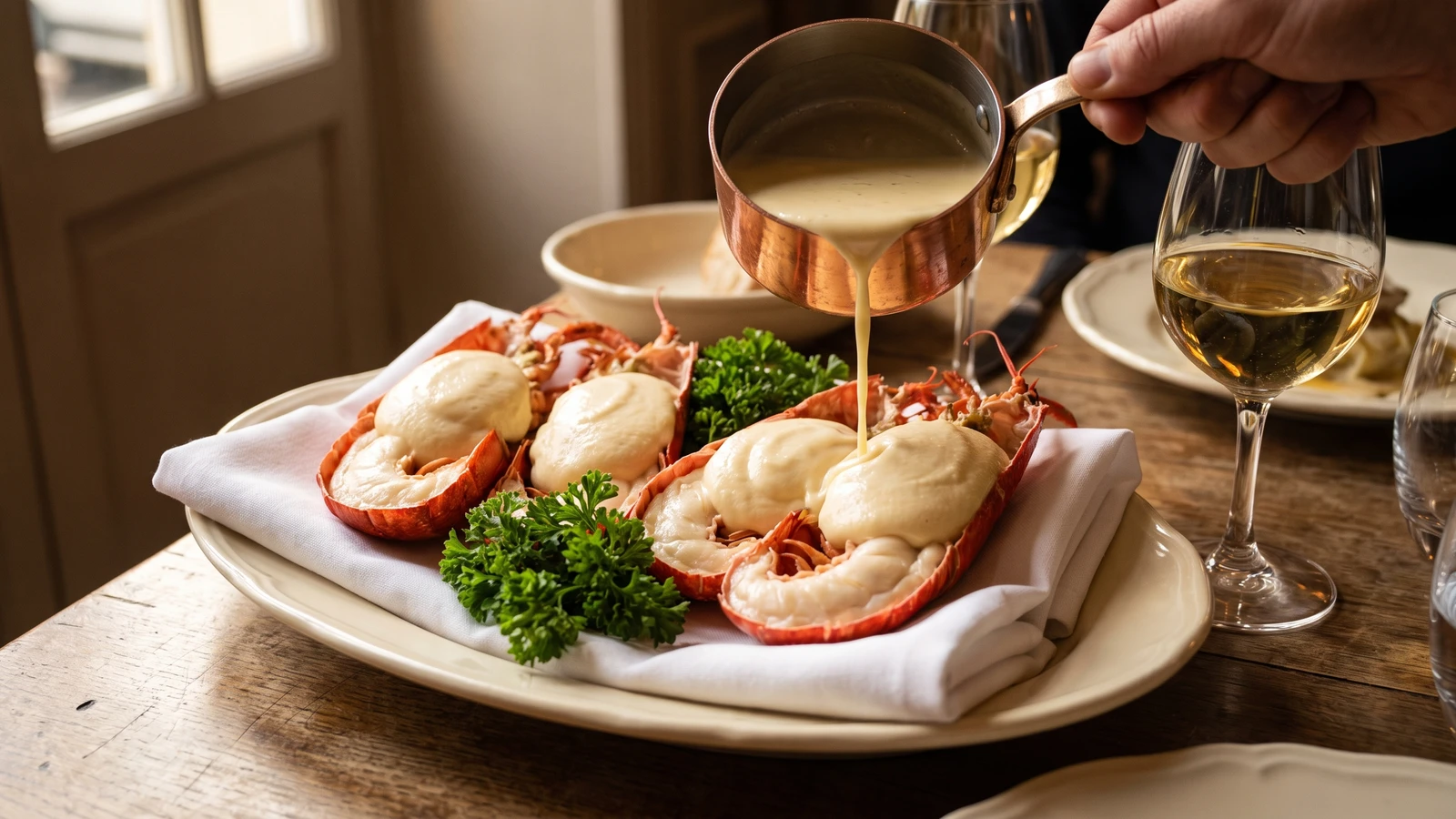
Soufflés de Homard rise by cold mousseline, gentle poaching, and a buttered paper collar, lobster-rich and tender in their own shells with glossy Sauce au Vin Blanc passed at the table.
Soufflés de Homard (lobster mousseline poached in the half-shell) teaches one discipline: cold before heat. The lobster, egg white, and cream must remain cold enough to bind into a mousseline, the fine cream-bound forcemeat at the heart of the dish. Once filled, the shells want gentle, even poaching. Let the mixture warm while you work and it becomes loose and grainy before it ever reaches the oven.
The original recipe assumed a fish station to empty and prepare the carapaces, a saucier tending the accompanying sauce, and fish stock never off the fire. A salamander, useful for gratins, has no role here because the mousseline must poach without browning. At home, a food processor replaces the mortar, a quick fond from the claw shells replaces the stockpot, and a moderate oven with a thin film of water replaces the dedicated poaching setup. The sieve, buttered paper collars, and gentle heat remain. Those aren't brigade scaffolding; they are the dish. One cook, one stove, one evening.
The model portion gives two half-carapaces. For four diners, two lobsters give four, while the proportions and poaching method remain intact. They emerge coral-shelled and ivory-topped, tender enough to yield beneath a spoon, with the glossy white-wine sauce served separately so every guest takes what pleases them. Before touching a pan, chill the processor bowl and make room for an ice bath. Keeping the mousseline cold is the step that decides everything.
Soufflés de homard belong to the Parisian classical service table, where fish forcemeats were molded back into their shells and carried from the fish station to the dining room. Despite the name, this is not the familiar egg-white soufflé baked in porcelain; it is lobster mousseline gently poached inside cooked half-carapaces, with a paper collar controlling its expansion. Normandy contributes Sauce Normande as one suitable accompaniment, but the dish itself is not Norman; White-wine, Diplomate, and Béchamel finished with lobster butter were equally at home beside it.
Quantity
2, about 1½ lb (680 g) each, yielding about 12 oz (340 g) raw meat
dispatched and split lengthwise; raw meat, 4 half-carapaces, and empty claw shells kept separately
Quantity
1 tablespoon (15 ml / 18 g)
Quantity
1 tablespoon (15 ml / 14 g)
Quantity
1 medium (about ¼ cup / 40 g)
thinly sliced
Quantity
¾ cup (180 ml / 180 g)
Quantity
2 cups (480 ml / 480 g)
Quantity
1 small sprig
Quantity
1
Quantity
1¼ teaspoons (6.25 ml / 7 g)
divided
Quantity
¼ teaspoon (1.25 ml / 0.6 g)
Quantity
2 (about ¼ cup / 60 ml / 60 g)
Quantity
1 cup (240 ml / 240 g)
very cold
Quantity
2 tablespoons (30 ml / 30 g)
very cold
Quantity
2 tablespoons (30 ml / 28 g)
softened
Quantity
¼ cup (60 ml / 60 g)
Quantity
¾ cup (180 ml / 180 g)
Quantity
4 tablespoons (60 ml / 56 g)
cold and cut into small cubes
Quantity
1 teaspoon (5 ml / 5 g)
Quantity
1 small bunch (about 2 loosely packed cups / 50 g)
washed and dried
| Ingredient | Quantity |
|---|---|
| uncooked cold-water lobstersdispatched and split lengthwise; raw meat, 4 half-carapaces, and empty claw shells kept separately | 2, about 1½ lb (680 g) each, yielding about 12 oz (340 g) raw meat |
| fine sea salt for cooking the half-carapaces | 1 tablespoon (15 ml / 18 g) |
| unsalted butter for the lobster fond | 1 tablespoon (15 ml / 14 g) |
| shallotthinly sliced | 1 medium (about ¼ cup / 40 g) |
| dry white wine | ¾ cup (180 ml / 180 g) |
| cold water | 2 cups (480 ml / 480 g) |
| thyme | 1 small sprig |
| bay leaf | 1 |
| fine sea salt for the mousseline and saucedivided | 1¼ teaspoons (6.25 ml / 7 g) |
| freshly ground white pepper | ¼ teaspoon (1.25 ml / 0.6 g) |
| pasteurized large egg whites | 2 (about ¼ cup / 60 ml / 60 g) |
| heavy cream for the mousselinevery cold | 1 cup (240 ml / 240 g) |
| heavy cream for adjusting the mousseline (optional)very cold | 2 tablespoons (30 ml / 30 g) |
| unsalted butter for the parchment collarssoftened | 2 tablespoons (30 ml / 28 g) |
| boiling water for the baking tray | ¼ cup (60 ml / 60 g) |
| heavy cream for the Sauce au Vin Blanc | ¾ cup (180 ml / 180 g) |
| unsalted butter for finishing the saucecold and cut into small cubes | 4 tablespoons (60 ml / 56 g) |
| fresh lemon juice | 1 teaspoon (5 ml / 5 g) |
| curled-leaf parsleywashed and dried | 1 small bunch (about 2 loosely packed cups / 50 g) |
Ask the fishmonger to dispatch the lobsters, split them lengthwise, remove and return all raw tail and claw meat, and preserve four long half-carapaces and the empty claw shells. Set the raw meat in a shallow bowl over ice. Clean the half-carapaces of gills and soft matter without scraping away the coral shell. Bring a wide pot of water to a quiet boil, add the 1 tablespoon of salt, and lower in the half-carapaces. Cook for 3 minutes at a gentle boil so they set without twisting. Drain them concave side down, then dry them thoroughly.
Crush the empty claw shells into several pieces. Melt 1 tablespoon of butter in a small saucepan over medium heat, add the shells and shallot, and cook for 3 to 4 minutes, stirring, until the shells turn vivid red and the butter smells distinctly of lobster. Add the white wine and boil until reduced by half. Pour in the cold water, add the thyme and bay leaf, and hold at a bare simmer for 20 minutes, skimming any grey froth. Strain the fond, the concentrated shell stock, pressing the shells lightly without grinding them through the sieve. Return it to the pan and reduce to 1 cup (240 ml). Reserve ¼ cup (60 ml) for adjusting the finished sauce.
Chill the food processor bowl and blade for 15 minutes. Cut the cold lobster meat into small pieces and weigh out about 12 ounces (340 g). Pulse it with 1 teaspoon of the divided salt and the white pepper until the paste becomes fine and tacky. Add the egg whites in two additions, processing only until each disappears. Force the paste through a fine-mesh sieve with a stiff spatula into a chilled bowl set over ice. The processor replaces the old mortar, but the sieve stays because it removes sinew and gives the mousseline its silk. Work the 1 cup of very cold cream into the paste in four additions, stirring firmly with a spatula until each is absorbed before adding the next. Keep the bowl over ice. If the paste loosens, turns shiny with fat, or loses its tack, stop immediately. Ça se rattrape: chill it over ice for 10 minutes, then work the remaining cream in one teaspoon at a time. Poach a teaspoonful in barely trembling water until opaque and firm, about 3 minutes. Taste it. If it seems rubbery, fold in 1 tablespoon of the optional cold cream and test again; if it spreads instead of holding, chill the bowl for another 15 minutes before retesting.
Heat the oven to 325°F (165°C). Divide the mousseline evenly among the four dry half-carapaces, about 5½ ounces (155 g) in each, and smooth the tops level with a damp spoon. Cut four doubled strips of sturdy baking parchment, each 3 inches (7.5 cm) wide and long enough to wrap around one shell. Butter the side that will face inward, wrap each strip snugly around its filled shell, and tie it with kitchen twine so the collar rises 1 inch (2.5 cm) above the shell. The collar isn't decoration. It keeps the expanding mousseline inside the carapace, exactly where it belongs.
Arrange the collared shells close together on a rimmed baking tray so they cannot tip. Pour the boiling water onto the tray, using only enough to wet its whole surface rather than making a deep water bath. Bake for 15 to 20 minutes without opening the oven during the first 12. The tops should be softly domed and resilient, the centres opaque and at least 145°F (63°C). If a centre remains loose, leave the collar in place and return that shell to the oven for 2 minutes at a time. Hard heat toughens the lobster and exaggerates the rise; gentle poaching gives tenderness without drama.
While the soufflés poach, combine ¾ cup (180 ml) of the reduced fond with the ¾ cup of cream and simmer until the Sauce au Vin Blanc, the white-wine sauce, coats the back of a spoon and a finger drawn through it leaves a clean path. Remove the pan from the heat. Monter au beurre, whisk in the cold butter, one cube at a time, until the sauce gleams. Add the lemon juice and the remaining ¼ teaspoon of salt, then taste. If it tightens, loosen it with reserved fond. If it separates into oily beads, put 1 tablespoon of cold fond in a clean bowl and whisk the broken sauce into it gradually. Hold the finished sauce over warm water, never over direct heat.
Lift the shells from the tray and tilt each carefully to drain any water caught underneath. Snip the twine and peel away the parchment without pressing the risen mousseline. Cradle the four shells on a folded white linen napkin set over a warmed oval platter, then surround them with small bunches of very green curled parsley. Pass the Sauce au Vin Blanc separately so the tops remain proud and every guest can spoon sauce around, rather than over, the soufflé. Serve at once. À table!
1 serving (about 230g)
Culinary guides, cultural storytelling, and the editorial depth that makes cooking meaningful.
Discover Culinary ExplorerChef Juliette
John Dory has the delicacy of sole and the firmness of turbot. A light flouring, a quick butter sauté, and nut-brown beurre noisette show exactly why looks never mattered.

Chef Juliette
Fresh haddock proves its delicacy in the meunière pan: a fine flour crust, moist pearly flakes, and beurre noisette sharpened with lemon and parsley, ready from one skillet in half an hour.

Chef Juliette
Éperlans à l’Anglaise turns small fish into a lesson in disciplined coating: boned smelts under a close, crisp crumb, pan-fried in clarified butter and finished with bright, half-melted maître d’hôtel butter.

Chef Juliette
Tiny smelts, shallot, mushrooms, white wine, gratin sauce, and fine bread raspings meet a fierce oven, where the fish must turn tender in the same breath the buttered crust bronzes.