Culinary Explorer

A cooking platform built around craft, culture, and the stories behind what we eat.
Discover Culinary Explorer
Homard Grillé

Homard Grillé

Created by Chef Juliette

Based on No. 946, Homard Grillé, from Le Guide Culinaire (1907) by Auguste Escoffier

Homard Grillé teaches restraint over the fire: a brief court-bouillon poach protects the flesh, butter carries the final heat, and sharp Devilled sauce Escoffier gives sweet lobster its proper counterpoint.

Main Dishes
French
Date Night
Romantic
Dinner Party
25 min
Active Time
30 min cook55 min total
Yield4 servings

Homard Grillé (grilled lobster) teaches a simple restraint: the grill is there to finish the lobster, not cook it from raw. Give it a three-parts poach in court-bouillon first, and the flesh stays pearly and tender while butter and fierce heat bronze the cut surface. Skip that protection and the outside tightens before the claws are properly hot.

The original kitchen assumed a court-bouillon pot already at hand, a saucier drawing from stock never off the fire, and a salamander waiting above the pass. At home, you need one wide pot, prepared Devilled sauce Escoffier warmed gently, and either a hot covered grill or the fiercest broiler your oven owns. Four small lobsters replace the brigade's open-ended service quantity because they poach evenly, split cleanly, and still fit one home grill. One cook, one stove, one evening.

The napkin-lined serving dish and elaborate curled-parsley border are service scaffolding, so a warm platter and a loose ring of parsley take their place. The three-parts poach, lengthwise split, melted butter, fierce final grilling, cracked claws, and sharp sauce are the dish, and they stay. Watch the center of the tail meat: it should still be translucent when you split it, because the grill gets the last word.

Homard grillé sits at the meeting point of Brittany's Atlantic lobster trade and the Paris dining-room repertoire, where coastal shellfish entered the classical family of grilled fish preparations. The three-parts court-bouillon poach is the telling refinement: raw lobster can tighten before its shell conducts enough heat, so the grill finishes the cooking rather than beginning it. Devilled sauce Escoffier supplies the traditional sharp, peppered counterpoint to the lobster's sweet flesh.

The technique, the tradition, and the story behind every dish.

Discover Culinary Explorer

Ingredients

live hard-shell North Atlantic lobsters

Quantity

4, each 1¼ pounds (570 g)

prepared court-bouillon

Quantity

4 quarts (3.8 L / about 3.8 kg)

unsalted butter

Quantity

8 tablespoons (120 ml / 115 g)

melted

prepared Devilled sauce Escoffier

Quantity

1½ cups (360 ml / about 375 g)

curly-leaf parsley

Quantity

1 small bunch (about 2 oz / 60 g)

washed and thoroughly dried

Equipment Needed

  • 10- to 12-quart stockpot with lid
  • Covered outdoor grill or broiler with a rimmed metal tray
  • Heavy chef's knife and nonslip cutting board
  • Long tongs and heatproof pastry brush
  • Lobster cracker or sturdy kitchen shears
  • Instant-read thermometer
  • Large warmed oval serving platter

Instructions

  1. 1

    Ready the heat

    Bring the prepared court-bouillon to a lively simmer in a 10- to 12-quart stockpot, then reserve a small cupful in a clean jug before the lobsters enter. Heat a covered grill for strong direct heat with a cooler zone beside it, about 475°F to 500°F (245°C to 260°C), and scrub the grate clean. For the broiler equivalent, set a rack about 6 inches (15 cm) from the element and heat it fully. Warm a large serving platter while you work.

  2. 2

    Poach three-parts

    Have the fishmonger dispatch the lobsters immediately before cooking, or chill them briefly until insensible and dispatch each decisively through the head with a heavy chef's knife. Lower two lobsters into the simmering court-bouillon, cover until the liquid returns to a simmer, then uncover and cook for 4 minutes. Lift them out and repeat with the remaining pair. The shells should be brightening, with the outer tail meat opaque but the core still translucent. If a lobster is already opaque through the center, shorten its final grilling to less than a minute; the poach has done more of the work, so the fire must do less.

  3. 3

    Split and clean

    Let each lobster rest for 2 to 3 minutes, only until it can be held safely through a folded towel. Set it flat on a nonslip board and split it lengthwise from head through tail with the heavy knife. Remove the gritty stomach sac from behind the head and pull away the intestinal vein; leave the coral and tomalley in place if sound and wanted. Keep the claws attached. Work promptly, because the residual heat is still cooking the flesh.

  4. 4

    Warm the sauce

    Put the prepared Devilled sauce Escoffier in a small saucepan over low heat and stir until evenly warm, never boiling. If it tightens beyond a spoonable consistency, whisk in the reserved court-bouillon a little at a time until it flows again. Ça se rattrape. Hold the sauce at the gentlest heat while the lobster meets the grill.

  5. 5

    Butter and grill

    Brush the split surfaces generously with melted butter, letting some run into the joints between tail and body. Set the halves shell-side down over direct heat, close the grill, and cook for about 3 minutes. Turn them cut-side down for only 30 to 60 seconds, just long enough to bronze the buttered surface. If the butter flares, move the halves immediately to the cooler zone rather than letting the flesh sit over flame. Under a broiler, arrange them cut-side up on a rimmed tray, brush with butter, and cook for 3 to 5 minutes without turning. Pull each half as soon as the flesh is pearly, just opaque, and 140°F to 142°F (60°C to 61°C) at the thickest part of the tail; the brief rest carries it toward 145°F (63°C).

  6. 6

    Crack and serve

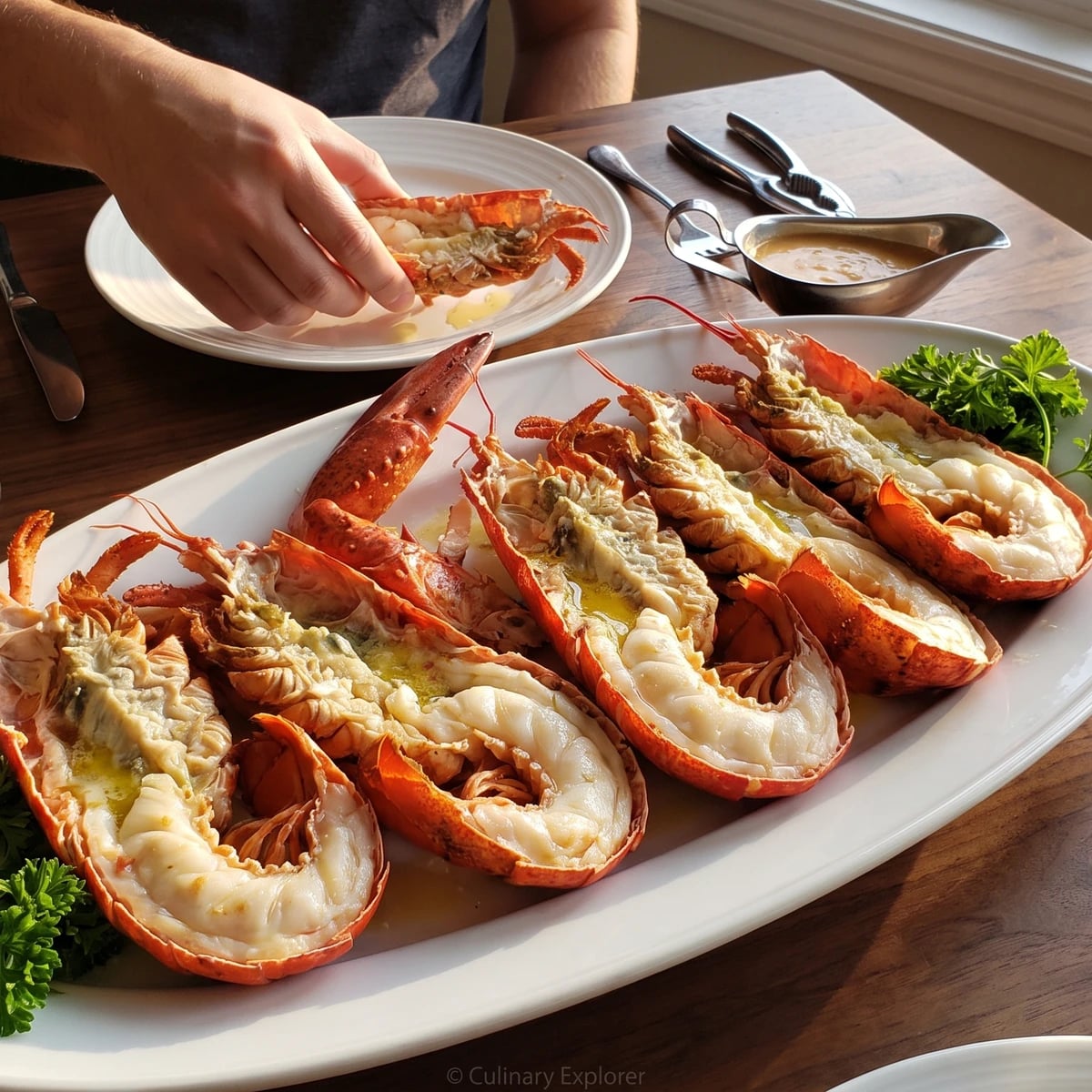
    Hold each hot claw in a folded towel and crack the shell once with a lobster cracker or the back of a heavy knife, opening a clean path to the meat without crushing it. Arrange the halves cut-side up on the warm platter, claws facing outward, and surround them loosely with the curly-leaf parsley. Bring the Devilled sauce Escoffier to the table in a warm sauceboat and serve it alongside, not poured over the bronzed buttered flesh. À table!

Chef Tips

  • Choose lively hard-shell cold-water lobsters of similar size, so they reach three-parts cooked together. European blue lobster is the traditional prize, but firm North Atlantic lobster carries the method honestly and is far easier to find.
  • The court-bouillon should taste seasoned and aromatic before the lobster enters. This first cooking protects the flesh; plain water cooks it, but contributes nothing.
  • The shell acts as a small roasting pan on the grill. Keep it underneath for most of the cooking, then give the cut face only a brief turn for color. Long exposure on the flesh side is how sweet lobster becomes firm and cottony.
  • Serve the Devilled sauce Escoffier beside the lobster so each guest controls the balance. A dry, bright white such as Muscadet Sèvre-et-Maine or Chablis has enough acidity for the sauce without bullying the shellfish.

Advance Preparation

  • Prepare the court-bouillon up to 2 days ahead, chill it promptly, and keep it covered in the refrigerator. Bring it back to a lively simmer before the lobsters enter.
  • The Devilled sauce Escoffier may be prepared earlier the same day and rewarmed over very low heat. If it has thickened while standing, loosen it with a spoonful of reserved court-bouillon.
  • Wash and dry the parsley, melt the butter, set the table, and ready the grill before dispatching the lobsters. Do not three-parts poach them hours ahead; the brief path from pot to grill is what keeps the flesh tender.

Frequently Asked Questions

Nutrition Information

1 serving (about 250g)

Calories
365 calories
Total Fat
27 g
Saturated Fat
16 g
Trans Fat
1 g
Unsaturated Fat
9 g
Cholesterol
235 mg
Sodium
1300 mg
Total Carbohydrates
7 g
Dietary Fiber
1 g
Sugars
2 g
Protein
25 g

Note: Chef personas and recipes are created with AI assistance. Cook with care: follow safe food-handling practices, check doneness with a thermometer when needed, and adapt for allergies and your kitchen.

Where cooking meets culture.

Culinary guides, cultural storytelling, and the editorial depth that makes cooking meaningful.

Discover Culinary Explorer

More from Fish - Lobster (Homard)

Browse the full collection