
Chef Juliette
John Dory (St. Pierre)
John Dory has the delicacy of sole and the firmness of turbot. A light flouring, a quick butter sauté, and nut-brown beurre noisette show exactly why looks never mattered.
A cooking platform built around craft, culture, and the stories behind what we eat.
Created by Chef Juliette
Based on No. 944, Homard Clarence, from Le Guide Culinaire (1907) by Auguste Escoffier
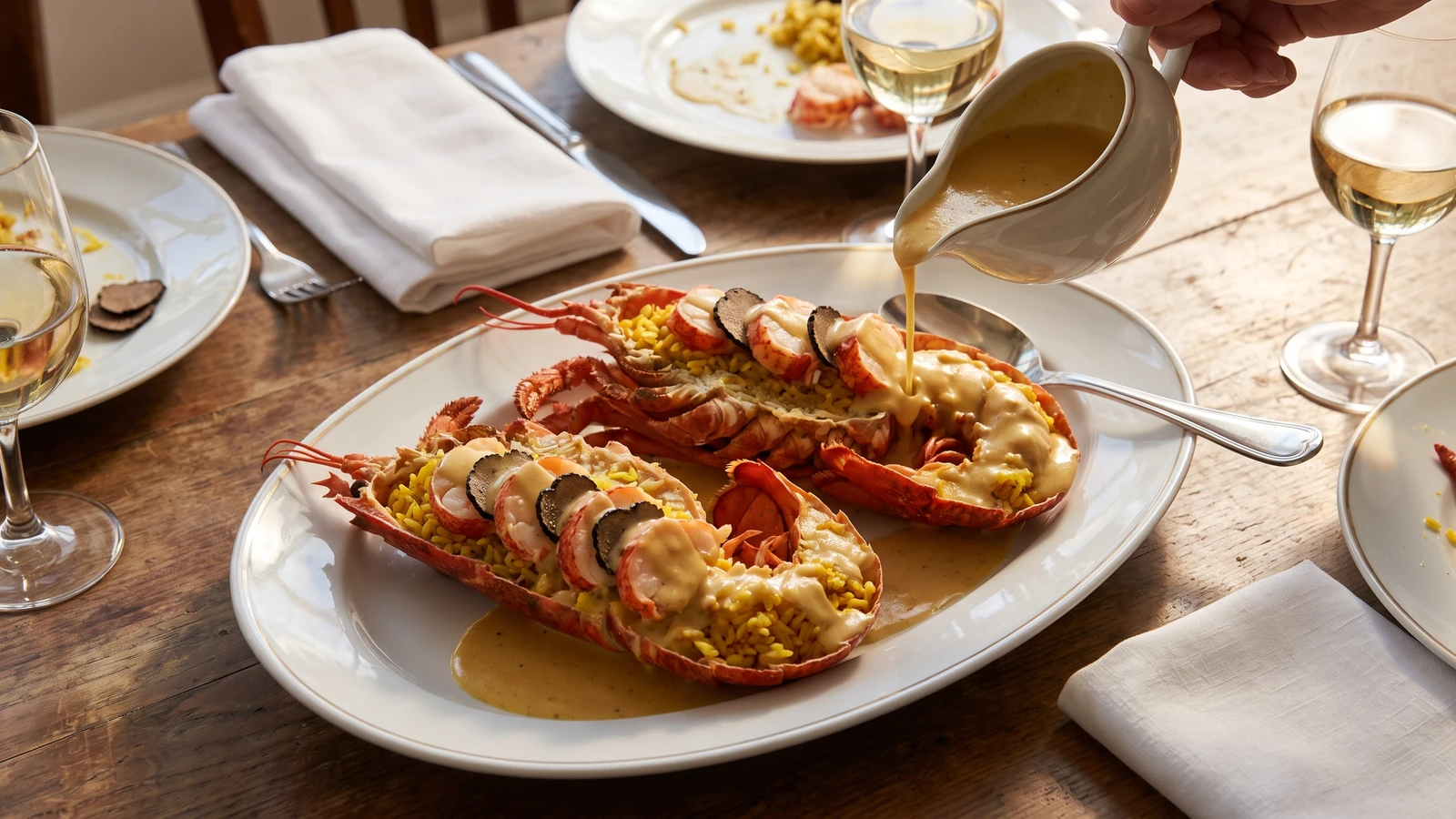
Lobster, warm curry, buttered rice, and truffle arranged in its own shell, with a creamy cullis folded into Béchamel and more sauce passed generously at the table.
Homard Clarence (lobster on rice à l’Indienne under curry-scented Béchamel) teaches one true thing: curry must warm the lobster, never bully it. The finished sauce should taste first of shellfish and cream, with the spice arriving afterward, fragrant and rounded. It veils the tail rather than burying it.
The original entry assumed court-bouillon ready on the range, a saucier holding Béchamel, fish fumet never far away, and another pair of hands pounding the body meat while the tail stayed hot in a vegetable-pan. Here, strained court-bouillon replaces the perpetual stockpot, one saucepan makes enough Béchamel for both cullis and sauceboat, and a small covered sauté pan holds the lobster. A food processor replaces the mortar, but the fine sieve stays. The mortar was brigade scaffolding; the smooth cullis is the dish. One cook, one stove, one evening.
No salamander is needed because Clarence is coated, not gratinéed. Keep the curry pale as it blooms in butter and cook the roux without browning. That gentle handling of the spice is the step that decides everything.
Homard Clarence belongs to the codified Parisian grande cuisine table rather than to a coastal regional repertoire. It joins poached lobster, rice à l’Indienne, curry, truffle, and Béchamel in the grand-kitchen manner, then returns the meat to its own shell and passes extra sauce separately. The source’s restraint matters: Clarence is coated, not browned under a salamander, so the dish depends on a supple cullis and warm spice rather than a gratin crust.
Quantity
1, about 3 pounds (1.35 kilograms)
or humanely dispatched immediately before cooking
Quantity
4 quarts (3.8 liters / 3.8 kilograms)
Quantity
2 cups (480 milliliters / 475 grams)
Quantity
1 medium (150 grams)
sliced
Quantity
1 medium (75 grams)
sliced
Quantity
1 stalk (50 grams)
sliced
Quantity
4 sprigs
Quantity
1
Quantity
1 teaspoon (5 milliliters / 3 grams)
Quantity
1/4 cup (60 milliliters / 72 grams)
Quantity
1 cup (240 milliliters / 190 grams)
rinsed and drained
Quantity
2 tablespoons (30 milliliters / 28 grams)
Quantity
1 small (30 grams)
finely chopped
Quantity
1/2 teaspoon (2.5 milliliters / 1 gram)
Quantity
1 1/2 cups (360 milliliters / 360 grams)
Quantity
3 tablespoons (45 milliliters / 42 grams)
Quantity
1/4 cup (60 milliliters / 32 grams)
Quantity
2 teaspoons (10 milliliters / 4 grams)
Quantity
2 1/2 cups (600 milliliters / 618 grams)
warmed
Quantity
1 teaspoon (5 milliliters / 6 grams), plus more to taste
Quantity
1/4 teaspoon (1.25 milliliters / 0.6 gram)
Quantity
2 tablespoons (30 milliliters / 30 grams)
Quantity
2 teaspoons (10 milliliters / 10 grams)
Quantity
1 small (25 grams)
fresh or preserved, drained and thinly sliced
| Ingredient | Quantity |
|---|---|
| live hard-shell lobsteror humanely dispatched immediately before cooking | 1, about 3 pounds (1.35 kilograms) |
| water | 4 quarts (3.8 liters / 3.8 kilograms) |
| dry white wine | 2 cups (480 milliliters / 475 grams) |
| yellow onionsliced | 1 medium (150 grams) |
| carrotsliced | 1 medium (75 grams) |
| celerysliced | 1 stalk (50 grams) |
| thyme | 4 sprigs |
| bay leaf | 1 |
| black peppercorns | 1 teaspoon (5 milliliters / 3 grams) |
| coarse sea salt | 1/4 cup (60 milliliters / 72 grams) |
| long-grain white rice, preferably basmatirinsed and drained | 1 cup (240 milliliters / 190 grams) |
| unsalted butter for the rice | 2 tablespoons (30 milliliters / 28 grams) |
| shallotfinely chopped | 1 small (30 grams) |
| mild Madras curry powder for the rice | 1/2 teaspoon (2.5 milliliters / 1 gram) |
| strained lobster court-bouillon | 1 1/2 cups (360 milliliters / 360 grams) |
| unsalted butter for the Béchamel | 3 tablespoons (45 milliliters / 42 grams) |
| plain flour | 1/4 cup (60 milliliters / 32 grams) |
| mild Madras curry powder for the Béchamel | 2 teaspoons (10 milliliters / 4 grams) |
| whole milkwarmed | 2 1/2 cups (600 milliliters / 618 grams) |
| fine sea salt | 1 teaspoon (5 milliliters / 6 grams), plus more to taste |
| ground white pepper | 1/4 teaspoon (1.25 milliliters / 0.6 gram) |
| heavy cream | 2 tablespoons (30 milliliters / 30 grams) |
| fish fumet or unsalted mushroom cooking liquor | 2 teaspoons (10 milliliters / 10 grams) |
| black trufflefresh or preserved, drained and thinly sliced | 1 small (25 grams) |
Combine the water, wine, onion, carrot, celery, thyme, bay leaf, peppercorns, and coarse salt in a stockpot broad enough to hold the lobster. Bring to a boil, then simmer uncovered for 20 minutes so the vegetables and wine season the liquid. Taste it. It should be distinctly savory and lightly wine-sharp, not as salty as seawater.
Return the court-bouillon to a full boil. Lower the lobster headfirst into the pot, cover, and let the liquid return to a boil, then reduce it to a steady simmer. Cook for 22 to 25 minutes, until the shell is bright red and the thickest tail meat reaches 140 to 145°F (60 to 63°C), opaque and just firm. Lift it out and drain immediately. Let it cool only until you can handle it, about 15 minutes. Lobster carried far beyond done cannot be made tender again, so judge the meat, not merely the clock.
Strain 1 1/2 cups of the hot court-bouillon. Melt the rice butter in a saucepan over medium-low heat, add the shallot, and cook without coloring for 2 minutes. Stir in the 1/2 teaspoon curry powder for 20 seconds, just until fragrant, then add the rice and turn every grain through the butter. Pour in the strained court-bouillon, bring to a simmer, cover tightly, and cook over the lowest heat for 15 minutes. Remove from the heat and rest, still covered, for 10 minutes before fluffing. If the rice is firm and dry, add 2 tablespoons of hot court-bouillon and cover for 5 minutes. If it is wet, spread it briefly on a warm tray. Ça se rattrape.
Melt the Béchamel butter over low heat. Add the 2 teaspoons curry powder and stir for 20 to 30 seconds, stopping while its perfume is warm and sweet. Do not let it darken. Stir in the flour and cook the roux for 2 minutes without browning, then add the warm milk a little at a time, whisking each addition smooth before the next. Add the fine salt and white pepper, bring to the gentlest simmer, and cook for 8 minutes, stirring along the pan floor, until the Béchamel lightly coats a spoon. If it lumps, take it off the heat, whisk firmly, and pass it through the fine sieve. If it tightens too far, whisk in warm milk a tablespoon at a time. Ça se rattrape.
Split the lukewarm lobster lengthwise with a heavy knife and keep both half-carapaces intact. Remove the tail meat in whole pieces and slice it crosswise into neat medallions about 3/8 inch (1 centimeter) thick. Crack the claws and pick all remaining meat. Remove and discard the stomach sac, feathery gills, intestinal vein, and any bitter dark matter. Reserve the coral and creamy parts, following local shellfish guidance concerning green tomalley. If tomalley is discouraged, omit only that green matter and continue with the body meat and coral. Pulse the remaining meat and permitted creamy parts with the heavy cream until finely pounded, then force the mixture through a fine sieve. The processor is the modern mortar; the sieve is not negotiable, because it gives the cullis its silk.
Measure 1 cup plus 3 tablespoons (285 milliliters) of the hot curry Béchamel into the sieved lobster mixture, matching the source’s half-pint proportion, and whisk gently until smooth. Warm it over low heat without boiling. The sauce should fall from the spoon in a broad ribbon and leave the lobster flavor in front of the curry. If it becomes grainy, take it off the heat and pass it once more through the sieve; if it is too thick to coat thinly, loosen it with a spoonful of warm milk.
Put the tail medallions in a small covered sauté pan with the fish fumet, a concentrated fish essence, or the mushroom cooking liquor. Set the pan over the lowest heat for 60 to 90 seconds, turning the pieces once, then take it off the heat and keep it covered. The liquid must glisten around the lobster, never boil. This is the home equivalent of the vegetable-pan that held the meat for service.
Warm the cleaned half-carapaces and a long oval serving platter in a very low oven, about 180°F (80°C), for 5 minutes. Fill each shell two-thirds full with rice à l’Indienne. Lay the warm lobster medallions over the rice, intercalating each piece with a thin slice of truffle. Coat everything lightly with the lobster cullis, leaving the shapes of the tail and truffle visible beneath the gleaming sauce. Set both shells snugly on the hot platter. Do not brown them. Homard Clarence wears a veil, not a crust.
Reheat the remaining curry Béchamel over low heat and pour it into a warmed sauceboat. If a skin has formed, whisk in a tablespoon of warm milk and strain it before serving. Carry the platter and sauceboat to the table together, giving each guest rice, tail, cullis, truffle, and another spoonful of Béchamel if they wish. À table!
1 serving (about 400g)
Culinary guides, cultural storytelling, and the editorial depth that makes cooking meaningful.
Discover Culinary ExplorerChef Juliette
John Dory has the delicacy of sole and the firmness of turbot. A light flouring, a quick butter sauté, and nut-brown beurre noisette show exactly why looks never mattered.

Chef Juliette
Fresh haddock proves its delicacy in the meunière pan: a fine flour crust, moist pearly flakes, and beurre noisette sharpened with lemon and parsley, ready from one skillet in half an hour.

Chef Juliette
Éperlans à l’Anglaise turns small fish into a lesson in disciplined coating: boned smelts under a close, crisp crumb, pan-fried in clarified butter and finished with bright, half-melted maître d’hôtel butter.

Chef Juliette
Tiny smelts, shallot, mushrooms, white wine, gratin sauce, and fine bread raspings meet a fierce oven, where the fish must turn tender in the same breath the buttered crust bronzes.