
Chef Juliette
Filets de Soles Américaine
Folded sole, barely poached in fumet, circles lobster beneath a gleaming brandy-and-tomato shellfish sauce. The sauce is the whole dish, and gentle heat is the lesson.
A cooking platform built around craft, culture, and the stories behind what we eat.
Created by Chef Juliette
Based on No. 930, Turbotin Daumont, from Le Guide Culinaire (1907) by Auguste Escoffier
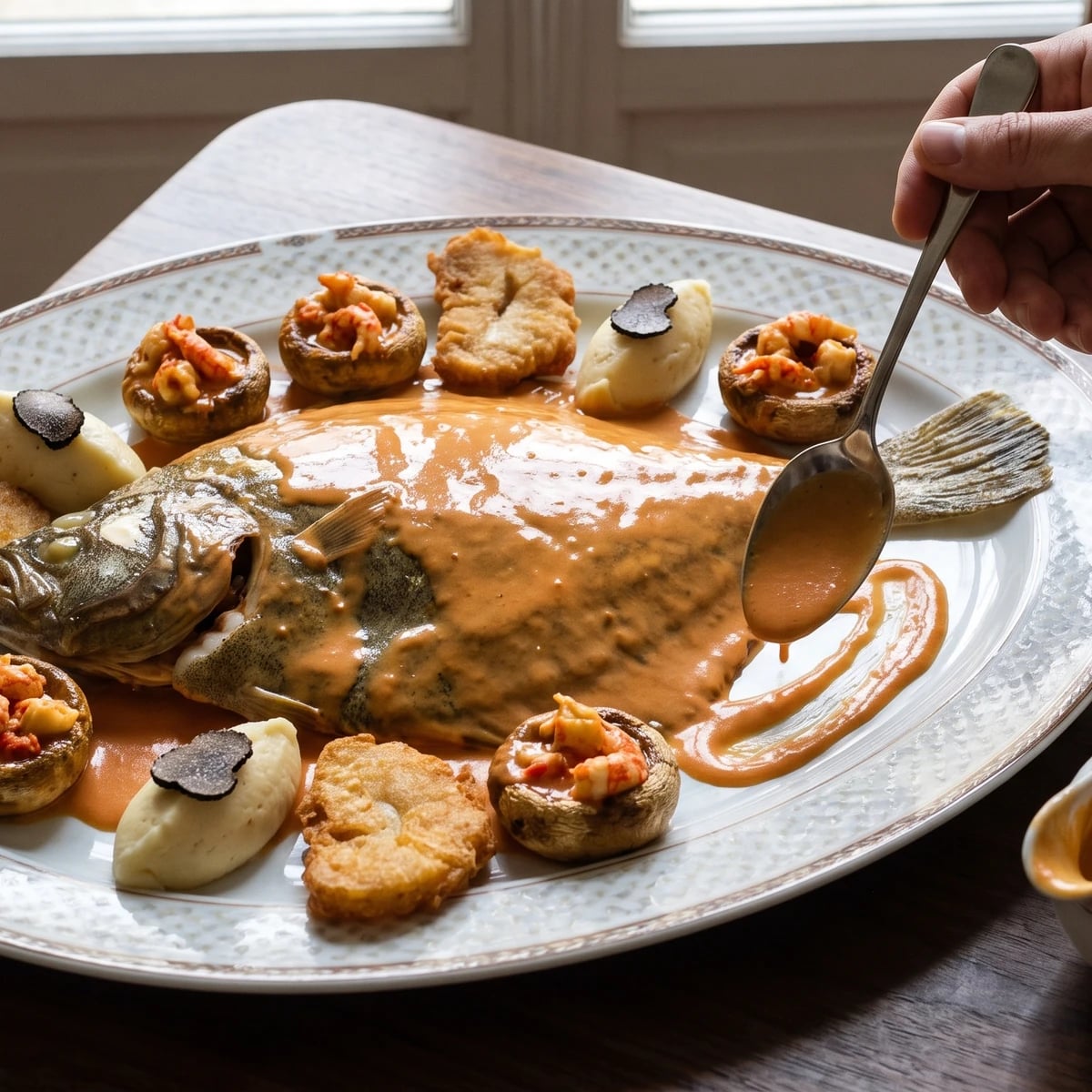
Turbotin Daumont restores a boned small turbot to its whole shape around crayfish-scented forcemeat, then surrounds it with glossy Nantua sauce, stuffed mushrooms, cream quenelles, and crisp milt.
Turbotin Daumont (small whole turbot, boned, stuffed, and garnished in the Daumont manner) teaches one of the grand kitchen's sharpest lessons: illusion depends on structure. The fish is opened from underneath, its frame removed, its cavity filled with crayfish-butter whiting forcemeat, then rebuilt until the dark side looks untouched. Keep the fish and forcemeat cold, fill lightly, and preserve that natural outline. If the shape is lost, sauce cannot give it back.
The original lived inside a brigade with a fish cook for boning, a saucier on staff, stock never off the fire, spare hands shaping four different garnishes, and a salamander ready whenever a sauce required glazing. At home, the removed frame makes a quick stock, one forcemeat becomes both stuffing and quenelles, and the reduced poaching liquor strengthens a compact Nantua sauce. The broiler stays off because this entry coats the fish rather than gratinating it. Separate stations were brigade scaffolding, so they go; the whole rebuilt fish, crayfish butter, Nantua sauce, and last-minute fried milt are the dish, so they stay. One cook, one stove, one evening.
The finished platter should be generous and unmistakable: the turbot's head and tail framing a natural diamond-shaped body beneath coral-ivory sauce, with buttered mushrooms carrying crayfish tails, pale quenelles capped in black truffle, and crisp golden milt around it. Eight pieces of each garnish replace the sole recipe's four because the larger fish and four-person table demand the increase. Before the turbot meets heat, turn it dark side up and judge its silhouette. If it looks whole then, it will arrive whole.
Turbotin Daumont belongs to the Parisian grand-kitchen repertoire, where a named garnish encoded an entire arrangement rather than one sauce or ingredient. Its Nantua sauce carries the crayfish tradition of Nantua in Bugey, where cooks built its characteristic coral richness from crushed shells and butter. That sauce does not make the whole preparation Bugey cooking; Daumont is a composed service pattern transferred from sole to a larger young turbot, with its sauce and surrounding garnishes increased accordingly.
Quantity
1, 2¼ to 2½ lb (1 to 1.15 kg), prepared according to Sole à la Daumont (No. 823)
gutted through the gill opening with head and tail attached
Quantity
16 medium
thawed if frozen, tails and shells separated
Quantity
½ cup (120 ml / 113 g)
Quantity
10 oz (285 g)
pin bones removed, cut into cubes, and thoroughly chilled
Quantity
1 large
very cold
Quantity
¾ cup (180 ml / 180 g)
very cold
Quantity
2 teaspoons (10 ml / 12 g)
divided
Quantity
¼ teaspoon (1 ml / 0.5 g)
Quantity
⅛ teaspoon (0.6 ml / 0.25 g)
divided
Quantity
2½ cups (600 ml / 600 g)
to make about 1½ cups stock from the removed turbot frame
Quantity
12 oz (340 g)
8 caps kept whole and the remaining mushrooms sliced
Quantity
1 cup (240 ml / 240 g)
Quantity
1 tablespoon (15 ml / 15 g)
Quantity
1 tablespoon (15 ml / 14 g)
Quantity
⅔ cup (160 ml / 160 g)
Quantity
3 tablespoons (45 ml / 42 g)
cut into small pieces
Quantity
3 tablespoons (45 ml / 24 g)
Quantity
3 tablespoons (45 ml / 42 g)
Quantity
¾ cup (180 ml / 180 g)
Quantity
1 small, about ½ oz (14 g)
cut into 8 thin rounds
Quantity
8 oz (225 g)
chilled and cut into 8 even slices
Quantity
¼ cup (60 ml / 30 g)
Quantity
1 large
beaten
Quantity
1 tablespoon (15 ml / 15 g)
Quantity
¾ cup (180 ml / 75 g)
Quantity
4 tablespoons (60 ml / 56 g)
for frying
Quantity
4 cups (960 ml / 960 g)
Quantity
2 tablespoons (30 ml / 28 g)
| Ingredient | Quantity |
|---|---|
| whole chicken-turbot (turbotin)gutted through the gill opening with head and tail attached | 1, 2¼ to 2½ lb (1 to 1.15 kg), prepared according to Sole à la Daumont (No. 823) |
| whole cooked shell-on crayfishthawed if frozen, tails and shells separated | 16 medium |
| unsalted butter for crayfish butter | ½ cup (120 ml / 113 g) |
| skinless whiting filletpin bones removed, cut into cubes, and thoroughly chilled | 10 oz (285 g) |
| egg whitevery cold | 1 large |
| heavy cream for the forcemeatvery cold | ¾ cup (180 ml / 180 g) |
| fine sea saltdivided | 2 teaspoons (10 ml / 12 g) |
| ground white pepper | ¼ teaspoon (1 ml / 0.5 g) |
| cayenne pepperdivided | ⅛ teaspoon (0.6 ml / 0.25 g) |
| cold water for quick fish stockto make about 1½ cups stock from the removed turbot frame | 2½ cups (600 ml / 600 g) |
| small white mushrooms8 caps kept whole and the remaining mushrooms sliced | 12 oz (340 g) |
| water for mushroom cooking liquor | 1 cup (240 ml / 240 g) |
| fresh lemon juice | 1 tablespoon (15 ml / 15 g) |
| unsalted butter for mushroom cooking liquor | 1 tablespoon (15 ml / 14 g) |
| dry white wine | ⅔ cup (160 ml / 160 g) |
| unsalted butter for poachingcut into small pieces | 3 tablespoons (45 ml / 42 g) |
| all-purpose flour for the roux | 3 tablespoons (45 ml / 24 g) |
| unsalted butter for the roux | 3 tablespoons (45 ml / 42 g) |
| heavy cream for Nantua sauce | ¾ cup (180 ml / 180 g) |
| preserved black trufflecut into 8 thin rounds | 1 small, about ½ oz (14 g) |
| cleaned carp or cod miltchilled and cut into 8 even slices | 8 oz (225 g) |
| all-purpose flour for the à l'anglaise coating | ¼ cup (60 ml / 30 g) |
| egg for the coatingbeaten | 1 large |
| cold water for the egg coating | 1 tablespoon (15 ml / 15 g) |
| fine fresh breadcrumbs | ¾ cup (180 ml / 75 g) |
| clarified butterfor frying | 4 tablespoons (60 ml / 56 g) |
| water for poaching the quenelles | 4 cups (960 ml / 960 g) |
| unsalted butter for the mushroom garnish | 2 tablespoons (30 ml / 28 g) |
Keep the fish on ice until the board is ready. Lay it pale side up and, following Sole à la Daumont (No. 823), make a neat lengthwise opening over the central ridge without cutting through the dark skin. Slide a flexible knife against the frame to release the flesh on both sides, snip the spine near the head and tail, then lift out the central frame while leaving the fillet ends attached at both extremities. Remove loose rib and pin bones, but preserve the head, tail, fin fringe, and natural outline. A fishmonger can do this through the underside if given those exact instructions.
Remove the gills from the frame, rinse away any blood, and put the bones into a narrow saucepan with the cold water. Bring it slowly to the barest simmer, skim once, and cook uncovered for 20 minutes without boiling. Strain through a fine sieve and reduce only if necessary to leave about 1½ cups (360 ml / 360 g). Reserve 1¼ cups for the sauce and hold the remainder for adjusting its consistency.
Remove the dark intestinal thread from each crayfish tail and refrigerate the tails. Crush the shells and heads coarsely in a sturdy food processor, the honest home equivalent of pounding them in a mortar. Melt the butter over low heat, add the shells, and cook very gently for 12 to 15 minutes, stirring often, until the butter is coral-red and smells distinctly of crayfish. Do not let the milk solids brown. Strain through a fine sieve, pressing firmly, and keep the butter barely warm.
Chill the processor bowl and blade for 10 minutes. Process the whiting with 1¼ teaspoons of the salt, the white pepper, and half the cayenne until smooth and tacky. Add the cold egg white, then pour in all but 2 tablespoons of the cold cream in a thin stream while pulsing. Pass the mixture through a fine sieve. Poach a teaspoonful in barely simmering water and taste it; the texture should be smooth, springy, and moist. If it turns coarse or leaks liquid, the mixture became warm. Ça se rattrape: chill it for 10 minutes, then pulse in the reserved cream one teaspoon at a time. Reserve about 1 cup (240 ml / 190 g) of plain cream forcemeat for the quenelles, then fold 2 tablespoons (30 ml / 28 g) of crayfish butter into the remainder.
Season the turbot cavity lightly, then spread in the crayfish-butter forcemeat without packing it hard; the mixture expands as it poaches. Fold the flesh back over the filling and close the underside with short wooden picks and two loose loops of kitchen twine. Turn the fish dark side up and restore the broad diamond outline required by Sole à la Daumont (No. 823). If a small tear opens underneath, lay buttered parchment over it during poaching and plate that side down. The damage is hidden, the structure remains sound.
Put the whole mushroom caps and sliced mushrooms into a wide pan with the water, lemon juice, mushroom-cooking butter, and a pinch of salt. Cover with a parchment round and simmer gently for 7 to 9 minutes, until the caps are tender but retain their shape. Lift out the 8 caps and reserve them. Strain the cuisson, the mushroom cooking liquor, and measure ⅔ cup (160 ml / 160 g). If there is too much, reduce it; if there is too little, add enough water to restore the measure.
Melt the roux butter in a saucepan, stir in the flour, and cook for 2 minutes without allowing it to colour. This roux, flour cooked in butter, gives the sauce its quiet body. Whisk in the 1¼ cups of quick fish stock gradually, then add all but 2 tablespoons of the sauce cream. Simmer gently for 8 minutes, whisking occasionally, until the base lightly coats the back of a spoon. Reserve the remaining cold cream for the final emulsion and keep the sauce base warm.
Heat the oven to 350°F (180°C). Butter a shallow oval roasting dish lightly with one piece of the poaching butter and lay in the turbotin dark side up. Pour the white wine and measured mushroom liquor around it, dot the remaining butter over the fish, and cover closely with buttered parchment and foil. Poach for 28 to 35 minutes, until the fish yields gently at its thickest point and the centre of the stuffing reaches 145°F (63°C). The liquid should tremble, never boil, because hard heat squeezes moisture from both fish and forcemeat.
While the turbotin cooks, bring the quenelle water and a pinch of salt to a bare tremble. Shape the reserved cream forcemeat into 8 small rounds with two wet teaspoons, lowering each directly into the water. Poach for 5 to 7 minutes, turning once, until they float, feel softly springy, and reach 145°F (63°C) at the centre. Lift them onto a buttered plate, cover, and keep warm.
Transfer the cooked turbotin carefully to a warmed oval platter and cover it loosely with its parchment. Strain the poaching liquor into a clean saucepan and reduce at a brisk simmer to ⅔ cup (160 ml / 160 g), about 6 to 8 minutes. Whisk it gradually into the warm sauce base, simmer for 2 minutes, then remove the pan from the heat and whisk in 3 tablespoons (45 ml / 42 g) of crayfish butter. The sauce should be coral-ivory, glossy, and fluid enough to coat the fish. If orange fat beads appear, set the pan over cool water and whisk in the reserved cold cream a teaspoon at a time. Ça se rattrape. If the sauce is too tight, loosen it with the reserved stock; do not boil it after the crayfish butter goes in.
Warm the mushroom caps gently in the garnish butter until glazed, without browning them. Spoon a little Nantua sauce into each cap and arrange 2 crayfish tails over it. Set one truffle round on each warm quenelle. For the milt à l'anglaise, meaning floured, egged, and breadcrumbed, season the slices, coat them first in flour, then in the egg beaten with water, and finally in breadcrumbs. Fry them at the last moment in clarified butter over medium heat for 2 to 3 minutes per side, until crisp and deep gold outside and opaque at the centre.
Remove every pick and length of twine from the turbotin. Coat the fish generously with Nantua sauce while leaving the head and tail visible, then arrange the crayfish-filled mushrooms, truffle-topped quenelles, and fried milt in alternating groups around it. Serve the remaining sauce in a warmed sauceboat. Bring the platter to the table immediately. À table!
1 serving (about 600g)
Culinary guides, cultural storytelling, and the editorial depth that makes cooking meaningful.
Discover Culinary Explorer
Chef Juliette
Folded sole, barely poached in fumet, circles lobster beneath a gleaming brandy-and-tomato shellfish sauce. The sauce is the whole dish, and gentle heat is the lesson.

Chef Juliette
A fine à l'anglaise crust, set the instant it touches hot clarified butter, protects tender sole before maître-d'hôtel butter melts across the ridges. The lesson is heat first, gentle frying second.

Chef Juliette
Pepper-filled sole paupiettes rise over butter-stewed tomatoes, capsicum risotto, and crisp aubergine, all glossed with lightly browned butter. The lesson is control: keep every element distinct and never let the poach boil.

Chef Juliette
Filets de Soles Caprice turns restraint into surprise: fine-crumbed sole grilled light gold, buttered banana laid over each fillet, and mustard-bright Sauce Robert sent separately so every bite balances sweet, savory, and sharp.