
Chef Juliette
John Dory (St. Pierre)
John Dory has the delicacy of sole and the firmness of turbot. A light flouring, a quick butter sauté, and nut-brown beurre noisette show exactly why looks never mattered.
A cooking platform built around craft, culture, and the stories behind what we eat.
Created by Chef Juliette
Based on No. 928, Turbotin Bonne Femme, from Le Guide Culinaire (1907) by Auguste Escoffier
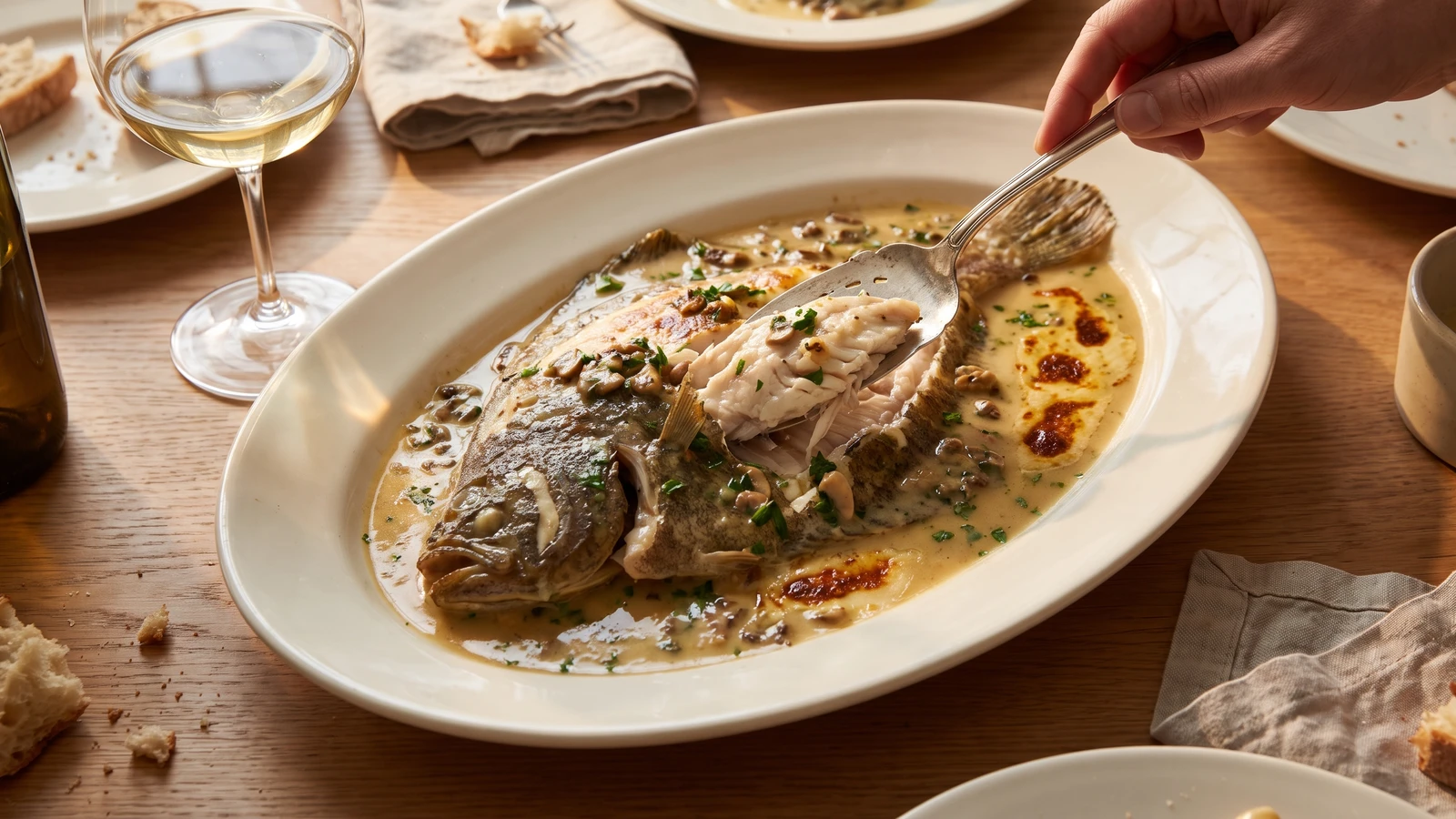
A whole turbotin bakes gently in wine and fumet, then its cooking liquor becomes a mushroom-studded, butter-glossed sauce: the classical lesson that nothing flavorful in the pan is ever wasted.
Turbotin Bonne Femme (small turbot baked with mushrooms, wine, and a butter-glazed sauce) teaches one true thing: the cooking liquor is not runoff, it is the sauce. Baste the fish with it while the flesh cooks on the bone, then reduce it, give it body with fish velouté, and finish it with butter until it gleams. C'est la même grammaire: fumet, reduction, velouté, emulsion.
The book's kitchen assumed a saucier on staff, fish fumet and velouté ready at hand, a hot holding place, and a salamander for the final glaze. At home, one shallow baking dish, one small saucepan, a warm platter, and the broiler do those jobs in sequence. The source's two to two-and-one-half-pound turbotin is already right for four, so its proportions remain intact; what disappears is brigade scaffolding, not technique. One cook, one stove, one evening.
The incision beside the backbone, frequent basting, reduction by half, butter finish, and quick glaze are the dish and must stay. The step that decides everything is the reduction: stop at half before the butter enters, or the sauce will be either watery or harsh. If the emulsion breaks, ça se rattrape, and the method gives you the way back.
Bonne femme, literally "good wife," belongs less to one province than to French cuisine bourgeoise and the Parisian classical table, where the term signaled direct, home-minded cooking rather than one universal sauce. For fish, it traveled into the grand repertoire as a shallow poach with shallot, mushrooms, wine, and fumet, followed by a sauce made from the cooking liquor itself. Despite a common assumption, bonne femme does not always mean cream; this turbotin gets its ivory richness from fish velouté and butter, not Normandy's cream larder.
Quantity
1 fish, 2 to 2½ lb (900 g to 1.1 kg)
cleaned, with gills and viscera removed and fringe fins trimmed
Quantity
2 teaspoons (10 ml / 12 g)
finely chopped
Quantity
1 teaspoon (5 ml / 1 g)
concassé (roughly chopped)
Quantity
1¼ cups (300 ml / 85 g)
finely minced
Quantity
¾ cup plus 2 teaspoons (190 ml / 188 g)
Quantity
¾ cup plus 2 teaspoons (190 ml / 190 g)
Quantity
3 tablespoons (45 ml / about 50 g)
Quantity
6 tablespoons plus 1 teaspoon (95 ml / 90 g)
divided, with the sauce butter cut into small pieces
Quantity
1 teaspoon (5 ml / 6 g)
divided
| Ingredient | Quantity |
|---|---|
| whole small turbotcleaned, with gills and viscera removed and fringe fins trimmed | 1 fish, 2 to 2½ lb (900 g to 1.1 kg) |
| shallotfinely chopped | 2 teaspoons (10 ml / 12 g) |
| flat-leaf parsleyconcassé (roughly chopped) | 1 teaspoon (5 ml / 1 g) |
| button mushroomsfinely minced | 1¼ cups (300 ml / 85 g) |
| dry white wine | ¾ cup plus 2 teaspoons (190 ml / 188 g) |
| fish fumet (concentrated fish stock) | ¾ cup plus 2 teaspoons (190 ml / 190 g) |
| prepared fish velouté | 3 tablespoons (45 ml / about 50 g) |
| cold unsalted butterdivided, with the sauce butter cut into small pieces | 6 tablespoons plus 1 teaspoon (95 ml / 90 g) |
| fine sea saltdivided | 1 teaspoon (5 ml / 6 g) |
Heat the oven to 350°F (180°C) with a rack in the center. Use 1 teaspoon (5 ml / 5 g) of the butter to coat a shallow baking dish just large enough to hold the turbotin without bending it. Have the fish velouté ready, cut the remaining 6 tablespoons (90 ml / 85 g) butter into small cold pieces, and set an oval serving platter nearby. Once the fish is cooked, the sauce moves quickly.
Dry the turbotin thoroughly and lay it dark side up. With a flexible knife, make one lengthwise cut directly over the backbone from the head end toward the tail. Angle the blade against the ribs and partly release the two upper fillets for about 1 inch (2.5 cm) on either side of the cut, leaving them attached to the bone and skin. This opening lets the cooking liquor reach the thickest flesh and makes the finished fish easier to serve. Season the fish with about half the salt.
Scatter the chopped shallot, parsley concassé, and minced mushrooms evenly across the buttered dish. Set the turbotin over them, dark side up, then pour the white wine and fish fumet around the fish rather than washing them over its surface. The liquid should surround the lower part of the fish without covering it; this is a shallow cook, not a boil.
Bake uncovered for 25 to 35 minutes, basting the upper surface and the opening beside the backbone every 5 minutes with the wine and fumet from the dish. Keep the liquid at a gentle tremble. If it begins boiling hard, lower the oven by 25°F (15°C); fierce heat tightens turbot before its thick center cooks. The fish is ready when the flesh beside the backbone has turned opaque, remains moist, and releases cleanly from the bone. An instant-read thermometer in the thickest flesh should approach 140°F (60°C), with the resting heat carrying it close to 145°F (63°C).
Lift the turbotin carefully onto the warm platter, keeping it whole, and cover it loosely with parchment or foil. Pour the cooking liquor, mushrooms, shallot, and parsley into a small saucepan. Note its depth, bring it to a brisk but controlled boil, and reduce it to exactly half its volume, usually 6 to 10 minutes. Taste near the end. It should be concentrated and savory, not aggressively salty; if it has become too salty before reaching half, add 2 tablespoons (30 ml / 30 g) water and reduce only until the flavor is balanced. Heat the broiler while the liquor reduces.
Whisk the prepared fish velouté into the reduced cooking liquor and simmer for 1 to 2 minutes, until the sauce lightly coats the back of a spoon. Remove the pan from the heat and monter au beurre (whisk in cold butter), adding the 6 tablespoons of butter one small piece at a time until the sauce is smooth, ivory-colored, and glossy. Do not boil once the butter enters. If the sauce separates into oily streaks, stop. Ça se rattrape: put 1 tablespoon (15 ml / 15 g) cold fumet or water in a clean saucepan, then whisk in the broken sauce a spoonful at a time over the lowest heat until it comes together. Taste and add only as much of the remaining salt as the sauce needs.
Spoon the sauce and its mushroom garnish over the turbotin, letting it settle into the opening beside the backbone. Place the platter about 6 inches (15 cm) below the hot broiler for 30 to 60 seconds, just until the glaze shines and takes the faintest color at its highest points. The salamander's work lasted seconds, and so should the broiler's; if the surface is not coloring promptly, take the fish out rather than cooking it again. Serve at once, spooning the sauce around each fillet. À table!
1 serving (about 170g)
Culinary guides, cultural storytelling, and the editorial depth that makes cooking meaningful.
Discover Culinary ExplorerChef Juliette
John Dory has the delicacy of sole and the firmness of turbot. A light flouring, a quick butter sauté, and nut-brown beurre noisette show exactly why looks never mattered.

Chef Juliette
Fresh haddock proves its delicacy in the meunière pan: a fine flour crust, moist pearly flakes, and beurre noisette sharpened with lemon and parsley, ready from one skillet in half an hour.

Chef Juliette
Éperlans à l’Anglaise turns small fish into a lesson in disciplined coating: boned smelts under a close, crisp crumb, pan-fried in clarified butter and finished with bright, half-melted maître d’hôtel butter.

Chef Juliette
Tiny smelts, shallot, mushrooms, white wine, gratin sauce, and fine bread raspings meet a fierce oven, where the fish must turn tender in the same breath the buttered crust bronzes.