
Chef Juliette
John Dory (St. Pierre)
John Dory has the delicacy of sole and the firmness of turbot. A light flouring, a quick butter sauté, and nut-brown beurre noisette show exactly why looks never mattered.
A cooking platform built around craft, culture, and the stories behind what we eat.
Created by Chef Juliette
Based on No. 926, Turbotin à l’Amiral, from Le Guide Culinaire (1907) by Auguste Escoffier
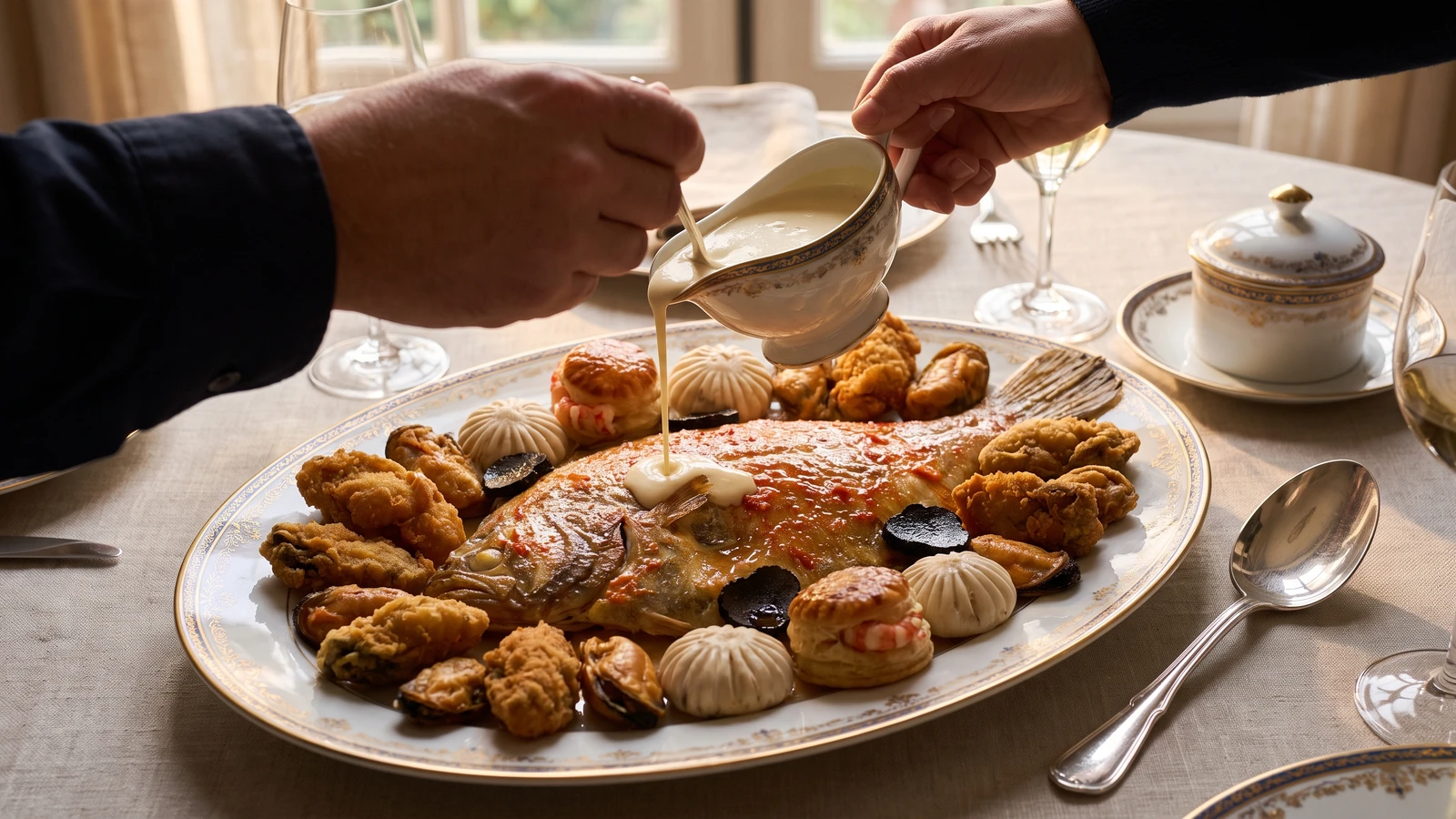
Whole turbot gleaming with crayfish butter, a ring of crisp Villeroy shellfish, puff-pastry cases, fluted mushrooms, and truffle: the grand garnish translated for one cook without surrendering its ceremony.
Turbotin à l’Amiral (young turbot in the Admiral’s manner) teaches orchestration. The fish itself asks only for a fragrant court-bouillon and gentle timing; the real work is arranging several small preparations so they arrive hot, crisp, and sauced together. One true thing governs the evening: every garnish must be ready before the turbot enters its poaching liquor.
The grand kitchen assumed a saucier on staff, stock never off the fire, a pastry hand, a fish kettle fitted with its grill, and a wall of heat that kept even the salamander ready. Your kitchen offers a snug roasting pan with a rack, one saucepan used in sequence, an ordinary oven, and bought all-butter puff pastry. Making pastry and maintaining several stocks were brigade scaffolding, so they can go. The Sauterne court-bouillon, shellfish à la Villeroy, twice-brushed beurre d’écrevisse, truffle, and exact measure of reduced poaching liquor in the sauce Normande are the dish, so they stay.
Finished properly, the whole fish gleams under coral-red butter while fried oysters and mussels give way beneath the teeth to creamy centres; crayfish patties, fluted mushrooms, and dark truffle complete the ring. It is generous, ceremonial food, but it remains possible for one cook, one stove, one evening. Before the fish meets the hot court-bouillon, line up the warm platter, garnishes, fryer, sauce base, and potatoes. That readiness decides everything.
Turbotin à l’Amiral belongs to Parisian grand cuisine, where the title à l’Amiral signaled a naval abundance of shellfish arranged around a whole fish rather than a recipe native to one coast. The Sauterne poach brought Bordeaux wine into that formal repertoire, while sauce Normande contributed Normandy’s grammar of fish stock, oysters, mussels, mushrooms, cream, and butter. Its Norman sauce should not be mistaken for a Norman origin; this is a Parisian composition built from distinct regional preparations.
Quantity
1 whole, 2½ lb (1.1 kg)
cleaned, head on and fins trimmed
Quantity
3 cups plus 2 tablespoons (750 ml / 740 g)
Quantity
3 cups (710 ml / 710 g)
plus more only if needed to cover the fish
Quantity
1 medium, about 7 oz (200 g)
sliced
Quantity
1 medium, about 4 oz (115 g)
sliced
Quantity
1
Quantity
2 teaspoons (10 ml / 12 g)
plus more for the potatoes
Quantity
1 teaspoon (5 ml / 3 g)
Quantity
12, about 1¼ lb (570 g)
tails and shells separated
Quantity
¾ cup (180 ml / 170 g)
Quantity
8
shucked with their liquor reserved
Quantity
12
scrubbed and debearded
Quantity
2 cups (475 ml / 475 g)
divided
Quantity
6 tablespoons (90 ml / 85 g)
divided
Quantity
1¼ cups (300 ml / 150 g)
divided
Quantity
1 cup (240 ml / 240 g)
divided
Quantity
2
Quantity
1 sheet, about 9 oz (255 g)
kept cold
Quantity
3
beaten and divided
Quantity
1½ cups (360 ml / 150 g)
Quantity
4 cups (950 ml / 870 g)
Quantity
8, about 8 oz (225 g)
caps and stems separated
Quantity
1, about 4 oz (115 g)
juiced
Quantity
1 small, about ¾ oz (20 g)
thinly sliced
Quantity
1½ lb (680 g)
peeled
Quantity
⅛ teaspoon (0.6 ml / 0.3 g)
Quantity
¼ teaspoon (1.25 ml / 0.6 g)
| Ingredient | Quantity |
|---|---|
| whole young turbotcleaned, head on and fins trimmed | 1 whole, 2½ lb (1.1 kg) |
| Sauterne wine, preferably Sauternes or Barsac | 3 cups plus 2 tablespoons (750 ml / 740 g) |
| waterplus more only if needed to cover the fish | 3 cups (710 ml / 710 g) |
| yellow onionsliced | 1 medium, about 7 oz (200 g) |
| carrotsliced | 1 medium, about 4 oz (115 g) |
| bouquet garni of parsley stems, thyme, and bay | 1 |
| fine sea saltplus more for the potatoes | 2 teaspoons (10 ml / 12 g) |
| black peppercorns | 1 teaspoon (5 ml / 3 g) |
| cooked whole crayfishtails and shells separated | 12, about 1¼ lb (570 g) |
| unsalted butter for beurre d’écrevisse | ¾ cup (180 ml / 170 g) |
| large oystersshucked with their liquor reserved | 8 |
| large musselsscrubbed and debearded | 12 |
| unsalted fish stockdivided | 2 cups (475 ml / 475 g) |
| additional unsalted butterdivided | 6 tablespoons (90 ml / 85 g) |
| all-purpose flourdivided | 1¼ cups (300 ml / 150 g) |
| heavy creamdivided | 1 cup (240 ml / 240 g) |
| large egg yolks | 2 |
| all-butter puff pastrykept cold | 1 sheet, about 9 oz (255 g) |
| large eggsbeaten and divided | 3 |
| fine dry breadcrumbs | 1½ cups (360 ml / 150 g) |
| neutral frying oil | 4 cups (950 ml / 870 g) |
| large white mushroomscaps and stems separated | 8, about 8 oz (225 g) |
| lemonjuiced | 1, about 4 oz (115 g) |
| black trufflethinly sliced | 1 small, about ¾ oz (20 g) |
| small waxy potatoespeeled | 1½ lb (680 g) |
| cayenne pepper | ⅛ teaspoon (0.6 ml / 0.3 g) |
| ground white pepper | ¼ teaspoon (1.25 ml / 0.6 g) |
Put the Sauterne, water, onion, carrot, reserved mushroom stems, bouquet garni, salt, and peppercorns in a wide pot. Bring them slowly to a simmer and cook for 20 minutes, then strain. The court-bouillon must be cooked before it touches the turbot, just as the source directs; otherwise the vegetables remain raw while the delicate fish is already done. Reserve 1 cup (240 ml) for the shellfish and mushrooms, then keep the rest ready for poaching.
Chill the crayfish tails for the patties. Crush the shells and heads coarsely, put them in a small saucepan with the ¾ cup butter, and cook over very gentle heat for 15 to 20 minutes, pressing the shells occasionally. The butter should turn coral-red and smell distinctly of crayfish without browning. Strain it through a fine sieve lined with damp cheesecloth and press firmly; this is beurre d’écrevisse, the red crayfish butter used both on the fish and in the sauce Normande. If the colour is pale, return the shells and butter to low heat for another 5 minutes. Do not scorch it in pursuit of red.
Bring ¾ cup (180 ml) of the reserved court-bouillon to a lively simmer in a covered saucepan. Add the mussels, cover, and remove each one as it opens, discarding any that remain closed. Slip the oysters into the same liquid for 30 to 45 seconds, just until their edges begin to curl, then lift them out. Strain all the cooking liquor together with the reserved oyster liquor through a fine sieve and measure 1 cup (240 ml); if it is sandy, strain it again. Remove the mussels from their shells and dry both kinds of shellfish thoroughly.
Melt 3 tablespoons of the additional butter and stir in ⅓ cup (40 g) of the flour. Cook this white roux for 2 minutes without colouring it, then whisk in ¾ cup (180 ml) fish stock and ½ cup (120 ml) strained shellfish liquor. Simmer until the sauce is very thick and leaves the pan floor exposed behind the spoon, then stir in ¼ cup (60 ml) cream. Remove it from the heat and whisk in 1 egg yolk. If the sauce slides from a spoon instead of holding as a soft paste, return it to gentle heat before adding the yolk and reduce it further. Ça se rattrape. Coat each oyster and mussel generously with the warm sauce Villeroy and set them separately on a parchment-lined tray. Chill for 1 hour, until the coating is firm. Dredge each piece in ⅔ cup (80 g) flour, dip it in 2 beaten eggs, and cover it with breadcrumbs. Chill again until frying time.
Heat the oven to 400°F (200°C). Cut 8 rounds, about 2½ inches (6 cm) wide, from the cold puff pastry. Leave 4 whole for the bases and cut a smaller circle from each remaining round to make rings, keeping the centres as lids. Brush the bases lightly with some of the remaining beaten egg, set the rings on top, brush the rings, and prick only the centres of the bases. Bake for 15 to 18 minutes, until deeply puffed and golden. Remove any soft pastry from the cavities and reserve the cases and lids. Bought all-butter pastry replaces the pastry station, not the crayfish filling or the small-patty form.
Cut shallow curved channels from the centre to the edge of each mushroom cap with a small knife, turning the cap between cuts to make the classical fluting. Bring the remaining ¼ cup (60 ml) reserved court-bouillon to a simmer with 1 tablespoon butter and the lemon juice. Add the caps, cover with parchment, and cook gently for 5 to 7 minutes, until tender but still neat. Drain and reserve them covered. Keep the truffle slices at cool room temperature so their fragrance is not muted by the refrigerator.
Melt 2 tablespoons butter in a saucepan, stir in ¼ cup (30 g) flour, and cook the white roux for 2 minutes without browning. Whisk in the remaining 1¼ cups (295 ml) fish stock and ½ cup (120 ml) shellfish liquor, then simmer gently for 10 minutes, skimming if necessary. Add the remaining ¾ cup (180 ml) cream and reduce until you have 1½ cups (360 ml) of smooth sauce that coats the back of a spoon. Season lightly with white pepper and set the base aside. Do not add the final yolk, cayenne, crayfish butter, or reduced court-bouillon yet.
Put the potatoes in a saucepan, cover them with cold salted water, and bring them to a quiet simmer. Cook until a small knife enters cleanly, about 15 to 20 minutes depending on size. These are pommes à l’anglaise, potatoes cooked plainly in water. Drain them thoroughly, let their surface moisture evaporate for a minute, and hold them covered in a warmed timbale or deep serving bowl.
Heat the oven to 325°F (165°C). Set the turbot dark side up. Cut along the backbone from head to tail, then slide a flexible knife a short way beneath each upper fillet to partly separate it from the bones without detaching it. This is the source’s gashing step, and it lets the thickest part cook evenly while making the fish easier to serve. Lay the fish on a wire rack inside a snug, deep roasting pan. Bring the remaining court-bouillon to a full boil and pour it over the fish, adding only enough hot water to cover if necessary. Cover with buttered parchment and transfer immediately to the oven. Cook for 10 to 12 minutes per 2 lb (900 g), which is about 13 to 15 minutes for this fish, until the flesh beside the backbone is opaque and reaches 145°F (63°C). Start checking at 12 minutes. If the flesh remains translucent at the bone, return it for 2 minutes; underdone fish can be finished, while overdone turbot cannot be made succulent again.
As the fish nears completion, heat the frying oil to 350°F (175°C) and warm the pastry cases and mushroom caps in a low oven. Lift the cooked turbot on its rack and let it drain, loosely covered. Measure ½ cup (120 ml) of its poaching liquor into a small saucepan and boil it down to exactly 2 tablespoons (30 ml). Warm the sauce Normande base and whisk in the reduced court-bouillon. This preserves the source ratio of one part reduction to twelve parts sauce. Temper the remaining egg yolk with a spoonful of warm sauce, whisk it back into the pan, and heat gently until the sauce gains body. Do not boil. Whisk in 2 tablespoons (30 ml) beurre d’écrevisse and the cayenne. If the sauce splits, take it off the heat and whisk a tablespoon of cold cream in a clean bowl, then add the broken sauce gradually. Ça se rattrape. Fry the breaded oysters and mussels in small batches for 60 to 90 seconds, until deep gold and crisp, then drain them well. Warm the crayfish tails for only 30 seconds in 2 tablespoons of the finished sauce Normande, divide them among the pastry cases, and replace their lids.
Transfer the drained turbot to a warm oval platter and blot away any poaching liquid. Melt enough remaining beurre d’écrevisse to brush the fish generously. Apply one coat, wait 30 seconds for it to settle, then brush on the second coat exactly as the source directs. Arrange the four crayfish patties around the fish, then make alternating little heaps of oysters and mussels à la Villeroy. Add the fluted mushroom caps and truffle slices so the garnish remains proportional and the whole fish stays visible. Serve the sauce Normande separately in a warm sauceboat and the pommes à l’anglaise in their timbale. À table!
1 serving (about 730g)
Culinary guides, cultural storytelling, and the editorial depth that makes cooking meaningful.
Discover Culinary ExplorerChef Juliette
John Dory has the delicacy of sole and the firmness of turbot. A light flouring, a quick butter sauté, and nut-brown beurre noisette show exactly why looks never mattered.

Chef Juliette
Fresh haddock proves its delicacy in the meunière pan: a fine flour crust, moist pearly flakes, and beurre noisette sharpened with lemon and parsley, ready from one skillet in half an hour.

Chef Juliette
Éperlans à l’Anglaise turns small fish into a lesson in disciplined coating: boned smelts under a close, crisp crumb, pan-fried in clarified butter and finished with bright, half-melted maître d’hôtel butter.

Chef Juliette
Tiny smelts, shallot, mushrooms, white wine, gratin sauce, and fine bread raspings meet a fierce oven, where the fish must turn tender in the same breath the buttered crust bronzes.