
Chef Juliette
John Dory (St. Pierre)
John Dory has the delicacy of sole and the firmness of turbot. A light flouring, a quick butter sauté, and nut-brown beurre noisette show exactly why looks never mattered.
A cooking platform built around craft, culture, and the stories behind what we eat.
Created by Chef Juliette
Based on No. 924, Cold Turbot, from Le Guide Culinaire (1907) by Auguste Escoffier
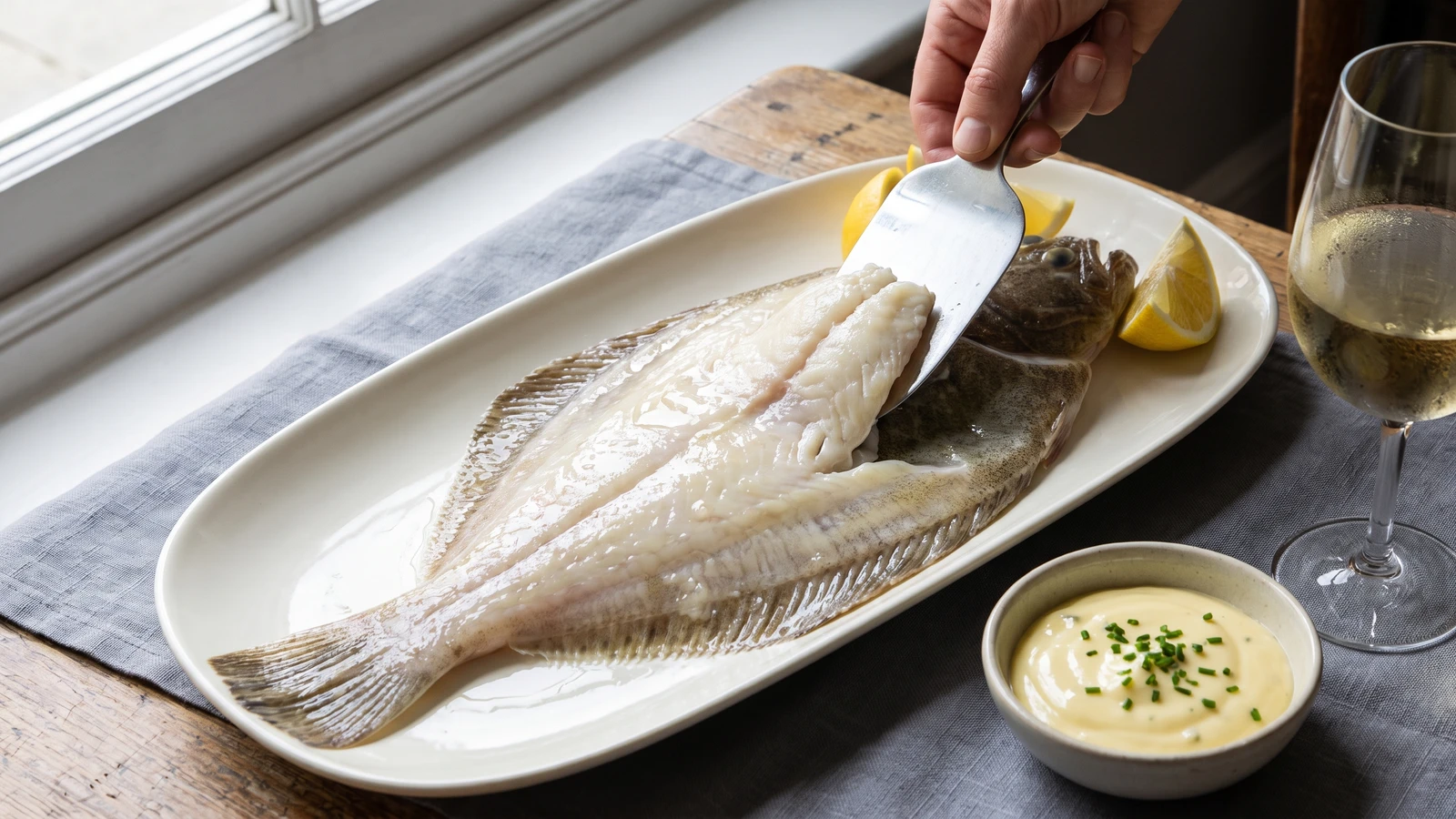
Whole turbot poached gently, skinned warm, and brought to the table just cooled with mayonnaise citronnée, before its pearly flesh has time to tighten: cold fish governed by timing, not refrigeration.
Turbot froid (cold turbot) teaches one true thing: cold fish is governed by timing, not refrigeration. Turbot served just cooled is pearly, succulent, and faintly sweet, splendid beside mayonnaise citronnée (cold lemon mayonnaise). Leave it for hours and those broad flakes contract, crumple, and lose the delicacy that lets this fish rival cold salmon or trout.
The old service assumed a turbot kettle, a saucier with cold emulsions ready, and enough hands to time the platter against the dining room. A home kitchen has a roasting pan shaped into a snug poaching basin, a cheesecloth sling, and one bowl for the sauce. The specialized kettle and elaborate cold-platter decoration are brigade scaffolding and can go; the whole fish, the gentle poach, and the immediate service are the dish. One cook, one stove, one evening.
When it is right, the upper skin slips away cleanly and the exposed flesh holds a moist ivory gloss from its cooking liquor. Don't slice it before the guests sit down. The step that decides everything is the cooling: lift the turbot the instant it is just cooked, then serve when warmth has only just left the flesh.
Turbot froid belongs to the grand cold service of Paris and the French Channel coast, built around whole fish landed in Normandy and Brittany and sent inland for formal tables. The dish traveled into household entertaining because a whole poached turbot could be carved generously and served with the established family of cold emulsified sauces. Its name misleads modern cooks: cold meant recently poached and just cooled, not refrigerated overnight, because turbot firms and loses its sweetness more quickly than salmon or trout.
Quantity
1 whole, about 3 to 3½ lb (1.4 to 1.6 kg)
gutted with fins trimmed
Quantity
12 cups (2.8 L / 2.8 kg)
divided
Quantity
2 cups (480 ml / 480 g)
Quantity
1 medium (about 5 oz / 150 g)
thinly sliced
Quantity
1 small (about 3 oz / 85 g)
thinly sliced
Quantity
8
Quantity
1
Quantity
1 teaspoon (5 ml / 3 g)
Quantity
¼ cup (60 ml / 60 g)
Quantity
2 tablespoons (30 ml / 36 g)
Quantity
2
Quantity
1 tablespoon (15 ml / 15 g)
Quantity
3 tablespoons (45 ml / 45 g)
divided
Quantity
¾ cup (180 ml / 165 g)
Quantity
2 tablespoons (30 ml / 30 g)
as needed
Quantity
½ teaspoon (2.5 ml / 3 g)
Quantity
¼ teaspoon (1.25 ml / 0.5 g)
Quantity
2 tablespoons (30 ml / 6 g)
finely snipped
Quantity
1
cut into wedges
| Ingredient | Quantity |
|---|---|
| whole turbotgutted with fins trimmed | 1 whole, about 3 to 3½ lb (1.4 to 1.6 kg) |
| cold waterdivided | 12 cups (2.8 L / 2.8 kg) |
| dry white wine | 2 cups (480 ml / 480 g) |
| medium onionthinly sliced | 1 medium (about 5 oz / 150 g) |
| small carrotthinly sliced | 1 small (about 3 oz / 85 g) |
| parsley stems | 8 |
| bay leaf | 1 |
| black peppercorns | 1 teaspoon (5 ml / 3 g) |
| white wine vinegar | ¼ cup (60 ml / 60 g) |
| fine sea salt for the court-bouillon | 2 tablespoons (30 ml / 36 g) |
| pasteurized large egg yolks | 2 |
| Dijon mustard | 1 tablespoon (15 ml / 15 g) |
| fresh lemon juicedivided | 3 tablespoons (45 ml / 45 g) |
| neutral sunflower or grapeseed oil | ¾ cup (180 ml / 165 g) |
| cold water for the mayonnaiseas needed | 2 tablespoons (30 ml / 30 g) |
| fine sea salt for the mayonnaise | ½ teaspoon (2.5 ml / 3 g) |
| ground white pepper | ¼ teaspoon (1.25 ml / 0.5 g) |
| chivesfinely snipped | 2 tablespoons (30 ml / 6 g) |
| lemoncut into wedges | 1 |
Set a medium bowl on a damp towel so it cannot wander. Whisk the egg yolks with the Dijon mustard, 1 tablespoon (15 ml / 15 g) of the lemon juice, the salt, and white pepper. Add the oil a few drops at a time until the emulsion catches and the whisk leaves clear tracks, then pour in the rest in a fine steady thread while whisking constantly. Whisk in the remaining lemon juice and enough cold water to give the mayonnaise citronnée a soft, spoonable fall, then fold in the chives. Cover and refrigerate. If the mayonnaise splits, put 1 teaspoon (5 ml / 5 g) cold water in a clean bowl and whisk in the broken sauce one teaspoon at a time until smooth. Ça se rattrape.
Combine 4 cups (960 ml / 960 g) of the water with the wine, onion, carrot, parsley stems, bay leaf, peppercorns, vinegar, and 2 tablespoons (30 ml / 36 g) salt. Bring to a gentle simmer and cook for fifteen minutes so the aromatics give up their flavour without turning bitter. Let it settle for ten minutes, then strain it into a large bowl set in a cold-water bath. Add the remaining 8 cups (1.9 L / 1.9 kg) very cold water. This court-bouillon, a short aromatic poaching liquor, must feel cool before it meets the fish; hot liquor seizes the outside while the centre remains raw.
Heat the oven to 325°F (160°C). Line a large roasting pan with crossed sheets of heavy foil and then parchment, drawing the sides inward to form a basin only slightly larger than the fish. Lay a long piece of unbleached cheesecloth across the basin as a sling, leaving generous handles, then settle the turbot on it pale-side down and dark-side up. Pour in enough cold court-bouillon to cover the fish, reserving about 1 cup (240 ml / 240 g) in the refrigerator. Lay a parchment cartouche directly on the liquid and seal the pan with foil. This snug basin is the honest home equivalent of a turbot kettle, and the sling supplies the missing second pair of hands.
Slide the covered pan into the oven and begin checking after twenty-five minutes. The court-bouillon should barely quiver at the edges, never boil. If hard bubbles break the surface, pull the pan out, add some of the reserved cold court-bouillon, lower the oven to 300°F (150°C), and continue gently. Cook until the flesh beside the central bone is pearly opaque, releases with slight pressure, and reaches 145°F (63°C), usually thirty-five to forty-five minutes depending on thickness. Check early and often. Once turbot has tightened from excess heat, no quantity of sauce can make those broad flakes supple again.
Ladle away enough hot court-bouillon to expose the cheesecloth handles, then lift the turbot carefully and let it drain for two minutes. Transfer it to an oval platter. While the fish is still warm, loosen the dark upper skin at the tail with a small knife and peel it toward the head, leaving the pale underside skin in place to support the fillets. If a patch of flesh follows the skin, stop pulling, ease it free with the blunt side of the knife, and place the lifted piece back where it belongs; a spoonful of cooking liquor will settle and gloss it. Strain ¼ cup (60 ml / 60 g) of the liquor over the exposed flesh, tent loosely with parchment, and let the fish stand for twenty to twenty-five minutes. Serve when the platter is barely cool and the liquor has only begun to turn tacky, always within forty-five minutes of lifting. Do not refrigerate or slice it in advance.
Bring the mayonnaise citronnée from the cold and whisk in a teaspoon of water if it has tightened. Arrange the lemon wedges beside the turbot. To carve, divide the two upper fillets along the central bone and lift them outward with a fish slice. Raise the backbone from tail toward head, then serve the two lower fillets from their supporting skin. Give each guest mayonnaise citronnée alongside rather than burying the moist flesh beneath it. This fish has waited quite long enough. À table!
1 serving (about 240g)
Culinary guides, cultural storytelling, and the editorial depth that makes cooking meaningful.
Discover Culinary ExplorerChef Juliette
John Dory has the delicacy of sole and the firmness of turbot. A light flouring, a quick butter sauté, and nut-brown beurre noisette show exactly why looks never mattered.

Chef Juliette
Fresh haddock proves its delicacy in the meunière pan: a fine flour crust, moist pearly flakes, and beurre noisette sharpened with lemon and parsley, ready from one skillet in half an hour.

Chef Juliette
Éperlans à l’Anglaise turns small fish into a lesson in disciplined coating: boned smelts under a close, crisp crumb, pan-fried in clarified butter and finished with bright, half-melted maître d’hôtel butter.

Chef Juliette
Tiny smelts, shallot, mushrooms, white wine, gratin sauce, and fine bread raspings meet a fierce oven, where the fish must turn tender in the same breath the buttered crust bronzes.