
Chef Juliette
John Dory (St. Pierre)
John Dory has the delicacy of sole and the firmness of turbot. A light flouring, a quick butter sauté, and nut-brown beurre noisette show exactly why looks never mattered.
A cooking platform built around craft, culture, and the stories behind what we eat.
Created by Chef Juliette
Based on No. 921, Dominos de Filets de Soles, from Le Guide Culinaire (1907) by Auguste Escoffier
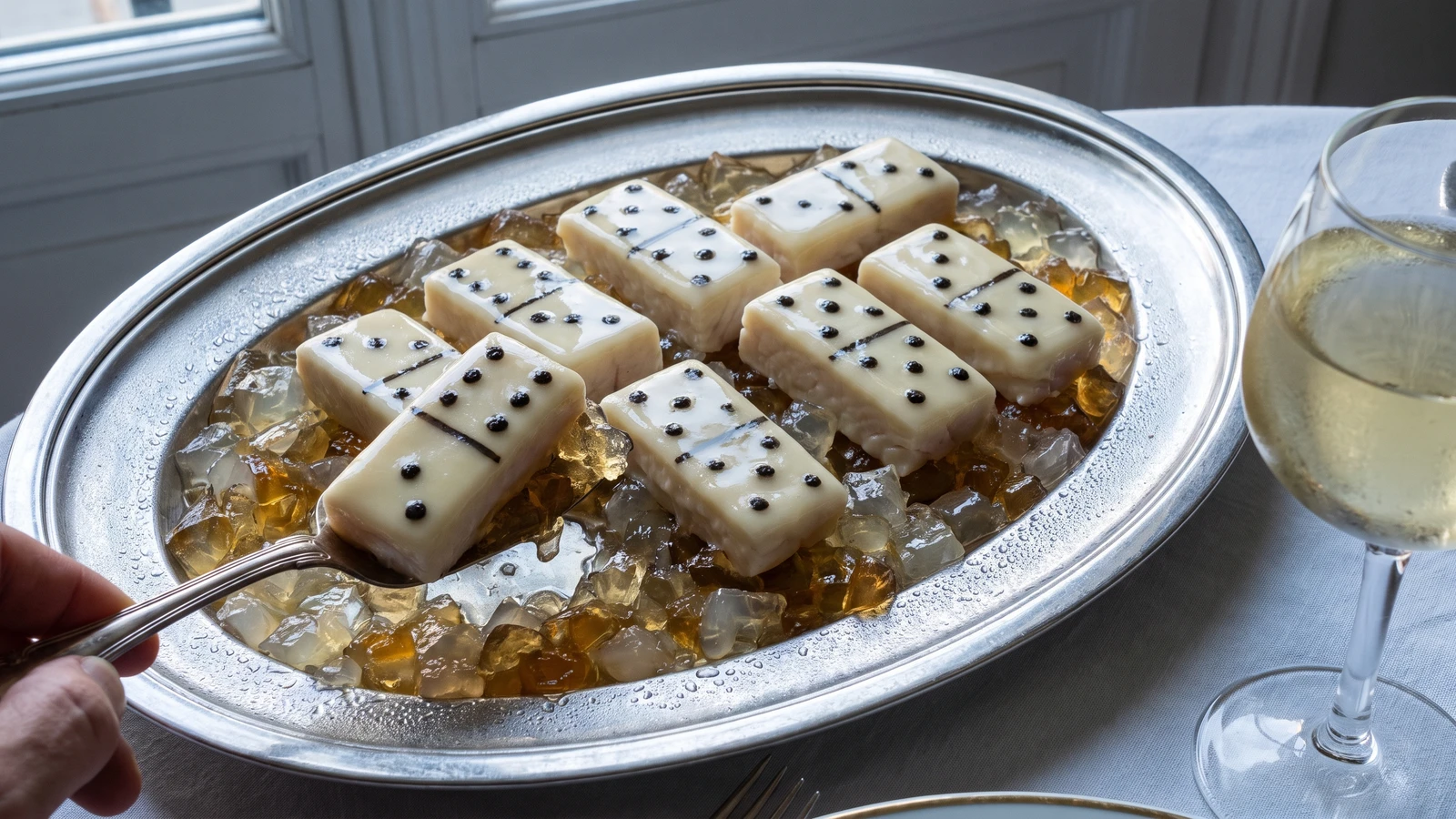
Domino tiles of chilled sole, ivory with chaud-froid and black truffle pips, rest on caviar jelly: a cold-kitchen lesson in exact setting, clean trimming, and playful abundance.
Dominos de Filets de Soles teach that cold cookery lives or dies by temperature. The sole must be cold enough to trim cleanly, the white maigre chaud-froid, a meatless jellied coating, must be cool enough to cling without ridges, and the fish jelly must be melted but scarcely warm. Get those three states right and the little ivory tiles, black with truffle pips and shining under clear jelly, look playful rather than laborious.
The original assumed a saucier on staff, a fish stock never off the fire, and a garde-manger, the cold-kitchen cook, pressing, coating, and glazing whole trays. A salamander, useful elsewhere in the canon, has no work in this cold dish. At home, one clear fish jelly serves as coating support, glaze, and foundation; a small saucepan replaces the stockpot, a food processor replaces the mortar, and the fine sieve stays because smoothness is part of the dish. That consolidation removes brigade scaffolding. The pressing, exact trimming, equal weight of caviar to sole trimmings, half-weight of coloured jelly, truffle pips, and final clear glaze remain untouched.
This is generous food with a wink in it, meant to arrive in a loose heap rather than a stiff parade. The one step that matters most is the chaud-froid coating: bring it to the texture of thick cream before it meets the cold fish, because too warm slides off and too cold sets in furrows. Ça se rattrape, and the method tells you exactly how.
Dominos de Filets de Soles belong to the Parisian grande cuisine cold table, where the garde-manger turned poached fish, aspic, truffle, and caviar into patterned dishes for formal suppers. The domino conceit is visual, but the economy beneath it is serious: sole trimmings are pounded with their own weight in caviar, then set beneath the immaculate fillets rather than discarded. The dish traveled from elaborate banquet service into smaller household entertaining because its work can be divided across a day and completed entirely before guests sit down.
Quantity
4, about 1 1/3 pounds (600 g) total
skinned
Quantity
8 ounces, about 3 cups (720 ml / 225 g)
thinly sliced
Quantity
2 cups (475 ml / 475 g)
Quantity
3 tablespoons (45 ml / 45 g)
divided
Quantity
5 tablespoons (75 ml / 70 g)
divided
Quantity
2 1/2 cups (590 ml / 590 g)
Quantity
6 teaspoons (30 ml / 18 g)
Quantity
2 tablespoons (30 ml / 16 g)
Quantity
1/2 cup (120 ml / 120 g)
Quantity
About 1/3 cup (80 ml / 80 g), or exactly the weight of the cooked sole trimmings
Quantity
1 small, about 1 ounce (28 g)
Quantity
1 tablespoon (15 ml / 12 g)
Quantity
1 teaspoon (5 ml / 4 g)
Quantity
1 1/2 teaspoons (7.5 ml / 8 g)
divided
Quantity
1/4 teaspoon (1.25 ml / 0.5 g)
| Ingredient | Quantity |
|---|---|
| large Dover sole filletsskinned | 4, about 1 1/3 pounds (600 g) total |
| button mushroomsthinly sliced | 8 ounces, about 3 cups (720 ml / 225 g) |
| water | 2 cups (475 ml / 475 g) |
| fresh lemon juicedivided | 3 tablespoons (45 ml / 45 g) |
| unsalted butterdivided | 5 tablespoons (75 ml / 70 g) |
| clear unsalted fish stock | 2 1/2 cups (590 ml / 590 g) |
| unflavoured powdered gelatin | 6 teaspoons (30 ml / 18 g) |
| all-purpose flour | 2 tablespoons (30 ml / 16 g) |
| heavy cream | 1/2 cup (120 ml / 120 g) |
| caviar | About 1/3 cup (80 ml / 80 g), or exactly the weight of the cooked sole trimmings |
| black truffle, fresh or preserved | 1 small, about 1 ounce (28 g) |
| granulated sugar | 1 tablespoon (15 ml / 12 g) |
| neutral oil | 1 teaspoon (5 ml / 4 g) |
| fine sea saltdivided | 1 1/2 teaspoons (7.5 ml / 8 g) |
| ground white pepper | 1/4 teaspoon (1.25 ml / 0.5 g) |
Put the sliced mushrooms, water, 1 tablespoon of the lemon juice, 1 tablespoon of the butter, and 1/4 teaspoon of the salt in a covered saucepan. Bring just to a simmer and cook gently for 10 minutes, until the mushrooms surrender their liquid without browning. Strain through a fine sieve, pressing lightly, and reserve the clear cooking liquor. The mushrooms have done their work here; keep them for an omelette or toast, but don't add them to the finished dish.
Pour 1/2 cup (120 ml) of the cold fish stock into a bowl, sprinkle the gelatin evenly over it, and leave it for 10 minutes to swell. Warm the remaining fish stock with 1/2 cup (120 ml) of the mushroom liquor until just below a simmer, then remove it from the heat and whisk in the swollen gelatin until completely dissolved. Never boil gelatin after adding it, or its setting strength suffers. Strain the fish jelly through a damp fine cloth, season with 1/4 teaspoon of the salt, and chill a spoonful for 10 minutes as a test; it should set firmly enough to cut while remaining tender under a fork. Keep the main batch liquid over barely warm water.
Place each sole fillet between sheets of parchment and tap it gently with the flat side of a mallet or a small saucepan until evenly 4 to 5 mm thick. Season with 1/2 teaspoon of the salt and the white pepper. Butter a wide sauté pan or shallow baking dish with 1 tablespoon of the butter, lay in the fillets without folding them, and add 1 cup (240 ml) of mushroom liquor, 1 tablespoon of lemon juice, and 2 tablespoons of butter in small pieces. Cover with buttered parchment and poach over the gentlest heat, or in a 325°F (165°C) oven, for 5 to 8 minutes. The liquor should barely tremble, and the fish should reach 145°F (63°C) at its thickest point without tightening at the edges.
Lift the fillets carefully onto a parchment-lined tray and reserve the poaching liquor. Cover the fish with another sheet of parchment, set a second tray or flat board on top, and add a light weight of about 2 pounds (900 g). This is pressure enough to keep the fillets flat, not enough to crush them. Refrigerate under the weight for at least 1 hour, until thoroughly cold and firm.
Melt the remaining 2 tablespoons of butter in a small saucepan, stir in the flour, and cook this white roux for 2 minutes without letting it colour. Gradually whisk in 3/4 cup (180 ml) of the strained sole poaching liquor, using extra mushroom liquor if the pan yielded less, then simmer gently for 5 minutes until smooth. Add the cream and simmer for another 3 to 4 minutes, until the sauce coats a spoon. Off the heat, whisk in 1/2 cup (120 ml) of the liquid fish jelly and the remaining tablespoon of lemon juice. Strain, add the remaining salt, and cool while stirring until the chaud-froid has the body of thick cream, around 80°F (27°C). If it sets into ridges, warm it gently over water; if it slides from a cold spoon, chill it for 5 minutes. Ça se rattrape.
Remove the weight from the sole and trim the cold fillets into 8 equal rectangles, each about 2 3/4 by 1 1/2 inches (7 by 3.5 cm). Save and weigh every trimming. Pulse the trimmings briefly with exactly their weight in caviar, then force the mixture through a fine sieve; the processor replaces the mortar, but the sieve stays because the finished layer must be perfectly smooth. Cook the sugar in a small dry saucepan until deep amber, remove the pan from the heat, and carefully stir in 1/2 cup (120 ml) of warm fish jelly. Weigh the fish-caviar paste and fold in coloured jelly equal to half that weight. Spread the mixture in a lightly oiled 8-inch (20 cm) square tray, no thicker than the sole fillets, and refrigerate for about 45 minutes, until firmly set.
Arrange the sole rectangles on a rack over a chilled tray. Spoon the cool chaud-froid over each one, guiding it down the sides so every surface wears an even ivory coat. Refrigerate for 10 minutes, then tidy the lower edges with a small knife. If bare patches show, apply a second thin coat instead of one heavy one; a thick coat smothers the fish and cracks when cut.
Cut the truffle into very thin slices, then stamp out small round pips with the narrow end of a piping tip. Arrange the pips on the tacky chaud-froid in recognizable domino patterns. Melt enough fish jelly for glazing and cool it to 80°F (27°C), fluid but scarcely warm, then brush a thin coat over each domino. Chill for 5 minutes and apply a second coat for a clear gloss. If warm jelly softens the white coating, stop and chill the dominoes until firm, then cover the blemish with cool chaud-froid before glazing again.
Turn the set caviar jelly onto a cold board and cut it into rectangles exactly matching the sole dominoes. Brush each dark rectangle with a little cool melted fish jelly, set a white domino on top, and chill for 10 minutes so the layers bind. Chop the remaining clear and coloured jelly, mound it in the centre of a chilled serving dish, and arrange the dominoes over it in a loose, muddled heap, preserving the source's bit of play rather than lining them up like soldiers. Chill for 30 minutes, then let the platter stand for 10 minutes before serving so the flavours aren't numbed by the cold. À table!
1 serving (about 275g)
Culinary guides, cultural storytelling, and the editorial depth that makes cooking meaningful.
Discover Culinary ExplorerChef Juliette
John Dory has the delicacy of sole and the firmness of turbot. A light flouring, a quick butter sauté, and nut-brown beurre noisette show exactly why looks never mattered.

Chef Juliette
Fresh haddock proves its delicacy in the meunière pan: a fine flour crust, moist pearly flakes, and beurre noisette sharpened with lemon and parsley, ready from one skillet in half an hour.

Chef Juliette
Éperlans à l’Anglaise turns small fish into a lesson in disciplined coating: boned smelts under a close, crisp crumb, pan-fried in clarified butter and finished with bright, half-melted maître d’hôtel butter.

Chef Juliette
Tiny smelts, shallot, mushrooms, white wine, gratin sauce, and fine bread raspings meet a fierce oven, where the fish must turn tender in the same breath the buttered crust bronzes.