
Chef Juliette
John Dory (St. Pierre)
John Dory has the delicacy of sole and the firmness of turbot. A light flouring, a quick butter sauté, and nut-brown beurre noisette show exactly why looks never mattered.
A cooking platform built around craft, culture, and the stories behind what we eat.
Created by Chef Juliette
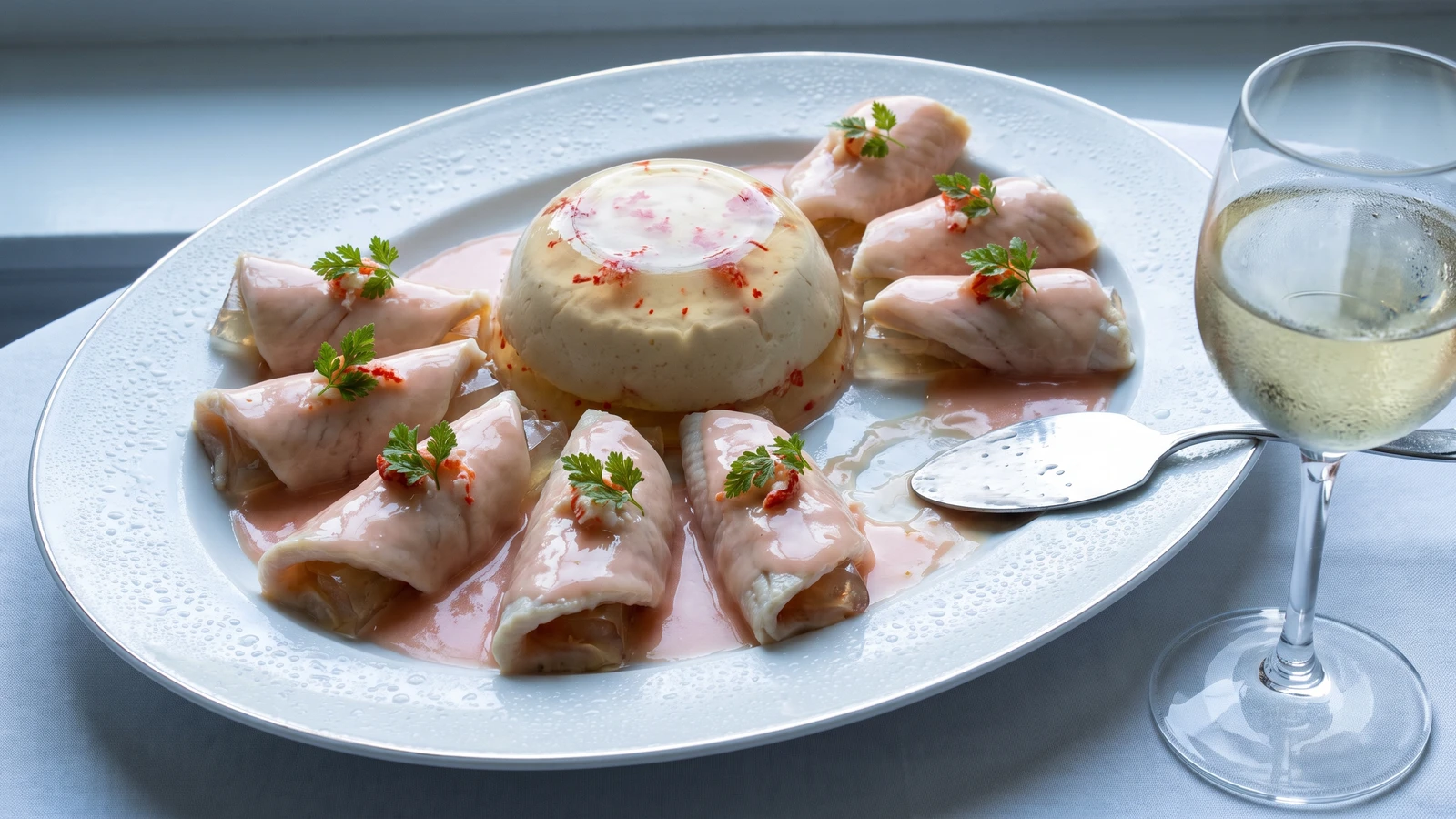
Based on No. 919, Filets de Soles Charlotte, from Le Guide Culinaire (1907) by Auguste Escoffier
Cold sole, pink chaud-froid, coral, chervil, and horseradish milt mousse form a composed centerpiece that teaches the exact temperature and patient layering of classical cold fish work.
Filets de Soles Charlotte (cold sole fillets in a pink masking sauce with horseradish milt mousse) teaches one uncompromising principle: temperature is structure. The sole is poached gently so it stays white, then coated with pink chaud-froid, a sauce made warm and used cold. Each layer must be chilled enough to hold the next, yet supple enough to join it without seams.
The original assumed a saucier on staff, fish fumet never off the fire, and a garde-manger hand watching three different setting points. It assumed no salamander, because Charlotte is built entirely in the cold larder. At home, one saucepan, powdered gelatin, a fine sieve, a cooling rack, and a small metal pudding basin do the work. The brigade's separate hands are scaffolding and can go. The gentle poach, milt mousse, pink coating, chervil and coral ornament, and clear fish-jelly glaze are the dish and must stay. One cook, one stove, one evening, followed by a patient rest in the cold.
Before you touch the pan, know this: never boil the sole, and never coat it while either fish or sauce is warm. The fillets must be cold and dry, while the chaud-froid must remain fluid at nappé, the coating consistency that clings to a spoon. That meeting of temperatures decides the whole dish.
Filets de Soles Charlotte belongs to the Parisian garde-manger tradition of formal cold service, where poached fish was masked in chaud-froid, ornamented, and sealed beneath fish jelly so a buffet centerpiece remained moist and immaculate. The name is an appellation of the classical repertory, not a regional sole preparation, and Charlotte here should not be confused with the molded sweet of the same name. Its central milt mousse records a grand-kitchen habit of treating soft roe as a delicacy rather than a trimming, while chervil, lobster coral, and precise jelly dice make the composition legible before the first serving is taken.
Quantity
8 fillets (about 1 lb 12 oz / 800 g total)
pin bones removed
Quantity
2 teaspoons (10 ml / 12 g)
divided
Quantity
2 tablespoons plus 2 teaspoons (40 ml / 38 g)
divided
Quantity
5 cups (1.2 L / 1.2 kg)
divided
Quantity
about 1¼ cups (300 ml / 300 g)
Quantity
6 teaspoons (30 ml / 18 g)
divided
Quantity
3 tablespoons (45 ml / 24 g)
Quantity
1 cup plus 2 tablespoons (270 ml / 270 g)
divided
Quantity
3 tablespoons (45 ml / 24 g)
Quantity
¼ cup (60 ml / 50 g)
divided
Quantity
½ cup (120 ml / 10 g)
Quantity
¼ teaspoon (1.25 ml / 0.6 g)
| Ingredient | Quantity |
|---|---|
| skinless Dover sole filletspin bones removed | 8 fillets (about 1 lb 12 oz / 800 g total) |
| fine sea saltdivided | 2 teaspoons (10 ml / 12 g) |
| unsalted butterdivided | 2 tablespoons plus 2 teaspoons (40 ml / 38 g) |
| fish fumetdivided | 5 cups (1.2 L / 1.2 kg) |
| cleaned fresh cod milt | about 1¼ cups (300 ml / 300 g) |
| unflavored powdered gelatindivided | 6 teaspoons (30 ml / 18 g) |
| plain flour | 3 tablespoons (45 ml / 24 g) |
| heavy creamdivided | 1 cup plus 2 tablespoons (270 ml / 270 g) |
| freshly grated horseradish | 3 tablespoons (45 ml / 24 g) |
| cooked lobster coraldivided | ¼ cup (60 ml / 50 g) |
| small chervil leaves | ½ cup (120 ml / 10 g) |
| finely ground white pepper | ¼ teaspoon (1.25 ml / 0.6 g) |
Butter a wide shallow pan with 1 tablespoon (15 ml / 14 g) of the butter. Season the sole lightly, then fold each fillet into three with its smooth presentation surface outward. Arrange them close together without overlapping and add 3 cups (720 ml / 720 g) of the fish fumet, enough to come about two-thirds of the way up the fish. Cover directly with a buttered parchment round. Bring the fumet slowly to the faintest quiver, never a boil, then poach for 4 to 6 minutes, until the fillets are opaque and just firm. Boiling tightens the flesh, clouds the fumet, and spoils the whiteness Charlotte requires. Lift the fillets into a shallow chilled tray, spoon over a little poaching liquid, cover directly with parchment, and refrigerate. Reserve every drop of fumet.
Rinse the cleaned milt gently and place it in a small saucepan with 1¼ cups (300 ml / 300 g) fish fumet. Bring it slowly to a bare tremble and poach for 6 to 8 minutes, until opaque throughout and at least 145°F (63°C) at the center. Lift it out and chill it promptly. Combine its poaching liquid with the reserved sole fumet, bring the liquid to a full boil for 1 minute, and skim carefully. Strain through damp muslin or a coffee filter without pressing. Measure 3¾ cups plus 2 tablespoons (950 ml / 950 g), adding reserved fresh fumet if necessary.
Measure 2¾ cups (650 ml / 650 g) of the strained fumet. Take ⅓ cup (80 ml / 80 g) from it and sprinkle over 4⅔ teaspoons (23 ml / 14 g) gelatin. Leave it for 5 minutes to swell. Heat the remaining fumet until hot but not boiling, remove it from the heat, and stir in the swollen gelatin until completely dissolved. Season lightly, remembering that cold dulls salt. Strain again and let the fish jelly cool until fluid but no longer warm. If it sets before you need it, stand the bowl in barely warm water and stir gently. Ça se rattrape.
Bloom the remaining 1⅓ teaspoons (7 ml / 4 g) gelatin in 2 tablespoons (30 ml / 30 g) of the remaining cold fumet. Melt the remaining 1 tablespoon plus 2 teaspoons (25 ml / 24 g) butter in a saucepan, stir in the flour, and cook for 2 minutes without allowing the roux to color. Whisk in the remaining 1 cup plus 2 tablespoons (270 ml / 270 g) fumet gradually, then simmer gently for 8 minutes. Add ½ cup (120 ml / 120 g) cream and cook until the sauce reaches nappé and a finger drawn across the coated spoon leaves a clean path. Remove it from the heat, dissolve in the bloomed gelatin, then blend in 1 heaped tablespoon (20 ml / 18 g) lobster coral. Season with a little salt and white pepper and pass the chaud-froid through a fine sieve. Stir it over an ice bath until cool, pale pink, and thick enough to coat in one smooth layer.
Chill a narrow 2½-cup (600 ml) metal dome mold or pudding basin. Pour in about ⅓ cup (80 ml / 80 g) fluid fish jelly and rotate the mold over ice until the interior carries a thin, even coat. Drain any excess back into the bowl. When the coating is tacky, sprinkle it evenly with 1½ tablespoons (22 ml / 20 g) finely chopped lobster coral, then seal the coral beneath another thin spoonful of jelly. Pour 1¼ cups (300 ml / 300 g) jelly into a shallow straight-sided tray to a depth of about ⅜ inch (1 cm). Chill both until firm, keeping the remaining jelly fluid for the mousse and final glaze.
Purée the chilled poached milt with the grated horseradish, ½ cup (120 ml / 120 g) fluid fish jelly, a pinch of salt, and half the white pepper. Press the mixture through a fine sieve so no membrane remains. Whip the remaining ⅔ cup (150 ml / 150 g) cream to soft peaks, then fold it into the milt mixture in three additions. Taste it cold. The horseradish should be distinct but not bitter. If the mixture begins setting before the cream is folded in, warm the outside of the bowl briefly with your hands; if it remains loose, chill it for 5 minutes and fold again when it begins to mound. Fill the jelly-lined mold, press gently to exclude air pockets, and level the top. Chill for at least 4 hours, until firmly set.
Lift the cold fillets from their tray and trim only the ragged edges, keeping them generous rather than carving away supper for geometry. Blot every surface completely dry and set the fillets on a chilled rack over a tray. Bring the pink chaud-froid to cool nappé consistency, then spoon it over each fillet in one confident coat, covering the top and sides. If the sauce slides off, either the fish is wet or the sauce is too warm. Scrape it back into the bowl, blot and rechill the fillets, cool the sauce until it clings, and coat again. Ça se rattrape. Chill for 15 to 20 minutes, until the surface is set.
Arrange a small rosette of chervil leaves on each coated fillet, with the pointed tips radiating outward. Place a pea-sized bit of the remaining lobster coral at the center of every rosette. Cool the reserved fish jelly until slightly syrupy but still fluid, then spoon a thin layer over each fillet without disturbing the leaves. If the jelly drags, it is too cold; warm it gently. If it softens the chaud-froid, it is too warm; chill both and begin the glaze again after the coating resets. Refrigerate until the glaze is clear and firm.
Cut the firm jelly from the shallow tray into regular ⅜-inch (1 cm) dice. Unmold the milt mousse onto a well-chilled oval platter by wrapping the mold briefly in a warm towel, then lifting it straight upward. Arrange the fillets against the dome with their narrow tail ends uppermost, keeping the chervil rosettes visible. Surround the whole composition with an even border of jelly dice. Hold it under refrigeration and bring it out about 10 minutes before serving, never long enough for the glaze to soften. Serve with a fish slice so each guest receives two fillets, a spoonful of mousse, and some jelly. À table!
1 serving (about 450g)
Culinary guides, cultural storytelling, and the editorial depth that makes cooking meaningful.
Discover Culinary ExplorerChef Juliette
John Dory has the delicacy of sole and the firmness of turbot. A light flouring, a quick butter sauté, and nut-brown beurre noisette show exactly why looks never mattered.

Chef Juliette
Fresh haddock proves its delicacy in the meunière pan: a fine flour crust, moist pearly flakes, and beurre noisette sharpened with lemon and parsley, ready from one skillet in half an hour.

Chef Juliette
Éperlans à l’Anglaise turns small fish into a lesson in disciplined coating: boned smelts under a close, crisp crumb, pan-fried in clarified butter and finished with bright, half-melted maître d’hôtel butter.

Chef Juliette
Tiny smelts, shallot, mushrooms, white wine, gratin sauce, and fine bread raspings meet a fierce oven, where the fish must turn tender in the same breath the buttered crust bronzes.