
Chef Juliette
John Dory (St. Pierre)
John Dory has the delicacy of sole and the firmness of turbot. A light flouring, a quick butter sauté, and nut-brown beurre noisette show exactly why looks never mattered.
A cooking platform built around craft, culture, and the stories behind what we eat.
Created by Chef Juliette
Based on No. 917, Bordure de Filets de Soles à l’Italienne, from Le Guide Culinaire (1907) by Auguste Escoffier
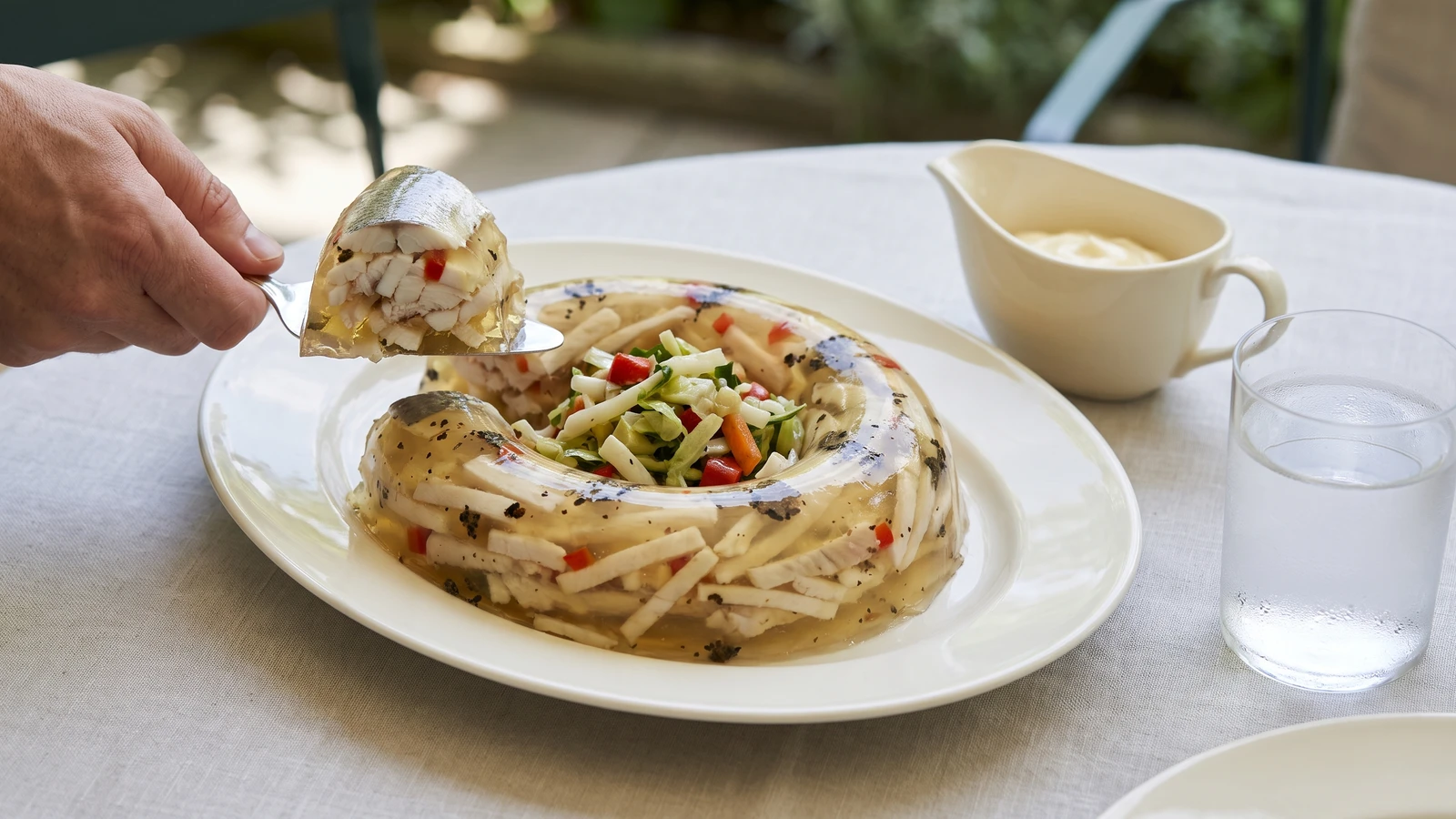
Bordure de Filets de Soles à l’Italienne sets delicate sole, black truffle, and red pepper in lucid fish aspic, then crowns its cool centre with vegetable salad and serves mayonnaise at the side.
Bordure de Filets de Soles à l’Italienne (a chilled border of sole fillets in fish jelly) teaches control of the cold gelée. Know this before touching a pan: every ingredient and every finished layer must be cold before the mould is filled. Warm fish clouds the gelée, loose moisture weakens it, and haste makes the suspended julienne slide instead of holding its clean pattern.
The original assumed a saucier with clarified fish jelly ready, a stock never off the fire, a cold station packed with ice, and a broad border mould intended for formal service. Your equivalent is good unsalted fish stock, strained after the sole is poached and strengthened with measured gelatin, plus a smooth 4-cup ring mould serving four. A full egg-white clarification is brigade scaffolding and can go; the thin gelée lining, the mould filled two-thirds with garnish, the rice cushion, the central Italian salad, and the mayonnaise served apart are the dish and must stay. The stated proportion remains untouched: two filleted soles take 2 ounces of truffle and 1½ ounces of capsicum. One cook, one stove, one evening.
When it is right, the border is pale gold and lucid, showing ivory sole, black truffle, and lacquer-red capsicum cut julienne-fashion, meaning slender matchstick rods. The step that decides it is the first lining of the mould. Let that thin coat set completely before adding the garnish; if it slips or leaves a bare patch, chill it and patch it with another spoonful. Ça se rattrape.
Bordure de Filets de Soles à l’Italienne belongs to the Parisian grand-kitchen cold table, where poached fish and clear gelée were shaped into composed dishes that also passed into formal bourgeois dining rooms. Here à l’Italienne names the garnish language of red capsicum, truffle, and a composed vegetable salad rather than an origin in an Italian household kitchen. The nearly hidden rice cushion is traditional service engineering: it levels the mould, keeps it from skidding, and catches the first softening of the gelée.
Quantity
8 fillets, about 1¼ pounds (570 g)
Quantity
4 cups (950 ml / 950 g)
Quantity
2½ envelopes, 5½ teaspoons (27 ml / 18 g)
Quantity
2 ounces (57 g)
drained and cut julienne-fashion
Quantity
½ large pepper, 1½ ounces (43 g)
peeled, thoroughly drained, and cut julienne-fashion
Quantity
1 tablespoon (15 ml / 15 g)
Quantity
1, about 5 ounces (140 g)
peeled and cut into ¼-inch dice
Quantity
1, about 2½ ounces (70 g)
peeled and cut into ¼-inch dice
Quantity
¾ cup (180 ml / 75 g)
trimmed and cut into ½-inch lengths
Quantity
⅓ cup (80 ml / 50 g)
Quantity
2 teaspoons (10 ml / 10 g)
rinsed and drained
Quantity
2 tablespoons (30 ml / 27 g)
Quantity
2 teaspoons (10 ml / 10 g)
Quantity
½ teaspoon (2.5 ml / 3 g)
Quantity
¾ cup (180 ml / 140 g)
cold and pressed dry
Quantity
1
Quantity
1 teaspoon (5 ml / 5 g)
Quantity
2 teaspoons (10 ml / 10 g)
Quantity
¾ cup (180 ml / 165 g)
Quantity
2 teaspoons (10 ml / 10 g)
Quantity
1 to 2 tablespoons (15 to 30 ml / 15 to 30 g)
Quantity
2 teaspoons (10 ml / 12 g), divided, plus more for the blanching water
Quantity
¼ teaspoon (1 ml / 0.5 g), divided
| Ingredient | Quantity |
|---|---|
| skinless sole fillets, from 2 whole soles | 8 fillets, about 1¼ pounds (570 g) |
| good-quality unsalted fish stock | 4 cups (950 ml / 950 g) |
| powdered unflavored gelatin | 2½ envelopes, 5½ teaspoons (27 ml / 18 g) |
| preserved whole black truffledrained and cut julienne-fashion | 2 ounces (57 g) |
| roasted red capsicumpeeled, thoroughly drained, and cut julienne-fashion | ½ large pepper, 1½ ounces (43 g) |
| fresh lemon juice for the fish gelée | 1 tablespoon (15 ml / 15 g) |
| small waxy potatopeeled and cut into ¼-inch dice | 1, about 5 ounces (140 g) |
| small carrotpeeled and cut into ¼-inch dice | 1, about 2½ ounces (70 g) |
| green beanstrimmed and cut into ½-inch lengths | ¾ cup (180 ml / 75 g) |
| shelled peas | ⅓ cup (80 ml / 50 g) |
| capersrinsed and drained | 2 teaspoons (10 ml / 10 g) |
| extra-virgin olive oil for the Italian salad | 2 tablespoons (30 ml / 27 g) |
| white wine vinegar for the Italian salad | 2 teaspoons (10 ml / 10 g) |
| Dijon mustard for the Italian salad | ½ teaspoon (2.5 ml / 3 g) |
| cooked white ricecold and pressed dry | ¾ cup (180 ml / 140 g) |
| large pasteurized egg yolk | 1 |
| Dijon mustard for the mayonnaise | 1 teaspoon (5 ml / 5 g) |
| white wine vinegar for the mayonnaise | 2 teaspoons (10 ml / 10 g) |
| sunflower or grapeseed oil | ¾ cup (180 ml / 165 g) |
| fresh lemon juice for the mayonnaise | 2 teaspoons (10 ml / 10 g) |
| cold water | 1 to 2 tablespoons (15 to 30 ml / 15 to 30 g) |
| fine sea salt | 2 teaspoons (10 ml / 12 g), divided, plus more for the blanching water |
| finely ground white pepper | ¼ teaspoon (1 ml / 0.5 g), divided |
Set a smooth 4-cup (1 litre) border mould in a basin of ice and water, keeping the rim above the water. Chill the serving platter as well. Have a flat tray ready for the poached sole; once cooked, every part of this dish must remain properly cold.
Reserve ½ cup (120 ml) of the cold fish stock for blooming the gelatin. Heat the remaining stock in a wide sauté pan to 175°F to 180°F (79°C to 82°C), a bare tremble rather than a boil. Season the sole lightly with salt, poach it in uncrowded batches for 3 to 5 minutes, and lift each fillet out when opaque and at least 145°F (63°C) at its thickest point. Cool the fillets in a single layer, cover, and refrigerate. Turbulent stock clouds and breaks delicate sole, so keep the liquid calm.
Sprinkle the gelatin evenly over the reserved cold stock and leave it for 10 minutes to bloom. Strain the poaching stock through a damp coffee filter or a fine sieve lined with damp muslin, then measure 2½ cups (590 ml); reduce it gently if there is too much, or add water if there is too little. Heat this measured stock without boiling, whisk in the bloomed gelatin until completely dissolved, then add the lemon juice, ¾ teaspoon of salt, and a small pinch of white pepper. Taste it slightly more seasoned than a warm soup, because chilling mutes flavour. Cool the gelée over ice, stirring, until it flows like light cream.
Pour about ½ cup (120 ml) of the thickened gelée into the ice-cold mould. Rock and turn the mould steadily so a thin, even film catches over the bottom, outer wall, and central tube, then pour the excess back into the bowl. Refrigerate the mould for 10 minutes, until the lining is fully set. If the gelée slides away, the mould or gelée is too warm; chill both and patch the bare place with a spoonful. Ça se rattrape. If the remaining gelée begins setting in the bowl, stand it briefly in lukewarm water and stir until fluid again.
Pat the chilled sole dry and cut it julienne-fashion into slender matchstick strips about 1½ inches (4 cm) long. Cut the truffle and capsicum to the same dimensions. Combine the three gently so the sole remains in defined strips, then spoon the garnish loosely into the lined mould until it stands two-thirds full. This proportion is the architecture of the original dish, so do not compress the garnish to the rim. Pour in the cool, fluid gelée until the mould is full, easing a thin skewer through the mixture to release trapped air without scratching the lining.
Transfer the mould level to the refrigerator and leave it undisturbed for at least 6 hours, preferably overnight. Once the surface has set, cover it without pressing the covering against the gelée. Do not freeze it; frozen gelée releases water as it thaws and loses its clean structure.
Cook the potato in salted water until tender but still sharply diced, about 7 minutes. Blanch the carrot, green beans, and peas separately until tender and bright, about 4 minutes for the carrot, 3 minutes for the beans, and 1 minute for the peas. Drain every vegetable thoroughly and spread them on a tray to cool. Whisk the olive oil, vinegar, mustard, ½ teaspoon salt, and a pinch of white pepper, then fold in the vegetables and capers. Chill for at least 1 hour. The salad should be dressed and glossy, never wet enough to pool inside the border.
Whisk the pasteurized yolk with the mustard, vinegar, ¼ teaspoon salt, and a pinch of white pepper. Add the neutral oil drop by drop until the emulsion takes hold, then pour it in a thin stream while whisking constantly. Finish with the lemon juice and enough cold water to make a sauce that falls from the spoon in a slow ribbon. If it breaks, stop. Put 1 teaspoon of cold water in a clean bowl and whisk in the broken mayonnaise a teaspoon at a time until smooth, then continue gradually with the remainder. Keep it covered and cold.
On the chilled platter, press the cold rice into a low ring matching the exact footprint of the mould, no more than ¼ inch (6 mm) high. This is deliberate service scaffolding: it keeps the border level, prevents it from sliding, and should disappear completely beneath the gelée.
Dip the mould to just below its rim in lukewarm water for 5 seconds, dry it, and invert it squarely over the rice cushion. Lift gently. If the border refuses to release, wrap the outer wall and central tube with a warm towel for another 5 seconds; do not use hot water long enough to soften the shape. Spoon the well-drained Italian salad into the centre and bring the mayonnaise in a sauceboat at the side. Keep the dish cold until it reaches the table, and do not leave it at room temperature for more than 2 hours. À table!
1 serving (about 550g)
Culinary guides, cultural storytelling, and the editorial depth that makes cooking meaningful.
Discover Culinary ExplorerChef Juliette
John Dory has the delicacy of sole and the firmness of turbot. A light flouring, a quick butter sauté, and nut-brown beurre noisette show exactly why looks never mattered.

Chef Juliette
Fresh haddock proves its delicacy in the meunière pan: a fine flour crust, moist pearly flakes, and beurre noisette sharpened with lemon and parsley, ready from one skillet in half an hour.

Chef Juliette
Éperlans à l’Anglaise turns small fish into a lesson in disciplined coating: boned smelts under a close, crisp crumb, pan-fried in clarified butter and finished with bright, half-melted maître d’hôtel butter.

Chef Juliette
Tiny smelts, shallot, mushrooms, white wine, gratin sauce, and fine bread raspings meet a fierce oven, where the fish must turn tender in the same breath the buttered crust bronzes.