
Chef Juliette
Filets de Soles Américaine
Folded sole, barely poached in fumet, circles lobster beneath a gleaming brandy-and-tomato shellfish sauce. The sauce is the whole dish, and gentle heat is the lesson.
A cooking platform built around craft, culture, and the stories behind what we eat.
Created by Chef Juliette
Based on No. 912, Timbale de Filets de Soles Carême, from Le Guide Culinaire (1907) by Auguste Escoffier
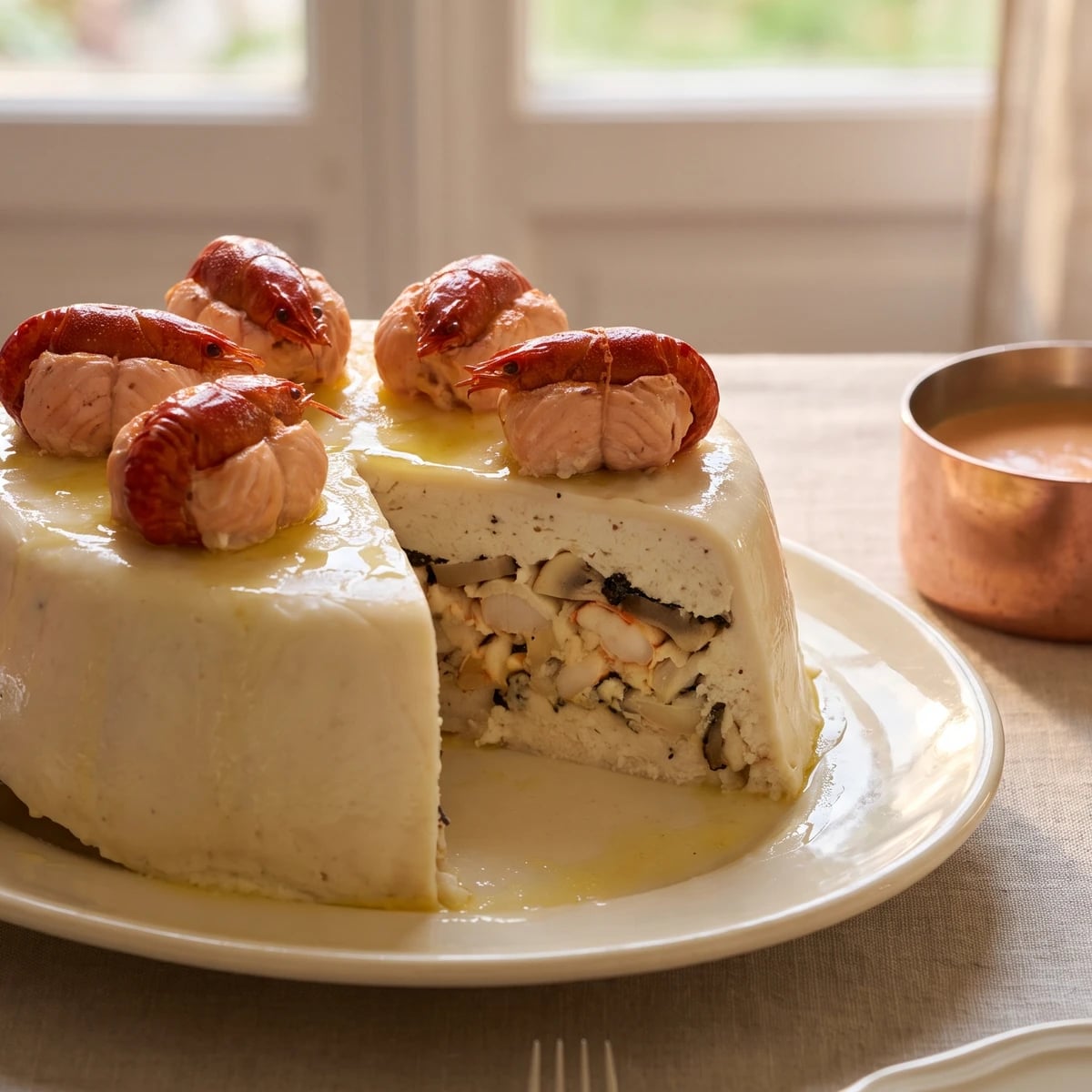
A sole-lined timbale built around cold fish forcemeat, shellfish, mushrooms, truffle, and Béchamel, gently poached until sliceable, then crowned with salmon paupiettes and served beside coral Sauce Nantua.
Timbale de Filets de Soles Carême (Carême-style sole timbale) teaches structure. Supple fillets form the outer mould, a farce mousseline de poisson (silken fish forcemeat) becomes the supporting wall, and thick Béchamel holds the shellfish and truffle without leaking into the seams. Keep the farce mousseline truly cold. Warm fish and cream separate under the blade, while a cold paste cooks into a tender, coherent shell.
The entry was written for a brigade: three medium soles, six decorated paupiettes, a fish cook at the board, a saucier on staff, a stock never off the fire, and an oven whose cooler front could set the lining. This home version keeps the same two-thirds proportion for four guests: two soles and four salmon paupiettes (rolled fish parcels), a cold food processor in place of mortar work, one batch of Béchamel divided between the filling and Sauce Nantua, and crayfish shells infused in butter on demand. A small pound-cake mould replaces the banquet mould. The salamander can stay dark, since fierce top heat has no work here.
The scale and brigade labor have changed, not the intent. The sole lining, half-inch forcemeat wall, shellfish and truffle garnish, thirty-minute bain-marie (hot-water bath), paupiette crown, and Sauce Nantua served apart all remain because they are the dish. One cook, one stove, one evening. The step that matters most is the first partial poach: set the forcemeat only until it clings firmly to the sole, because that wall must carry everything that follows.
The timbale's real home is Parisian grande cuisine, where fish fillets, forcemeat, truffle, and shellfish were assembled into architectural celebration dishes before being presented with a separate sauce. The Carême designation signals that formal Parisian grammar: a moulded exterior, a contrasting garnish hidden within, and ornament that reveals the cook's control of structure. As timbales passed into bourgeois celebration cooking, their size diminished, but the essential method remained gentle poaching rather than the fierce baking of a fish pie.
Quantity
8 fillets, about 1 pound (450 g) total
pin bones removed
Quantity
6 ounces (170 g)
ice-cold and diced
Quantity
1
Quantity
½ cup (120 ml / 120 g)
ice-cold
Quantity
1½ teaspoons (7.5 ml / 9 g)
divided
Quantity
¾ teaspoon (3.75 ml / 1.8 g)
divided
Quantity
1½ tablespoons (22.5 ml / 21 g)
Quantity
⅔ cup (160 ml / 90 g)
Quantity
6
shucked with their liquor reserved
Quantity
12
scrubbed and debearded
Quantity
¾ cup (180 ml / 85 g)
trimmed
Quantity
1½ tablespoons (22.5 ml / 10 g)
thinly sliced and drained if preserved
Quantity
1½ tablespoons (22.5 ml / 21 g)
Quantity
3 tablespoons (45 ml / 42 g)
Quantity
⅓ cup (80 ml / 40 g)
Quantity
1⅔ cups (400 ml / 415 g)
Quantity
1 pinch
Quantity
⅛ teaspoon (0.6 ml / 0.25 g)
Quantity
8, about 12 ounces (340 g) shell-on
Quantity
4 tablespoons (60 ml / 57 g)
Quantity
⅓ cup (80 ml / 80 g)
kept cold
Quantity
4 strips, about 5 ounces (140 g) total
| Ingredient | Quantity |
|---|---|
| small skinless sole fillets from 2 medium solespin bones removed | 8 fillets, about 1 pound (450 g) total |
| skinless whiting or cod, plus the sole trimmingsice-cold and diced | 6 ounces (170 g) |
| large egg white | 1 |
| heavy cream for the farce mousselineice-cold | ½ cup (120 ml / 120 g) |
| fine sea saltdivided | 1½ teaspoons (7.5 ml / 9 g) |
| ground white pepperdivided | ¾ teaspoon (3.75 ml / 1.8 g) |
| softened unsalted butter for the mould | 1½ tablespoons (22.5 ml / 21 g) |
| small cooked peeled shrimp | ⅔ cup (160 ml / 90 g) |
| oysters in the shellshucked with their liquor reserved | 6 |
| small mussels in the shellscrubbed and debearded | 12 |
| small button mushroomstrimmed | ¾ cup (180 ml / 85 g) |
| black truffle, fresh or preservedthinly sliced and drained if preserved | 1½ tablespoons (22.5 ml / 10 g) |
| unsalted butter for the mushrooms and paupiettes | 1½ tablespoons (22.5 ml / 21 g) |
| unsalted butter for the Béchamel | 3 tablespoons (45 ml / 42 g) |
| all-purpose flour | ⅓ cup (80 ml / 40 g) |
| whole milk | 1⅔ cups (400 ml / 415 g) |
| freshly grated nutmeg | 1 pinch |
| cayenne pepper | ⅛ teaspoon (0.6 ml / 0.25 g) |
| small cooked whole crayfish | 8, about 12 ounces (340 g) shell-on |
| unsalted butter for the crayfish butter | 4 tablespoons (60 ml / 57 g) |
| heavy cream for Sauce Nantuakept cold | ⅓ cup (80 ml / 80 g) |
| thin skinless salmon strips | 4 strips, about 5 ounces (140 g) total |
Put the food-processor bowl and blade, the diced whiting or cod, the sole trimmings, and the cream in the cold for 15 minutes. Heat the oven to 325°F (160°C), place a rack in the lower middle, and bring a kettle of water to the boil. Butter an 8½ by 4½-inch (21 by 11 cm), roughly 1¼-liter metal pound-cake mould liberally, reaching every corner. Lay each sole fillet between sheets of parchment and tap it gently to an even ⅛-inch (3 mm) thickness. Trim the edges neatly, add the scraps to the chilled fish, and return the fillets to the cold.
Reserve 1 tablespoon (15 ml / 15 g) of the cold cream. Pulse the diced fish and sole trimmings with ¾ teaspoon of the salt and ¼ teaspoon of the white pepper until smooth and tacky. Add the egg white and pulse just until absorbed, then feed in the remaining cream gradually while the machine runs. Stop as soon as the farce mousseline looks glossy and holds a soft peak. Poach a teaspoonful in barely simmering water for 2 minutes, taste, and correct the seasoning. Reserve about ⅓ cup (80 ml / 85 g) of the farce mousseline for closing the timbale and keep everything cold.
Line the buttered mould with the sole fillets, placing them side by side with their narrow tails meeting around the centre of the bottom and their broad ends projecting above the rim. Overlap the edges slightly and press out every pocket of air. Spread the farce mousseline over the fish in an even ½-inch (1.25 cm) layer, using a spoon dipped in cold water. Set the mould in a roasting pan, add boiling water to come about 1 inch (2.5 cm) up its sides, and bake for 7 to 9 minutes, just until the forcemeat loses its wet gloss and adheres firmly to the fillets. Remove the mould, let it settle for 5 minutes, then cut the projecting fillets level with the rim and reserve those pieces for the lid.
Put the mussels in a covered saucepan with 2 tablespoons (30 ml) of water and cook over medium heat until they open, about 3 minutes. Discard any that remain closed, remove the meats, and drain them well. Warm the oyster liquor until it barely trembles, slide in the oysters, and poach for 1 to 2 minutes, just until their edges curl. Drain them and cut any large oyster in half. Melt half the butter reserved for the garnish in the saucepan and cook the mushrooms gently until tender and their released liquid has evaporated, without taking them to a hard brown. Combine the cooled mushrooms, shrimp, oysters, mussels, and sliced truffle. Keep the garnish dry and barely warm.
Melt the Béchamel butter over medium-low heat, stir in the flour, and cook the roux for 2 minutes without coloring it. Add the milk in several portions, whisking each one smooth before the next, then simmer gently for 8 to 10 minutes. The Béchamel must be thick enough to hold a clear trail from the whisk. Season it confidently with ½ teaspoon of the remaining salt, ¼ teaspoon of white pepper, the nutmeg, and half the cayenne. Reserve ¾ cup (180 ml / about 185 g) for Sauce Nantua and cover its surface. Fold enough of the remaining Béchamel into the shellfish garnish to cohere it completely without leaving loose sauce in the bowl.
Spoon the bound garnish into the lined mould, pressing gently into the corners without disturbing the sole wall, and stop ⅓ inch (8 mm) below the rim. Cover the filling with the reserved pieces of sole, overlapping them to make a complete lid. Spread the reserved farce mousseline over them in a thin, continuous layer and smooth the seam with a wet spoon. No filling should remain visible. Chill the closed timbale for 10 minutes while the kettle returns to the boil.
Set the mould in the roasting pan and pour in freshly boiled water to come halfway up its sides. Poach in the 325°F (160°C) oven for 30 minutes. The bath should tremble gently, never churn, and the centre of the timbale should reach 145°F (63°C). If it has not reached that point after 30 minutes, give it another 5 minutes and test again. Lift the mould from the bain-marie and rest it for 8 to 10 minutes before unmoulding.
While the timbale poaches, remove the tails from all eight crayfish. Reserve four tails whole for the paupiettes and chop the other four for Sauce Nantua. Clean and dry the four best red carapaces for the crown. Crush the remaining shells and claws, then cook them with the crayfish-butter portion of butter over low heat for 8 minutes, stirring and pressing until the butter turns coral and smells richly of shellfish. Cover, steep off the heat for 10 minutes, then strain through a fine sieve, pressing firmly on the shells. Keep the crayfish butter warm but not hot.
Flatten the salmon strips to an even ⅛ inch (3 mm) and season them lightly with salt and white pepper. Lay one whole crayfish tail across each strip and roll the salmon around it to form a compact paupiette. Butter a shallow lidded pan with the remaining garnish butter, arrange the paupiettes seam-side down, and add ¼ cup (60 ml) of water. Cover and poach at the barest tremble for 4 to 5 minutes, until the salmon is just opaque and holds its shape. Keep them warm in the covered pan and brush the cleaned carapaces with a trace of crayfish butter.
Warm the reserved Béchamel with all but 1 tablespoon (15 ml / 15 g) of the cold cream, whisking until smooth. Bring it only to a gentle simmer, then remove it from the heat and whisk in the crayfish butter a spoonful at a time. Fold in the four chopped crayfish tails and season with the remaining cayenne, salt, and white pepper. Sauce Nantua should flow in a broad ribbon while coating the back of a spoon. Keep it warm in a sauceboat and do not boil it after the crayfish butter enters.
Run a thin knife only along the two short ends of the mould, place a warm round platter over it, and invert decisively. Lift the mould straight upward. If it clings, wrap the outside with a warm damp towel for 20 seconds and try again without shaking. Arrange the four salmon paupiettes as a garland across the top, setting one cleaned crayfish carapace above each. Bring Sauce Nantua separately, slice the timbale thickly with a sharp knife, and serve at once. À table!
1 serving (about 450g)
Culinary guides, cultural storytelling, and the editorial depth that makes cooking meaningful.
Discover Culinary Explorer
Chef Juliette
Folded sole, barely poached in fumet, circles lobster beneath a gleaming brandy-and-tomato shellfish sauce. The sauce is the whole dish, and gentle heat is the lesson.

Chef Juliette
A fine à l'anglaise crust, set the instant it touches hot clarified butter, protects tender sole before maître-d'hôtel butter melts across the ridges. The lesson is heat first, gentle frying second.

Chef Juliette
Pepper-filled sole paupiettes rise over butter-stewed tomatoes, capsicum risotto, and crisp aubergine, all glossed with lightly browned butter. The lesson is control: keep every element distinct and never let the poach boil.

Chef Juliette
Filets de Soles Caprice turns restraint into surprise: fine-crumbed sole grilled light gold, buttered banana laid over each fillet, and mustard-bright Sauce Robert sent separately so every bite balances sweet, savory, and sharp.