
Chef Juliette
John Dory (St. Pierre)
John Dory has the delicacy of sole and the firmness of turbot. A light flouring, a quick butter sauté, and nut-brown beurre noisette show exactly why looks never mattered.
A cooking platform built around craft, culture, and the stories behind what we eat.
Created by Chef Juliette
Based on No. 910, Timbale de Filets de Soles Carmélite, from Le Guide Culinaire (1907) by Auguste Escoffier
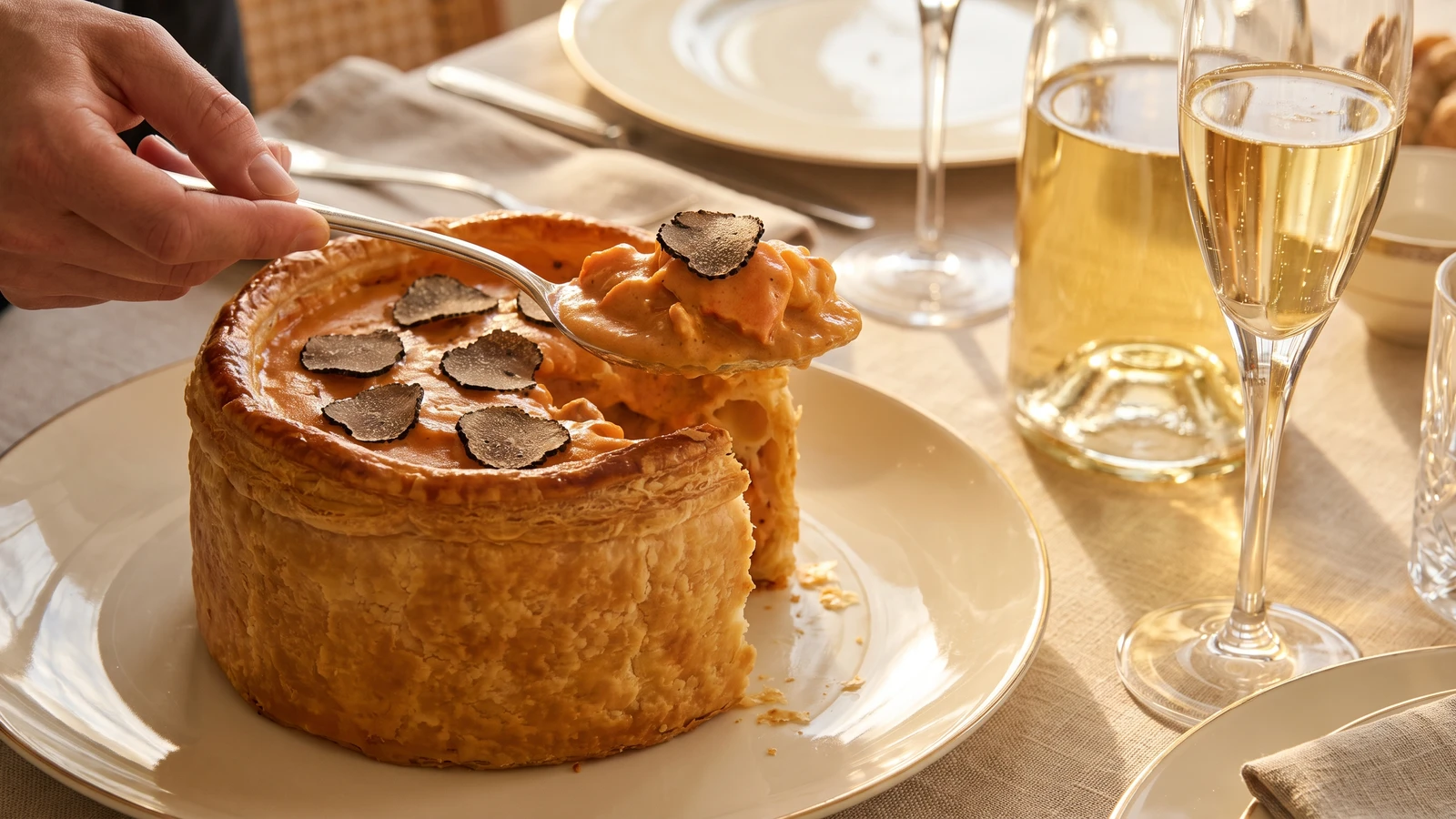
A crisp pastry tower holding rolled sole, lobster à la New-burg, and black truffle in a silken lobster sauce, with one discipline above all: heat it thoroughly, and never let it boil.
Timbale de Filets de Soles Carmélite (a pastry timbale of stuffed sole, lobster, and truffle) teaches orchestration. The one true thing to know before touching a pan is this: the shell must remain crisp, the filling must arrive properly hot, and the lobster sauce must never boil. Timing, not ornament, decides the dish.
The original kitchen assumed a pastry cook, a saucier on staff, fish forcemeat already cold, fumet, the concentrated fish essence, never off the fire, and a salamander ready to refresh the shell. The home equivalent is an 18 cm springform, a food processor, an ordinary oven, and one prepared batch of Homard à la New-burg (with raw lobster) (No. 948). This version scales twelve sole rolls to eight and three ounces of truffle to two, preserving the source proportions while making a generous main dish for four. One cook, one stove, one evening.
Multiple cooks working in parallel and the folded napkin beneath the finished timbale are brigade scaffolding, so they go. The baked pastry case, lobster-butter fish forcemeat, fumet poach, proper quantity of truffle, and gentle final warming are the dish itself, so they stay. Have the hot shell waiting before the filling enters its sauce; that final no-boil warming is the step that matters most.
Timbale de Filets de Soles Carmélite belongs to the formal Parisian table, where timbale names both the deep mold and the drum-shaped pastry case presented from it. Its lobster à la New-burg records the canon’s appetite for ideas beyond France: the brandy, Marsala, and cream preparation traveled from New York dining rooms into French sauce work, then met sole and truffle here. The dish is not tied to a fishing village or province; its identity lies in pastry architecture, fumet-poached fish, and controlled sauce heat.
Quantity
2½ cups (600 ml / 300 g)
Quantity
1 teaspoon (5 ml / 6 g)
Quantity
¾ cup (180 ml / 170 g)
cut into small cubes
Quantity
1
Quantity
3 tablespoons (45 ml / 45 g), plus up to 1 tablespoon (15 ml / 15 g) if needed
Quantity
1 tablespoon (15 ml / 14 g)
Quantity
1 egg yolk beaten with 1 teaspoon (5 ml / 5 g) water
Quantity
8 fillets, about 1 pound (450 g) total
Quantity
5 ounces (140 g)
cut into small cubes
Quantity
1 teaspoon (5 ml / 6 g)
divided between the forcemeat and sole fillets
Quantity
¼ teaspoon (1.25 ml / 0.6 g)
divided
Quantity
1
very cold
Quantity
⅓ cup (80 ml / 80 g)
very cold
Quantity
1½ tablespoons (22 ml / 21 g)
softened but still cool
Quantity
2½ cups (600 ml / 600 g)
Quantity
2 teaspoons (10 ml / 9 g)
Quantity
1 prepared batch, about 2½ cups (600 ml / 650 g), Homard à la New-burg (with raw lobster) (No. 948)
tail meat kept separate from the sauce
Quantity
2 ounces (55 g)
drained if preserved
Quantity
2 tablespoons (30 ml / 30 g)
| Ingredient | Quantity |
|---|---|
| all-purpose flour | 2½ cups (600 ml / 300 g) |
| fine sea salt for the pastry | 1 teaspoon (5 ml / 6 g) |
| cold unsalted buttercut into small cubes | ¾ cup (180 ml / 170 g) |
| large egg | 1 |
| ice water | 3 tablespoons (45 ml / 45 g), plus up to 1 tablespoon (15 ml / 15 g) if needed |
| softened unsalted butter for the mold | 1 tablespoon (15 ml / 14 g) |
| egg yolk wash | 1 egg yolk beaten with 1 teaspoon (5 ml / 5 g) water |
| small skinless sole fillets | 8 fillets, about 1 pound (450 g) total |
| very cold skinless sole or whiting for the fish forcemeatcut into small cubes | 5 ounces (140 g) |
| fine sea salt for the fishdivided between the forcemeat and sole fillets | 1 teaspoon (5 ml / 6 g) |
| finely ground white pepperdivided | ¼ teaspoon (1.25 ml / 0.6 g) |
| large egg whitevery cold | 1 |
| heavy cream for the forcemeatvery cold | ⅓ cup (80 ml / 80 g) |
| lobster buttersoftened but still cool | 1½ tablespoons (22 ml / 21 g) |
| fish fumet | 2½ cups (600 ml / 600 g) |
| softened unsalted butter for the parchment cartouche | 2 teaspoons (10 ml / 9 g) |
| Homard à la New-burg (with raw lobster)tail meat kept separate from the sauce | 1 prepared batch, about 2½ cups (600 ml / 650 g), Homard à la New-burg (with raw lobster) (No. 948) |
| fresh or preserved whole black truffledrained if preserved | 2 ounces (55 g) |
| cold heavy cream for sauce rescue (optional) | 2 tablespoons (30 ml / 30 g) |
Combine the flour and pastry salt, then rub or cut in the cold butter until the mixture resembles coarse crumbs with a few small flakes remaining. Add the whole egg and 3 tablespoons of ice water, mixing only until the dough holds when pressed; add the final tablespoon of water a teaspoon at a time if dry flour remains. Press the dough into a thick disc, wrap it, and chill for 30 minutes. This pâte à timbale, a sturdy timbale pastry, must support a generous filling, so keep it tender but not fragile.
Heat the oven to 375°F (190°C) and butter an 18 cm by 7.5 cm deep springform or charlotte mold. Roll the dough ⅛ inch (3 mm) thick. Cut a circle for the base and a long strip for the wall, allowing a ¾ inch (2 cm) overlap; press the seams firmly together and chill the lined mold for 20 minutes. Line it with parchment and fill with pastry weights or dry beans to the top so the wall cannot slump. Bake for 25 minutes, remove the weights carefully, brush the interior with the egg-yolk wash, and bake for another 12 to 15 minutes, until deeply butter-gold and dry. If a seam opens, brush it with yolk, press a thin scrap of pastry over the gap, and return it to the oven. Ça se rattrape. Unmold carefully and hold the shell in a 250°F (120°C) oven.
Chill the food processor bowl and blade for 10 minutes. Pulse the cubed fish with ½ teaspoon of the fish salt and half the white pepper until smooth and sticky, then add the cold egg white. Reserve 1 tablespoon of the cold cream and pulse in the remainder in three additions, stopping as soon as the farce mousseline de poisson, the silky fish forcemeat, holds a soft peak. Pulse in the lobster butter just until evenly coral-colored. Keep the mixture below 50°F (10°C); if the bowl becomes warm or the forcemeat looks greasy, stop and chill it for 15 minutes before continuing. Poach a teaspoon in the fumet until fully opaque, taste it, and adjust the seasoning. If the test is too firm, fold the reserved cream into the forcemeat.
Pat the eight sole fillets thoroughly dry and season them lightly with the remaining fish salt and white pepper. Lay each fillet with its smoother former-skin side upward, spread about 2 tablespoons of forcemeat over it without reaching the edges, and roll from the narrow tail end toward the thicker end. Set the rolls seam-side down and chill for 10 minutes so they hold their shape.
Bring the fumet to 175°F (80°C) in a wide sauté pan, keeping it below a simmer. Arrange the rolls seam-side down in one layer and cover them with a parchment cartouche rubbed with the softened butter. Poach gently for 7 to 9 minutes, until the centers reach 145°F (63°C) and the fish feels just firm when pressed. Boiling tightens the sole and can force out the forcemeat, so lower the heat at the first bubble. Lift the rolls onto a warm tray and drain them well. Reserve ½ cup (120 ml / 120 g) of the fumet.
Separate the tail meat from the prepared Homard à la New-burg (with raw lobster) (No. 948), then slice the meat neatly across the grain. Cut eight fine, complete slices from the truffle for the top of the timbale and slice the remainder for the filling. Bring the warm pastry shell to the serving platter now; once the sauce and garnish meet, there must be no waiting.
Put the lobster sauce in a wide saucepan over low heat and stir until glossy and thoroughly warm. Add the sole rolls, lobster slices, and truffle from the filling, turning everything gently in the sauce until it reaches 165°F (74°C). Do not let it boil. If the sauce tightens, loosen it with reserved fumet one teaspoon at a time. If the cream separates, lift out the fish and lobster, put 1 tablespoon of cold cream in a clean saucepan, and whisk the split sauce into it spoonful by spoonful off the heat; return the garnish only when the sauce is smooth. Ça se rattrape.
Transfer the sole rolls and lobster slices into the hot timbale shell with a broad spoon, then pour the truffle-rich lobster sauce around them until the shell is generously filled. Deck the surface with the eight reserved truffle slices. Carry it straight to the table while the pastry is crisp and the sauce gleams. À table!
1 serving (about 485g)
Culinary guides, cultural storytelling, and the editorial depth that makes cooking meaningful.
Discover Culinary ExplorerChef Juliette
John Dory has the delicacy of sole and the firmness of turbot. A light flouring, a quick butter sauté, and nut-brown beurre noisette show exactly why looks never mattered.

Chef Juliette
Fresh haddock proves its delicacy in the meunière pan: a fine flour crust, moist pearly flakes, and beurre noisette sharpened with lemon and parsley, ready from one skillet in half an hour.

Chef Juliette
Éperlans à l’Anglaise turns small fish into a lesson in disciplined coating: boned smelts under a close, crisp crumb, pan-fried in clarified butter and finished with bright, half-melted maître d’hôtel butter.

Chef Juliette
Tiny smelts, shallot, mushrooms, white wine, gratin sauce, and fine bread raspings meet a fierce oven, where the fish must turn tender in the same breath the buttered crust bronzes.