
Chef Juliette
John Dory (St. Pierre)
John Dory has the delicacy of sole and the firmness of turbot. A light flouring, a quick butter sauté, and nut-brown beurre noisette show exactly why looks never mattered.
A cooking platform built around craft, culture, and the stories behind what we eat.
Created by Chef Juliette
Based on No. 908, Turban de Filets de Soles et Saumon Villaret, from Le Guide Culinaire (1907) by Auguste Escoffier
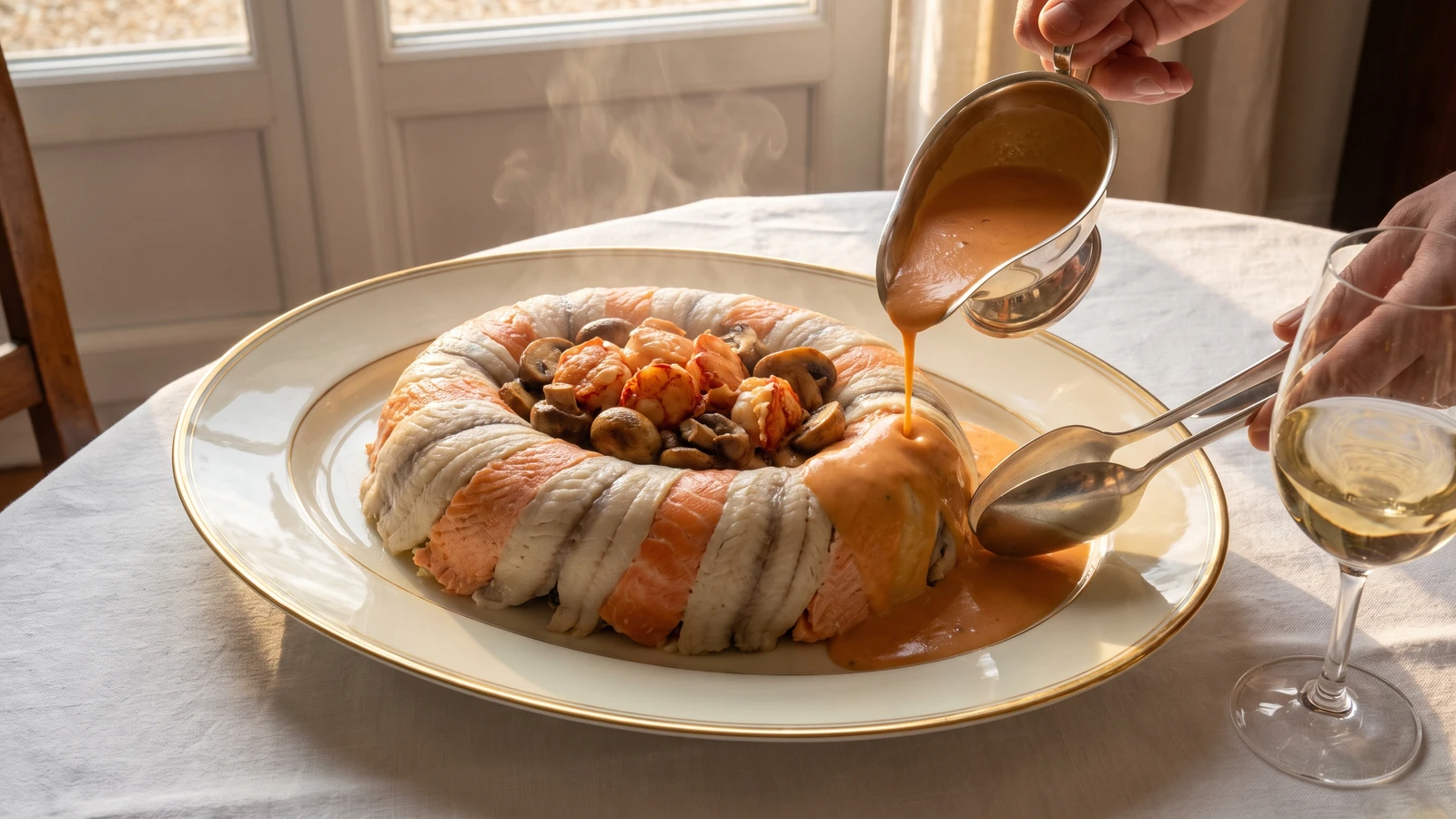
Alternating bands of white sole and red salmon become a tender moulded crown, its centre generous with lobster and mushrooms, while coral-tinted lobster-butter Béchamel supplies the sauce the Villaret name requires.
Turban de Filets de Soles et Saumon Villaret (a moulded crown of sole and salmon) teaches exact shaping under gentle heat. The one true thing to know before touching a pan is this: the white and orange strips must match in length, width, and thickness. If they do, they cook together and the crown reads cleanly; if they don't, one colour dries while the other slumps.
The original kitchen assumed a saucier on staff, a stock never off the fire, and a salamander within reach. This particular entry needs none of that background machinery except a properly made Béchamel and lobster butter ready to finish it. The home translation is a small savarin mould, a roasting pan for a bain-marie (water bath), and lobster butter drawn from the shell of the lobster already serving as garnish. One cook, one stove, one evening.
The fixed parts are the alternating crown and the Béchamel finished with lobster butter. Those steps are the dish and must stay. The source explicitly leaves the garnish open, so lobster meat and butter-browned mushrooms fill the centre here; using the same lobster for its meat and shell removes a separate brigade preparation without changing the Villaret intent.
When the crown turns out, its bands should be distinct, moist, and gently curved, with coral-ivory sauce gleaming around the base. Before the fish meets the mould, make those salmon slices answer exactly to the sole. That is the step that decides it.
Turban presentations belong to the formal Parisian classical table rather than to one provincial larder, using a ring mould to turn delicate fish fillets into a celebration centrepiece. In the Villaret form, the designation governs only the alternating white sole and red salmon of the crown; the garnish may change, while the Béchamel finished with lobster butter does not. The dish passed readily to bourgeois celebration tables because a savarin mould and gentle bain-marie could reproduce the essential form in a home oven.
Quantity
4 fillets, about 12 ounces (340 g) total
pin bones removed and kept cold
Quantity
12 ounces (340 g)
skin and pin bones removed and kept cold
Quantity
1 lobster, about 1½ pounds (680 g)
meat removed; shell rinsed, dried, and reserved
Quantity
1 tablespoon (15 ml / 14 g)
softened
Quantity
1½ teaspoons (7.5 ml / 8 g)
divided
Quantity
½ teaspoon (2.5 ml / 1 g)
divided
Quantity
6 tablespoons (90 ml / 85 g)
Quantity
2 cups (475 ml / 150 g)
wiped clean and quartered
Quantity
1 tablespoon (15 ml / 14 g)
Quantity
2 tablespoons (30 ml / 28 g)
Quantity
2 tablespoons (30 ml / 16 g)
Quantity
1½ cups (360 ml / 370 g)
warmed, with ¼ cup reserved for adjusting
Quantity
1 small pinch
| Ingredient | Quantity |
|---|---|
| large skinless sole filletspin bones removed and kept cold | 4 fillets, about 12 ounces (340 g) total |
| very red center-cut salmon, preferably sockeyeskin and pin bones removed and kept cold | 12 ounces (340 g) |
| cooked lobstermeat removed; shell rinsed, dried, and reserved | 1 lobster, about 1½ pounds (680 g) |
| unsalted butter for the mouldsoftened | 1 tablespoon (15 ml / 14 g) |
| fine sea saltdivided | 1½ teaspoons (7.5 ml / 8 g) |
| ground white pepperdivided | ½ teaspoon (2.5 ml / 1 g) |
| unsalted butter for the lobster butter | 6 tablespoons (90 ml / 85 g) |
| small button mushroomswiped clean and quartered | 2 cups (475 ml / 150 g) |
| unsalted butter for the mushrooms | 1 tablespoon (15 ml / 14 g) |
| unsalted butter for the Béchamel | 2 tablespoons (30 ml / 28 g) |
| all-purpose flour | 2 tablespoons (30 ml / 16 g) |
| whole milkwarmed, with ¼ cup reserved for adjusting | 1½ cups (360 ml / 370 g) |
| freshly grated nutmeg | 1 small pinch |
Break the reserved cooked lobster shell into thumb-sized pieces with kitchen shears. Melt the 6 tablespoons butter over low heat, add the shell, and cook gently for 10 minutes, stirring and pressing the pieces until the butter turns coral and smells unmistakably of lobster. Keep the milk solids pale. Strain through a fine sieve, pressing firmly; you need about 3 tablespoons of lobster butter for the sauce. Keep it fluid but not hot.
Heat the oven to 325°F (165°C). Lay the sole between sheets of parchment and gently even out any thick portions without crushing the flesh. Cut four neat strips, using the natural size of the fillets as your guide. Slice the salmon on a shallow angle into four pieces matching the sole in length, width, and thickness, about 5 by 13 cm and 4 to 5 mm thick. Season both fish lightly with half the salt and white pepper. Equal strips are the principle of the Villaret crown: they must bend and cook at the same rate.
Butter a 7-inch (18 cm), roughly 4-cup (1 litre) savarin mould generously. Lay one sole strip crosswise through the ring channel, prettiest face against the mould, then place a salmon strip beside it, overlapping the long edges by about ¼ inch (6 mm). Continue around the mould, alternating white and orange, and tuck the ends neatly against the inner and outer walls. Patch any small gap on the hidden inside with a fish trimming. If a strip tears, overlap it rather than discarding it; ça se rattrape. Cover and refrigerate while you prepare the garnish and sauce.
Cut the lobster meat into generous medallions and bite-sized pieces. Melt 1 tablespoon butter in a wide skillet over medium-high heat and sauté the mushrooms until their released liquid evaporates and their edges turn bronze, 6 to 8 minutes. Season lightly with some of the remaining salt and pepper, then set them beside the lobster. The lobster is already cooked, so do not add it to the hot pan and tighten it into rubber.
Melt 2 tablespoons butter in a saucepan over medium-low heat. Add the flour and whisk for 2 minutes without allowing it to colour; this is a roux blanc, a white roux, and cooking it removes the raw flour taste. Add all but the reserved ¼ cup warm milk in several additions, whisking each one smooth before adding the next. Simmer gently for 8 to 10 minutes, stirring into the corners, until the Béchamel is silky and coats the back of a spoon. Season with nutmeg and the remaining salt and white pepper. Press parchment directly onto its surface and hold it over very low heat.
Set the mould in a roasting pan. Cover the fish directly with a round of parchment, then cover the mould loosely with foil. Pour recently boiled water into the roasting pan until it reaches halfway up the mould, forming the bain-marie. Bake for 20 to 25 minutes, until the fish is just opaque and the centre of a thick strip reaches 145°F (63°C). A hard oven contracts the fish and opens the seams; the bain-marie keeps the crown tender and evenly set.
Lift the mould from the bain-marie, uncover it, and rest it for 3 minutes. Tip it carefully over the sink to drain the collected fish juices, then loosen only the inner and outer rims with a thin flexible spatula. Invert a warmed serving platter over the mould and turn both together. If the crown clings, lay a hot damp towel over the mould for 20 seconds and try again; do not shake it. The butter will release before the fish does.
Bring the Béchamel back to the faintest simmer, then remove it from the heat. Whisk in about 3 tablespoons lobster butter a spoonful at a time until the sauce is coral-ivory, glossy, and softly flowing. If it turns greasy, stop and whisk 1 tablespoon of the reserved cold milk in a clean saucepan, then add the sauce gradually; ça se rattrape. Fold the lobster and mushrooms into one-third of the sauce just long enough to warm them, then spoon this garnish into the centre of the crown. Pool some remaining sauce around the base and send the rest in a warm sauceboat so the white and orange bands remain visible. À table!
1 serving (about 340g)
Culinary guides, cultural storytelling, and the editorial depth that makes cooking meaningful.
Discover Culinary ExplorerChef Juliette
John Dory has the delicacy of sole and the firmness of turbot. A light flouring, a quick butter sauté, and nut-brown beurre noisette show exactly why looks never mattered.

Chef Juliette
Fresh haddock proves its delicacy in the meunière pan: a fine flour crust, moist pearly flakes, and beurre noisette sharpened with lemon and parsley, ready from one skillet in half an hour.

Chef Juliette
Éperlans à l’Anglaise turns small fish into a lesson in disciplined coating: boned smelts under a close, crisp crumb, pan-fried in clarified butter and finished with bright, half-melted maître d’hôtel butter.

Chef Juliette
Tiny smelts, shallot, mushrooms, white wine, gratin sauce, and fine bread raspings meet a fierce oven, where the fish must turn tender in the same breath the buttered crust bronzes.