
Chef Juliette
John Dory (St. Pierre)
John Dory has the delicacy of sole and the firmness of turbot. A light flouring, a quick butter sauté, and nut-brown beurre noisette show exactly why looks never mattered.
A cooking platform built around craft, culture, and the stories behind what we eat.
Created by Chef Juliette
Based on No. 907, Turban de Filets de Soles à la Villaret, from Le Guide Culinaire (1907) by Auguste Escoffier
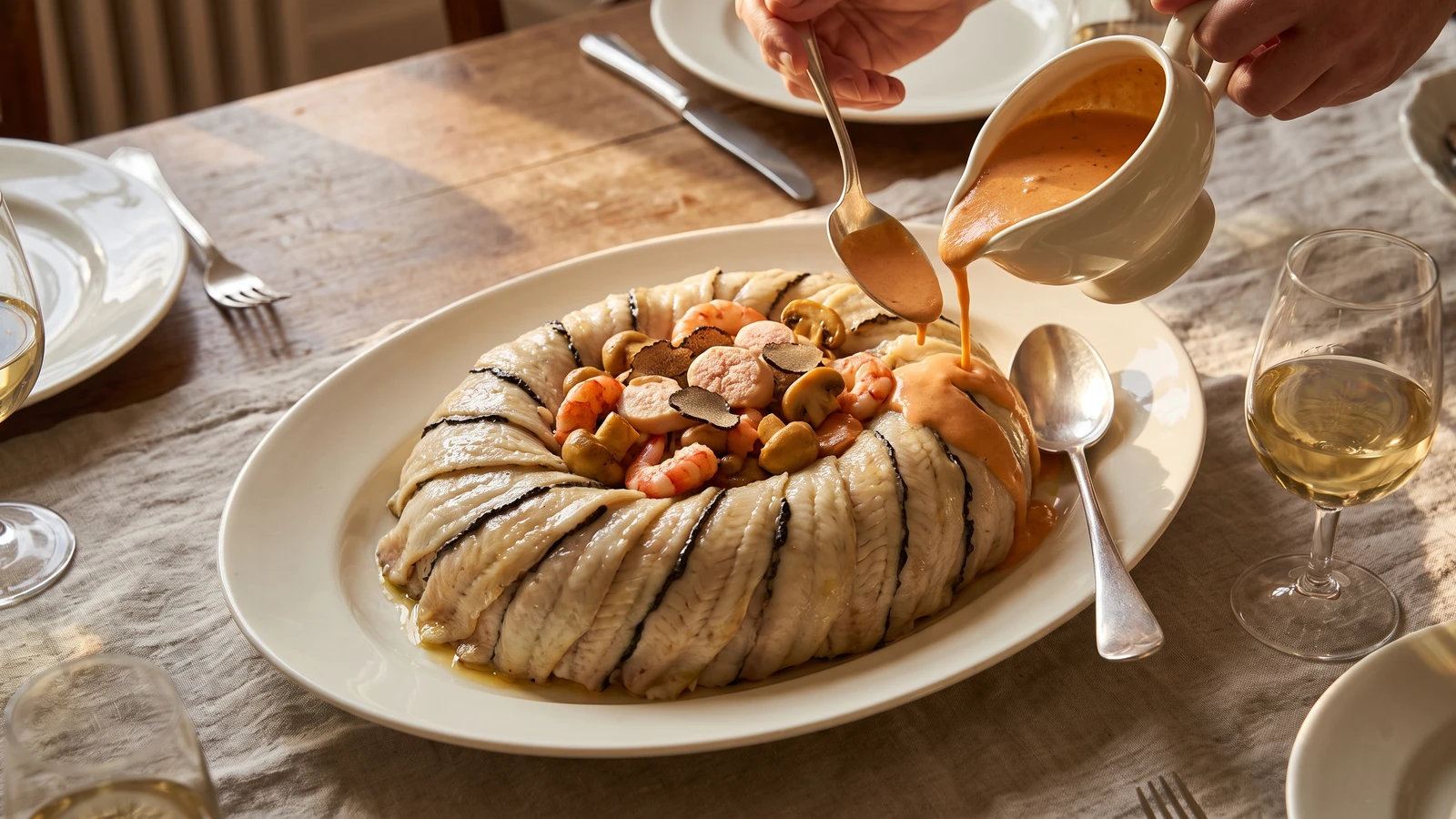
A crown of sole and truffle, filled with cold-worked lobster mousseline and poached gently in a bain-marie, then turned out under glossy lobster Béchamel: classical structure made possible for one careful home cook.
Turban de Filets de Soles à la Villaret (a crown of sole fillets filled with lobster mousseline) teaches one governing principle: temperature gives delicate forcemeat its structure. The lobster mousseline, a lobster paste lightened with cream, must remain truly cold while it is worked. Keep that emulsion intact and the crown will poach tender, hold its shape, and turn out with every ivory fillet and black truffle seam visible.
The original assumed a fish cook trimming sole, a saucier on staff holding Béchamel, a cold larder for the mousseline, and several hands bringing garnish and mould together at service. A stock never off the fire and a salamander belonged to that brigade too, but this entry uses neither, so neither is invented here. The honest home translation is an eight-inch Savarin-mould, a food processor in place of pounding and sieving, lobster butter pressed from the tail shells, and one saucepan used first for Béchamel and then for the garnish. One cook, one stove, one evening.
The separate hands and repeated sieving were brigade scaffolding, and they can go. The overlapping sole, truffle lining, cold mousseline, gentle bain-marie, careful draining, and lobster-butter finish are the dish and must stay. Fresh poached milt is now difficult to buy; soft cod roe remains the first choice, while a small scallop is the honest home equivalent, tender and marine but not identical. Before touching the pan, chill the lobster, cream, processor bowl, and blade. That is the step that decides everything.
Turban mouldings belong to the classical Parisian dining table, where fish fillets were arranged in a crown that could be carried whole into the dining room and portioned cleanly. À la Villaret is not a regional claim; the name identifies this particular composition of sole, truffle, lobster mousseline, poached milt, shrimp, mushrooms, and Béchamel enriched with lobster butter. The form passed naturally into bourgeois celebration cooking because a Savarin-mould and bain-marie could reproduce the grand kitchen's controlled poaching at home.
Quantity
8 fillets (18 oz / 510 g total)
trimmed straight
Quantity
1 small truffle (¾ oz / 20 g)
drained if necessary and thinly sliced
Quantity
3 tablespoons (45 ml / 42 g)
softened
Quantity
3 tails (about 18 oz / 510 g shell-on, yielding about 8 oz / 225 g meat)
meat and shells separated
Quantity
1 (about 2 tablespoons / 30 ml / 30 g)
Quantity
¾ cup (180 ml / 175 g)
very cold
Quantity
1¼ teaspoons (6 ml / 7.5 g)
divided
Quantity
¼ teaspoon (1.25 ml / 0.6 g)
divided
Quantity
4 tablespoons (60 ml / 56 g)
Quantity
2¼ cups (540 ml / 555 g)
divided, with ¼ cup reserved for adjustment
Quantity
3 tablespoons (45 ml / 42 g)
Quantity
⅓ cup (80 ml / 42 g)
Quantity
1 small pinch
Quantity
8 shrimp (3 oz / 85 g peeled weight)
peeled and deveined
Quantity
3 oz (85 g)
quartered
Quantity
3 oz (85 g)
roe left in its sacs, or scallops halved crosswise if large
Quantity
1 tablespoon (15 ml / 14 g)
| Ingredient | Quantity |
|---|---|
| thin skinless sole fillets, preferably Dover soletrimmed straight | 8 fillets (18 oz / 510 g total) |
| whole black truffle, fresh or jarreddrained if necessary and thinly sliced | 1 small truffle (¾ oz / 20 g) |
| unsalted butter for the mould and glazesoftened | 3 tablespoons (45 ml / 42 g) |
| raw cold-water lobster tailsmeat and shells separated | 3 tails (about 18 oz / 510 g shell-on, yielding about 8 oz / 225 g meat) |
| large egg white | 1 (about 2 tablespoons / 30 ml / 30 g) |
| heavy creamvery cold | ¾ cup (180 ml / 175 g) |
| fine sea saltdivided | 1¼ teaspoons (6 ml / 7.5 g) |
| ground white pepperdivided | ¼ teaspoon (1.25 ml / 0.6 g) |
| unsalted butter for the lobster butter | 4 tablespoons (60 ml / 56 g) |
| whole milkdivided, with ¼ cup reserved for adjustment | 2¼ cups (540 ml / 555 g) |
| unsalted butter for the Béchamel roux | 3 tablespoons (45 ml / 42 g) |
| all-purpose flour | ⅓ cup (80 ml / 42 g) |
| freshly grated nutmeg | 1 small pinch |
| small raw shrimppeeled and deveined | 8 shrimp (3 oz / 85 g peeled weight) |
| small button mushroomsquartered | 3 oz (85 g) |
| fresh soft cod roe or milt, or small dry sea scallopsroe left in its sacs, or scallops halved crosswise if large | 3 oz (85 g) |
| unsalted butter for the centre garnish | 1 tablespoon (15 ml / 14 g) |
Put the food processor bowl and blade in the freezer for twenty minutes. Keep the lobster meat and cream in the cold while you work, and reserve two tablespoons of the measured cream for testing and rescue. Chop the lobster shells into manageable pieces with sturdy kitchen shears. Cold is not tidiness here; it keeps the butterfat in the cream emulsified with the lobster proteins.
Melt the four tablespoons of butter for the lobster butter in a small saucepan over medium-low heat. Add the chopped shells and cook for eight to ten minutes, pressing and turning them until they are coral-red and the butter smells distinctly of lobster. Do not let the butter brown. Crush the shells firmly with a wooden spoon, then strain through a fine-mesh sieve and press until you have about three tablespoons of clear orange butter. Discard the shells and reserve the lobster butter.
Melt the three tablespoons of roux butter in a saucepan, stir in the flour, and cook gently for two minutes without allowing it to colour. Whisk in two cups of the milk a little at a time, making each addition smooth before adding the next. Bring to a bare simmer and cook for eight minutes, stirring along the pan floor, until the Béchamel coats a spoon without tasting floury. Season with one-half teaspoon of the salt, half the white pepper, and the nutmeg. If lumps appear, take the pan off the heat and whisk firmly; strain it if necessary. Press parchment against the surface and hold the sauce aside. The lobster butter goes in near service, not now.
Heat the oven to 325°F (165°C) and bring a kettle of water almost to the boil. Flatten each sole fillet gently between sheets of parchment with a moistened meat pounder or the base of a small saucepan, aiming for an even thickness of about one-eighth inch. Trim the long edges straight and season the fillets with one-quarter teaspoon of the salt. Butter an 8-inch (20 cm), 4-cup (1 L) Savarin-mould liberally with two tablespoons of the softened butter. Lay the fillets aslant around it, narrow ends hanging over the inner edge and wider ends over the outer edge, overlapping them slightly. Slip a thin truffle slice between each fillet and reserve the remaining truffle for the centre. Refrigerate the lined mould.
Put the cold lobster meat, the remaining one-half teaspoon salt, and the remaining white pepper in the chilled processor. Pulse until the meat becomes a fine, tacky paste, scraping the bowl once. Add the egg white and pulse only until absorbed. With the motor running in short bursts, add all but the reserved two tablespoons of cold cream in a thin stream. Stop as soon as the mousseline is smooth. Poach a teaspoonful in barely trembling water for two minutes; it should hold together and feel tender. If it is firm, pulse in the remaining cream one spoonful at a time. If the mixture turns glossy, loose, or greasy, stop immediately and set the processor bowl over ice for ten minutes, then pulse in one tablespoon of the reserved cream. Ça se rattrape. A warm mousseline cannot be bullied smooth.
Spoon the lobster mousseline into the lined mould, pressing it carefully against the sole so no air pockets remain. Tap the mould gently several times on a folded kitchen towel to settle the filling, then fold the overhanging ends of the fillets across it. Set the mould in a deep roasting pan and pour in the hot water to reach halfway up its sides, making a bain-marie, or hot-water bath. Poach in the oven for twenty-eight to thirty-five minutes, until the centre reaches 145°F (63°C) and springs back lightly. The water should quiver, never boil. If it begins bubbling hard, add a little cool water to the bath and lower the oven by 25°F (15°C); violent heat squeezes liquid from the mousseline and toughens the sole.
While the turban poaches, cook the garnish. If using soft cod roe or milt, lower the intact sacs into barely simmering salted water and poach for eight to ten minutes, until opaque and firm enough to slice; drain and cut into small medallions. If using scallops, poach them in barely simmering water for two to three minutes, until just opaque, then drain. Poach the shrimp in the same gentle fashion for one to two minutes, until curled and opaque. Melt the garnish butter in a skillet and cook the mushrooms for five minutes, until tender and lightly golden. Keep everything warm, not boiling.
Warm the Béchamel gently, whisking in enough of the reserved milk to restore a soft coating consistency. Take it off the heat and whisk in the lobster butter a spoonful at a time, keeping the sauce glossy and emulsified. If it looks oily around the edge, stop adding butter and whisk in one tablespoon of cold reserved milk before continuing. Fold about three-quarters cup of the lobster Béchamel through the shrimp, mushrooms, poached milt or scallops, and reserved truffle slices. Hold the remaining sauce in a warm sauceboat.
Lift the cooked turban from the bain-marie and let it stand for five minutes. Invert it onto a warm serving platter but leave the mould in place for two minutes so the released cooking liquid can drain. Tilt the mould slightly and blot away that liquid, then lift the mould straight up. If the fish clings, wrap the mould in a hot damp towel for ten seconds and try again; do not dig around the edge with a knife. Melt the remaining tablespoon of softened butter and brush it lightly over the sole, glazing the surface and sweeping away the pale froth left by its poached albumen.
Spoon the bound shrimp, mushroom, milt or scallop, and truffle garnish generously into the centre of the turban. Bring it to the table at once with the remaining lobster Béchamel in its sauceboat. Cut between the overlapping fillets so each serving receives sole, truffle, mousseline, and centre garnish. À table!
1 serving (about 450g)
Culinary guides, cultural storytelling, and the editorial depth that makes cooking meaningful.
Discover Culinary ExplorerChef Juliette
John Dory has the delicacy of sole and the firmness of turbot. A light flouring, a quick butter sauté, and nut-brown beurre noisette show exactly why looks never mattered.

Chef Juliette
Fresh haddock proves its delicacy in the meunière pan: a fine flour crust, moist pearly flakes, and beurre noisette sharpened with lemon and parsley, ready from one skillet in half an hour.

Chef Juliette
Éperlans à l’Anglaise turns small fish into a lesson in disciplined coating: boned smelts under a close, crisp crumb, pan-fried in clarified butter and finished with bright, half-melted maître d’hôtel butter.

Chef Juliette
Tiny smelts, shallot, mushrooms, white wine, gratin sauce, and fine bread raspings meet a fierce oven, where the fish must turn tender in the same breath the buttered crust bronzes.