
Chef Juliette
John Dory (St. Pierre)
John Dory has the delicacy of sole and the firmness of turbot. A light flouring, a quick butter sauté, and nut-brown beurre noisette show exactly why looks never mattered.
A cooking platform built around craft, culture, and the stories behind what we eat.
Created by Chef Juliette
Based on No. 906, Mousselines de Soles, from Le Guide Culinaire (1907) by Auguste Escoffier
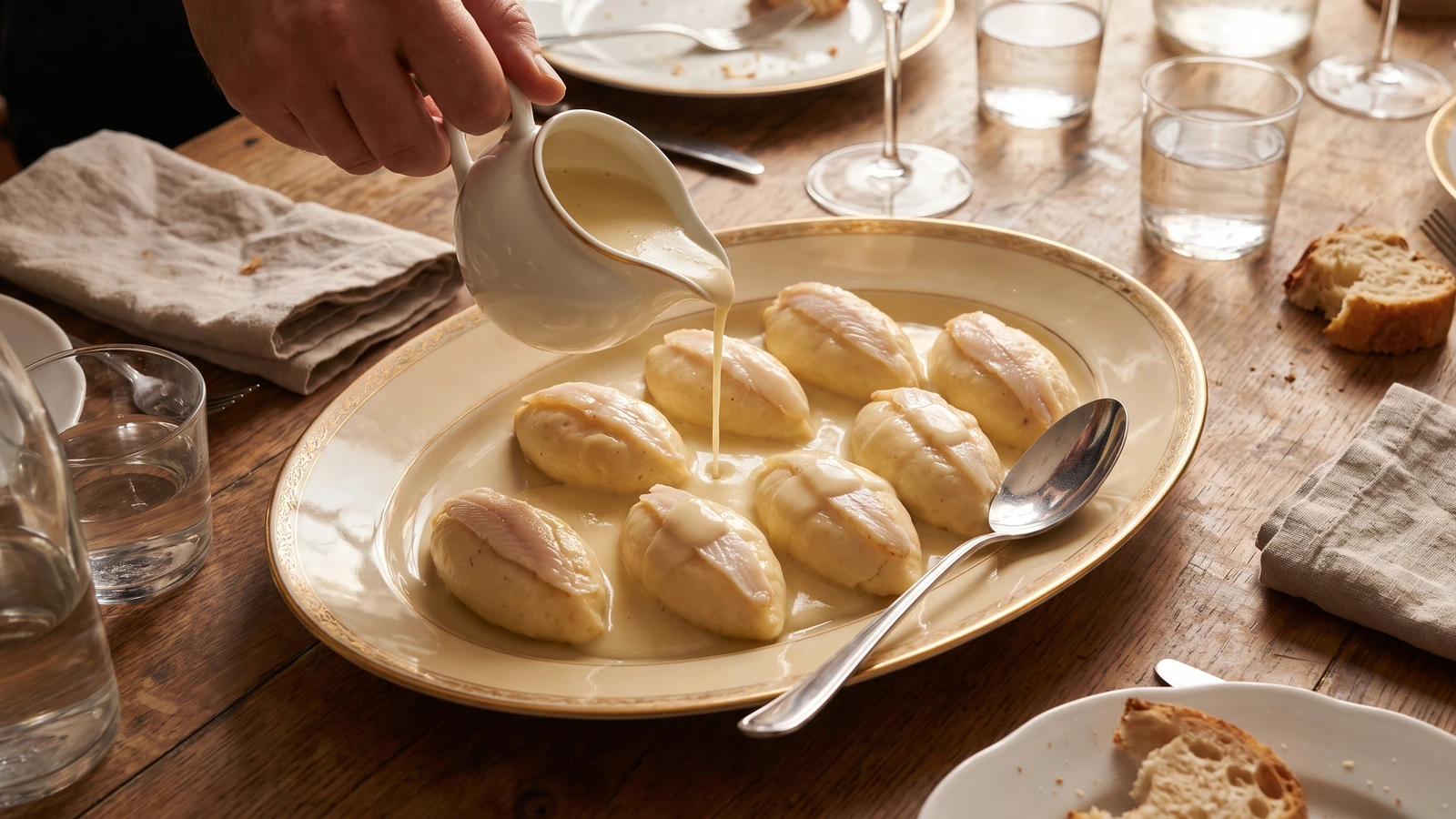
Large, feather-light quenelles of sole, spoon-shaped and gently poached, then served with the fish sauce or fresh vegetable purée your menu wants. The whole craft lies in keeping the mousseline cold and the water quiet.
Mousselines de Soles (large sole mousseline quenelles) teach one unyielding lesson: lightness is made in the cold. Keep the forcemeat chilled, handle it briefly, and poach it in water that barely trembles. When those three conditions meet, the mousselines swell into tender ovals with a fine, almost weightless crumb.
The original entry assumes Mousseline de Saumon (No. 797) already prepared, with sole substituted for salmon in precisely the same proportions, a saucier ready with whichever fish sauce the menu requires, and a poaching station waiting. A stockpot never off the fire may have fed that sauce, but no salamander belongs to this preparation. At home, one chilled batch, two ordinary tablespoons, a wide lidded pan, and one separately prepared sauce or vegetable purée do the work. The brigade's service quantities and separate shaping station are scaffolding, so they go; the cold forcemeat, spoon-moulding, fine raw slice of sole, and gentle poach are the dish, so they stay. One cook, one stove, one evening.
Done properly, each mousseline sits plump and pearly beneath its fine cap of sole, ready to take on a glossy fish sauce or a smooth vegetable purée without losing its own delicacy. Poach one small tester before shaping the rest. If it slumps, chill the mixture; if its edges fray, quiet the water. That little rehearsal protects everything that matters.
Mousselines de Soles belong to the Parisian classical grand-kitchen table, where mousseline forcemeat turned delicate fish into spoon-shaped quenelles light enough for formal service. The preparation passed naturally into bourgeois dining rooms because its elegance came from texture rather than ornament: sole replaced salmon without changing the proportions, while the accompanying fish sauce or fresh vegetable purée changed with the menu. Despite the name, mousseline here is not a sauce; it describes the exceptionally light forcemeat that gives the quenelle its character.
Quantity
1 home-scale batch Mousseline de Saumon (No. 797), sufficient for 4 servings
thoroughly chilled
Quantity
8 paper-thin slices (about 4 oz / 115 g)
trimmed to fit the mousselines
Quantity
1 tablespoon (15 ml / 14 g)
softened
Quantity
8 cups (1.9 L / 1.9 kg)
Quantity
2 teaspoons (10 ml / 12 g)
Quantity
2 cups (480 ml / about 480 g)
warmed for serving
| Ingredient | Quantity |
|---|---|
| mousseline forcemeat prepared with sole replacing salmon in unchanged proportionsthoroughly chilled | 1 home-scale batch Mousseline de Saumon (No. 797), sufficient for 4 servings |
| skinless sole fillettrimmed to fit the mousselines | 8 paper-thin slices (about 4 oz / 115 g) |
| unsalted buttersoftened | 1 tablespoon (15 ml / 14 g) |
| water | 8 cups (1.9 L / 1.9 kg) |
| fine sea salt | 2 teaspoons (10 ml / 12 g) |
| prepared fish sauce or fresh vegetable purée (optional)warmed for serving | 2 cups (480 ml / about 480 g) |
Butter a wide, shallow sauté pan and a circle of parchment large enough to cover its surface. Bring the water and salt just to a boil in a separate saucepan, then reduce the heat until the water holds at 180 to 185°F (82 to 85°C), with movement beneath the surface but no rolling bubbles. Set the chosen fish sauce or vegetable purée over the gentlest heat so it will be ready when the mousselines are.
Take the cold Mousseline de Saumon (No. 797), prepared with sole replacing salmon, from the refrigerator and poach a teaspoonful in the quiet water for 2 to 3 minutes. Cut and taste it: the texture should be tender, cohesive, and light. If it spreads or slumps, return the batch to the cold for 15 minutes; if its edges turn ragged, the water is too hot, so lower the heat before continuing. Ça se rattrape. Do not reach for flour or breadcrumbs, which would change the forcemeat rather than rescue it.
Dip two ordinary tablespoons into hot water and shake them nearly dry. Scoop a generous oval of the cold forcemeat with one spoon, then pass it between the spoons two or three times to smooth the surface. Shape 8 mousselines, working quickly and setting them in the buttered pan as you go. Use a light hand. Repeated shaping warms and compresses the mixture, and lightness is the whole dish.
Lay one fine raw slice of sole over each mousseline, trimming it if necessary so the forcemeat remains visible around the edge. Press only enough to make the slice adhere. The sole cap should follow the oval without squeezing or flattening it.
Pour the hot salted water gently around the mousselines until they are covered, taking care not to strike their delicate tops. Lay the buttered parchment directly over the surface, cover the pan, and poach for 10 to 12 minutes, keeping the liquid between 180 and 185°F (82 to 85°C). They are ready when slightly swollen, softly resilient at the centre, and at least 145°F (63°C) inside. If the water begins to boil, pull the pan off the heat for 30 seconds, then return it at a lower setting; if an edge starts to fray, tuck the parchment close and let the water settle before continuing.
Lift each mousseline with a slotted spoon or fish slice and rest it on a clean towel for 20 seconds, just long enough to remove excess water. Arrange two per person on warm plates. Pool the warm fish sauce around them, not over their fine sole caps, or set them on a generous bed of fresh vegetable purée. Serve immediately, while the texture is at its lightest. À table!
1 serving (about 145g)
Culinary guides, cultural storytelling, and the editorial depth that makes cooking meaningful.
Discover Culinary ExplorerChef Juliette
John Dory has the delicacy of sole and the firmness of turbot. A light flouring, a quick butter sauté, and nut-brown beurre noisette show exactly why looks never mattered.

Chef Juliette
Fresh haddock proves its delicacy in the meunière pan: a fine flour crust, moist pearly flakes, and beurre noisette sharpened with lemon and parsley, ready from one skillet in half an hour.

Chef Juliette
Éperlans à l’Anglaise turns small fish into a lesson in disciplined coating: boned smelts under a close, crisp crumb, pan-fried in clarified butter and finished with bright, half-melted maître d’hôtel butter.

Chef Juliette
Tiny smelts, shallot, mushrooms, white wine, gratin sauce, and fine bread raspings meet a fierce oven, where the fish must turn tender in the same breath the buttered crust bronzes.