
Chef Juliette
Filets de Soles Américaine
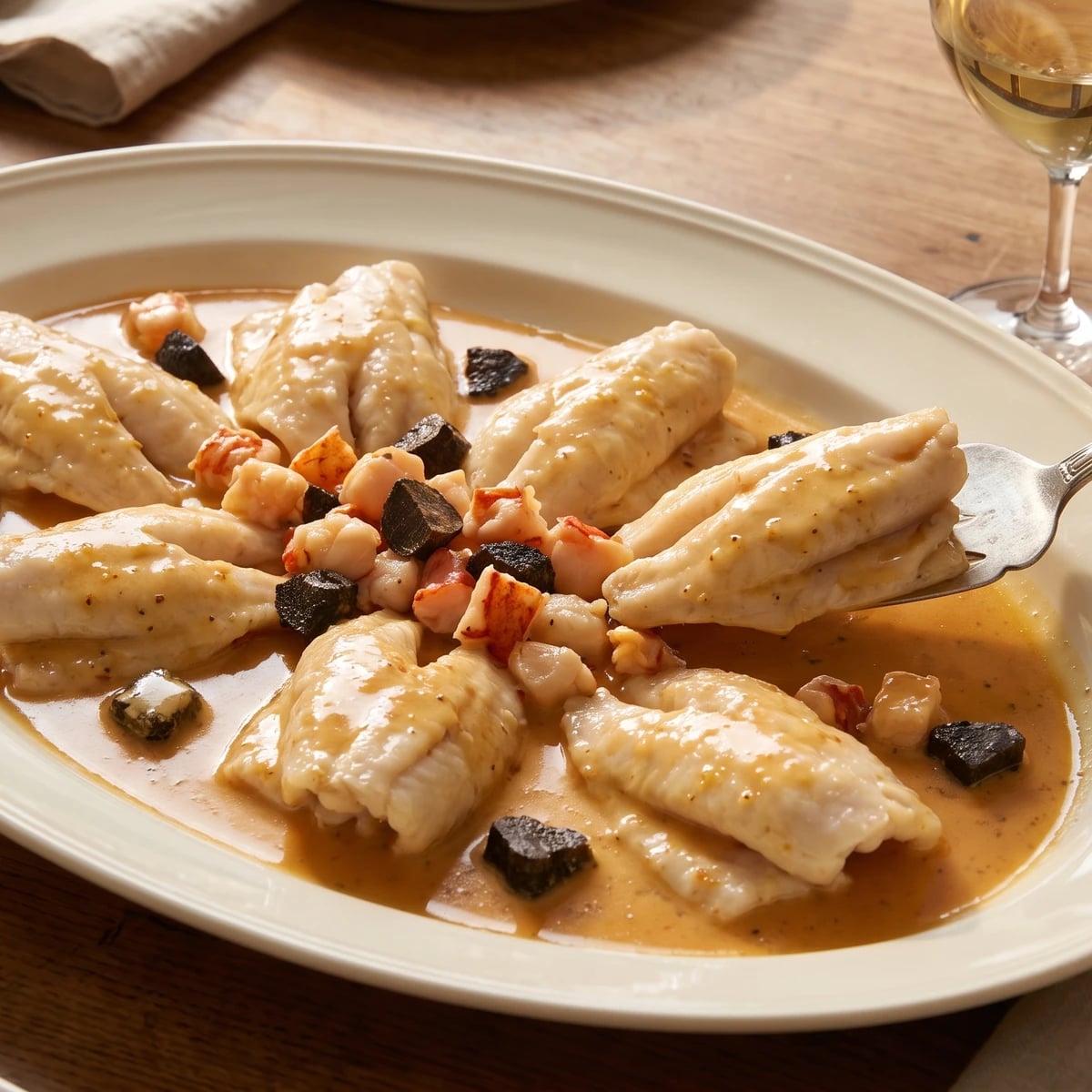
Folded sole, barely poached in fumet, circles lobster beneath a gleaming brandy-and-tomato shellfish sauce. The sauce is the whole dish, and gentle heat is the lesson.
A cooking platform built around craft, culture, and the stories behind what we eat.
Created by Chef Juliette
Based on No. 902, Filets de Soles Victoria, from Le Guide Culinaire (1907) by Auguste Escoffier
Folded Dover sole poached at a tremble, ringed around spiny lobster and black truffle, then cloaked in coral Victoria sauce and glazed fast: a lesson in gentle heat followed by decisive heat.
Filets de Soles Victoria (Victoria-style sole fillets) teaches a clean contrast: poach with restraint, glaze with speed. The one true thing to know before touching the pan is that sole must never boil. Its fumet, a concentrated fish essence, should barely tremble around the folded fillets, leaving them pearly, moist, and delicate enough to accept the rich sauce without disappearing beneath it.
The source formula assumed a saucier holding Victoria sauce, a stockpot that supplied fumet without pause, and a salamander fierce enough to glaze the platter in moments. At home, the separate sauce station is brigade scaffolding, so it goes. We make a small lobster butter from the reserved tail shells, turn the reduced poaching liquor into the sauce, and use a close, fully heated broiler. What stays is the dish itself: folded sole gently poached in fumet, the exact three-to-one weight of lobster to truffle, Victoria sauce, and the fast final glaze. One cook, one stove, one evening.
Keep the poach below a bubble. That quiet heat is the step that decides whether the sole reaches the table supple or tired, and everything after it moves quickly.
Filets de Soles Victoria belongs to the formal Parisian branch of the classical canon, where folded sole fillets became a canvas for prestige garnishes and sauces built from the fish's own cooking liquor. Victoria is not a coastal regional style from Normandy or Brittany: its identity is the precise union of sole, spiny-lobster tail, black truffle, and a quickly glazed lobster-enriched sauce. The formula traveled from grand dining rooms to bourgeois celebration tables because its drama comes from disciplined sauce work and arrangement, not from an enormous joint or a brigade at service.
Quantity
8 fillets, about 2½ ounces / 70 g each
Quantity
2 tails, yielding 1 cup (240 ml / 170 g) meat
tail meat diced and shells reserved
Quantity
⅓ cup (80 ml / 57 g)
cut into small dice
Quantity
½ cup (120 ml / 113 g)
divided
Quantity
2 cups (480 ml / 480 g)
Quantity
2 tablespoons (30 ml / 16 g)
Quantity
1 cup (240 ml / 240 g)
divided
Quantity
2
Quantity
1 tablespoon (15 ml / 15 g)
Quantity
1 teaspoon (5 ml / 6 g)
divided
Quantity
¼ teaspoon (1 ml / 0.5 g)
| Ingredient | Quantity |
|---|---|
| skinless Dover sole fillets | 8 fillets, about 2½ ounces / 70 g each |
| cooked spiny-lobster tails in shelltail meat diced and shells reserved | 2 tails, yielding 1 cup (240 ml / 170 g) meat |
| black trufflecut into small dice | ⅓ cup (80 ml / 57 g) |
| unsalted butterdivided | ½ cup (120 ml / 113 g) |
| fish fumet | 2 cups (480 ml / 480 g) |
| plain flour | 2 tablespoons (30 ml / 16 g) |
| heavy creamdivided | 1 cup (240 ml / 240 g) |
| large egg yolks | 2 |
| fresh lemon juice | 1 tablespoon (15 ml / 15 g) |
| fine sea saltdivided | 1 teaspoon (5 ml / 6 g) |
| finely ground white pepper | ¼ teaspoon (1 ml / 0.5 g) |
Remove the cooked tail meat from its shells, weigh out exactly 1 cup (240 ml / 170 g), and cut it into neat dice. Refrigerate the meat while you work. Snip the shells into pieces with kitchen shears and crush them firmly. Melt 5 tablespoons (75 ml / 71 g) of the butter over low heat, add the shells, and cook gently for 8 to 10 minutes, pressing them often, until the butter turns coral and smells distinctly of lobster. It must not brown. Strain through a fine sieve, pressing hard, to make beurre de homard (lobster butter); you should have about 3 tablespoons (45 ml / 42 g). Keep it soft, not hot.
Heat the oven to 325°F (165°C). Pat the fillets completely dry, then season both sides with ¾ teaspoon (4 ml / 4.5 g) of the salt and the white pepper. Fold each fillet into an even three-layer parcel, tucking the narrow tail end inward first so every piece has roughly the same thickness. Butter a wide ovenproof sauté pan with 1 tablespoon (15 ml / 14 g) of the remaining butter and arrange the fillets seam-side down in a single layer.
Pour the fish fumet around the fillets and set the pan over medium-low heat. The instant the liquid begins to tremble at the edges, cover the fish with buttered parchment or a close-fitting lid and transfer the pan to the oven. Poach for 7 to 10 minutes, until the fillets are pearly and just opaque at their folds, about 140°F (60°C) at the center; the final glaze will carry them to 145°F (63°C). If bubbles break across the surface, lift the pan from the heat and uncover it for 30 seconds before continuing more gently. Ça se rattrape, provided you stop the boil at once. Lift the fillets onto a tray with a fish spatula and cover them loosely with parchment.
Strain the poaching fumet into the sauté pan and reduce it briskly to 1 cup (240 ml / 240 g); the fish is out now, so the liquid may boil. Meanwhile, melt the remaining 2 tablespoons (30 ml / 28 g) plain butter in a 2-quart saucepan. Stir in the flour and cook this roux blanc (white roux) for 2 minutes without letting it color. Whisk in the reduced fumet a little at a time, then add ¾ cup (180 ml / 180 g) of the cream. Simmer gently for 3 to 5 minutes, whisking, until the sauce coats the back of a spoon in an even ivory layer. If small lumps remain, pass it through the fine sieve; cooking well is not cooking fancy, and a sieve settles the matter.
Whisk the yolks with 2 tablespoons (30 ml / 30 g) of the remaining cream. Whisk in a ladleful of hot sauce, then return this liaison, the egg-yolk and cream enrichment, to the saucepan. Stir over the lowest heat until the sauce thickens slightly and reaches 160°F (71°C), but never let it boil. Remove it from the heat and whisk in the lemon juice followed by the beurre de homard, a spoonful at a time. Season with the remaining salt. The finished Victoria sauce should fall from the spoon in a heavy, glossy ribbon. If the yolks grain or butter leaks at the edge, put 1 tablespoon (15 ml / 15 g) cold reserved cream in a clean warm bowl and whisk in the broken sauce one spoonful at a time. Use the final spoonful of cream to loosen the sauce if it holds too stiffly.
Set a broiler rack 5 to 6 inches (13 to 15 cm) below the element and heat the broiler fully. Let the lobster meat lose its refrigerator chill for 15 minutes, then combine it with the diced truffle. Arrange the folded sole fillets seam-side down in an oval on a shallow broiler-safe serving dish, leaving the center open. Mound the lobster and truffle in that center, keeping the source proportion intact: 6 ounces (170 g) lobster to 2 ounces (57 g) truffle. Spoon the hot Victoria sauce generously over both the fillets and their garnish, covering every exposed surface without flooding the rim.
Slide the platter under the broiler for 45 to 75 seconds, watching without looking away. Remove it as soon as the sauce tightens to a satin gloss and takes a few butter-gold freckles. This glaze is a sheen, not a crust; if it has not colored after one minute, serve it pale rather than sacrificing the sole to the broiler. Carry the platter directly to the table. À table!
1 serving (about 325g)
Culinary guides, cultural storytelling, and the editorial depth that makes cooking meaningful.
Discover Culinary Explorer
Chef Juliette
Folded sole, barely poached in fumet, circles lobster beneath a gleaming brandy-and-tomato shellfish sauce. The sauce is the whole dish, and gentle heat is the lesson.

Chef Juliette
A fine à l'anglaise crust, set the instant it touches hot clarified butter, protects tender sole before maître-d'hôtel butter melts across the ridges. The lesson is heat first, gentle frying second.

Chef Juliette
Pepper-filled sole paupiettes rise over butter-stewed tomatoes, capsicum risotto, and crisp aubergine, all glossed with lightly browned butter. The lesson is control: keep every element distinct and never let the poach boil.

Chef Juliette
Filets de Soles Caprice turns restraint into surprise: fine-crumbed sole grilled light gold, buttered banana laid over each fillet, and mustard-bright Sauce Robert sent separately so every bite balances sweet, savory, and sharp.