Culinary Explorer

A cooking platform built around craft, culture, and the stories behind what we eat.
Discover Culinary Explorer
Filets de Soles Pompadour

Filets de Soles Pompadour

Created by Chef Juliette

Based on No. 898, Filets de Soles Pompadour, from Le Guide Culinaire (1907) by Auguste Escoffier

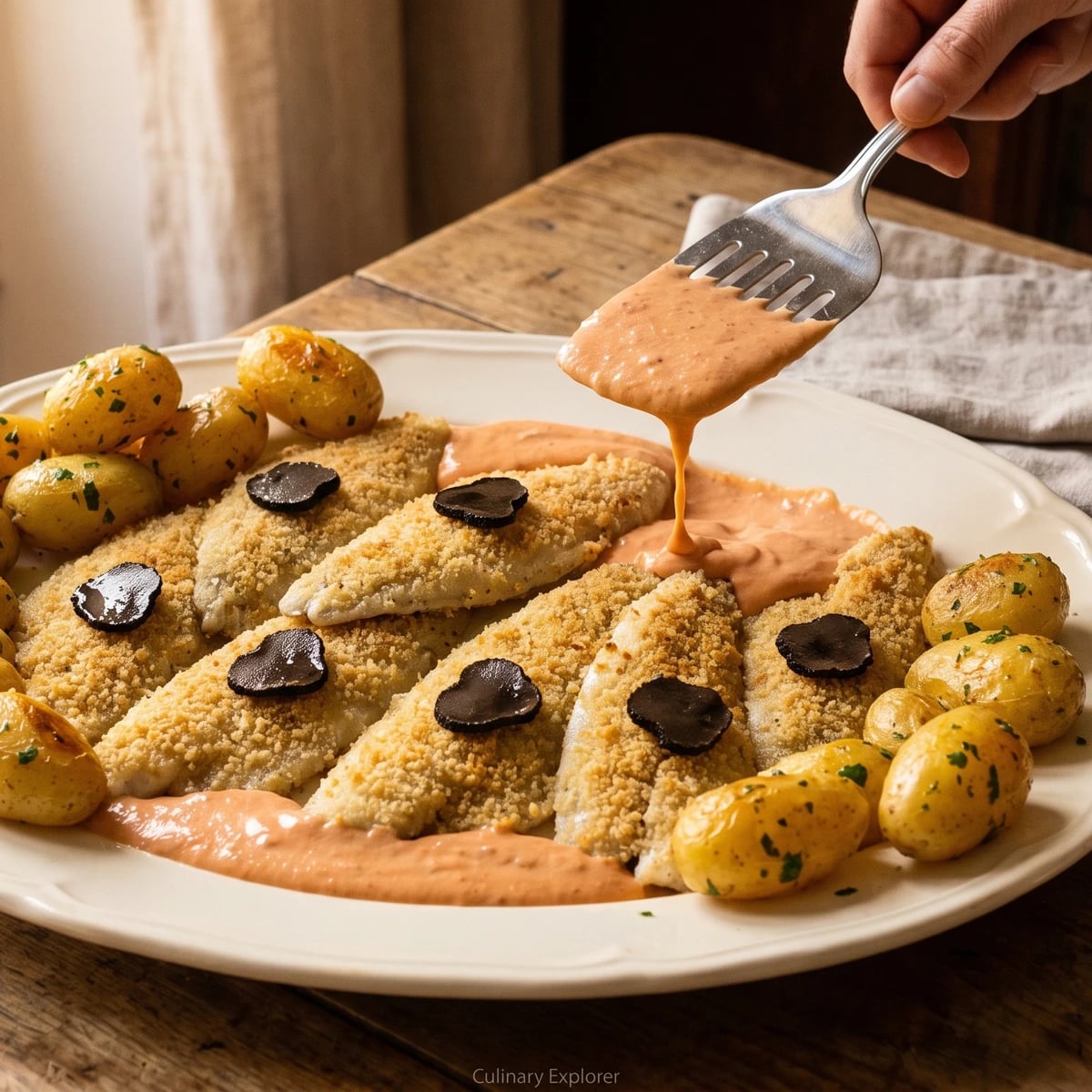
Buttered, crumbed sole beneath a bronzed broiler crust, bordered with tomato-tinted Béarnaise, Château potatoes, and glazed truffle: a formal composition whose success rests on one thing, an emulsion firm enough to stand.

Main Dishes
French
Dinner Party
Special Occasion
45 min
Active Time
50 min cook1 hr 35 min total
Yield4 servings

Filets de Soles Pompadour (Pompadour sole fillets) teaches coordination. The fish must reach the platter bronzed and moist just as the Béarnaise tomatée (tomato-tinted Béarnaise) becomes warm, glossy, and firm enough to hold a cord. Know this before touching a pan: the sauce is not meant to puddle. It must stand.

The original preparation assumed a saucier minding the emulsion, a stockpot never off the fire supplying meat glaze, a salamander for fierce overhead heat, and another pair of hands turning the potatoes. At home, a bowl over barely warm water replaces the saucier, good unsalted demi-glace reduced by half supplies the spoonful of meat glaze, and the ordinary broiler does the salamander's work. Eight fillets serve four, and the Pommes de Terre Château (No. 2208) arrive as their own finished preparation. That is the brigade scaled down honestly: one cook, one stove, one evening.

The holding pans and extra hands were scaffolding, so they can go. The buttered crumbs, grilled sole, firm Béarnaise tomatée, potatoes, and truffle are the dish, so every one stays. Whisk the yolks to a true ribbon before the butter enters; that sabayon is the step that makes the Béarnaise stand.

Filets de Soles Pompadour belongs to the Parisian grand-kitchen repertoire, where Channel sole was divided into neat fillets and given a composed garnish for formal service. Pompadour is an honorific menu name, not a coastal style or a regional tomato preparation; here its identity comes from grilled buttered crumbs, Béarnaise tomatée, Pommes de Terre Château (No. 2208), and truffle touched with meat glaze. The dish moved readily to the home table once the broiler replaced the salamander and small-batch emulsions made a dedicated saucier unnecessary.

The technique, the tradition, and the story behind every dish.

Discover Culinary Explorer

Ingredients

skinless Dover sole fillets

Quantity

8 fillets (about 1½ pounds / 680 g total)

pin bones removed

fine sea salt

Quantity

1 teaspoon (5 ml / 6 g)

divided

ground white pepper

Quantity

¼ teaspoon (1.25 ml / 0.5 g)

clarified unsalted butter

Quantity

1 cup (240 ml / 220 g)

warmed and divided

very fine fresh white breadcrumbs

Quantity

1 cup (240 ml / 70 g)

smooth canned tomato purée

Quantity

½ cup (120 ml / 125 g)

white wine vinegar

Quantity

2 tablespoons (30 ml / 30 g)

dry white wine

Quantity

2 tablespoons (30 ml / 30 g)

small shallot

Quantity

1 shallot (about 2 tablespoons / 30 g)

very finely chopped

black peppercorns

Quantity

6

lightly crushed

fresh tarragon leaves and tender stems

Quantity

2 tablespoons (30 ml / 4 g)

divided

fresh chervil leaves

Quantity

1 tablespoon (15 ml / 3 g)

finely chopped

large egg yolks

Quantity

3

cold water

Quantity

1 tablespoon (15 ml / 15 g)

Pommes de Terre Château

Quantity

4 servings (about 1¾ pounds / 800 g) Pommes de Terre Château (No. 2208)

finished and kept hot

fresh or preserved black truffle

Quantity

8 paper-thin slices (about ⅓ ounce / 10 g)

drained if preserved

meat glaze, or unsalted veal demi-glace

Quantity

1 tablespoon (15 ml / 18 g) meat glaze, or 2 tablespoons (30 ml / 35 g) demi-glace before reducing

melted

Equipment Needed

  • Small heavy saucepan for the tomato reduction
  • Small saucepan and medium heatproof bowl for the bain-marie
  • Balloon whisk
  • Broiler-safe rimmed sheet pan and wire rack
  • Thin flexible fish spatula
  • Piping bag or sturdy food bag with one corner cut
  • Large oval serving platter

Instructions

  1. 1

    Set the service

    Begin the Pommes de Terre Château (No. 2208) according to its own entry, timing the finished component to remain hot while the sole grills. Set the broiler rack about 6 inches from the heat and preheat the broiler thoroughly. Warm a large oval platter with hot water, then dry it just before plating. Measure ¾ cup (180 ml / 165 g) of the clarified butter for the sauce and reserve ¼ cup (60 ml / 55 g) for the fish.

  2. 2

    Build both reductions

    Cook the tomato purée in a small saucepan over medium-low heat, stirring often, until it reduces to about 3 tablespoons and looks thick, smooth, and brick red. Set it aside to remain warm. In a second small saucepan, combine the vinegar, wine, shallot, peppercorns, and half the tarragon. Simmer until only 2 tablespoons of sharp, fragrant liquid remain, then strain it into a heatproof bowl and press firmly on the aromatics. Reducing these foundations is the work; do not try to make the finished sauce firm by chilling it.

  3. 3

    Mount the Béarnaise

    Whisk the yolks, cold water, and strained vinegar reduction over a saucepan of barely simmering water. Keep the bowl above the water, never in it, and whisk until the yolks become pale, foamy, and thick enough to leave a clear ribbon for several seconds. Remove the bowl from the heat and whisk in the reserved ¾ cup of warm clarified butter drop by drop at first, then in a thin stream once the emulsion has taken. Fold in 2 tablespoons of the tomato reduction, the remaining chopped tarragon, the chervil, and enough salt and white pepper to sharpen the flavor. The Béarnaise tomatée should hold a firm ridge from the whisk. If butter begins to pool, stop adding it and whisk in a teaspoon of cool water; if the sauce breaks completely, place a teaspoon of cool water in a clean bowl and whisk in the broken sauce one spoonful at a time. Ça se rattrape. Hold the finished sauce over warm water, off the heat, for no longer than 30 minutes.

    A firm Béarnaise begins with a properly cooked sabayon. If the yolks never held a ribbon, more butter will only make a loose, greasy sauce.
  4. 4

    Crumb the sole

    Pat the sole completely dry and season both sides with the remaining salt and white pepper. Brush each fillet generously with the reserved clarified butter, then press it lightly into the fresh breadcrumbs so both sides wear a fine, even coat. Shake away loose crumbs and let the fillets rest on a broiler-safe rack for 5 minutes. No flour and no egg belong here; butter is what fastens the crumbs and gives them their flavor.

  5. 5

    Grill beneath the broiler

    Set the rack over a bare rimmed sheet pan and slide it beneath the fully heated broiler. Grill the first side for 3 to 4 minutes, until the crumbs are butter-gold with bronzed edges, then turn the fillets carefully with a thin spatula and grill for another 2 to 3 minutes. The sole is ready when the center has just turned opaque and flakes under gentle pressure, about 145°F (63°C) at the thickest point. If the crumbs color before the fish is ready, lower the pan one rack and finish more gently; if a patch of coating lifts during turning, press on fresh crumbs, touch them with butter, and give that spot another 30 seconds.

  6. 6

    Assemble without delay

    Warm the meat glaze only until fluid. Arrange the sole fillets in two slightly overlapping rows on the warmed platter, then spoon or pipe the firm Béarnaise tomatée in a continuous cord around them. If the sauce tightened while waiting, whisk in warm water a few drops at a time until it moves but still holds its shape. Surround the fish with the hot Pommes de Terre Château (No. 2208). Brush each truffle slice with melted meat glaze and lay one on every fillet. Carry the platter straight to the table. À table!

Chef Tips

  • Dover sole gives the sweetest flavor and finest texture, but good lemon sole or small flounder fillets can carry the method honestly. Keep the pieces equal in thickness so the broiler finishes them together.
  • Use fresh white breadcrumbs ground very fine. Dry commercial crumbs form a hard shell and drink too much butter; these fillets want a delicate coat that browns quickly before the fish dries.
  • Fresh black truffle is magnificent when available. A whole preserved black truffle, drained and sliced thinly, is the classical pantry's honest answer outside its season; oily imitation truffle slices are not.
  • The tomato should tint and steady the Béarnaise, not turn it into ketchup. Reduce plain canned purée slowly until its raw edge disappears, then add only enough to give the sauce a warm coral color.
  • Serve a dry white Burgundy or another full, mineral white with enough body for butter and truffle. Keep it cool rather than icy, or the wine will disappear beside the sauce.

Advance Preparation

  • The tomato purée and vinegar reductions can be made a day ahead and chilled separately. Bring both to a warm room temperature before mounting the sauce.
  • The sole may be buttered and crumbed up to 30 minutes ahead, then held uncovered in the refrigerator. Longer holding softens the crumbs.
  • Have the Pommes de Terre Château (No. 2208) completed within 15 minutes of serving. The Béarnaise tomatée may be held warm for 30 minutes, but it must never be refrigerated or reheated over direct heat.

Frequently Asked Questions

Nutrition Information

1 serving (about 460g)

Calories
1050 calories
Total Fat
79 g
Saturated Fat
47 g
Trans Fat
2 g
Unsaturated Fat
30 g
Cholesterol
405 mg
Sodium
1450 mg
Total Carbohydrates
51 g
Dietary Fiber
5 g
Sugars
5 g
Protein
34 g

Note: Chef personas and recipes are created with AI assistance. Cook with care: follow safe food-handling practices, check doneness with a thermometer when needed, and adapt for allergies and your kitchen.

Where cooking meets culture.

Culinary guides, cultural storytelling, and the editorial depth that makes cooking meaningful.

Discover Culinary Explorer

More from Fish - Fillets of Sole

Browse the full collection