
Chef Juliette
John Dory (St. Pierre)
John Dory has the delicacy of sole and the firmness of turbot. A light flouring, a quick butter sauté, and nut-brown beurre noisette show exactly why looks never mattered.
A cooking platform built around craft, culture, and the stories behind what we eat.
Created by Chef Juliette
Based on No. 888, Filets de Soles aux Huîtres, from Le Guide Culinaire (1907) by Auguste Escoffier
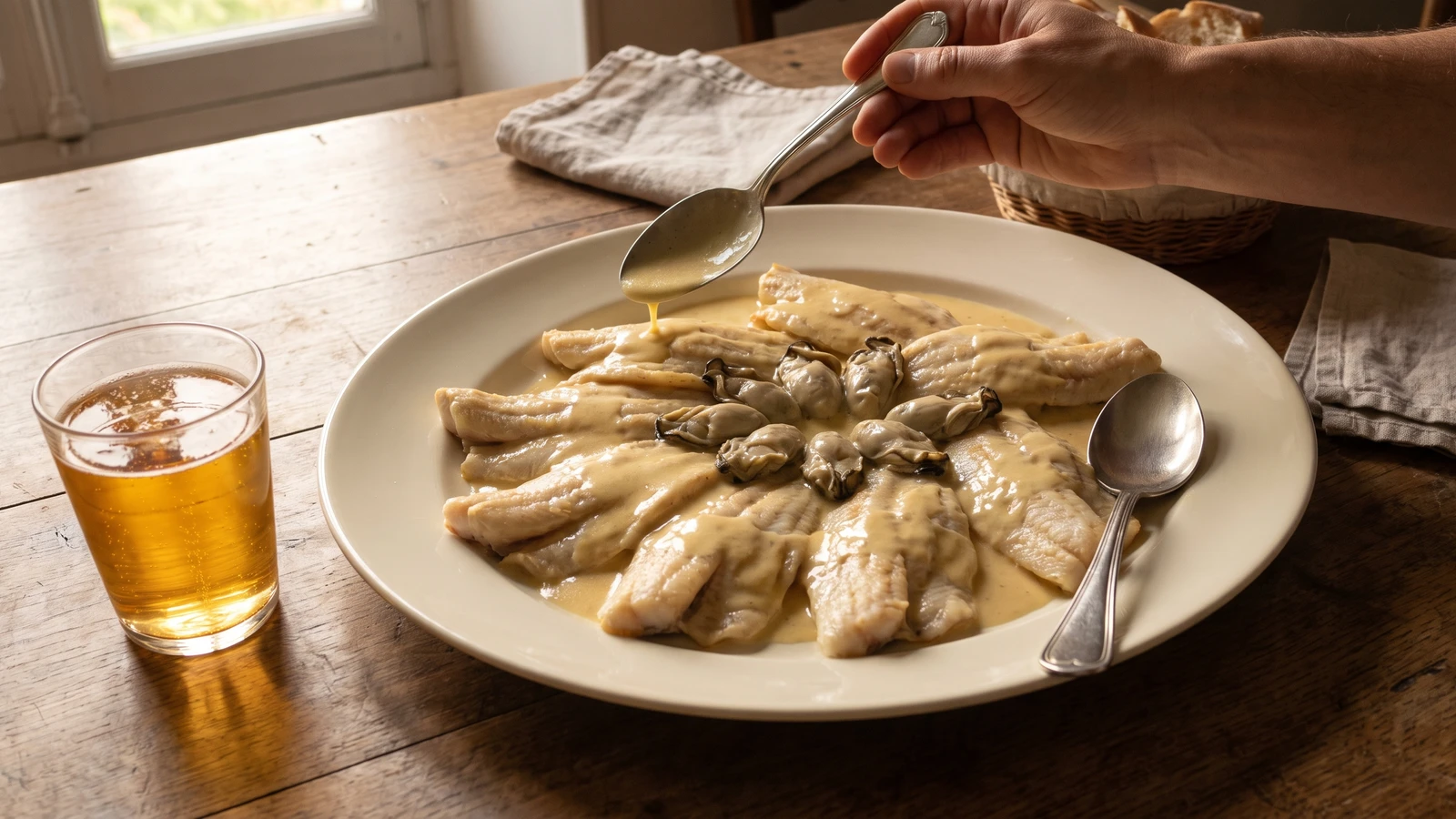
Folded sole and plump oysters under an ivory Sauce Normande, a study in gentle poaching and exact reduction where the sea seasons the sauce and butter gives it its gloss.
Filets de Soles aux Huîtres (folded sole fillets with oysters) teaches concentration without aggression. The one true thing to know before touching a pan is that oyster liquor is seasoning, not broth: strain it until perfectly clean, then reduce it gently, because one shell chip or one violent boil will bully the entire dish.
The original entry assumed a saucier with finished Sauce Normande waiting, fish stock never far from the fire, linen for straining, and enough hands to open oysters while the sole was portioned. At home, prepare the Sauce Normande in advance, strain through a damp coffee filter, and cook eight fillets for four people. The book leaves the quantity of sole to service, so that is the only portion translated. It needs no salamander because the dish is coated, not gratinéed. One cook, one stove, one evening.
The brigade scaffolding may go. The dish may not. Keep the twelve oysters, the walnut-sized piece of real butter, the folded poach, the reduced cooking liquor, and the oval arrangement exactly where they belong. The step that decides everything is the reduction: stop when the liquor tastes concentrated and clean, before salt overwhelms its sweetness.
Filets de soles aux huîtres belongs to Normandy's coastal register within the classical canon, where Channel sole, oysters, cream, and butter meet without southern herbs or olive oil. In grand kitchens, oyster liquor was never waste: strained and reduced, it sharpened Sauce Normande and carried the shellfish into every spoonful. The formal oval arrangement came from service, but the flavor grammar remains coastal and practical rather than ornamental.
Quantity
8 fillets (about 1½ lb / 680 g total)
pin bones removed
Quantity
12 oysters
scrubbed, with all their liquor
Quantity
2 tablespoons (30 ml / 28 g)
Quantity
1½ cups (360 ml / about 380 g)
1¼ cups warmed and ¼ cup kept cool for adjustment
Quantity
1 tablespoon (15 ml / 15 g)
only if needed to rescue the sauce
| Ingredient | Quantity |
|---|---|
| skinless sole filletspin bones removed | 8 fillets (about 1½ lb / 680 g total) |
| medium live oysters in their shellsscrubbed, with all their liquor | 12 oysters |
| unsalted butter | 2 tablespoons (30 ml / 28 g) |
| prepared Sauce Normande1¼ cups warmed and ¼ cup kept cool for adjustment | 1½ cups (360 ml / about 380 g) |
| cold water (optional)only if needed to rescue the sauce | 1 tablespoon (15 ml / 15 g) |
Warm 1¼ cups of the prepared Sauce Normande over the lowest heat, stirring often, until it flows readily from a spoon. Keep the remaining ¼ cup cool for adjustment. Do not let the warm sauce simmer; Sauce Normande is already finished, and hard heat can separate its butter and cream. Fill the serving platter with hot water so the porcelain loses its chill, then empty and dry it just before plating.
Discard any oyster that remains open when tapped. Hold each oyster cup-side down in a thick folded towel, open it with an oyster knife, and collect every drop of liquor in a bowl. Slide each oyster free and inspect it for shell fragments. Line a fine-mesh sieve with a damp coffee filter and strain the liquor into a wide sauté pan; the filter is the honest home equivalent of the linen named in the original.
Set the pan of strained liquor over gentle heat and add the oysters. Let the liquid come only to a quiet tremble, turning the oysters once, until they look plump and opaque, their edges begin to curl, and their centers reach 145°F / 63°C, about 1 to 2 minutes depending on size. Lift them out with a slotted spoon and cover loosely. Trim away any tough ragged fringe, the beard named in the classical instruction, and remove any last speck of shell. Keep every drop of liquor in the pan.
Fold each sole fillet neatly into thirds, with the smoother side facing outward and the final fold underneath. Arrange the fillets in one close layer in the oyster liquor and dot them with the butter, using all of it. Cover the fish directly with a round of parchment, then hold the liquid at the barest tremble until the fillets turn opaque, feel resilient under a fingertip, and reach 145°F / 63°C at their thickest point, about 5 to 7 minutes. A hard boil tightens sole and clouds the liquor; if the pan begins to bubble strongly, pull it from the heat for thirty seconds. Ça se rattrape.
Lift the sole carefully onto a warm tray, letting its juices drain back into the pan, and cover it loosely. Strain the cooking liquor into a small clean saucepan and reduce it at a controlled simmer until about ⅓ cup (80 ml / about 85 g) remains and the taste is distinctly of oysters but still rounded by butter. Taste twice as it reduces. If the salt turns sharp, stop immediately; salt does not cook away, it only concentrates, and the reserved Sauce Normande will provide the adjustment.
Off the heat, whisk the reduced cooking liquor gradually into the warm Sauce Normande, tasting as you go. Add the cool reserved sauce if the oyster liquor needs softening, then return the pan to the lowest heat only long enough for the sauce to nappe, coating the back of a spoon in an even ivory layer. Never boil it. If the sauce looks greasy or finely curdled, put the cold water in a clean bowl and whisk in one spoonful of broken sauce until smooth, then rebuild the rest spoonful by spoonful. Ça se rattrape.
Arrange the eight folded fillets in an overlapping oval on the warmed platter. Place the twelve oysters in the center, three for each serving, exactly as the source directs. Spoon the finished Sauce Normande generously over both fish and oysters, covering every surface without flooding the rim. Serve at once while the sole is tender and the sauce holds its gloss. À table!
1 serving (about 285g)
Culinary guides, cultural storytelling, and the editorial depth that makes cooking meaningful.
Discover Culinary ExplorerChef Juliette
John Dory has the delicacy of sole and the firmness of turbot. A light flouring, a quick butter sauté, and nut-brown beurre noisette show exactly why looks never mattered.

Chef Juliette
Fresh haddock proves its delicacy in the meunière pan: a fine flour crust, moist pearly flakes, and beurre noisette sharpened with lemon and parsley, ready from one skillet in half an hour.

Chef Juliette
Éperlans à l’Anglaise turns small fish into a lesson in disciplined coating: boned smelts under a close, crisp crumb, pan-fried in clarified butter and finished with bright, half-melted maître d’hôtel butter.

Chef Juliette
Tiny smelts, shallot, mushrooms, white wine, gratin sauce, and fine bread raspings meet a fierce oven, where the fish must turn tender in the same breath the buttered crust bronzes.