
Chef Juliette
John Dory (St. Pierre)
John Dory has the delicacy of sole and the firmness of turbot. A light flouring, a quick butter sauté, and nut-brown beurre noisette show exactly why looks never mattered.
A cooking platform built around craft, culture, and the stories behind what we eat.
Created by Chef Juliette
Based on No. 876, Filets de Soles Grand Duc, from Le Guide Culinaire (1907) by Auguste Escoffier
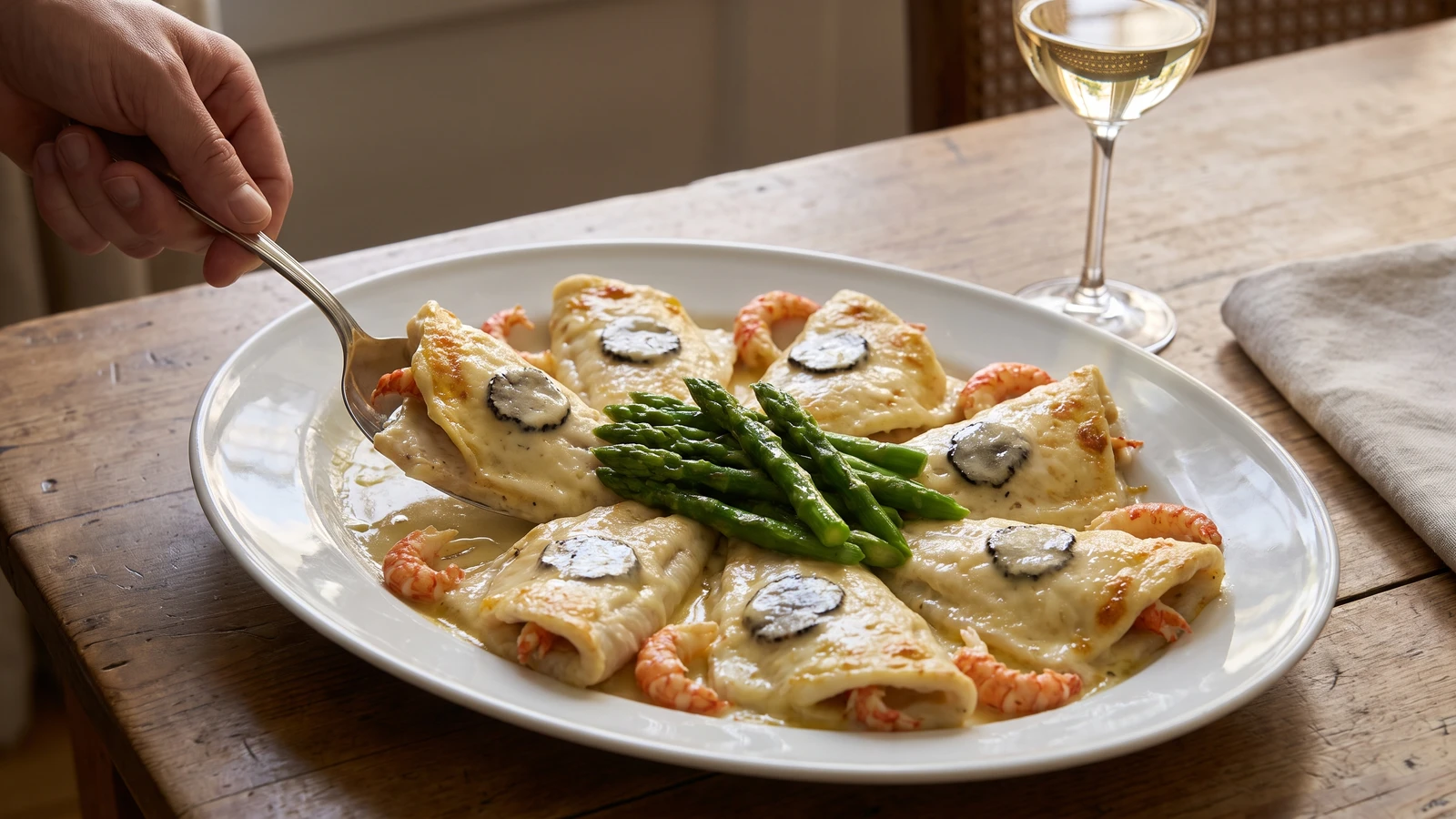
Filets de Soles Grand Duc brings gentle poaching, a reduced fumet, and a swift Mornay glaze into one composed platter, with truffle, crayfish tails, and green asparagus holding their proper places.
Filets de Soles Grand Duc (sole fillets with truffle, crayfish, asparagus, and glazed Mornay) teaches the discipline of composed fish cookery: every element is cooked separately, then brought together under one sauce without losing its own texture. The one true thing to know before touching a pan is this: the sole finishes twice, first in its poaching liquor and again beneath the glaze, so the poach must remain gentle and brief.
The original assumed a saucier on staff, fish fumet never far from the fire, mushroom liquor already waiting, and an overhead salamander fierce enough to color Mornay in moments. At home, make one quick mushroom liquor, hold a small Mornay base in a saucepan, and use a fully heated broiler over one oval platter. Cooked crayfish tails replace whole crayfish boiled and shelled to order, and a good preserved whole truffle may stand in when fresh is out of season. Those are changes of scale and equipment, not intent: eight folded fillets serve four, while the fumet poach, truffle, three crayfish tails between each fillet, Mornay glaze, and butter-bound asparagus all stay.
Making separate gallons of stock and sauce is brigade scaffolding, and it can go. Reducing the sole's poaching liquor into the Mornay is the dish, because it ties fish, mushroom, cheese, and cream into one flavor. The decisive step remains the poach: keep the liquor below a simmer and lift the sole while it is barely opaque, because the broiler finishes what the poacher begins.
Filets de Soles Grand Duc belongs to the formal Parisian grand-kitchen repertoire, where dishes were often named for ranks and patrons while their garnitures followed a precise culinary grammar. Grand Duc is not a regional sole preparation: the name identifies a lavish composition of sole, truffle, crayfish, asparagus, and glazed sauce, ingredients once managed by several stations and presented together from the dining-room platter. Recipe manuals carried that service into bourgeois celebration cooking, where the dish still makes sense when the labor is reduced but the arrangement is kept.
Quantity
8 fillets, about 2½ ounces (70 g) each, 1¼ pounds (560 g) total
Quantity
1¼ teaspoons (6 ml / 7 g)
divided
Quantity
¼ teaspoon (1 ml / 0.5 g)
Quantity
1 cup (240 ml / 240 g)
Quantity
3 cups sliced (720 ml / 225 g)
thinly sliced
Quantity
1 cup (240 ml / 240 g)
Quantity
1 tablespoon (15 ml / 14 g)
Quantity
2 teaspoons (10 ml / 9 g)
divided
Quantity
2 tablespoons (30 ml / 28 g)
Quantity
2 tablespoons (30 ml / 16 g)
Quantity
1 cup (240 ml / 245 g)
warmed
Quantity
⅓ cup (80 ml / 80 g)
divided
Quantity
½ cup finely grated (120 ml / 50 g)
finely grated
Quantity
¼ cup finely grated (60 ml / 20 g)
finely grated
Quantity
1 small pinch
Quantity
1 tablespoon (15 ml / 14 g)
cold and cubed
Quantity
1 small truffle, about ¾ ounce (20 g)
cut into 8 fine slices
Quantity
24 tails, about 1 cup (240 ml / 225 g)
thawed if frozen and dried well
Quantity
24 tips, about 1½ cups (360 ml / 140 g)
trimmed evenly
Quantity
2 tablespoons (30 ml / 28 g)
| Ingredient | Quantity |
|---|---|
| skinless Dover sole fillets | 8 fillets, about 2½ ounces (70 g) each, 1¼ pounds (560 g) total |
| fine sea saltdivided | 1¼ teaspoons (6 ml / 7 g) |
| ground white pepper | ¼ teaspoon (1 ml / 0.5 g) |
| fish fumet (concentrated fish essence) | 1 cup (240 ml / 240 g) |
| white button mushroomsthinly sliced | 3 cups sliced (720 ml / 225 g) |
| water | 1 cup (240 ml / 240 g) |
| unsalted butter for the mushroom liquor | 1 tablespoon (15 ml / 14 g) |
| softened unsalted butter for the poaching pan and platterdivided | 2 teaspoons (10 ml / 9 g) |
| unsalted butter for the roux | 2 tablespoons (30 ml / 28 g) |
| all-purpose flour | 2 tablespoons (30 ml / 16 g) |
| whole milkwarmed | 1 cup (240 ml / 245 g) |
| heavy creamdivided | ⅓ cup (80 ml / 80 g) |
| Gruyèrefinely grated | ½ cup finely grated (120 ml / 50 g) |
| Parmesanfinely grated | ¼ cup finely grated (60 ml / 20 g) |
| freshly grated nutmeg | 1 small pinch |
| cold unsalted butter for finishing the Mornaycold and cubed | 1 tablespoon (15 ml / 14 g) |
| fresh or preserved whole black trufflecut into 8 fine slices | 1 small truffle, about ¾ ounce (20 g) |
| cooked and shelled crayfish tailsthawed if frozen and dried well | 24 tails, about 1 cup (240 ml / 225 g) |
| green asparagus tipstrimmed evenly | 24 tips, about 1½ cups (360 ml / 140 g) |
| unsalted butter for binding the asparagus | 2 tablespoons (30 ml / 28 g) |
Heat the oven to 325°F (165°C). Run a fingertip over each sole fillet and remove any pin bones, then trim only ragged edges. Dry the fillets carefully and season them with half the salt and the white pepper. Fold each fillet once, bringing the thicker end over the thin end while leaving its pointed tail visible; keep them cold while you prepare the foundations.
Put the sliced mushrooms, water, 1 tablespoon butter, and a small pinch of the measured salt in a saucepan. Cover and hold at a gentle simmer for 10 minutes, until the mushrooms have surrendered their liquor but remain pale. Strain through a fine sieve without crushing them hard; measure ¾ cup (180 ml) of the clear cooking liquor and set it aside. The mushrooms have done their work here, so save them for an omelette or soup rather than crowding them onto this platter.
Melt the 2 tablespoons butter in a saucepan, stir in the flour, and cook this pale roux for 2 minutes without letting it color. Whisk in the warm milk gradually, making each addition smooth before adding the next. Hold at a quiet simmer for 5 minutes, whisking along the bottom, until the sauce is nappant, thick enough to coat the back of a spoon. Cover its surface directly and keep it warm; the poaching liquor and cheeses enter later.
Bring a saucepan of well-salted water to a lively boil. Add the asparagus tips and cook for 2 to 3 minutes, until vivid green and barely tender when pierced. Refresh them at once under very cold running water, then drain and dry them thoroughly. This stops their cooking now so they can be heated in butter at the final moment without losing their color.
Butter a wide shallow pan with 1 teaspoon of the softened butter and arrange the folded fillets in a single layer. Pour the fish fumet and the reserved mushroom cooking liquor around them, then cover closely with a lid or a round of parchment. Bring the liquid just to a tremble on the stove and transfer the pan to the oven for 6 to 9 minutes. Lift the sole as soon as it is barely opaque at the thickest fold, around 135°F (57°C); the glaze will finish it. Never let the liquor boil. Hard bubbling tightens these delicate fillets, and no sauce can give that tenderness back.
Lift the sole carefully with a fish spatula and let each fillet drain while loosely covered. Strain the poaching liquor into a clean saucepan and boil it down to ½ cup (120 ml), tasting near the end because its salt concentrates. Whisk the reduction and all but 1 tablespoon of the cream into the warm roux base, then simmer until it falls from the whisk in a broad ribbon. Take it off the heat before stirring in the Gruyère, Parmesan, nutmeg, and cold finishing butter. Do not boil after the cheese enters. If the Mornay turns oily or grainy, stop heating it. Ça se rattrape: whisk in the reserved cold cream a teaspoon at a time, then pass the sauce through a fine sieve. If it is too thick, loosen it with a spoonful of milk; if thin, reduce it before adding the cheeses.
Heat the broiler fully and set its rack about 6 inches (15 cm) from the element. Butter an oval broiler-safe platter with the remaining teaspoon of softened butter. Arrange the eight folded fillets in an oval with their pointed tails facing inward, exactly as the dish requires. Set one fine truffle slice in the middle of each fillet and place three crayfish tails between each neighboring pair. Spoon the Mornay evenly over the whole arrangement, coating it without burying its shape. If liquid seeps from the fish and thins the coating, tip it back into the saucepan and reduce briefly before trying again.
Slide the platter beneath the broiler for 2 to 4 minutes, watching without leaving it, until the Mornay blisters lightly and colors butter-gold at its highest points. This is a glaze, not a second bake. The fish should reach 145°F (63°C) at its thickest fold without drying. If the sauce remains pale after 3 minutes, move the platter slightly closer rather than extending the cooking.
While the platter glazes, melt the remaining 2 tablespoons butter in a small skillet. Add the asparagus tips with the last of the salt and toss only until hot, glossy, and lightly cohered by the butter. As soon as the platter leaves the broiler, heap the very green tips in its center and carry it directly to the table. The glaze should gleam, the sole should yield at the touch of the serving spoon, and the asparagus should still have a clean bite. À table!
1 serving (about 380g)
Culinary guides, cultural storytelling, and the editorial depth that makes cooking meaningful.
Discover Culinary ExplorerChef Juliette
John Dory has the delicacy of sole and the firmness of turbot. A light flouring, a quick butter sauté, and nut-brown beurre noisette show exactly why looks never mattered.

Chef Juliette
Fresh haddock proves its delicacy in the meunière pan: a fine flour crust, moist pearly flakes, and beurre noisette sharpened with lemon and parsley, ready from one skillet in half an hour.

Chef Juliette
Éperlans à l’Anglaise turns small fish into a lesson in disciplined coating: boned smelts under a close, crisp crumb, pan-fried in clarified butter and finished with bright, half-melted maître d’hôtel butter.

Chef Juliette
Tiny smelts, shallot, mushrooms, white wine, gratin sauce, and fine bread raspings meet a fierce oven, where the fish must turn tender in the same breath the buttered crust bronzes.