Culinary Explorer

A cooking platform built around craft, culture, and the stories behind what we eat.
Discover Culinary Explorer
Filets de Soles Bercy

Filets de Soles Bercy

Created by Chef Juliette

Based on No. 874, Filets de Soles Bercy, from Le Guide Culinaire (1907) by Auguste Escoffier

A Parisian lesson in gentle fish cookery: sole fillets barely baked in equal measures of white wine and fumet, basted with butter, then glazed just long enough to catch the light.

Main Dishes
French
Weeknight
Comfort Food
Dinner Party
20 min
Active Time
12 min cook32 min total
Yield4 servings

Filets de Soles Bercy (sole fillets with shallot, white wine, and fish fumet) teaches one true thing: baste, don't boil. The fillets sit on a bed of shallots in equal measures of wine and fumet while butter carries that fragrant liquor over the fish. Fumet means a concentrated fish essence, and here it supplies the foundation beneath an otherwise spare dish.

The classical entry assumed a saucier standing by to baste, fish stock never off the fire, and a salamander ready for the final glaze. The home equivalent is three tablespoons of finished fumet, a large spoon, a snug broiler-safe dish, and the top element of an ordinary oven. The unnamed brigade service becomes eight small fillets for four people, while the book's proportions remain intact. Its alternate saucepan reduction is scaffolding and can go tonight; the shallot bed, equal wine and fumet, repeated basting, and last-minute glaze are the dish and must stay. One cook, one stove, one evening.

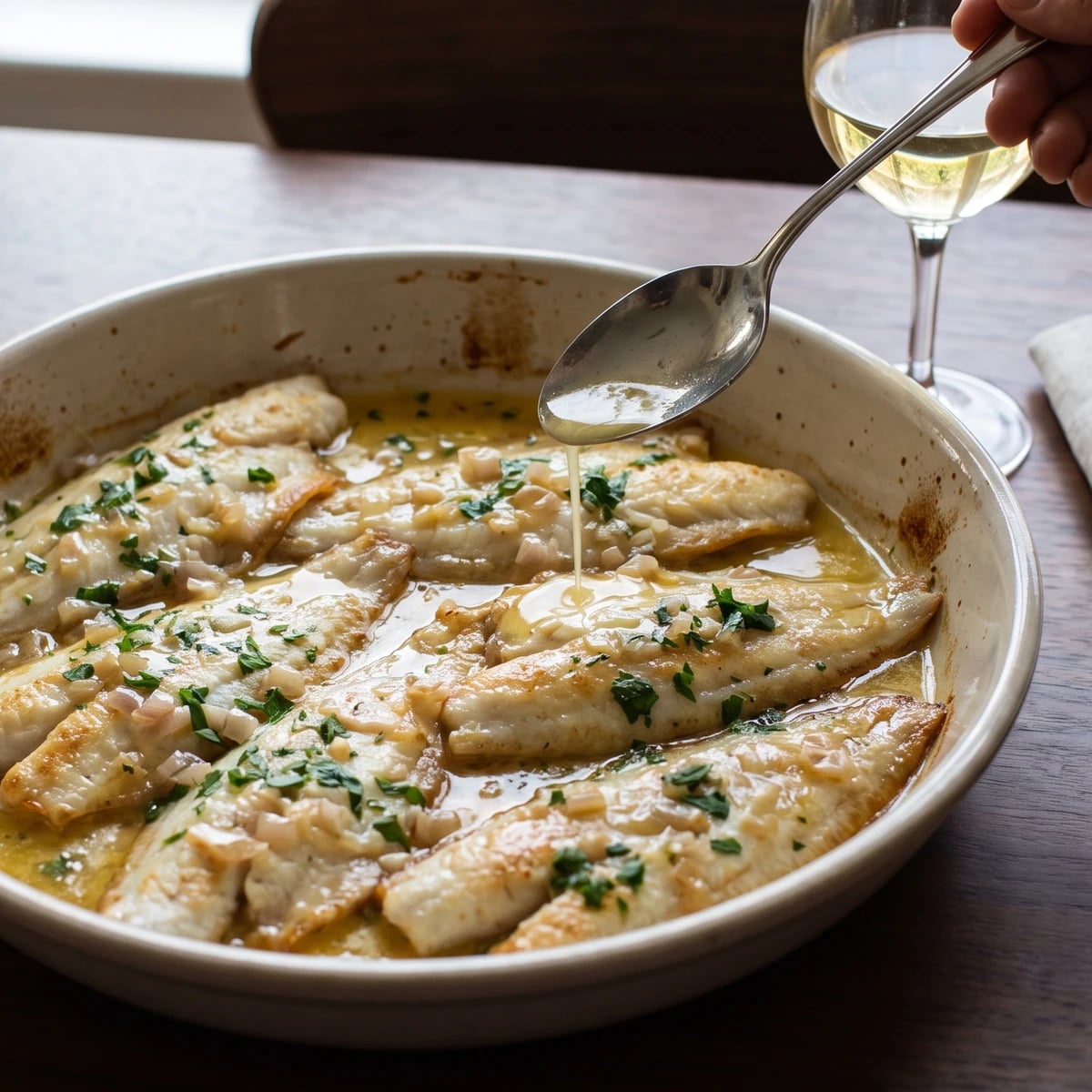
The finished sole should be tender and pearly beneath a butter-gold gloss, with lemon brightening the sauce only at the end. Watch the cooking liquor rather than the clock: it must barely tremble while you spoon it over the fillets. That is the step that decides Filets de Soles Bercy.

Filets de Soles Bercy belongs to Bercy, the eastern Paris quarter whose cellars and warehouses handled the capital's wine, which explains why white wine stands at the center of the preparation. The canonical à la Bercy treatment joins shallots, wine, fish liquor, butter, and parsley, and it may be built either directly around the fish or reduced separately before coating it. Bercy was not a coastal fishing village; the name records a Parisian wine trade and the kitchen method that grew beside it.

The technique, the tradition, and the story behind every dish.

Discover Culinary Explorer

Ingredients

skinless sole fillets

Quantity

8 (about 1½ lb / 680 g total)

pin bones removed and patted dry

small shallots

Quantity

2 (¼ cup / 40 g)

very finely chopped

unsalted butter

Quantity

1 tablespoon plus 1 teaspoon (20 ml / 19 g)

divided

dry white wine

Quantity

3 tablespoons (45 ml / 44 g)

fish fumet

Quantity

3 tablespoons (45 ml / 45 g)

fresh lemon juice

Quantity

½ teaspoon (2.5 ml / 2.5 g)

flat-leaf parsley

Quantity

1 tablespoon (15 ml / 4 g)

very finely chopped

Equipment Needed

  • Shallow 9 by 13-inch (23 by 33 cm) broiler-safe baking dish
  • Large basting spoon
  • Thin fish spatula

Instructions

  1. 1

    Prepare the baking dish

    Set a rack in the upper third of the oven, about 6 inches (15 cm) below the broiler element, and heat the oven to 375°F (190°C). Butter a shallow broiler-safe baking dish with the reserved 1 teaspoon (5 ml / 5 g) butter, coating the bottom generously, then scatter the chopped shallots across it in an even layer.

    Choose a dish that holds the fillets snugly in one layer. In a dish that is too broad, the small measure of cooking liquor evaporates before it can baste the fish.
  2. 2

    Arrange and moisten

    Lay the dry sole fillets lengthwise over the shallots, side by side without overlapping. If a tail end is much thinner than the rest, tuck it beneath itself so it cooks at the same pace. Pour the white wine and fish fumet around the fillets, preserving the book's equal measure of each, then cut the remaining 1 tablespoon (15 ml / 14 g) butter into small pieces and dot them over the fish.

  3. 3

    Bake and baste

    Bake uncovered for 8 to 12 minutes. After the first 3 minutes, tilt the dish carefully and spoon the wine, fumet, and melted butter over every fillet; repeat every 2 minutes. The liquor should barely tremble at the edges, never roll at a boil. If it boils hard or the fillet edges begin to contract, take the dish out for 1 minute, lower the oven to 350°F (175°C), and baste before returning it. Ça se rattrape: interrupting the fierce heat prevents the delicate flesh from toughening further. Begin checking at 8 minutes; the centers should be pearly opaque and just separate when nudged, with enough tenderness left for the final glaze.

    Frequent basting is not ceremony. It keeps the thin surface moist while butter and fish juices bind into a light, glossy cooking liquor.
  4. 4

    Glaze under broiler

    Turn the oven to its high broiler or grill setting. Baste the fillets once more, then place the dish beneath the element for 30 to 60 seconds. Glacer, to glaze, means setting a glossy film with only the faintest gold at the raised edges, not building a browned crust. If the surface remains matte, baste again and give it another 15 seconds; if the edges color first, pull the dish immediately. This brief broiler finish is the honest home equivalent of the salamander.

  5. 5

    Finish and serve

    Distribute a few drops of lemon juice over each fillet, then place a small pinch of chopped parsley on every one, exactly as the entry directs. Spoon the buttery shallot cooking liquor from the dish around and over the fish, and serve immediately in the dish in which it cooked. À table!

Chef Tips

  • Ask for thin, skinless sole fillets of similar size. Dover sole has the finest texture, but gray sole or another delicate flatfish is an honest home-market equivalent; thick cod or halibut changes both the cooking time and the character of the dish.
  • Use finished fish fumet, not undiluted concentrate straight from a jar. It should taste clean, concentrated, and marine without being aggressively salty, because three tablespoons carry the foundation of the entire cooking liquor.
  • Choose a dry white wine with bright acidity and little obvious oak. Use the same bottle at the table; there is too little wine in the dish for a poor one to hide.
  • A snug dish is part of the technique. The fillets need room to lie flat, but no empty acreage around them, or the wine and fumet disappear before the fish is ready.
  • Filets de Soles Bercy waits for no one. Leftovers may be covered and chilled for one day, but the sole will firm as it reheats, so assemble the table before the fish enters the oven.

Advance Preparation

  • The shallots and parsley may be chopped up to 6 hours ahead and refrigerated separately in covered containers.
  • Measure the white wine and finished fish fumet earlier in the day and keep them chilled. Bring the fumet just to cool room temperature while the oven heats so it does not arrest the cooking.
  • Do not assemble the fish in the wine ahead of time. The wine's acidity begins firming the delicate surface, so arrange and moisten the fillets only when the oven is ready.

Frequently Asked Questions

Nutrition Information

1 serving (about 160g)

Calories
185 calories
Total Fat
6 g
Saturated Fat
3 g
Trans Fat
0 g
Unsaturated Fat
3 g
Cholesterol
95 mg
Sodium
200 mg
Total Carbohydrates
2 g
Dietary Fiber
0 g
Sugars
1 g
Protein
30 g

Note: Chef personas and recipes are created with AI assistance. Cook with care: follow safe food-handling practices, check doneness with a thermometer when needed, and adapt for allergies and your kitchen.

Where cooking meets culture.

Culinary guides, cultural storytelling, and the editorial depth that makes cooking meaningful.

Discover Culinary Explorer

More from Fish - Fillets of Sole

Browse the full collection