
Chef Juliette
John Dory (St. Pierre)
John Dory has the delicacy of sole and the firmness of turbot. A light flouring, a quick butter sauté, and nut-brown beurre noisette show exactly why looks never mattered.
A cooking platform built around craft, culture, and the stories behind what we eat.
Created by Chef Juliette
Based on No. 849, Sole Lutèce, from Le Guide Culinaire (1907) by Auguste Escoffier
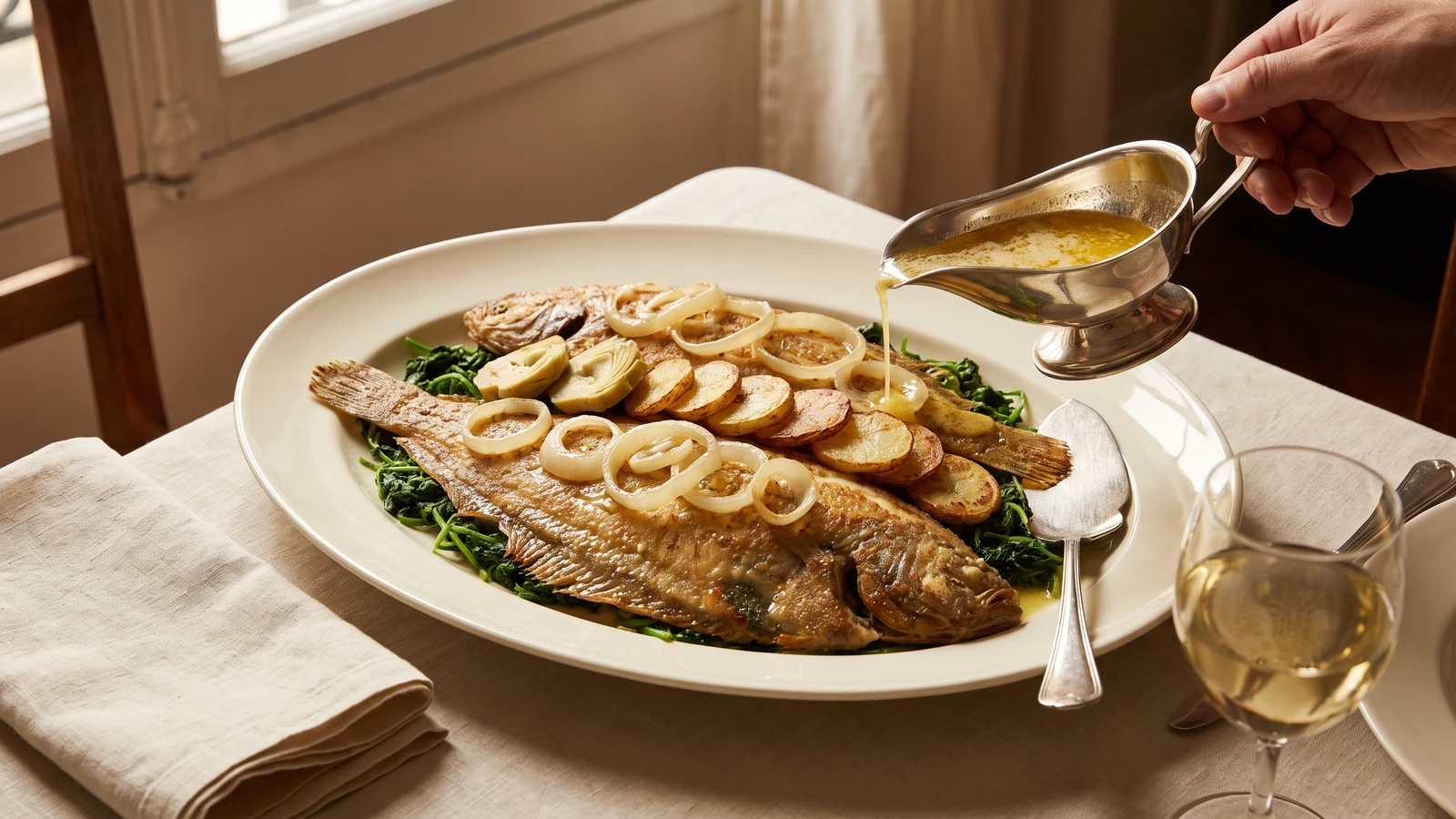
A Parisian lesson in timing: meunière sole laid over butter-browned spinach, crowned with onion and artichoke, bordered by golden potatoes, then finished at the last moment with beurre noisette.
Sole Lutèce, sole floured and sautéed in butter over spinach with onion, artichoke, and potato, teaches one true thing: the fish must be the last component cooked. The meunière method, flouring the sole lightly and sautéing it in butter, is quick and unforgiving of delay. Have every vegetable ready, every plate warm, and every guest nearly seated before the sole meets the pan.
The grand kitchen surrounding this entry would have had a saucier on staff, stock never off the fire, a salamander ready, and several cooks working at once, although Sole Lutèce calls for neither stock nor a salamander. Its hidden advantage was parallel labor. At home, one wide skillet, one low oven, and strict sequencing replace those extra hands. Two table-sized soles serve four, and plain preserved artichoke bottoms replace freshly turned and cooked bottoms because they give the correct tender ingredient without an afternoon of trimming. Parallel service is scaffolding and can go. The meunière cooking, buttered spinach, onion and artichoke crown, boiled-then-browned potato border, and final beurre noisette, lightly browned butter, are the dish and must stay.
When it lands on the table, the sole is pale gold, the spinach deep green, the potatoes bronzed at their edges, and butter gleams over everything without drowning it. Build the garnishes first and keep them warm, then flour and cook the fish only when the platter is ready to receive it. That order decides the dish.
Lutèce, the French form of Lutetia, is the old name of Paris, and Sole Lutèce belongs to the capital's classical table rather than to a provincial larder. The title is a learned Parisian flourish, not a claim that the recipe came from Lutetia's own kitchens; its substance is the familiar canon of meunière fish, buttered vegetables, and an orderly composed garnish. It passes naturally from grand service to the home table once parallel labor is removed and the original sequence is kept intact.
Quantity
2, about 1 to 1¼ pounds (450 to 570 g) each
cleaned, with dark skin removed, white skin scaled, and side fins trimmed
Quantity
12 loosely packed cups (12 oz / 340 g)
thoroughly dried and finely shredded
Quantity
4 bottoms (8 oz / 225 g drained)
cut into ¼-inch slices
Quantity
1 medium (5 oz / 140 g)
cut crosswise into thin rings
Quantity
4 medium (1½ lb / 680 g)
peeled and cut into ¼-inch rounds
Quantity
1⅜ cups (11 oz / 312 g)
divided
Quantity
½ cup (2.1 oz / 60 g)
Quantity
1½ tablespoons (0.9 oz / 25 g)
divided
Quantity
½ teaspoon (0.04 oz / 1 g)
divided
| Ingredient | Quantity |
|---|---|
| whole Dover solescleaned, with dark skin removed, white skin scaled, and side fins trimmed | 2, about 1 to 1¼ pounds (450 to 570 g) each |
| fresh spinachthoroughly dried and finely shredded | 12 loosely packed cups (12 oz / 340 g) |
| plain cooked artichoke bottomscut into ¼-inch slices | 4 bottoms (8 oz / 225 g drained) |
| yellow onioncut crosswise into thin rings | 1 medium (5 oz / 140 g) |
| waxy potatoespeeled and cut into ¼-inch rounds | 4 medium (1½ lb / 680 g) |
| unsalted butterdivided | 1⅜ cups (11 oz / 312 g) |
| all-purpose flour | ½ cup (2.1 oz / 60 g) |
| fine sea saltdivided | 1½ tablespoons (0.9 oz / 25 g) |
| finely ground white pepperdivided | ½ teaspoon (0.04 oz / 1 g) |
Heat the oven to 200°F (95°C) and warm a large ovenproof oval platter inside. Set the shredded spinach, onion rings, artichoke slices, and potato rounds beside the stove in separate bowls. Pat the soles completely dry, but do not flour them yet. Measure the butter into portions: 5 tablespoons for the potatoes, 3 for the onion and artichoke, 4 for the spinach, 6 for the soles, and 4 for the final beurre noisette.
Put the potato rounds in a wide saucepan, cover them with cold water, and season the water with 1 tablespoon of the salt. Bring it slowly to a gentle simmer and cook for 6 to 8 minutes, until a knife enters with slight resistance. Drain carefully and spread the rounds in one layer until their surfaces are dry. Melt 5 tablespoons of butter in the skillet over medium heat, then brown the potatoes in batches until both faces are deep gold, about 3 minutes per side. Transfer them to a tray in the low oven. If a few slices split, leave the pieces broad and brown them without stirring. Ça se rattrape: they will still make a handsome border.
Wipe out the skillet and melt 3 tablespoons of butter over medium-low heat. Add the onion rings with a pinch of salt and cook gently for 4 to 5 minutes, turning them without breaking their circles, until supple and faintly golden but not caramelized. Add the artichoke slices and toss for another 2 to 3 minutes, just until their edges take a little color and both vegetables shine with butter. Move them to a small ovenproof dish and hold them warm.
Wipe the skillet dry, add 4 tablespoons of butter, and let it foam over medium-high heat until the milk solids turn pale hazelnut. Add the shredded spinach by handfuls, tossing constantly so each addition wilts before the next goes in. Season with a small pinch each of salt and white pepper, then cook until the spinach is tender and no watery liquid remains on the pan floor. If it releases a puddle, push the spinach to the sides and boil the liquid away in the center before tossing everything together again. Spread the spinach over the bottom of the warm platter and return it to the oven.
Season the first sole lightly on both sides with salt and white pepper. Dust it with flour immediately before cooking, then shake off every loose speck; a heavy coat turns gummy instead of forming the fine meunière crust. Melt 3 tablespoons of butter in the clean skillet over medium heat. When the foam subsides and the butter is pale gold, lay in the sole and cook without shifting it for 4 to 5 minutes. Turn with two broad spatulas and cook the second side for 3 to 4 minutes, basting with the butter, until the flesh is opaque and separates easily from the backbone at its thickest point. Set it on the spinach and repeat with the second sole and the remaining 3 tablespoons of cooking butter.
Lay the two soles neatly side by side on the spinach. Arrange the buttered onion rings and artichoke slices over the fish, keeping the circles and slices visible rather than piling them into a mound. Border both long sides of the platter with the browned potato rounds, overlapping them slightly. Return the composed platter to the low oven only long enough to make the final butter, no more than 3 minutes.
Put 3 tablespoons of the final 4 tablespoons of butter in the wiped skillet over medium heat, keeping the last tablespoon cold. Swirl as the butter foams, then watch the milk solids: the moment they turn hazelnut-colored and smell toasted, pull the skillet from the heat and add the cold tablespoon to arrest the browning. Spoon the beurre noisette over the soles, vegetables, spinach, and potatoes at once. If the solids have gone black, do not pour them over dinner. Discard that butter and lightly brown the reserved tablespoon alone; the finish will be leaner, but the dish is rescued. Carry the platter straight to the table. À table!
1 serving (about 450g)
Culinary guides, cultural storytelling, and the editorial depth that makes cooking meaningful.
Discover Culinary ExplorerChef Juliette
John Dory has the delicacy of sole and the firmness of turbot. A light flouring, a quick butter sauté, and nut-brown beurre noisette show exactly why looks never mattered.

Chef Juliette
Fresh haddock proves its delicacy in the meunière pan: a fine flour crust, moist pearly flakes, and beurre noisette sharpened with lemon and parsley, ready from one skillet in half an hour.

Chef Juliette
Éperlans à l’Anglaise turns small fish into a lesson in disciplined coating: boned smelts under a close, crisp crumb, pan-fried in clarified butter and finished with bright, half-melted maître d’hôtel butter.

Chef Juliette
Tiny smelts, shallot, mushrooms, white wine, gratin sauce, and fine bread raspings meet a fierce oven, where the fish must turn tender in the same breath the buttered crust bronzes.