
Chef Juliette
John Dory (St. Pierre)
John Dory has the delicacy of sole and the firmness of turbot. A light flouring, a quick butter sauté, and nut-brown beurre noisette show exactly why looks never mattered.
A cooking platform built around craft, culture, and the stories behind what we eat.
Created by Chef Juliette
Based on No. 841, Sole aux Huîtres, from Le Guide Culinaire (1907) by Auguste Escoffier
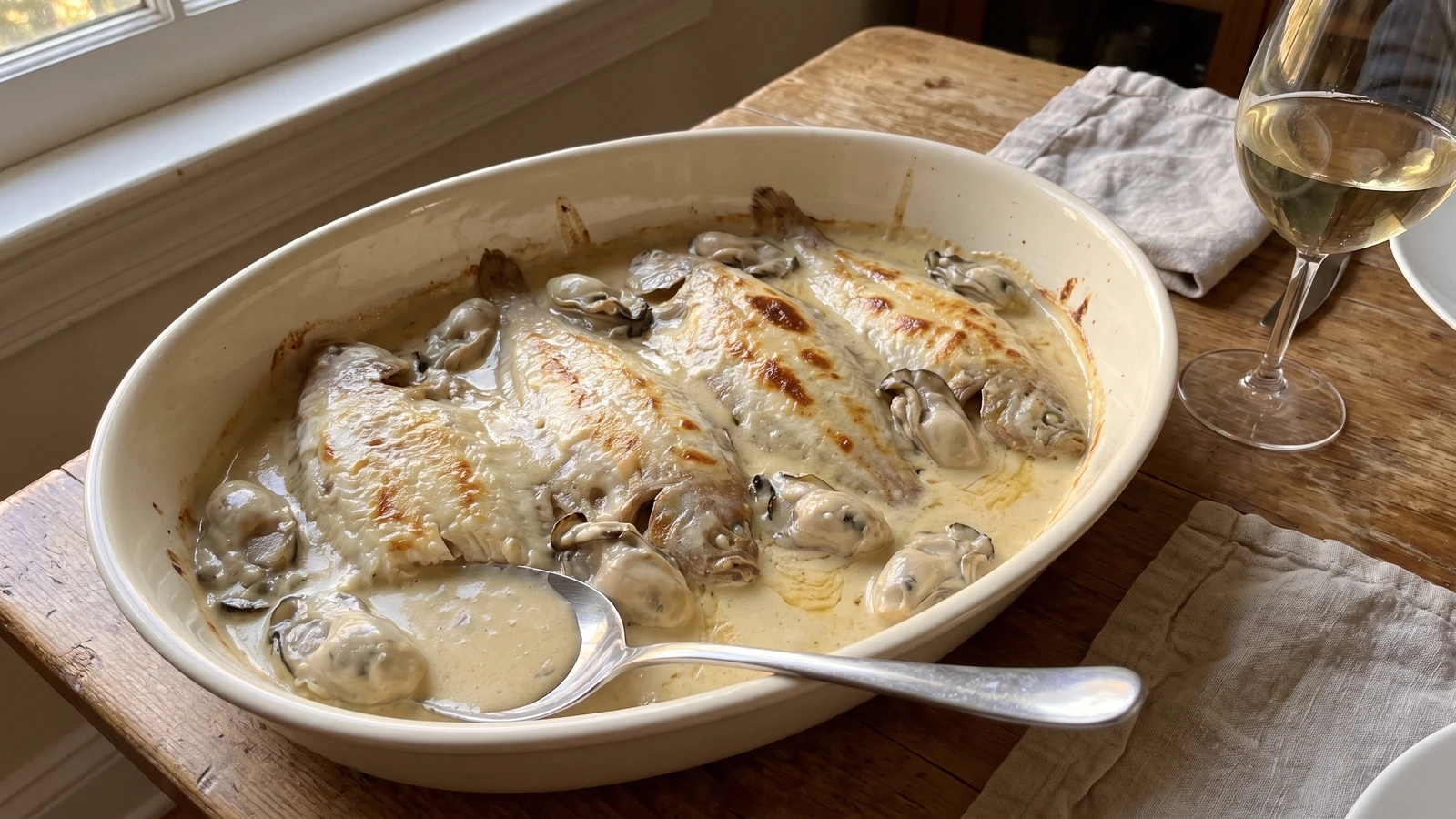
Four small soles shallow-poached in oyster liquor, ringed with plump oysters, napped in white wine sauce, and flashed beneath the broiler until the ivory surface catches a pale gloss.
Sole aux Huîtres (sole with oysters) teaches the classical economy of flavor: the liquid released by an ingredient does not leave the kitchen until it has done every job it can. The oysters poach in their own liquor, the sole follows in it, and that same liquor is reduced into the sauce. Before touching a pan, know this one true thing: oyster liquor is both flavor and salt, so strain every drop and season nothing until the reduction is finished.
The original entry assumed a saucier holding white wine sauce, a stock never off the fire, and a salamander waiting above the pass. A home kitchen needs the finished sauce prepared ahead, one snug broiler-safe gratin dish, and the hottest overhead broiler it offers. This version keeps the book's ratio of six oysters per sole and its exact sequence. The separate holding pans are brigade scaffolding and can go; the oyster-liquor poach, reduction, ring of oysters, and quick glaze are the dish and must stay. One cook, one stove, one evening.
When it is right, the sole remains pearly and tender, the oysters sit plump around it, and the ivory sauce gleams with only the palest gold from the glaze. The decisive step is the reduction: concentrate the sole-and-oyster liquor enough to sharpen the sauce, but stop before its salt takes command.
Sole aux Huîtres belongs to the Paris grand-kitchen repertoire, where Channel sole and oysters arriving from Normandy and the Atlantic beds met the disciplined sauce station. It is not simply a Norman household dish because sole and oysters share a platter; its identity lies in the metropolitan sequence of poaching, reducing, saucing, and glazing. Six oysters to each sole makes the shellfish part of the composition, not a token garnish.
Quantity
4, about 12 oz / 340 g each; 3 lb / 1.36 kg total
black skin removed, white skin scaled, heads removed, and fins trimmed
Quantity
24, about 4 lb 6 oz / 2 kg total
scrubbed, with every drop of liquor reserved
Quantity
2 cups (480 ml / about 490 g)
kept warm
| Ingredient | Quantity |
|---|---|
| small whole Dover solesblack skin removed, white skin scaled, heads removed, and fins trimmed | 4, about 12 oz / 340 g each; 3 lb / 1.36 kg total |
| small to medium live oysters in the shellscrubbed, with every drop of liquor reserved | 24, about 4 lb 6 oz / 2 kg total |
| prepared white wine saucekept warm | 2 cups (480 ml / about 490 g) |
Set an oven rack so the rim of the gratin dish will sit about 5 inches / 13 cm below the broiler later, then heat the oven to 350°F / 180°C. Confirm that the dish can withstand direct broiler heat. Rinse the prepared soles briefly only if necessary, dry them thoroughly, and arrange them in the dish without folding or stacking. A snug fit matters because the oyster liquor must surround the fish rather than disappear across a broad pan.
Shuck each oyster over a bowl so none of its liquor escapes. Discard any oyster with a cracked shell, an unpleasant odor, or a shell that remained open when tapped before shucking. Lift the oysters into a separate bowl, then pass all their liquor through a fine sieve lined with damp cheesecloth or an unbleached coffee filter into a small saucepan. Expect roughly 3/4 to 1 cup / 180 to 240 ml. Do not rinse the oysters; grit belongs in the filter, not under the tap.
Bring the strained liquor to the barest simmer. Slip in the oysters and poach gently for 1 to 2 minutes, lifting each one as soon as it turns opaque through the center, grows plump, and reaches 145°F / 63°C. A hard boil tightens an oyster before you can blink. Transfer them to a covered bowl, trim away any loose dark frilled beards, and strain the poaching liquor once more.
Pour the hot oyster liquor around the soles, spooning a little over their thickest portions. Cover the dish tightly with baking parchment and foil, then shallow-poach in the oven for 10 to 15 minutes. The flesh is ready when it has turned opaque, lifts cleanly from the backbone beside the head end, and reaches 145°F / 63°C at its thickest point. Drain every drop of cooking liquor through the fine sieve into a wide saucepan, keeping the soles in their dish and loosely covered for no longer than 5 minutes.
Taste the sole-and-oyster cooking liquor before reducing it. Simmer briskly until it measures about 1/2 cup / 120 ml, tasting as it concentrates; if the salt is already pronounced, stop sooner. Reserve 1/2 cup / 120 ml of the warm white wine sauce, then whisk the reduced liquor gradually into the remaining sauce over gentle heat until it is nappant, thick enough to coat the back of a spoon. If the salt becomes too strong, fold in the reserved sauce instead of reducing further. If the sauce separates, take it off the heat and whisk in 1 tablespoon / 15 ml of cold water, then rebuild it gradually in a clean warm pan. Ça se rattrape.
Switch the oven to high broil. Arrange six oysters around each sole, forming a generous ring rather than a decorative scattering. Nappez, coat generously, the fish and oysters with the finished sauce, letting it pool lightly around them. Broil for 30 to 90 seconds, rotating the dish if necessary, until the sauce gleams and catches the faintest gold at its highest points. Do not wait for a brown crust; the glaze must be quicker than the fish is delicate. Carry the dish directly to the table. À table!
1 serving (about 330g)
Culinary guides, cultural storytelling, and the editorial depth that makes cooking meaningful.
Discover Culinary ExplorerChef Juliette
John Dory has the delicacy of sole and the firmness of turbot. A light flouring, a quick butter sauté, and nut-brown beurre noisette show exactly why looks never mattered.

Chef Juliette
Fresh haddock proves its delicacy in the meunière pan: a fine flour crust, moist pearly flakes, and beurre noisette sharpened with lemon and parsley, ready from one skillet in half an hour.

Chef Juliette
Éperlans à l’Anglaise turns small fish into a lesson in disciplined coating: boned smelts under a close, crisp crumb, pan-fried in clarified butter and finished with bright, half-melted maître d’hôtel butter.

Chef Juliette
Tiny smelts, shallot, mushrooms, white wine, gratin sauce, and fine bread raspings meet a fierce oven, where the fish must turn tender in the same breath the buttered crust bronzes.