
Chef Juliette
John Dory (St. Pierre)
John Dory has the delicacy of sole and the firmness of turbot. A light flouring, a quick butter sauté, and nut-brown beurre noisette show exactly why looks never mattered.
A cooking platform built around craft, culture, and the stories behind what we eat.
Created by Chef Juliette
Based on No. 840, Sole Cubat, from Le Guide Culinaire (1907) by Auguste Escoffier
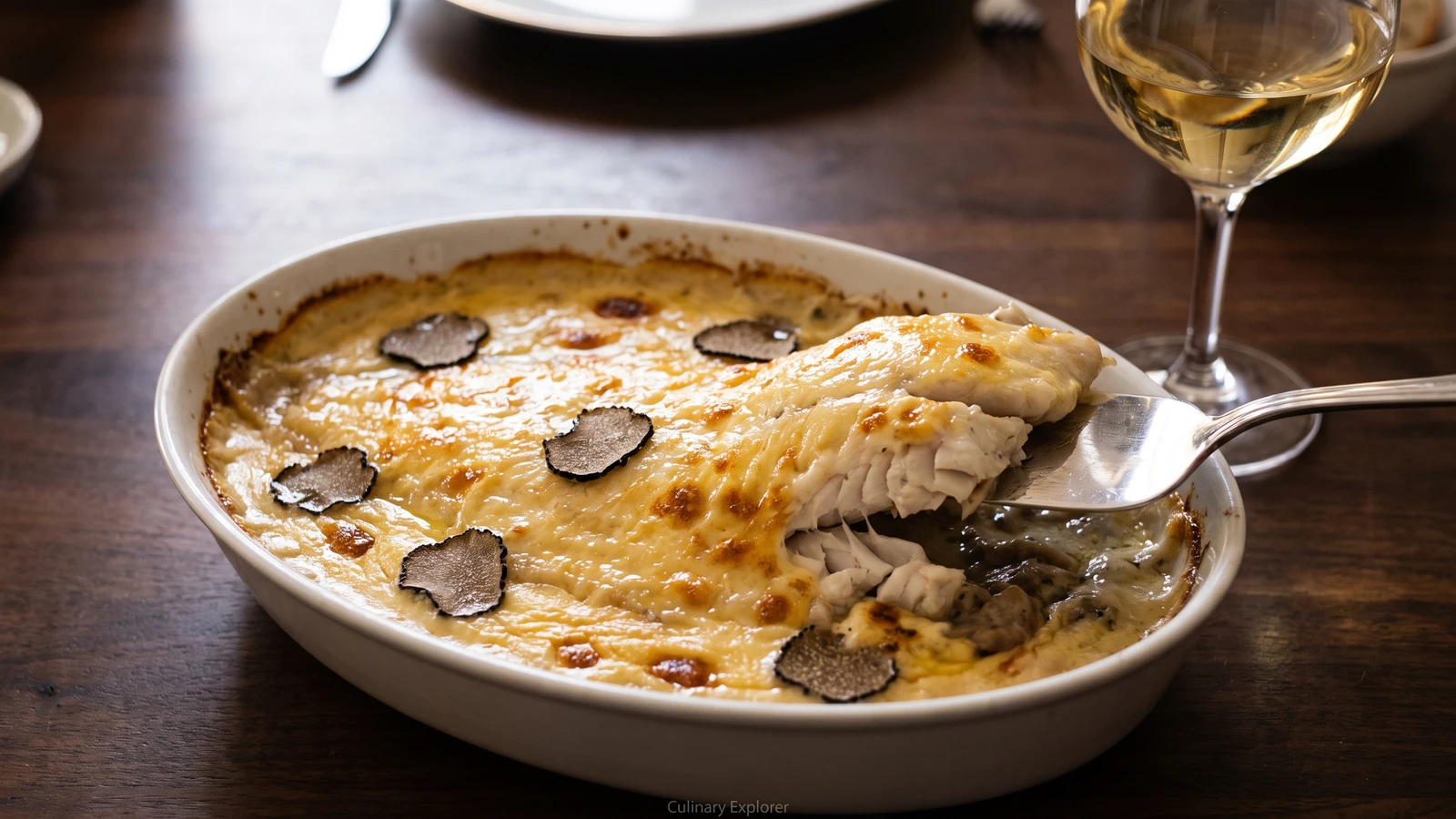
Sole Cubat teaches the final, fierce minute of a gratin: mushroom-poached sole over mushroom purée, striped with truffle, veiled in Mornay, and gilded before the fish can cook twice.
Sole Cubat teaches the final, fierce minute of a gratin. The sole is poached before it is dressed, the purée and Mornay are hot, and the broiler has one job: gild the cheese before the fish cooks twice. Glazing is not baking. Know that before touching a pan.
The original formula assumed a saucier on staff, a stock never off the fire, mushroom cooking liquor and purée already waiting, and a salamander overhead. This entry does not use the stock, so the home version does not smuggle it in: one pan of mushrooms gives both the liquor and purée, a small roux becomes Mornay, and a domestic broiler replaces the salamander. The single trimmed sole becomes its four fillets so it fits one shallow dish, while the one-fifth pint of liquor and half-ounce of poaching butter stay intact. That is the brigade scaffolding removed, not the dish rewritten. One cook, one stove, one evening.
The reward is pale, tender sole over an earthy mushroom bed, black truffle caught beneath a glossy ivory sauce, and a top freckled butter-gold. Keep every component hot, set the rack before assembly, and give the finished dish only the swift glaze it needs. That last minute decides Sole Cubat.
Sole Cubat belongs to the named-garnish repertoire of Parisian grand cuisine, where a cook's or patron's name signaled an exact arrangement rather than a regional larder. From formal dining rooms it passed into bourgeois recipe books, but the construction stayed fixed: mushroom purée below, truffle on the sole, Mornay above, then cheese and a quick glaze. It is not a coastal regional specialty; its home is the Paris table, and Cubat names the garnish rather than the fish's place of capture.
Quantity
4 fillets (1¼ to 1½ pounds / 570 to 680 g total)
Quantity
6 cups sliced (1.4 L / 450 g)
thinly sliced
Quantity
¾ cup (180 ml / 180 g)
Quantity
5 tablespoons (75 ml / 70 g)
divided
Quantity
1½ cups (360 ml / 370 g)
Quantity
¼ cup (60 ml / 30 g)
Quantity
½ cup finely grated (120 ml / 50 g)
divided
Quantity
⅓ cup finely grated (80 ml / 30 g)
divided
Quantity
1 small truffle (about ⅓ ounce / 10 g)
cut into 6 broad, fine slices
Quantity
1¼ teaspoons (6 ml / 7.5 g)
divided
Quantity
¼ teaspoon (1.25 ml / 0.5 g)
| Ingredient | Quantity |
|---|---|
| skinless fillets from 1 large Dover sole | 4 fillets (1¼ to 1½ pounds / 570 to 680 g total) |
| small white button mushroomsthinly sliced | 6 cups sliced (1.4 L / 450 g) |
| cold water | ¾ cup (180 ml / 180 g) |
| unsalted butterdivided | 5 tablespoons (75 ml / 70 g) |
| whole milk | 1½ cups (360 ml / 370 g) |
| all-purpose flour | ¼ cup (60 ml / 30 g) |
| Gruyèredivided | ½ cup finely grated (120 ml / 50 g) |
| Parmesandivided | ⅓ cup finely grated (80 ml / 30 g) |
| fresh black trufflecut into 6 broad, fine slices | 1 small truffle (about ⅓ ounce / 10 g) |
| fine sea saltdivided | 1¼ teaspoons (6 ml / 7.5 g) |
| ground white pepper | ¼ teaspoon (1.25 ml / 0.5 g) |
Put the sliced mushrooms in a wide pan with the water, 2 tablespoons of the butter, and ½ teaspoon of the salt. Bring to a gentle simmer, cover, and cook for 7 to 9 minutes, stirring once, until the mushrooms have collapsed and released their pale, savory liquor. Strain them through a fine-mesh sieve and reserve exactly ½ cup (120 ml / 120 g) of the cooking liquor. If you have less, add enough water to reach that measure; save any excess for another sauce.
Return the drained mushrooms to the dry pan and cook over medium heat until excess moisture evaporates and a spatula leaves a clean track across the pan. Process them until very smooth, scraping the bowl as needed. The purée must hold a low mound rather than run. If it slumps, return it to the pan and stir over gentle heat for another minute or two. Keep it covered and warm.
Reserve 2 tablespoons of the milk and warm the remainder. Melt 2 tablespoons of the butter in a heavy saucepan, whisk in the flour, and cook the pale roux for 90 seconds without letting it color. Add the warm milk in several additions, whisking each one smooth before pouring the next. Simmer gently for 4 to 6 minutes, until the sauce reaches nappe, the coating consistency that clings to a spoon while remaining fluid. Take it off the heat and stir in three-quarters of the combined cheeses, ¼ teaspoon of the salt, and the white pepper. If the Mornay turns grainy or gives up beads of fat, remove it from the heat and whisk in the reserved cold milk a teaspoon at a time. Ça se rattrape. Cover the surface and keep it warm.
Set the broiler rack about 6 inches (15 cm) below the heat and preheat the broiler on high. Arrange the sole fillets in one layer in a covered sauté pan, folding very thin tail ends underneath so the fish cooks evenly. Season with the remaining ½ teaspoon salt, pour in the reserved mushroom liquor, and dot the fish with the final tablespoon of butter, cut into small pieces as the original formula directs. Cover and hold at the barest simmer for 4 to 6 minutes, until the flesh is nearly opaque but still moist at the center, about 125 to 130°F (52 to 54°C). The final glaze will finish the cooking.
Spread the hot mushroom purée evenly across the bottom of a shallow broiler-safe gratin dish. Lift out the sole with a wide spatula and let each fillet drain for a few seconds on a clean folded towel, since loose poaching liquor would thin the Mornay. Lay the fillets over the purée and arrange the 6 truffle slices lengthwise across the fish, giving each portion one or two. Spoon over the hot Mornay until the sole is completely napped, then scatter the reserved cheese evenly across the surface.
Slide the dish beneath the broiler immediately and glaze for 2 to 4 minutes, rotating once if the heat is uneven. Glazing is not baking: pull the dish as soon as the Mornay bubbles at the rim and freckles butter-gold across the top, with the fish reaching 145°F (63°C) at its thickest point. If one patch races ahead, rotate the dish rather than leaving the sole under the heat longer. Bring Sole Cubat straight to the table while the sauce still gleams. À table!
1 serving (about 375g)
Culinary guides, cultural storytelling, and the editorial depth that makes cooking meaningful.
Discover Culinary ExplorerChef Juliette
John Dory has the delicacy of sole and the firmness of turbot. A light flouring, a quick butter sauté, and nut-brown beurre noisette show exactly why looks never mattered.

Chef Juliette
Fresh haddock proves its delicacy in the meunière pan: a fine flour crust, moist pearly flakes, and beurre noisette sharpened with lemon and parsley, ready from one skillet in half an hour.

Chef Juliette
Éperlans à l’Anglaise turns small fish into a lesson in disciplined coating: boned smelts under a close, crisp crumb, pan-fried in clarified butter and finished with bright, half-melted maître d’hôtel butter.

Chef Juliette
Tiny smelts, shallot, mushrooms, white wine, gratin sauce, and fine bread raspings meet a fierce oven, where the fish must turn tender in the same breath the buttered crust bronzes.