
Chef Juliette
John Dory (St. Pierre)
John Dory has the delicacy of sole and the firmness of turbot. A light flouring, a quick butter sauté, and nut-brown beurre noisette show exactly why looks never mattered.
A cooking platform built around craft, culture, and the stories behind what we eat.
Created by Chef Juliette
Based on No. 838, Sole Régence, from Le Guide Culinaire (1907) by Auguste Escoffier
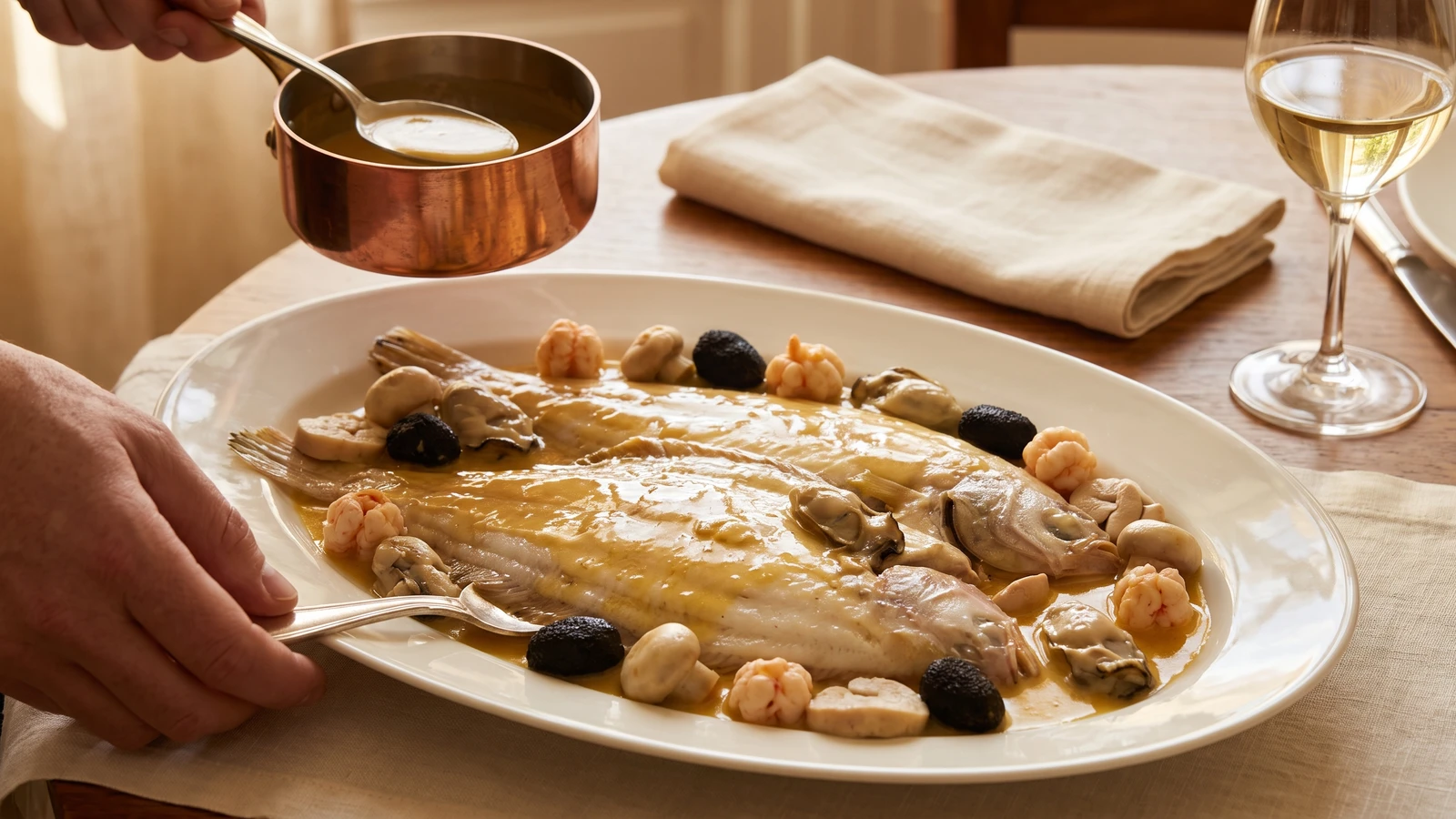
The grand plate full dress: white-wine-poached sole under ivory Normande sauce, encircled by crayfish quenelles, oysters, white mushrooms, truffles, and milt, all coordinated by one cook at home.
Sole Régence (sole in Normande sauce with its full classical garnish) teaches the discipline of convergence. The sole, quenelles, oysters, mushrooms, truffles, milt, and sauce must reach the platter together, each properly cooked and none made to wait until it loses its delicacy. That is the one true thing to know before touching a pan: finish the preparations first, then poach the fish and complete the sauce.
The source entry assumed a saucier on staff, fish stock never off the fire, a commis shaping quenelles, and a salamander within reach, though the Régence is cloaked rather than browned. Your honest equivalents are a food processor, one shallow roasting dish, a saucepan, and a warmed platter. The separate hands and thicket of service pans were brigade scaffolding, so they go. The white-wine poach, the reduction of the cooking liquors, the Normande liaison, and every member of the garnish are the dish, so they stay.
Two market-size whole soles serve four, with the original proportions preserved for each fish: six crayfish quenelles and four each of oysters, white mushrooms, olive-shaped truffles, and poached milt slices. Preserved whole truffles supply both the garnish and their packing juice as the truffle essence, while fresh cod milt gives the source entry's unspecified milt an ingredient a fishmonger can actually order. Nothing is disguised or quietly dropped. One cook, one stove, one evening.
Make every garnish ready before the yolks and butter enter the Normande sauce. Once that liaison is finished, direct heat becomes the enemy; keep it barely warm, bring the components together promptly, and let the ivory sauce gleam over the whole generous arrangement.
Régence is a Parisian classical garnish name, not a regional claim: on a menu it promises an elaborate company of quenelles, oysters, mushrooms, truffles, and milt around a fine fish. Sauce Normande brings Normandy's cream-rich fish cookery into that composition through fish stock, shellfish and mushroom liquors, cream, yolk, and butter, but the assembled plate belongs to the grand Parisian dining table rather than a Norman household pot. Passed through professional kitchens and cookery books, it became a test of timing because the luxury lies as much in keeping every delicate garnish tender as in the ingredients themselves.
Quantity
2, 1 to 1¼ pounds each (450 to 550 g each)
skinned, gutted, heads removed, and fins trimmed
Quantity
8½ tablespoons (128 ml / 120 g)
divided
Quantity
1 cup (240 ml / 240 g)
Quantity
2½ teaspoons (12.5 ml / 15 g)
divided
Quantity
½ teaspoon (2.5 ml / 1 g)
divided
Quantity
1 loosely packed cup (240 ml / 160 g)
diced
Quantity
1
Quantity
⅓ cup (80 ml / 80 g)
reserve 1 tablespoon
Quantity
2 tablespoons (30 ml / 28 g)
softened but cool
Quantity
6 cups (1.4 L / 1.4 kg)
Quantity
8
shucked, beards removed, and liquor reserved
Quantity
8, about 1 cup (240 ml / 120 g)
peeled and trimmed
Quantity
½ cup (120 ml / 120 g)
Quantity
1 tablespoon plus 1 teaspoon (20 ml / 20 g)
divided
Quantity
8 (about 60 g drained)
reserve 1 tablespoon (15 ml / 15 g) packing juice as truffle essence
Quantity
1 intact lobe (about 4 ounces / 120 g)
Quantity
2 cups (480 ml / 480 g)
Quantity
1 tablespoon (15 ml / 15 g)
Quantity
3 tablespoons (45 ml / 24 g)
Quantity
1½ cups (360 ml / 360 g)
Quantity
Up to ½ cup (120 ml / 120 g)
Quantity
½ cup (120 ml / 120 g)
reserve 1 tablespoon cold
Quantity
2
| Ingredient | Quantity |
|---|---|
| whole Dover solesskinned, gutted, heads removed, and fins trimmed | 2, 1 to 1¼ pounds each (450 to 550 g each) |
| unsalted butterdivided | 8½ tablespoons (128 ml / 120 g) |
| dry white wine | 1 cup (240 ml / 240 g) |
| fine sea saltdivided | 2½ teaspoons (12.5 ml / 15 g) |
| finely ground white pepperdivided | ½ teaspoon (2.5 ml / 1 g) |
| very cold whiting filletdiced | 1 loosely packed cup (240 ml / 160 g) |
| large egg white | 1 |
| cold heavy cream for the quenellesreserve 1 tablespoon | ⅓ cup (80 ml / 80 g) |
| prepared crayfish buttersoftened but cool | 2 tablespoons (30 ml / 28 g) |
| water for poaching the quenelles | 6 cups (1.4 L / 1.4 kg) |
| small oystersshucked, beards removed, and liquor reserved | 8 |
| small button mushroomspeeled and trimmed | 8, about 1 cup (240 ml / 120 g) |
| water for the mushrooms | ½ cup (120 ml / 120 g) |
| fresh lemon juicedivided | 1 tablespoon plus 1 teaspoon (20 ml / 20 g) |
| small whole preserved black trufflesreserve 1 tablespoon (15 ml / 15 g) packing juice as truffle essence | 8 (about 60 g drained) |
| fresh cod milt | 1 intact lobe (about 4 ounces / 120 g) |
| water for poaching the milt | 2 cups (480 ml / 480 g) |
| white wine vinegar | 1 tablespoon (15 ml / 15 g) |
| plain flour | 3 tablespoons (45 ml / 24 g) |
| unsalted fish stock | 1½ cups (360 ml / 360 g) |
| additional unsalted fish stock (optional) | Up to ½ cup (120 ml / 120 g) |
| heavy cream for the Normande saucereserve 1 tablespoon cold | ½ cup (120 ml / 120 g) |
| large egg yolks | 2 |
Chill the food-processor bowl and blade for 15 minutes. Process the whiting with ¼ teaspoon of the salt and a pinch of white pepper until it becomes smooth and sticky. Add the egg white, then the crayfish butter, processing only until each disappears. With the machine running, pour in all but the reserved tablespoon of cold cream in a thin thread. Scrape the whiting forcemeat into a cold bowl and test-poach a teaspoonful. It should be tender, cohesive, and distinctly crayfish-scented. If the mixture begins to look oily or grainy, stop before adding more cream, set the bowl over ice until thoroughly cold, then process again briefly with the reserved cream. Ça se rattrape. Keep the finished forcemeat cold.
Heat the 6 cups of water with ½ teaspoon salt in a wide pan until it holds at 175 to 185°F (80 to 85°C), with movement below the surface but no boil. Rinse two teaspoons in cold water and use them to shape 12 small oval quenelles, six for each sole. Lower them into the water as they are shaped and poach for 5 to 7 minutes, turning once, until firm and cooked through to 145°F (63°C). If they swell roughly or begin to fray, the water is too hot; pull the pan off the burner, let it settle, and continue gently. Lift the quenelles onto a plate, cover, and keep chilled if they will stand longer than 30 minutes.
Put the mushrooms in a small saucepan with the ½ cup water, 1 tablespoon lemon juice, 1 tablespoon (15 ml / 14 g) of the butter, and ¼ teaspoon salt. Cover with a parchment round and simmer gently for 5 to 7 minutes, until tender but still very white. Lift them out and reserve their cuisson, the cooking liquor. Strain the oyster liquor through a fine sieve, warm it only until it trembles, and poach the oysters for 20 to 30 seconds, until their edges just begin to curl; lift them out and reserve that liquor too. Bring the 2 cups water, vinegar, and ½ teaspoon salt to a bare simmer, add the intact cod milt, and poach for 8 to 10 minutes, until firm and cooked through to 145°F (63°C). Let it settle in its liquor for 5 minutes, then cut 8 neat slices. Trim the preserved truffles into olive shapes only if necessary, saving every trimming for the sauce.
Melt 2 tablespoons (30 ml / 28 g) butter in a saucepan over medium-low heat. Stir in the flour and cook this roux blanc, or white roux, for 2 minutes without allowing it to color. Whisk in the 1½ cups fish stock a little at a time, keeping the mixture smooth after each addition. Bring it to a quiet simmer and cook for about 20 minutes, skimming when needed, until the velouté lightly coats a spoon. If lumps appear, don't attack them with higher heat. Pass the velouté through a fine sieve and carry on.
Heat the oven to 350°F (180°C). Use about 1 teaspoon (5 ml / 5 g) of the butter to coat a shallow roasting dish large enough to hold both soles without overlapping. Lay in the fish, season them with ½ teaspoon salt and a little white pepper, pour the wine around them, and dot the remaining 2⅓ tablespoons (35 ml / 33 g) of this butter allocation over the top. Cover closely with buttered parchment or foil and poach in the oven for 15 to 22 minutes. Check at the thickest part beside the backbone: the flesh should lift cleanly and reach 145°F (63°C). Transfer the soles carefully to a warmed oval platter, cover loosely, and strain every drop of their poaching liquor into a saucepan.
Add the reserved mushroom cuisson and oyster liquor to the sole poaching liquid. Skim away any large pools of fat, then boil the combined liquors briskly until reduced to about ¾ cup (180 ml). This reduction is the flavor bridge between the fish and the Normande sauce, so don't leave it watery. Whisk it into the velouté and simmer for 5 minutes, until the base tastes concentrated and coats the spoon generously. If it becomes too tight, loosen it with a little additional fish stock. If it remains thin, reduce it now, before the yolks arrive.
Whisk the egg yolks with all but the reserved tablespoon of heavy cream. Whisk in a ladleful of the hot sauce base, then return the mixture to the saucepan. This is the liaison, an egg-yolk-and-cream thickening. Stir constantly over low heat until the sauce reaches about 175°F (79°C) and holds a clean line across the back of a spoon. Never let it boil. Take it off the heat and whisk in the remaining 2¾ tablespoons (40 ml / 40 g) butter a piece at a time, followed by the reserved truffle essence, truffle trimmings, and remaining teaspoon of lemon juice. If the sauce shows curds or a greasy rim, pull it from the heat immediately, strain it into a clean bowl, and whisk in the reserved tablespoon of cold cream. Ça se rattrape. Taste for salt and white pepper, then hold the sauce over barely warm water.
Place the quenelles, oysters, mushrooms, truffles, and milt slices in a wide pan with several spoonfuls of Normande sauce. Warm them over the gentlest heat for 1 to 2 minutes without simmering. Arrange six quenelles and four each of the oysters, mushrooms, truffles, and milt slices around each sole. Cover the fish and every member of the garnish generously with the remaining Normande sauce, allowing it to pool on the platter. No broiler and no decorative fuss. The sauce's ivory gloss and the full ring of garnish are the finish. Serve at once. À table!
1 serving (about 425g)
Culinary guides, cultural storytelling, and the editorial depth that makes cooking meaningful.
Discover Culinary ExplorerChef Juliette
John Dory has the delicacy of sole and the firmness of turbot. A light flouring, a quick butter sauté, and nut-brown beurre noisette show exactly why looks never mattered.

Chef Juliette
Fresh haddock proves its delicacy in the meunière pan: a fine flour crust, moist pearly flakes, and beurre noisette sharpened with lemon and parsley, ready from one skillet in half an hour.

Chef Juliette
Éperlans à l’Anglaise turns small fish into a lesson in disciplined coating: boned smelts under a close, crisp crumb, pan-fried in clarified butter and finished with bright, half-melted maître d’hôtel butter.

Chef Juliette
Tiny smelts, shallot, mushrooms, white wine, gratin sauce, and fine bread raspings meet a fierce oven, where the fish must turn tender in the same breath the buttered crust bronzes.