
Chef Juliette
John Dory (St. Pierre)
John Dory has the delicacy of sole and the firmness of turbot. A light flouring, a quick butter sauté, and nut-brown beurre noisette show exactly why looks never mattered.
A cooking platform built around craft, culture, and the stories behind what we eat.
Created by Chef Juliette
Based on No. 829, Sole à la Hollandaise, from Le Guide Culinaire (1907) by Auguste Escoffier
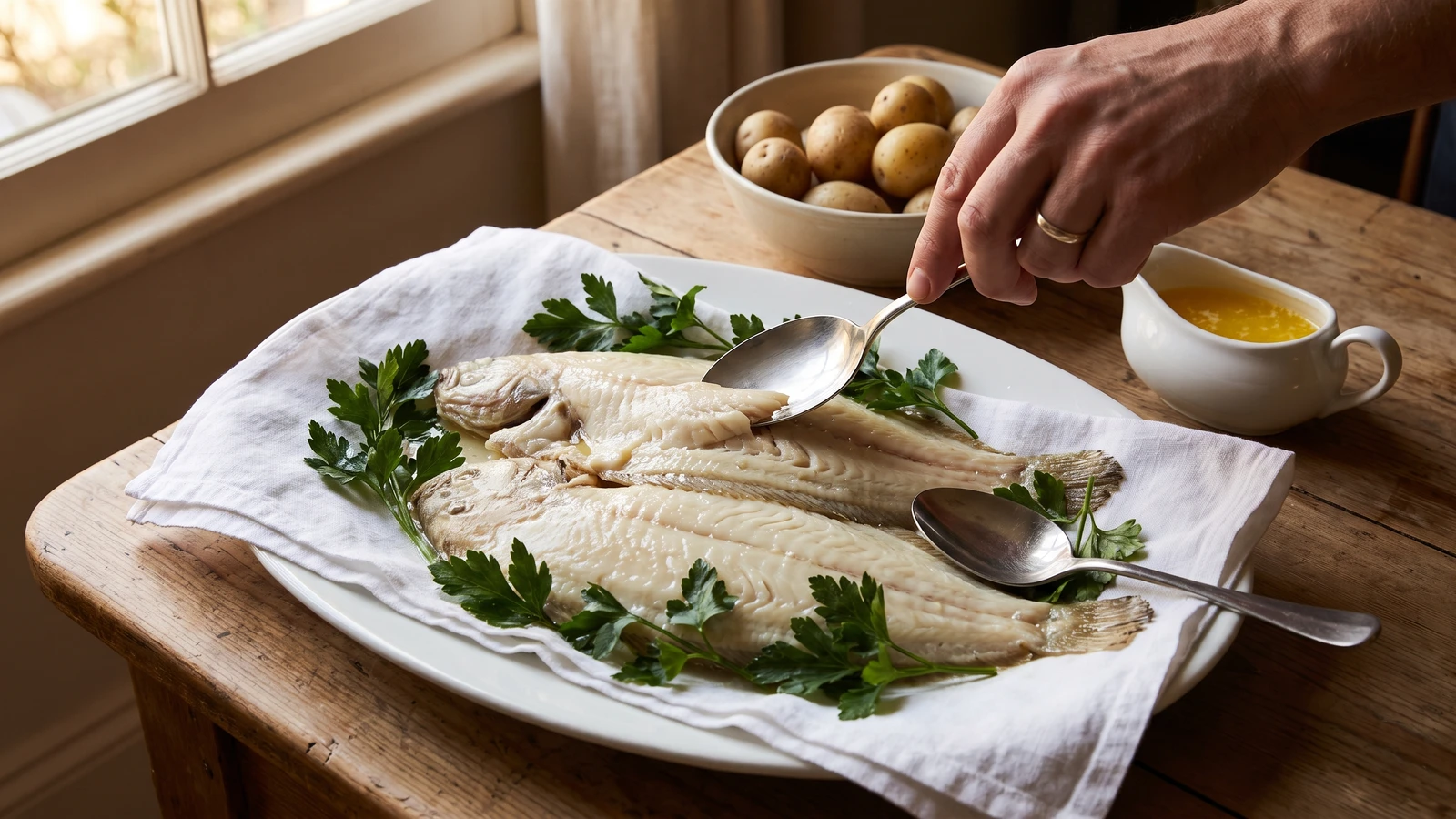
Sole à la Hollandaise proves that gentle poaching is a complete technique: tender whole fish, vivid parsley, plain potatoes, and melted butter, with no sauce or seasoning strong enough to conceal the cook’s attention.
Sole à la Hollandaise (whole sole gently poached with potatoes and melted butter) teaches the hardest kind of restraint: when there is nowhere for careless heat to hide. The one true thing to know before touching a pan is this: the water may reach its first boil, but once the lid goes on it must only tremble. A hard boil tightens sole, tears its fine surface, and turns tenderness to cotton.
The original method assumes a fish kettle large enough to hold a whole sole and a hand free to move it from water to service napkin while the potatoes and butter arrive at precisely the same moment. There is no saucier, permanent stockpot, or salamander to replace, because the absence of a built sauce is deliberate. At home, two deep lidded skillets stand in for the fish kettle, and a clean unscented linen napkin on a warmed platter drinks the last poaching water. The fish kettle is brigade scaffolding and can go. The salted-water poach, the linen, the plain potatoes, the green parsley, and the melted butter are the dish, and they stay.
The source is built around one whole sole and 2 ounces of butter. For four servings, the fish becomes two 1¼-pound soles, each serving two, and the butter becomes 4 ounces. Nothing is enriched, perfumed, or hidden. Served correctly, the flesh is pearly and moist, the parsley startlingly green, and the potatoes ready to catch their share of butter. One cook, one stove, one evening. Keep the covered poach below a boil; everything else is punctual service.
Sole à la Hollandaise belongs to the Parisian classical table’s family of plainly poached fish, and in this entry its Dutch label describes the service of boiled potatoes and melted butter. Despite the familiar title, it does not call for Sauce Hollandaise; eggs, lemon, or an emulsified sauce would rewrite the preparation. Household cookery retained the dining-room arrangement of whole fish on absorbent linen, ringed with parsley, because the presentation also solved the practical problem of draining a very delicate fish.
Quantity
2 whole, about 1¼ lb / 570 g each (2½ lb / 1.14 kg total)
skinned, gutted, heads removed, and fins closely trimmed
Quantity
3 quarts (2.8 L / 2.8 kg), or enough to cover by ½ inch / 1 cm
Quantity
1 tablespoon (15 ml / 18 g)
Quantity
2 lb, about 6 cups (1.4 L / 910 g)
peeled
Quantity
2 quarts (1.9 L / 1.9 kg)
Quantity
1 tablespoon (15 ml / 18 g)
Quantity
½ cup (120 ml / 113 g)
melted without browning
Quantity
2 packed cups (480 ml / 60 g)
washed, dried, and chilled
| Ingredient | Quantity |
|---|---|
| whole Dover solesskinned, gutted, heads removed, and fins closely trimmed | 2 whole, about 1¼ lb / 570 g each (2½ lb / 1.14 kg total) |
| cold water for poaching | 3 quarts (2.8 L / 2.8 kg), or enough to cover by ½ inch / 1 cm |
| fine sea salt for poaching | 1 tablespoon (15 ml / 18 g) |
| small waxy potatoespeeled | 2 lb, about 6 cups (1.4 L / 910 g) |
| cold water for boiling potatoes | 2 quarts (1.9 L / 1.9 kg) |
| fine sea salt for the potatoes | 1 tablespoon (15 ml / 18 g) |
| unsalted buttermelted without browning | ½ cup (120 ml / 113 g) |
| fresh parsley sprigswashed, dried, and chilled | 2 packed cups (480 ml / 60 g) |
Ask the fishmonger to skin, gut, trim, and crack the backbones if possible. Otherwise, set each sole flat on a board and support it with both hands. Bend it gently first one way and then the other at three evenly spaced points until the backbone gives with a faint crack; make a shallow curve, never a sharp fold that tears the flesh. Breaking the spine is the source method, not ceremony: it keeps the whole fish relaxed during poaching and makes the cooked fillets easier to lift cleanly from the frame.
Put the peeled potatoes in a saucepan with the 2 quarts of cold water and 1 tablespoon of salt. Bring to a boil, then lower the heat and simmer steadily for 15 to 20 minutes, until a small knife enters the centre without resistance but the potatoes still hold their shape. Drain thoroughly, return them to the dry hot saucepan for 30 seconds, then transfer them to a warmed serving bowl and cover with a folded towel. Plain means plain here: no herbs, stock, or butter goes into the pot.
Refresh the parsley sprigs in very cold water until they stand crisp and vivid, then dry them completely. Warm a large oval platter, dry it, and line it with a freshly laundered, unscented linen napkin. Keep the parsley cold until the fish arrives; its green border is part of the service, not a chopped flourish.
Lay one sole flat in each deep lidded skillet. Divide the 3 quarts of cold water and 1 tablespoon of salt between them, adding only enough water to cover each fish by about ½ inch. Set the pans uncovered over medium heat and watch closely. At the first definite boil, lower the heat immediately, cover, and poach for 10 minutes at the barest tremble. If either pan begins bubbling hard, pull it off the heat, uncover it, and add 2 tablespoons of cold water; once calm, return it to the lowest heat. Ça se rattrape. The sole is ready when the flesh is opaque at the backbone, parts easily from the frame, and reaches 145°F / 63°C at its thickest point. If needed, cover and give it 1 or 2 minutes more.
While the sole poaches, melt the butter in a small saucepan over the lowest heat, swirling until the last solid piece disappears. This is beurre fondu (plain melted butter), not Sauce Hollandaise, and it must remain butter-yellow without browned milk solids. Take it off the heat just before it is completely liquid and let the pan’s warmth finish the work. Pour it into a warmed sauceboat.
Lift each sole with two broad fish spatulas, supporting both head and tail ends so the backbone cannot sag. Hold it over the pan for several seconds, then lay it carefully on the linen-lined platter. The napkin absorbs the water the spatulas cannot catch, keeping the platter dry and the fish distinct from the butter served alongside. Arrange the cold parsley generously around the soles while they are still hot.
Bring the whole soles to the table with the boiled potatoes and warm beurre fondu alongside. To serve, run a spoon along the central backbone, lift the two upper fillets from each fish, remove the exposed frame, then lift the two lower fillets. Give each person two small fillets, potatoes, and melted butter to spoon as they please. Nothing more belongs on the plate. À table!
1 serving (about 410g)
Culinary guides, cultural storytelling, and the editorial depth that makes cooking meaningful.
Discover Culinary ExplorerChef Juliette
John Dory has the delicacy of sole and the firmness of turbot. A light flouring, a quick butter sauté, and nut-brown beurre noisette show exactly why looks never mattered.

Chef Juliette
Fresh haddock proves its delicacy in the meunière pan: a fine flour crust, moist pearly flakes, and beurre noisette sharpened with lemon and parsley, ready from one skillet in half an hour.

Chef Juliette
Éperlans à l’Anglaise turns small fish into a lesson in disciplined coating: boned smelts under a close, crisp crumb, pan-fried in clarified butter and finished with bright, half-melted maître d’hôtel butter.

Chef Juliette
Tiny smelts, shallot, mushrooms, white wine, gratin sauce, and fine bread raspings meet a fierce oven, where the fish must turn tender in the same breath the buttered crust bronzes.