Culinary Explorer

A cooking platform built around craft, culture, and the stories behind what we eat.
Discover Culinary Explorer
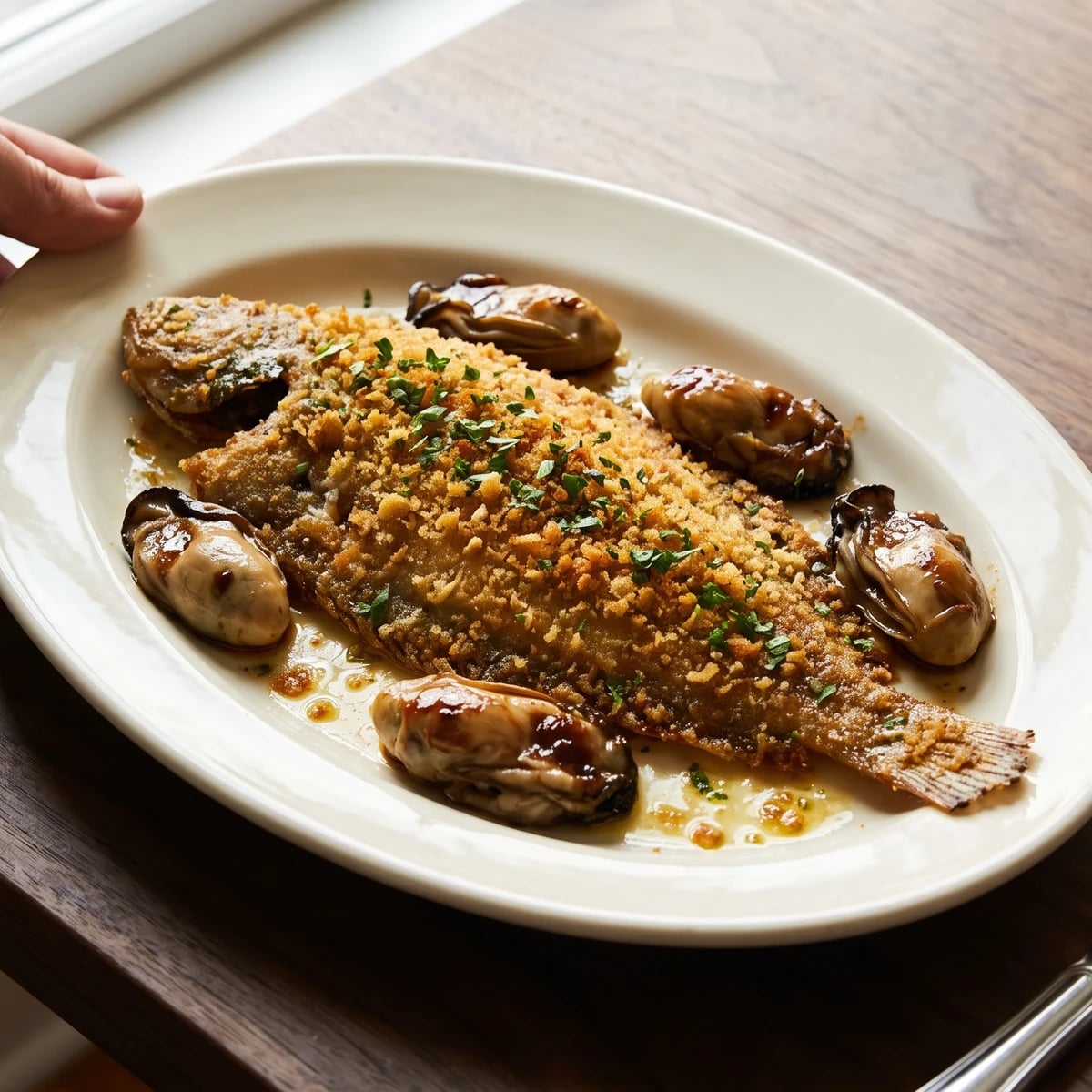
Sole Grillée, aux Huîtres à l’Américaine

Sole Grillée, aux Huîtres à l’Américaine

Created by Chef Juliette

Based on No. 827, Sole Grillée, aux Huîtres à l’Américaine, from Le Guide Culinaire (1907) by Auguste Escoffier

A whole sole browned under fierce heat, six briny oysters per plate, Worcestershire-sharpened liquor, and a crisp blanket of butter-fried crumbs: an extravagant lesson in bringing every element to the same hot finish.

Main Dishes
French
Dinner Party
Special Occasion
40 min
Active Time
20 min cook1 hr total
Yield4 servings

Sole Grillée, aux Huîtres à l’Américaine (grilled sole with Worcestershire-poached oysters) teaches last-minute coordination. The one true thing is this: the fish, oysters, crumbs, and plates must all be hot at once. Let any one of them wait and the crumbs soften, the oysters tighten, or the delicate sole cools beneath its generous covering.

This unusually spare entry calls for neither a saucier nor stock kept on the fire. It did assume a fierce fish grill or salamander, plates waiting hot, and several hands to fry crumbs, poach oysters, and move the sole at the same instant. At home, the broiler supplies the fierce overhead heat, two small pans handle the finish, and the order of work replaces the extra hands. The six oysters per sole and the original sequence remain untouched. One cook, one stove, one evening.

Separate stations and holding pans were brigade scaffolding, so they can go. The dish itself cannot: freshly cooked sole, oysters poached briefly in boiling Worcestershire, very hot fried breadcrumbs, and parsley applied at the last moment. The step that decides dinner comes before the heat begins: shuck the oysters, measure the crumbs, and warm the plates before switching on the broiler.

Sole Grillée, aux Huîtres à l’Américaine belongs to the cosmopolitan Paris dining room rather than to any single regional larder, joining Channel sole and oysters with Worcestershire, an imported English condiment valued for immediate savoury sharpness. Here, à l’Américaine does not mean the tomato, wine, and shellfish sauce attached to lobster in another branch of the canon; this formula defines it narrowly through oysters poached in boiling Worcestershire and hot fried crumbs. Its journey to the home table is unusually direct because its luxury comes from six oysters beside each sole and impeccable last-minute service, not from a long-built sauce.

The technique, the tradition, and the story behind every dish.

Discover Culinary Explorer

Ingredients

small whole Dover soles

Quantity

4 (about 2½ lb / 1.13 kg total; each 10 to 12 oz / 280 to 340 g)

skinned on both sides, heads removed, and fins trimmed

fine sea salt

Quantity

¾ teaspoon (4 ml / 4.5 g)

unsalted butter

Quantity

6 tablespoons (90 ml / 85 g)

divided, with 2 tablespoons for the sole and 4 tablespoons for the breadcrumbs

fresh fine white breadcrumbs

Quantity

1¼ cups (300 ml / 110 g)

hold back 2 tablespoons for correcting the texture

medium oysters

Quantity

24

freshly shucked and well drained

Worcestershire sauce

Quantity

¼ cup (60 ml / 65 g)

flat-leaf parsley

Quantity

1 tablespoon (15 ml / 4 g)

finely chopped

fresh lemon juice (optional)

Quantity

3 tablespoons (45 ml / 45 g)

for the optional almost-dry poached preparation

Equipment Needed

  • Large broiler-safe rimmed sheet, about 18 by 13 inches
  • Two broad fish spatulas
  • 10-inch heavy skillet for the breadcrumbs
  • Small saucepan for the oysters
  • Four heatproof dinner plates
  • Instant-read thermometer

Instructions

  1. 1

    Set the service

    Position an oven rack 4 to 5 inches beneath the broiler and heat the broiler on high for at least 10 minutes. Line a large rimmed sheet with foil and brush it with a little of the 2 tablespoons butter allotted to the fish. Fill four heatproof dinner plates with the hottest tap water and leave them to warm. Pat the soles completely dry, arrange them on the sheet in alternating directions, and season lightly with the salt. Keep the drained oysters cold beside the measured Worcestershire, parsley, and serving utensils. Once the fish begins cooking, there is no useful pause.

    Ask the fishmonger to skin and trim the soles. That preparation is useful service, not part of the cooking lesson, and it leaves you free to concentrate on the finish.
  2. 2

    Fry the breadcrumbs

    Melt the 4 tablespoons butter in a wide skillet over medium heat. Add all but the reserved 2 tablespoons breadcrumbs and toss continuously for 4 to 6 minutes, until every crumb is crisp, deeply butter-gold, and fragrant. Lower the heat as far as it will go and toss occasionally while the fish cooks. If the crumbs become greasy or gather into heavy clumps, remove the pan from the heat and toss in the reserved dry crumbs one spoonful at a time. Ça se rattrape. They should fall freely from the spoon, not sit like stuffing.

  3. 3

    Broil the sole

    Melt the remaining butter for the fish and brush it over the exposed surface. Broil for 4 to 5 minutes, until the upper surface takes a few golden patches. Turn each sole carefully with two broad spatulas, brush with the remaining butter, and broil for another 3 to 5 minutes. The flesh is ready when it has turned opaque, releases cleanly from the backbone, and reaches 145°F (63°C) at its thickest point. If the surface browns before the centre is cooked, lower the sheet by one rack and finish gently. If a fish tears while turning, place the torn side downward on the plate; the hot crumbs will cover it, and no one at your table requires an apology.

  4. 4

    Move to hot plates

    Pour the water from the warmed plates and dry them thoroughly. Transfer one sole to each plate, presentation side upward, and keep the plates beside the stove. Do not cover the fish tightly, which traps moisture and softens its surface. Increase the heat beneath the breadcrumbs for 20 to 30 seconds, tossing until they are very hot and loose, then remove them from the heat while the oysters cook.

  5. 5

    Poach the oysters

    Pour the Worcestershire into a small saucepan and bring it to a full boil. Add 12 oysters and swirl the pan so each one meets the sauce. Poach for 45 to 75 seconds, depending on size, until the rims curl gently, the centres turn opaque, and the oysters reach 145°F (63°C). Lift them out immediately and place three around each sole. Return the Worcestershire to a boil and repeat with the remaining oysters, giving every plate its full six. If the first oyster tightens sharply, lower the heat to a brisk simmer and shorten the cooking of the rest. Do not leave cooked oysters sitting in the sauce; Worcestershire seasons quickly, and prolonged boiling makes both sauce and oyster severe.

  6. 6

    Blanket and serve

    Return the breadcrumb skillet to medium-high heat for a final 20 seconds, tossing until the crumbs are thoroughly hot. Immediately cover each sole with a generous, even blanket, keeping the oysters visible around it, then finish with a pinch of chopped parsley. Carry the plates straight to the table. The crumbs should be crisp under the teeth, the oysters plump, and the sole moist beneath its covering. There is no holding step now. À table!

Chef Tips

  • Dover sole has the fine flesh and firm backbone that make whole-fish service graceful, but technique comes first. If whole Dover sole is unavailable, use 8 skinless sole fillets of the same total weight. The source explicitly permits fillets, so this changes neither the garnish nor the intent.
  • The source also permits the sole poached almost dry in butter and lemon juice. For that home preparation, arrange 8 fillets in one layer in a shallow buttered baking dish, add the 3 tablespoons lemon juice and the 2 tablespoons butter allotted to the fish, cover closely with parchment, and cook at 375°F (190°C) for 7 to 10 minutes, just until opaque. This lets one cook finish every fillet together; the oysters and breadcrumbs remain exactly as written.
  • Use fresh, fine white breadcrumbs rather than coarse crumbs. They must fry into a light, crisp covering that follows the shape of the fish, not hard nuggets that overwhelm the sole.
  • Worcestershire is not a background seasoning here. It is the oyster poaching liquor and should taste forceful, salty, and sharp, but the oysters meet it for less than a minute. Poach them only when the fish is already on its hot plate.
  • Pour a taut, dry white with enough acidity for the oysters and butter, such as Chablis or Muscadet. Keep the accompaniment quiet: small boiled potatoes or plainly buttered spinach will catch the crumbs without competing with the fish.

Advance Preparation

  • Have the fishmonger skin and trim the soles earlier the same day. Keep them covered and very cold, then dry them thoroughly just before cooking.
  • The oysters may be shucked up to 4 hours ahead, covered, and held over ice in the cold. Drain them immediately before poaching.
  • Make the fresh breadcrumbs and chop the parsley several hours ahead. The crumbs may be fried up to 1 hour early, spread on a plate to stay crisp, then reheated in the skillet just before serving.
  • Do not cook the sole or poach the oysters ahead. This dish is built around their simultaneous last-minute finish.

Frequently Asked Questions

Nutrition Information

1 serving (about 225g)

Calories
395 calories
Total Fat
21 g
Saturated Fat
12 g
Trans Fat
1 g
Unsaturated Fat
8 g
Cholesterol
140 mg
Sodium
940 mg
Total Carbohydrates
21 g
Dietary Fiber
1 g
Sugars
3 g
Protein
31 g

Note: Chef personas and recipes are created with AI assistance. Cook with care: follow safe food-handling practices, check doneness with a thermometer when needed, and adapt for allergies and your kitchen.

Where cooking meets culture.

Culinary guides, cultural storytelling, and the editorial depth that makes cooking meaningful.

Discover Culinary Explorer

More from Fish - Soles

Browse the full collection