
Chef Juliette
John Dory (St. Pierre)
John Dory has the delicacy of sole and the firmness of turbot. A light flouring, a quick butter sauté, and nut-brown beurre noisette show exactly why looks never mattered.
A cooking platform built around craft, culture, and the stories behind what we eat.
Created by Chef Juliette
Based on No. 821, Sole au Champagne, from Le Guide Culinaire (1907) by Auguste Escoffier
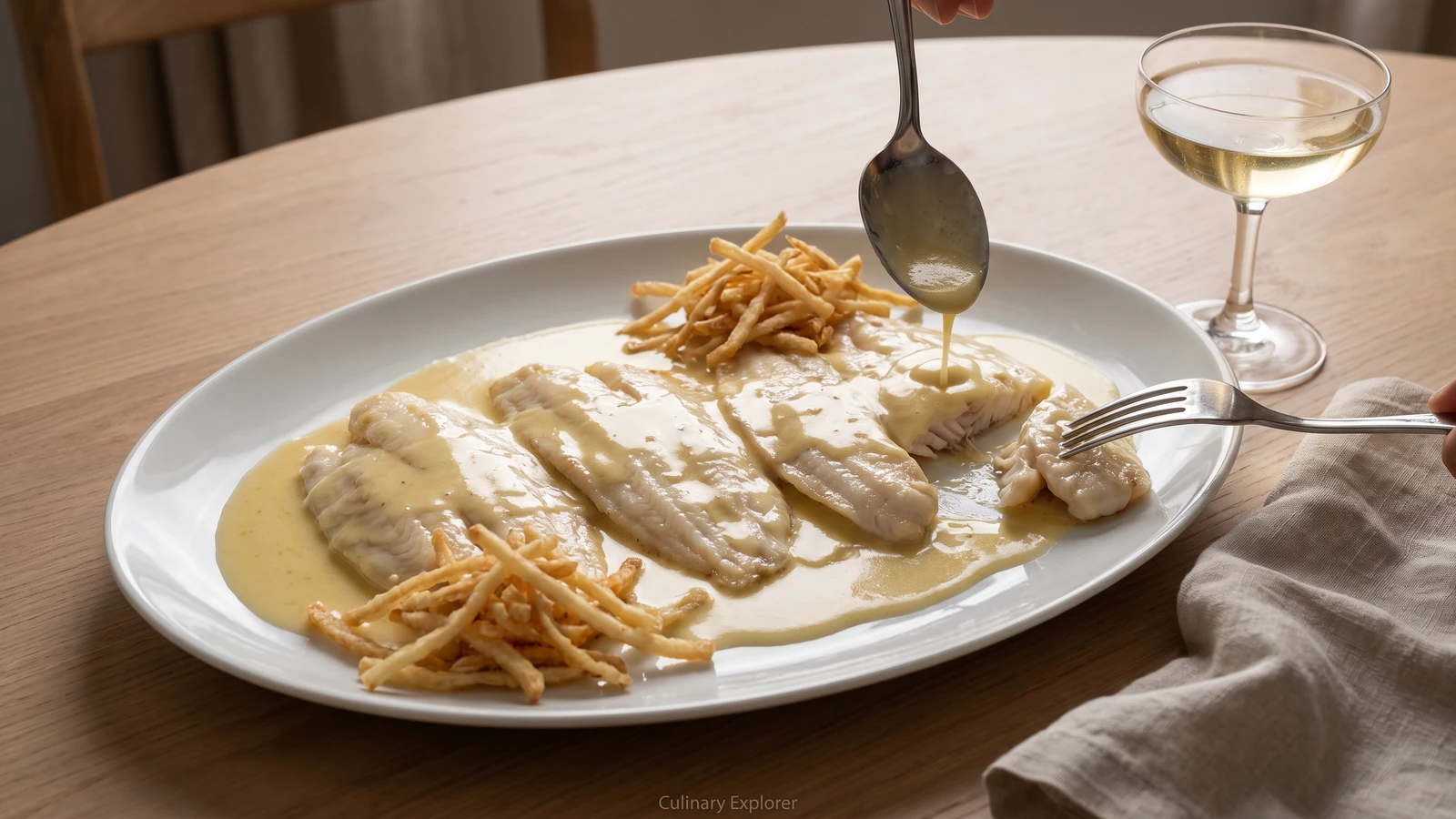
Champagne-poached sole under glossy velouté, with crisp julienne of sole at each side: a celebration dish that teaches reduction, mounting with butter, and timing the garnish at the last possible moment.
Sole au Champagne teaches the architecture of a classical fish sauce in one clean line: a shallow poach, an exact reduction, velouté, and a montée au beurre (cold butter whisked in off the heat). The one true thing to know before touching the pan is that the poaching liquor is not a by-product. It is the sauce, so the fish must cook gently and the liquor must reduce by half, no more and no less.
The original assumed a saucier on staff, fish stock never off the fire, and a salamander waiting to glaze the platter. At home, use a prepared small batch of fish velouté, a one-quart saucepan, and the broiler you already own. The brigade's separate stations and service-held sauce are scaffolding, so they go; the poach, reduction, butter finish, glaze, and last-minute julienne stay, because they are the dish. The quantities here feed four, one cook, one stove, one evening.
At the table, the sole should be pearly and tender beneath an ivory-gold sauce, with two little heaps of crisp fish providing the bite the soft preparation needs. Have the cold butter cubed and the julienne cut before the reduction begins. The one step that decides the dish is the montée au beurre: the pan must leave the heat before the butter goes in, and the sauce must never boil again.
Sole au Champagne belongs to the Parisian grand-kitchen canon, where delicate sole was poached in wine and its liquor returned to the plate as a reduced, butter-finished sauce. Its name points to the bottle rather than to a fish tradition of Champagne: the same method traveled through the repertory as Soles au Chablis, au Sauterne, au Samos, and au Château Yquem when the wine changed. The crisp julienne of sole is not decoration added later; it is the textural counterpoint built into the preparation.
Quantity
8 fillets (about 1½ lb / 680 g total)
Quantity
2 fillets (about 6 oz / 170 g total)
reserved for the julienne
Quantity
1 tablespoon (15 ml / 14 g)
softened, for buttering the dish
Quantity
1 cup plus 3 tablespoons (285 ml / 285 g)
Quantity
6 tablespoons plus 1 teaspoon (95 ml / 100 g)
Quantity
3 tablespoons (45 ml / 43 g)
very cold and cubed
Quantity
3 tablespoons (45 ml / 41 g)
Quantity
¼ cup (60 ml / 30 g)
for dredging
Quantity
1½ teaspoons (7.5 ml / 9 g)
divided
Quantity
¼ teaspoon (1.25 ml / 0.6 g)
divided
Quantity
Up to 2 tablespoons (30 ml / 30 g)
only if needed for rescue
| Ingredient | Quantity |
|---|---|
| skinless Dover sole fillets | 8 fillets (about 1½ lb / 680 g total) |
| additional skinless Dover sole filletsreserved for the julienne | 2 fillets (about 6 oz / 170 g total) |
| best-quality unsalted buttersoftened, for buttering the dish | 1 tablespoon (15 ml / 14 g) |
| dry brut Champagne | 1 cup plus 3 tablespoons (285 ml / 285 g) |
| prepared fish velouté | 6 tablespoons plus 1 teaspoon (95 ml / 100 g) |
| best-quality unsalted buttervery cold and cubed | 3 tablespoons (45 ml / 43 g) |
| clarified butter | 3 tablespoons (45 ml / 41 g) |
| all-purpose flourfor dredging | ¼ cup (60 ml / 30 g) |
| fine sea saltdivided | 1½ teaspoons (7.5 ml / 9 g) |
| finely ground white pepperdivided | ¼ teaspoon (1.25 ml / 0.6 g) |
| cold water (optional)only if needed for rescue | Up to 2 tablespoons (30 ml / 30 g) |
Heat the oven to 325°F (165°C). Coat a shallow 9-by-13-inch baking dish with the softened butter. Cut the two reserved fillets julienne-fashion into match-shaped strips about ⅛ inch (3 mm) wide, lay them between clean towels, and keep them cold. Pat the eight serving fillets dry, season them with 1 teaspoon of the salt and half the white pepper, and fold each thin tail end underneath so every fillet has an even thickness.
Arrange the serving fillets in one snug layer in the buttered dish and pour the Champagne around them, not directly over the seasoned surfaces. Cover closely with buttered baking parchment, then bake for 8 to 10 minutes. The liquid should barely tremble, never boil, and the fish is ready when its centre has turned pearly and separates into moist flakes under gentle pressure. Lift the fillets onto a warm broiler-safe platter in four overlapping pairs, cover loosely, and keep them warm.
Strain the poaching liquor into a measuring jug, note its volume, and pour it into a 1-quart heavy saucepan. Boil briskly until exactly half remains, usually 5 to 8 minutes. This reduction concentrates the Champagne and everything the sole gave the liquid, so measure rather than guessing by colour. If it slips below half, restore the missing volume with a little cold water and simmer for ten seconds.
Whisk the prepared fish velouté into the reduced liquor and simmer gently for 1 to 2 minutes, only until the sauce nappe the back of a spoon in a smooth veil. If it remains thin, reduce it now; once the butter enters, boiling is forbidden. Take the saucepan completely off the heat and whisk in the cold butter one cube at a time until the sauce is ivory, glossy, and softly fluid. If oily beads appear, stop. Ça se rattrape: whisk 1 teaspoon of cold water in a clean saucepan, then incorporate the broken sauce off the heat, one spoonful at a time.
Heat the broiler and place its rack 4 to 6 inches (10 to 15 cm) from the element. Taste the sauce, correcting the salt and white pepper only if needed, then spoon it generously over the sole. Broil for 20 to 40 seconds, watching without turning away, until the sauce clings in a taut glossy veil with the faintest butter-gold colour. Do not wait for a crust; excessive heat will split the sauce and toughen the fish.
Season the chilled sole julienne with the remaining salt and white pepper, dredge it lightly in the flour, and shake away every loose speck. Heat the clarified butter in a wide skillet until it shimmers, then toss in the strips in one uncrowded layer. Cook for 60 to 90 seconds, turning once, until the edges are crisp and pale gold. If the strips soften or clump, lift them out, let the butter regain its heat, and return them in a smaller batch.
Set a small, loose heap of crisp sole julienne at each side of the platter, keeping it above the sauce so it retains its bite. Carry the platter straight to the table while the velouté still gleams and the garnish is crisp. À table!
1 serving (about 265g)
Culinary guides, cultural storytelling, and the editorial depth that makes cooking meaningful.
Discover Culinary ExplorerChef Juliette
John Dory has the delicacy of sole and the firmness of turbot. A light flouring, a quick butter sauté, and nut-brown beurre noisette show exactly why looks never mattered.

Chef Juliette
Fresh haddock proves its delicacy in the meunière pan: a fine flour crust, moist pearly flakes, and beurre noisette sharpened with lemon and parsley, ready from one skillet in half an hour.

Chef Juliette
Éperlans à l’Anglaise turns small fish into a lesson in disciplined coating: boned smelts under a close, crisp crumb, pan-fried in clarified butter and finished with bright, half-melted maître d’hôtel butter.

Chef Juliette
Tiny smelts, shallot, mushrooms, white wine, gratin sauce, and fine bread raspings meet a fierce oven, where the fish must turn tender in the same breath the buttered crust bronzes.