Culinary Explorer

A cooking platform built around craft, culture, and the stories behind what we eat.
Discover Culinary Explorer
Fresh-water Trout

Fresh-water Trout

Created by Chef Juliette

Based on No. 816, Fresh-water Trout, from Le Guide Culinaire (1907) by Auguste Escoffier

Whole cold-water trout turn blue-silver under hot vinegar, then poach barely in court-bouillon and come to the table with parsley potatoes and beurre fondu, a lesson in freshness, restraint, and gentle heat.

Main Dishes
French
Weeknight
Comfort Food
Dinner Party
25 min
Active Time
45 min cook1 hr 10 min total
Yield4 servings

Truite au bleu (fresh-water trout poached blue) teaches the sharpest lesson in fish cookery: freshness is not decoration here, it is a working ingredient. Hot vinegar meets the trout's untouched natural coating and raises a blue-silver bloom, then a court-bouillon, the quick aromatic poaching liquor, cooks the flesh at scarcely a tremble. The result is delicate, clean, and generously buttered, with the skin itself proving how carefully the fish was handled.

The old formula assumed trout dispatched beside the stove, a long fish kettle, and hands free to clean and serve each one immediately. It needed neither a saucier on staff, a stockpot never off the fire, nor a salamander; its luxury was fish carried almost straight from cold, fast water. At home, ask the fishmonger to gut the trout without scaling, scrubbing, or rinsing them, collect them close to dinner time, and use a snug roasting pan in a low oven. The fish kettle and extra hands are brigade scaffolding; intact coating, hot vinegar, and gentle poaching are the dish.

The only modernization is equipment and scale: four portion trout go into one pan, and the low oven gives the same even, quiet heat without balancing a fish kettle across several burners. Nothing else is shortened. One cook, one stove, one evening. Before you touch the pan, protect that unwashed exterior; without it you may still have fine trout, but you do not have au bleu.

Truite au bleu belongs to cold, fast-water tables along France's eastern districts, particularly Alsace, the Jura, and Savoie, and is equally prized in Switzerland and Germany. The color is not a sauce or dye: hot vinegar acts on the unwashed protective coating of a trout taken very recently from the water, so freshness becomes visible. The classical canon adopted the method without changing its plain logic, whole fish, acidulated liquor, and a poach kept below the boil.

The technique, the tradition, and the story behind every dish.

Discover Culinary Explorer

Ingredients

whole fresh-water trout

Quantity

4, 8 to 10 ounces (225 to 285 g) each

gilled and gutted but unscaled, exterior unrinsed and protective coating intact

cold water for the court-bouillon

Quantity

10 cups (2.4 L / 2.4 kg)

white wine vinegar

Quantity

1½ cups (360 ml / 360 g)

divided

yellow onion

Quantity

1 medium (about 150 g)

thinly sliced

carrot

Quantity

1 medium (about 100 g)

thinly sliced

leek, white and pale green parts

Quantity

1 small (about 100 g)

rinsed and sliced

flat-leaf parsley stems

Quantity

8

thyme

Quantity

4 sprigs

bay leaves

Quantity

2

black peppercorns

Quantity

1 teaspoon (5 ml / 3 g)

fine sea salt

Quantity

2 tablespoons (30 ml / 36 g)

divided

small waxy potatoes

Quantity

12 (1½ pounds / 680 g)

scrubbed

cold water for the potatoes

Quantity

8 cups (1.9 L / 1.9 kg)

cold unsalted butter

Quantity

½ cup (120 ml / 113 g)

cut into small cubes

cold water for the beurre fondu

Quantity

3 tablespoons (45 ml / 45 g)

divided

flat-leaf parsley leaves

Quantity

3 tablespoons (45 ml / 12 g)

finely chopped

lemon

Quantity

1 (about 120 g)

cut into wedges

Equipment Needed

  • 5-quart saucepan for the court-bouillon
  • Deep 16 by 12-inch roasting pan or snug oval fish poacher
  • Baking parchment and heavy foil
  • Two wide fish spatulas
  • Small saucepan and whisk
  • Instant-read thermometer

Instructions

  1. 1

    Build the court-bouillon

    Heat the oven to 300°F (150°C). Combine the 10 cups of water, ¾ cup of the vinegar, onion, carrot, leek, parsley stems, thyme, bay leaves, peppercorns, and 1½ tablespoons of the salt in a large saucepan. Bring it slowly to a boil, lower the heat, and simmer for 20 minutes so the aromatics give themselves to the liquor without turning muddy. Strain the court-bouillon and keep it between 180 and 185°F (82 and 85°C), below a simmer.

  2. 2

    Cook the potatoes

    While the court-bouillon simmers, put the potatoes in a second saucepan with the 8 cups of cold water and the remaining ½ tablespoon salt. Bring them gently to a simmer and cook until a small knife enters the center without resistance, about 15 to 20 minutes. Drain them well, return them to the dry warm pan, and fold in 1 tablespoon of the chopped parsley. Cover and keep warm.

  3. 3

    Turn the trout blue

    Lay the trout in one layer in a snug deep roasting pan, alternating head and tail so they fit without bending. Handle them with damp hands and do not rinse, wipe, or scrape the skin. Bring the remaining ¾ cup vinegar just to a boil, then pour it slowly and evenly from head to tail over each fish. Within seconds, the skin should take on a blue-silver cast. If the color is patchy, tilt the pan and spoon the pooled vinegar over the pale places once more. If it remains silver, the protective coating was removed before the fish reached you; the trout is still worth cooking, but the blue cannot honestly be put back.

  4. 4

    Poach without boiling

    Pour the hot court-bouillon down the side of the roasting pan rather than directly onto the fish. It should reach at least three-quarters of the way up their sides. Lay a sheet of baking parchment directly on the liquid, cover the pan tightly with foil, and transfer it to the oven. Begin checking after 8 minutes; the trout will usually need 10 to 14 minutes, depending on their thickness. They are ready when the flesh beside the backbone is opaque and reaches 145°F (63°C). If the liquor begins bubbling hard, pull the pan from the oven, uncover it, and lower the oven to 275°F (135°C); caught promptly, ça se rattrape.

  5. 5

    Whisk the beurre fondu

    While the trout poach, make the beurre fondu, a warm emulsified butter. Bring 2 tablespoons of the cold water just to a simmer in a small saucepan, lower the heat completely, and whisk in the cold butter one cube at a time, adding each new piece before the last has quite disappeared. The sauce should be ivory, fluid, and glossy, never oily. Keep it barely warm and do not let it boil. If it separates, put 1 teaspoon of the reserved cold water in a clean saucepan and whisk the broken butter into it gradually, one spoonful at a time.

  6. 6

    Drain and serve

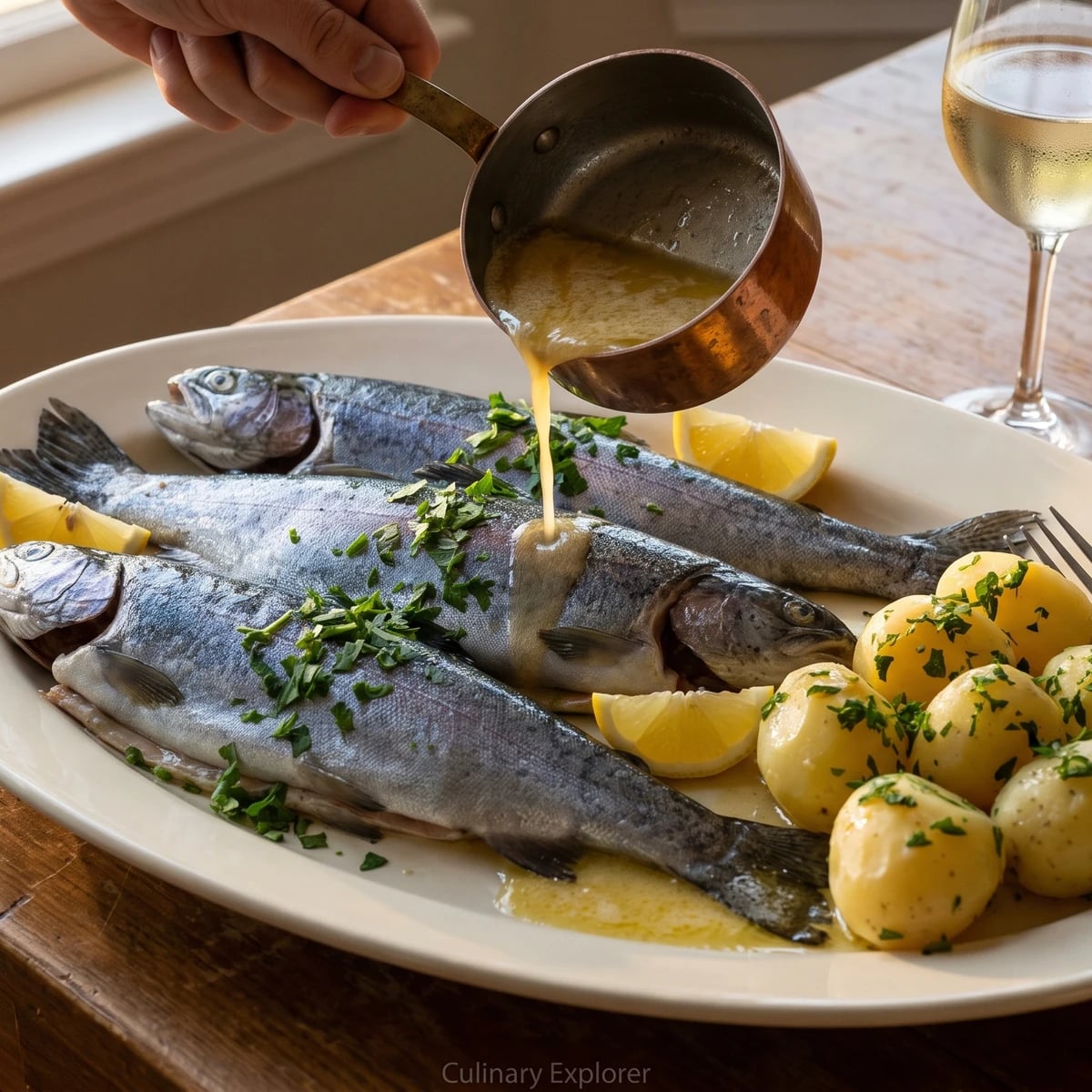
    Lift each trout carefully with two wide spatulas, supporting both head and tail, and let the court-bouillon drain without touching the blue skin. Arrange the fish on a warm oval platter with the parsley potatoes alongside. Spoon a little beurre fondu around the trout rather than over the skin, scatter over the remaining parsley, and serve the rest of the butter with the lemon wedges at the table. Serve at once. À table!

Chef Tips

  • Cold, fast water produces firm, fine-flavored trout, just as the old entry insists, but condition decides the dish at the counter. Look for bright convex eyes, red gills, resilient flesh, and a clean mineral smell. Most important, the skin should still feel naturally slippery rather than scrubbed dry.
  • Order the trout ahead and be exact with the fishmonger: dispatch and gut them close to collection, but do not scale, scrub, or rinse the exterior. Transporting a live fish is unnecessary; immediate handling at the shop gives the home cook the freshness the method actually needs.
  • If every trout available has already been scaled or thoroughly washed, change the plan rather than the standard. Make truite meunière (trout lightly floured and cooked in foaming butter) instead; a washed fish can be splendid meunière, but it cannot produce the blue bloom honestly.
  • Use plain white wine vinegar with a clean, bright acidity. Dark vinegar muddies the color, while heavily flavored vinegar overwhelms the trout before it ever reaches the court-bouillon.
  • Pour a dry Alsatian Riesling. Its acidity follows the vinegar without making the fish taste sharp, and it has enough body for the beurre fondu.

Advance Preparation

  • The court-bouillon may be simmered, strained, cooled, and refrigerated one day ahead. Reheat it only to 180 to 185°F (82 to 85°C) before it meets the trout.
  • The fish itself cannot wait gracefully. Keep it over ice in the coldest part of the refrigerator, protected from meltwater, and cook it the same day it is collected. Do not pour on the hot vinegar until the court-bouillon, potatoes, and butter are ready to finish.
  • Cube the butter and chop the parsley earlier in the day, then keep both cold. Once made, the beurre fondu should be held only briefly because reheating a chilled butter emulsion invites it to split.

Frequently Asked Questions

Nutrition Information

1 serving (about 350g)

Calories
590 calories
Total Fat
34 g
Saturated Fat
17 g
Trans Fat
1 g
Unsaturated Fat
14 g
Cholesterol
160 mg
Sodium
600 mg
Total Carbohydrates
36 g
Dietary Fiber
3 g
Sugars
2 g
Protein
37 g

Note: Chef personas and recipes are created with AI assistance. Cook with care: follow safe food-handling practices, check doneness with a thermometer when needed, and adapt for allergies and your kitchen.

Where cooking meets culture.

Culinary guides, cultural storytelling, and the editorial depth that makes cooking meaningful.

Discover Culinary Explorer

More from Fish - Trout

Browse the full collection