Culinary Explorer

A cooking platform built around craft, culture, and the stories behind what we eat.
Discover Culinary Explorer
Médaillons de Saumon

Médaillons de Saumon

Created by Chef Juliette

Based on No. 808, Médaillons de Saumon, from Le Guide Culinaire (1907) by Auguste Escoffier

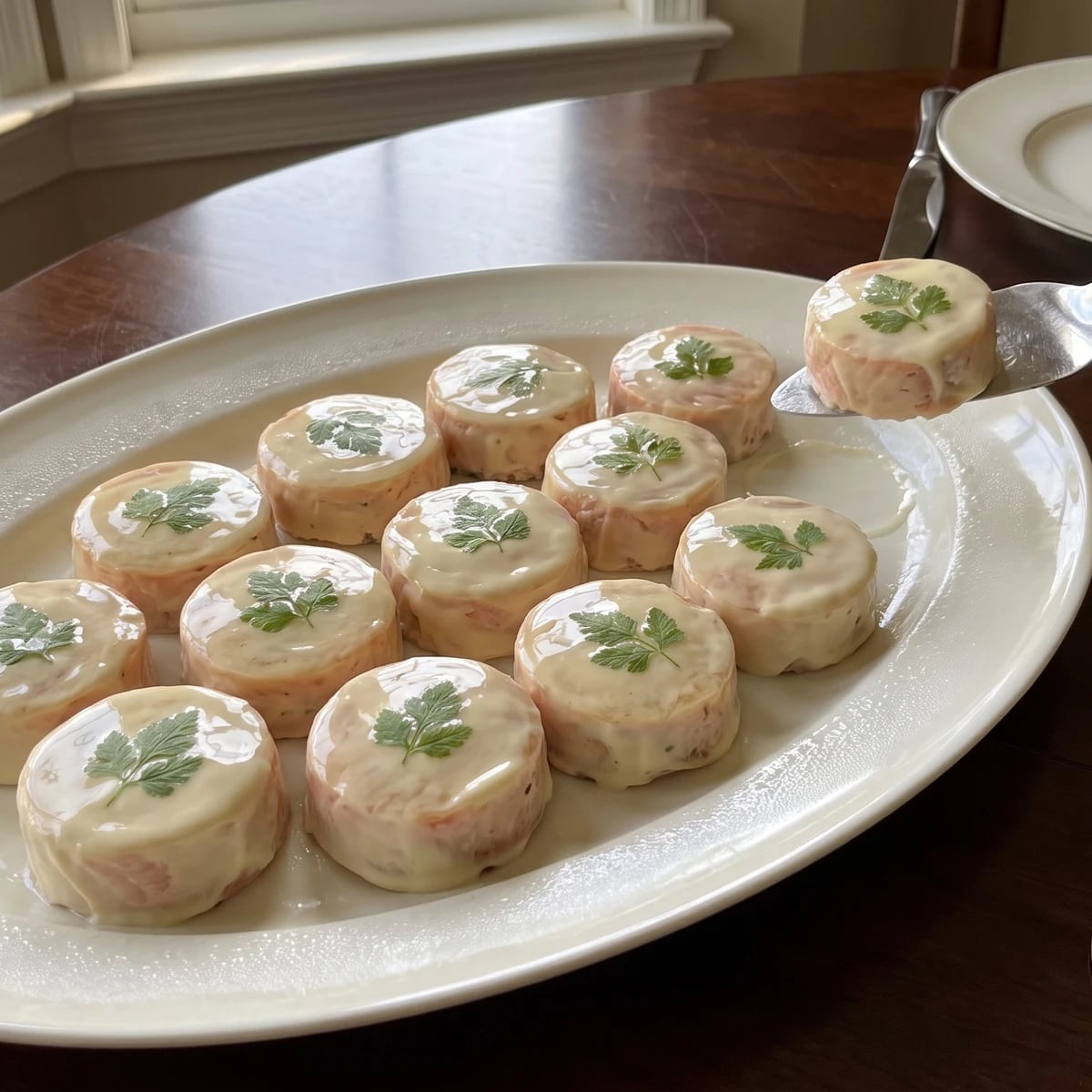
These Médaillons de Saumon turn exact cold cookery into a generous main: tender pressed salmon, a smooth coat of mayonnaise collée, and clear aspic, each layer set cleanly before the next.

Main Dishes
French
Special Occasion
Dinner Party
1 hr 15 min
Active Time
15 min cook4 hr 30 min total
Yield4 servings

Médaillons de Saumon (small salmon fillet rounds) teach the discipline of cold masking. Before touching a pan, know this: the cooked salmon must be flat, dry, and thoroughly chilled before the sauce reaches it. Warm fish loosens the emulsion, while damp fish sends it sliding toward the tray.

The original assumed a garde-manger working beside a saucier, clear fish aspic from stock never off the fire, matching cutters, and ample cold-room space. It did not call for the salamander, because there is nothing here to brown. At home, one center-cut fillet makes twelve medallions, a second tray and two tins become the light press, and strained fish stock reinforced with gelatin supplies the aspic. That equipment was brigade scaffolding, and it can go. Pocher à sec (cooking gently without added liquid), pressing, trimming after cooking, masking with mayonnaise collée (mayonnaise strengthened with aspic), and glazing with cold melted aspic are the dish. They stay. One cook, one stove, one evening.

The finished medallions are coral beneath an ivory coat, with chervil held under a clear glaze that catches the light. Chill and dry the trimmed rounds before masking them. If the mayonnaise slides, scrape it back, blot the fish, and chill both again. Ça se rattrape.

Médaillons de saumon belong to the Parisian cuisine classique of the cold buffet, where the garde-manger, the cold-larder station, shaped cooked fish into matching pieces and protected them beneath sauce and aspic. They traveled readily to bourgeois dinner-party tables because they could be completed before guests arrived and served without a last-minute pan. Despite the name, a medallion is not a special anatomical cut from the salmon: its uniform shape is made after cooking and pressing, which is why the trimming comes late.

The technique, the tradition, and the story behind every dish.

Discover Culinary Explorer

Ingredients

center-cut skinless salmon fillet

Quantity

1½ pounds (680 g)

pin bones removed

unsalted butter

Quantity

1 tablespoon (15 ml / 14 g)

softened

fine sea salt

Quantity

¾ teaspoon (3.75 ml / 4.5 g)

divided

finely ground white pepper

Quantity

¼ teaspoon (1.25 ml / 0.6 g)

divided

clear unsalted fish stock

Quantity

1½ cups (360 ml / 360 g)

well strained

cold water

Quantity

¼ cup (60 ml / 60 g)

unflavored powdered gelatin

Quantity

1 tablespoon (15 ml / 9 g)

pasteurized egg yolk

Quantity

1 large

at room temperature

Dijon mustard

Quantity

1 teaspoon (5 ml / 5 g)

white wine vinegar

Quantity

1 tablespoon (15 ml / 15 g)

divided

neutral oil, such as grapeseed or sunflower oil

Quantity

⅔ cup (160 ml / 147 g)

at room temperature

small flat chervil leaves

Quantity

12

rinsed and thoroughly dried

Equipment Needed

  • Long, sharp slicing knife
  • Two nesting rimmed trays
  • Two unopened tins, about 2 pounds (900 g) total, for pressing
  • 2¾-inch (7 cm) round or oval cutter
  • Wire rack and lined tray
  • Small offset spatula
  • Fine-mesh strainer and damp cloth or coffee filter
  • Instant-read thermometer
  • Medium whisk and mixing bowls

Instructions

  1. 1

    Slice the salmon

    Chill the salmon in the freezer for 15 minutes, just until firm enough to cut cleanly. Heat the oven to 325°F (165°C) and brush a rimmed metal tray generously with half the butter. Using a long, sharp slicing knife, cut the fillet across the grain on a shallow bias into twelve broad slices, each ⅓ inch (8 mm) thick. Do not trim them yet; cooking first and cutting afterward gives the medallions their even edges. Arrange the slices in one layer and season them with ½ teaspoon of the salt and ⅛ teaspoon of the white pepper.

    A fishmonger can cut the broad slices for you. Ask for twelve even salmon escalopes, ⅓ inch thick, from the center of a skinless fillet.
  2. 2

    Poach without liquid

    Rub a sheet of parchment with the remaining butter and lay it buttered-side down directly against the salmon. Pocher à sec in the oven for 4 to 7 minutes, until the flesh is just opaque, remains supple, and reaches about 140°F (60°C) at the center; the brief carryover beneath the paper will bring it close to 145°F (63°C). There is no added liquid. The close parchment and butter protect the thin slices while their own moisture cooks them.

  3. 3

    Press and chill

    Pour away any liquid from the tray without disturbing the salmon. Replace the top parchment with a clean sheet, set a second flat tray over it, and add about 2 pounds (900 g) of evenly distributed weight. Two unopened tins do the work nicely. Let the salmon settle for 10 minutes, then transfer the weighted tray to the refrigerator for at least 1½ hours. Keep the pressure light; you want level slices, not compressed fish.

  4. 4

    Build the aspic

    During the final half-hour of chilling, sprinkle the gelatin evenly over the cold water and leave it to bloom for 5 minutes. Bring the fish stock and ⅛ teaspoon of the salt to a bare simmer, skimming away any particles, then remove it from the heat. Stir in the bloomed gelatin until completely dissolved and strain through a damp fine cloth or coffee filter. Do not boil the gelatin once it has been added, or its setting strength weakens. Cool the aspic over a bowl of ice water, stirring occasionally, until it is cool but still fully liquid. Measure ⅓ cup (80 ml) for the mayonnaise and reserve the rest for glazing.

  5. 5

    Trim the medallions

    Remove the press and blot both sides of every salmon slice completely dry. Cut each with a 2¾-inch (7 cm) round or oval cutter, pressing straight down rather than twisting, and reserve the trimmings for an omelette or salmon salad. Set the twelve medallions on a wire rack over a lined tray and chill them uncovered for 10 minutes. This drying is not cosmetic. Moisture trapped beneath the mask is what makes the coating slip.

  6. 6

    Make mayonnaise collée

    Whisk the pasteurized yolk, Dijon mustard, 2 teaspoons of the vinegar, the remaining ⅛ teaspoon salt, and the remaining white pepper in a medium bowl. Add the oil first by drops, then in a fine steady thread once the emulsion has taken, whisking until the mayonnaise is thick and glossy. If it breaks, stop. Ça se rattrape: put the remaining teaspoon of vinegar in a clean bowl, whisk in a teaspoon of the broken mayonnaise until smooth, then add the rest gradually. Whisk the ⅓ cup (80 ml) of cooled liquid aspic into the finished mayonnaise in four additions. Set the bowl over ice and stir until the mayonnaise collée softly mounds on a spoon. If it becomes too firm, warm the outside of the bowl briefly with your hands; if it runs, give it another minute over ice.

    The egg yolk, mustard, oil, and liquid aspic should be near the same cool room temperature. A warm aspic melts the emulsion, while a half-set aspic leaves little lumps.
  7. 7

    Mask and set

    Leave the dry medallions on the rack and spoon about 1 tablespoon of mayonnaise collée over each one. Use a small offset spatula to coax an even layer over the top and sides without scraping the salmon. The coating should conceal the fish but remain thin enough to preserve its shape. Chill for 25 minutes, until the surface is firm. If the mask slides or pools, scrape it back into the bowl, blot and rechill the salmon, and thicken the sauce briefly over ice before trying again.

  8. 8

    Decorate and glaze

    Lay one dry chervil leaf flat on each set medallion. If the reserved aspic has gelled, melt it over the gentlest heat, then cool it over ice until it is fluid, lightly syrupy, and no warmer than 65°F (18°C). Spoon a thin coat from the center of each medallion so it flows over the top and sides. Chill for 10 minutes, then repeat with a second thin coat for an even gloss. If the aspic runs straight through the rack, it is too warm; cool it a little further. If it catches in lumps, warm the base of the bowl for a few seconds. Ça se rattrape.

  9. 9

    Arrange and serve

    Chill the glazed medallions for at least 1 hour. Lift them with a thin spatula and arrange three per person on a cold platter, leaving enough space that their glazed edges do not stick together. Let the platter stand for 10 minutes before serving so the salmon loses its refrigerator chill, but keep it below 40°F (4°C) until that final interval. The aspic should hold a clean gloss and the mayonnaise collée should cut neatly with the fish. À table!

Chef Tips

  • Choose the thick, even center of the fillet. The tapering tail cannot yield matching broad slices, and forcing it only creates ragged medallions. Technique first, always.
  • The source allows either mayonnaise thickened with jelly or a white, pink, or green chaud-froid. This version follows the mayonnaise collée path exactly; the emulsion supplies richness, while the aspic gives it enough body to mask the salmon.
  • The fish stock need not possess the impossible clarity of a brigade aspic, but it must be mild, unsalted, and free from particles. A murky, aggressively reduced stock turns the clear glaze brown and overwhelms the salmon.
  • Keep the finished dish cold and serve it within 24 hours. Do not freeze it. Freezing breaks both the mayonnaise emulsion and the aspic, leaving water on the surface when they thaw.
  • For a full dinner-party plate, serve the medallions with separately dressed tender lettuce and warm new potatoes. Keep the accompaniments away from the glazed platter so their vinaigrette cannot cloud the aspic. A dry white Burgundy has enough freshness for the mayonnaise and enough breadth for the salmon.

Advance Preparation

  • The aspic can be prepared up to 3 days ahead and refrigerated. Melt it over very gentle heat and cool it until lightly syrupy before mixing or glazing; never let it boil.
  • The salmon can be dry-poached and chilled under its light press overnight. Trim, mask, and glaze it the following morning.
  • The finished medallions may be completed up to 24 hours before serving. Refrigerate them on their platter beneath a loose cover that cannot touch the glaze.

Frequently Asked Questions

Nutrition Information

1 serving (about 295g)

Calories
725 calories
Total Fat
64 g
Saturated Fat
11 g
Trans Fat
0 g
Unsaturated Fat
47 g
Cholesterol
150 mg
Sodium
610 mg
Total Carbohydrates
0 g
Dietary Fiber
0 g
Sugars
0 g
Protein
38 g

Note: Chef personas and recipes are created with AI assistance. Cook with care: follow safe food-handling practices, check doneness with a thermometer when needed, and adapt for allergies and your kitchen.

Where cooking meets culture.

Culinary guides, cultural storytelling, and the editorial depth that makes cooking meaningful.

Discover Culinary Explorer

More from Fish - Salmon (Saumon)

Browse the full collection