
Chef Juliette
John Dory (St. Pierre)
John Dory has the delicacy of sole and the firmness of turbot. A light flouring, a quick butter sauté, and nut-brown beurre noisette show exactly why looks never mattered.
A cooking platform built around craft, culture, and the stories behind what we eat.
Created by Chef Juliette
Based on No. 805, Saumon Froid, ou Darne de Saumon Froid au Chambertin, from Le Guide Culinaire (1907) by Auguste Escoffier
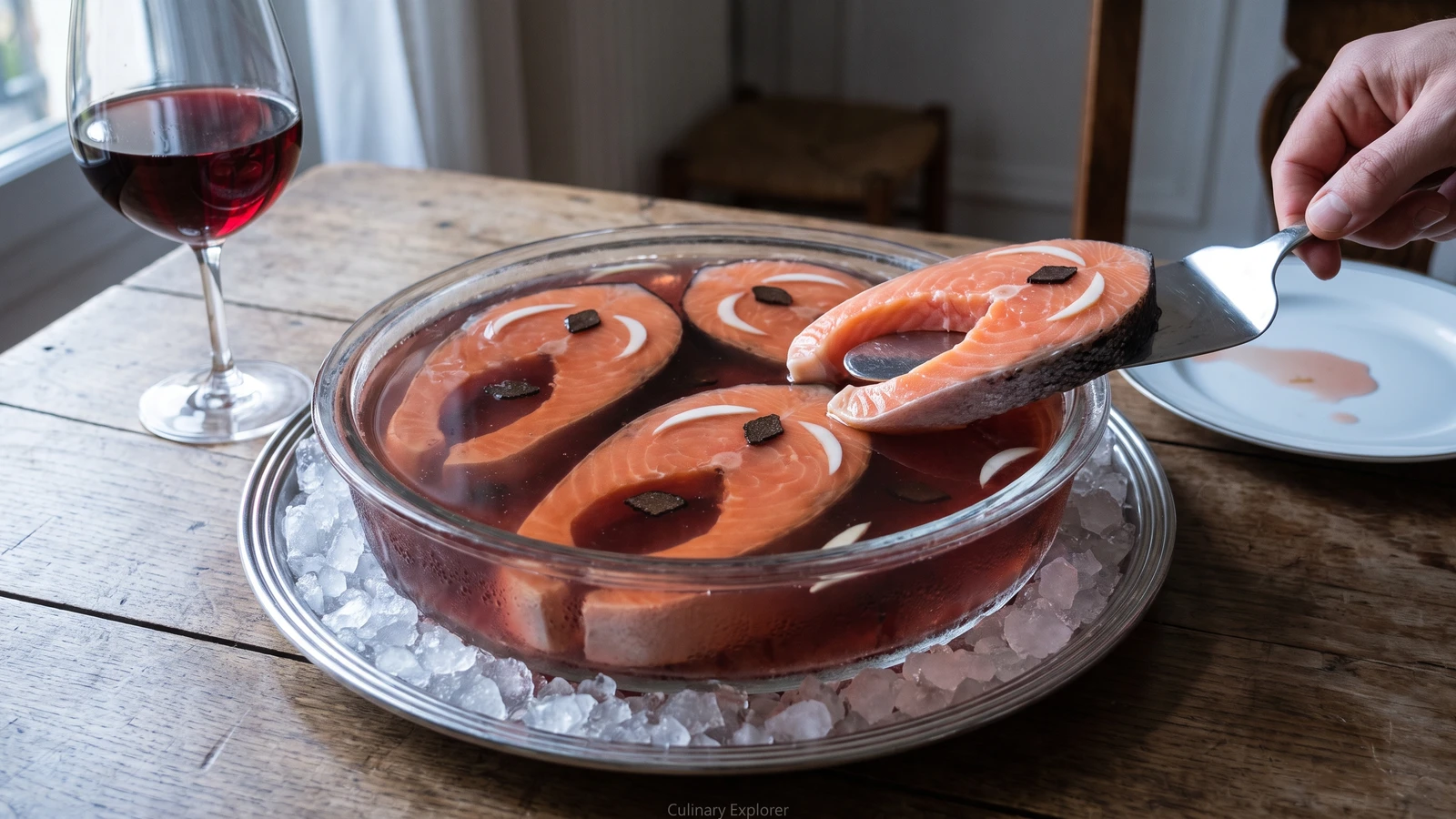
Saumon Froid turns one equal-part poaching liquor of clear fish fumet and Chambertin into both tenderness and wine-red aspic, a cold centerpiece whose discipline is clarity.
Saumon Froid, ou Darne de Saumon Froid au Chambertin (cold salmon, or a cold cross-cut salmon steak with Chambertin aspic), teaches one severe and useful principle: the poaching liquor must be treated as the finished sauce from the first minute. It cooks the fish, cools it, and becomes the aspic, so a cloudy boil or careless seasoning follows you all the way to the table. Keep it at a bare tremble and season it slightly more boldly than seems polite while warm, because cold mutes both salt and wine.
The original entry assumed a stockpot of clear fish fumet never off the fire, a saucier to turn the court-bouillon into flawless aspic, a whole salmon or service-size darne, and a crystal receptacle carried on carved ice. Here, four individual darnes poach in a snug pan; egg whites perform the saucier's clarification; a shallow glass dish and the refrigerator replace crystal and the cold room; crushed ice supports only the final service. The carved block and brigade scale are scaffolding, so they go. Equal parts fumet and Chambertin, cooling the salmon in that liquor, and glazing it with aspic drawn from the same liquid are the dish, so they stay.
The one step to guard is the clarification. Once the egg-white raft forms, stop stirring and never press it through the cloth; disturb it and the aspic dulls. If it clouds, ça se rattrape: cool it, clarify it once more with a fresh white, then build the glaze in thin coats. One cook, one stove, one evening.
Saumon Froid au Chambertin belongs to the grand cold-table repertoire of Paris, while its defining wine comes from Chambertin in Burgundy's Côte de Nuits. It is a Belle-vue presentation: poached fish is skinned, decorated, glazed with transparent aspic, and displayed in the jelly made from its own cooking liquor. The name can suggest a Burgundian household salmon dish, but the method traveled the other way, drawing a celebrated Burgundian red into formal Parisian service as a cold centerpiece.
Quantity
4, each about 1¼ inches (3 cm) thick and 6 ounces (170 g), 1½ pounds (680 g) total
Quantity
3 cups (710 ml / about 710 g)
cold
Quantity
3 cups (710 ml / about 700 g)
Quantity
1 teaspoon (5 ml / 6 g), plus more only if needed
Quantity
2 (about ¼ cup / 60 ml / 60 g total)
for clarification
Quantity
1 (about 2 tablespoons / 30 ml / 30 g)
for a second clarification if needed
Quantity
2 tablespoons (30 ml / 18 g)
Quantity
1 teaspoon (5 ml / 3 g)
for correcting a weak set if needed
Quantity
1 large (about 1 ounce / 30 g)
thinly sliced for the Belle-vue decoration
Quantity
½ ounce (15 g)
very thinly sliced into small diamonds
Quantity
8 pounds (3.6 kg)
divided between cooling and service
| Ingredient | Quantity |
|---|---|
| center-cut, bone-in salmon darnes | 4, each about 1¼ inches (3 cm) thick and 6 ounces (170 g), 1½ pounds (680 g) total |
| very clear fish fumetcold | 3 cups (710 ml / about 710 g) |
| Chambertin | 3 cups (710 ml / about 700 g) |
| fine sea salt | 1 teaspoon (5 ml / 6 g), plus more only if needed |
| large egg whitesfor clarification | 2 (about ¼ cup / 60 ml / 60 g total) |
| additional large egg white (optional)for a second clarification if needed | 1 (about 2 tablespoons / 30 ml / 30 g) |
| powdered unflavored gelatin | 2 tablespoons (30 ml / 18 g) |
| additional powdered unflavored gelatin (optional)for correcting a weak set if needed | 1 teaspoon (5 ml / 3 g) |
| hard-cooked egg whitethinly sliced for the Belle-vue decoration | 1 large (about 1 ounce / 30 g) |
| black trufflevery thinly sliced into small diamonds | ½ ounce (15 g) |
| cubed or crushed icedivided between cooling and service | 8 pounds (3.6 kg) |
Combine the very clear fish fumet, the concentrated fish essence, with the Chambertin and salt in a snug, deep sauté pan. This equal proportion is fixed by the dish, so do not stretch the liquid with water if the pan is too broad; move to a narrower vessel instead. Bring the court-bouillon, the poaching liquor, slowly to 175°F to 185°F (80°C to 85°C). It should tremble at the edges without boiling.
Lower the salmon darnes into the court-bouillon in one layer. A darne is a thick cross-cut steak through the bone, and the center bone stays in place to hold its horseshoe shape. Lay a round of parchment directly on the liquid, cover loosely, and maintain the barest tremble for 10 to 14 minutes. When the center reaches 130°F to 135°F (54°C to 57°C), take the pan off the heat and leave the fish in the liquor until carryover brings it to 145°F (63°C). If the liquid boils and white albumin pushes from the salmon, pull the pan off the burner immediately. The fish is not lost, and the clouded liquor will be rescued during clarification.
Set the covered pan in a wide ice-water bath, using about half the ice, and cool the salmon in its court-bouillon for 30 minutes. Transfer the pan to the refrigerator for another 45 to 60 minutes, until the darnes and liquid are thoroughly cold. Cooling in the liquor is not brigade scaffolding; it is part of the dish, keeping the salmon moist while the Chambertin and fumet settle into the flesh.
Lift the cold darnes onto a rack with two broad spatulas and reserve every drop of the cooking liquor. With a small sharp knife, ease away the outer skin and any loose surface fat while leaving the central bone and flesh intact. Remove stray pin bones with tweezers, then blot the surface gently. Cold salmon is firm enough to handle, but it still resents rough treatment.
Strain the cold cooking liquor through a fine sieve and measure 4 cups (950 ml / about 940 g) into a clean saucepan. Loosen the two egg whites with a whisk, stir them into the cold liquor, and heat very slowly while scraping the pan floor until the proteins gather and rise. Once the raft forms and the liquid reaches its first tremble, stop stirring. Make a small opening in the raft and cook gently for 10 minutes, then ladle the liquid through damp cheesecloth without pressing. Pressing forces the captured particles straight back through. If the aspic liquor remains cloudy, ça se rattrape: cool it completely and repeat the clarification with the additional egg white.
Measure 3 cups (710 ml / about 700 g) of clarified liquor. Chill ½ cup (120 ml / about 120 g) over ice, sprinkle the 2 tablespoons (18 g) gelatin evenly across it, and leave it for 5 minutes to bloom. Heat the remaining clarified liquor until hot but never boiling, then stir in the bloomed gelatin until perfectly dissolved. Taste a cooled spoonful and correct the salt if needed. Place a teaspoon on a cold saucer and chill it for 5 minutes; it should set firmly enough to cut while yielding under the tongue. If it remains syrupy, bloom the additional teaspoon of gelatin in a tablespoon of cold clarified liquor and dissolve it into the warm aspic. If it sets too firmly, melt it gently and loosen it with clarified liquor, one tablespoon at a time.
Pour a ⅛-inch (3 mm) layer of aspic into the chilled glass serving dish and refrigerate it for 10 to 15 minutes, until set but still tacky. Arrange the darnes on this bed. Brush each one with a thin coat of liquid aspic, place the hard-cooked egg-white slices and truffle diamonds in a restrained Belle-vue pattern, then brush again to secure them. Chill for 10 minutes and repeat with two more thin coats, setting each before the next. If the decoration slides, blot the fish and wait until the aspic thickens to the consistency of light syrup. If the bowl sets before you finish, warm it over barely hot water until fluid again.
Pour the remaining aspic slowly down the side of the dish until it rises halfway around the darnes. Chill for 20 minutes to anchor the fish, then add the rest until the salmon is just covered and the decoration remains clearly visible beneath the jelly. Refrigerate for at least 2 hours, until fully set. Immediately before serving, nest the glass dish in the remaining crushed ice on a rimmed tray. Keep it cold and bring it to the table with a broad fish slice. À table!
1 serving (about 165g)
Culinary guides, cultural storytelling, and the editorial depth that makes cooking meaningful.
Discover Culinary ExplorerChef Juliette
John Dory has the delicacy of sole and the firmness of turbot. A light flouring, a quick butter sauté, and nut-brown beurre noisette show exactly why looks never mattered.

Chef Juliette
Fresh haddock proves its delicacy in the meunière pan: a fine flour crust, moist pearly flakes, and beurre noisette sharpened with lemon and parsley, ready from one skillet in half an hour.

Chef Juliette
Éperlans à l’Anglaise turns small fish into a lesson in disciplined coating: boned smelts under a close, crisp crumb, pan-fried in clarified butter and finished with bright, half-melted maître d’hôtel butter.

Chef Juliette
Tiny smelts, shallot, mushrooms, white wine, gratin sauce, and fine bread raspings meet a fierce oven, where the fish must turn tender in the same breath the buttered crust bronzes.