
Chef Juliette
John Dory (St. Pierre)
John Dory has the delicacy of sole and the firmness of turbot. A light flouring, a quick butter sauté, and nut-brown beurre noisette show exactly why looks never mattered.
A cooking platform built around craft, culture, and the stories behind what we eat.
Created by Chef Juliette
Based on No. 801, Saumon Froid, ou Darne de Saumon Froid à la Royale, from Le Guide Culinaire (1907) by Auguste Escoffier
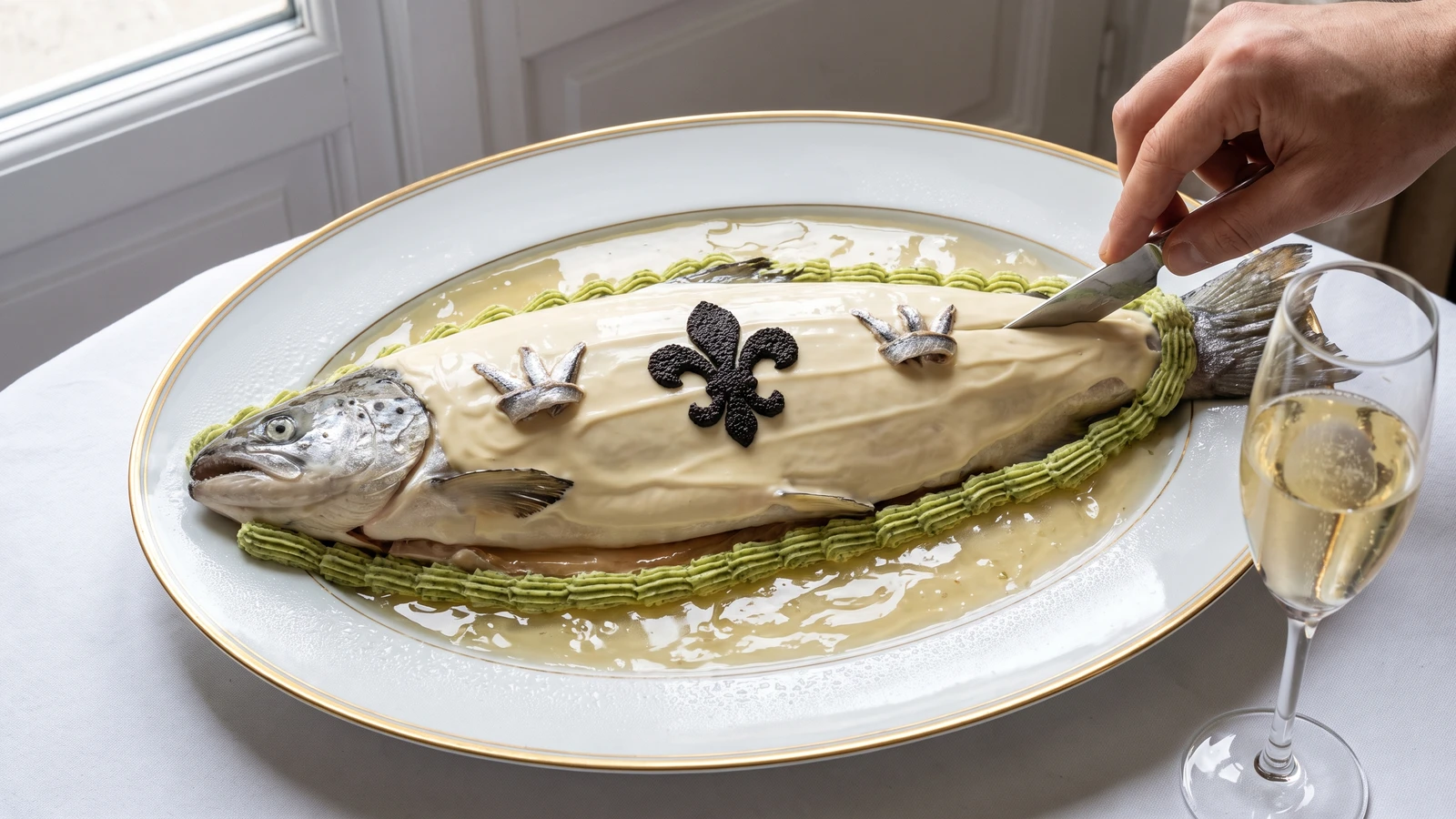
A cold salmon showpiece that teaches controlled setting: tender fish under salmon mousse and glossy jelly-bound mayonnaise, grounded on clear aspic, bordered with Montpellier butter, then marked with truffle and anchovy.
Saumon Froid, ou Darne de Saumon Froid à la Royale (cold salmon or cold salmon steak in the royal manner) teaches controlled setting. The one true thing to know before you touch a pan is that every layer must be cold enough to hold, while the fish jelly must remain just fluid enough to spread. Miss that narrow window and the royal coat slides or clots; meet it, and salmon, mousse, mayonnaise, and aspic cut as one composed slice.
The source entry assumed a saucier on staff, fish stock never off the fire for clear jelly, a cold station stocked with mousses, and several hands to dress a banquet salmon. It calls for no salamander because cold setting, not fierce heat, does the finishing. At home, the honest equivalents are a 2-pound center-cut salmon side, small prepared batches of its classical components, a level refrigerator shelf, an offset spatula, and an ordinary piping bag. The whole fish and divided labor are brigade scaffolding and can go; the domed Mousse de Saumon, jelly-bound Sauce Mayonnaise, clear aspic, Montpellier butter border, truffle fleur-de-lys, and two anchovy crowns are the dish and must stay. One cook, one stove, one evening.
Spread the mousse more generously along the middle and taper it toward the sides, restoring the handsome rise of a whole dressed fish without burying its shape. The decisive step comes next: bind the fish jelly into the mayonnaise only when both are cool and supple. That narrow emulsion-to-gel transition decides whether the coat sets smooth, and the rescue waits exactly where you need it.
Saumon froid à la Royale belongs to the ceremonial cold buffet of the French grand kitchen, especially the Paris table, rather than to a single province. The title à la Royale names its heraldic garnish and formal assembly: clear jelly, a truffle fleur-de-lys, and anchovy crowns turn cold poached fish into a celebration centerpiece. The ornament is not separate from the technique; aspic protects the fish, mousse restores its height, and jelly-bound mayonnaise keeps a clean coat through service.
Quantity
1 piece, about 2 pounds (900 g)
gently poached, thoroughly chilled, drained, and dried
Quantity
1¼ cups (300 ml / 285 g)
chilled but spreadable
Quantity
¾ cup (180 ml / 170 g)
made with pasteurized egg yolk
Quantity
1½ cups (360 ml / 360 g)
melted and cooled until fluid, divided
Quantity
¾ cup (180 ml / 170 g)
softened only until pipeable
Quantity
1 small truffle, about 1 ounce (28 g)
very thinly sliced
Quantity
8 fillets, about 1½ ounces (42 g)
drained and patted dry
| Ingredient | Quantity |
|---|---|
| center-cut skin-on salmon side or large darnegently poached, thoroughly chilled, drained, and dried | 1 piece, about 2 pounds (900 g) |
| prepared Mousse de Saumonchilled but spreadable | 1¼ cups (300 ml / 285 g) |
| prepared Sauce Mayonnaisemade with pasteurized egg yolk | ¾ cup (180 ml / 170 g) |
| prepared clear fish jellymelted and cooled until fluid, divided | 1½ cups (360 ml / 360 g) |
| prepared Montpellier buttersoftened only until pipeable | ¾ cup (180 ml / 170 g) |
| black trufflevery thinly sliced | 1 small truffle, about 1 ounce (28 g) |
| oil-packed anchovy filletsdrained and patted dry | 8 fillets, about 1½ ounces (42 g) |
Place a 15 by 10-inch (38 by 25 cm) oval platter on a level refrigerator shelf until cold. Reserve ¼ cup (60 ml / 60 g) of the clear fish jelly for the mayonnaise, then pour the remaining 1¼ cups (300 ml / 300 g) into the platter, making an even layer about ⅛ inch (3 to 4 mm) deep. Prick surface bubbles while the jelly remains fluid and chill for 25 to 35 minutes, until completely firm. If the jelly starts setting before it levels, return it to the bowl and warm it gently just until fluid. Never boil it, which clouds the clarity you worked for.
Set the chilled salmon on a flat tray with its presentation face upward. A fillet side is already bared on top, so leave its lower skin attached as support. If using a bone-in darne, carefully remove the skin from the upper presentation side only, exposing the fillets while leaving the underside intact. Pull any remaining pin bones, trim only ragged edges, and pat the flesh absolutely dry. Surface moisture loosens the mousse and lets the finished coat slide.
Masquer, meaning coat completely, the bared salmon with the Mousse de Saumon. Use a small offset spatula to lay the mousse rather more thickly along the middle than at the sides, forming a gentle rounded rise while preserving the salmon's outline. If the mousse drags and tears, it is too cold; leave it for 5 minutes, then smooth it with a spatula dipped in warm water and wiped completely dry. If it slumps, chill the salmon for 10 minutes before continuing. Refrigerate the masked salmon for 25 to 30 minutes, until the mousse feels firm.
Bring the Sauce Mayonnaise and reserved clear fish jelly to the same cool, supple temperature, about 65 to 70°F (18 to 21°C). Whisk the jelly into the mayonnaise one spoonful at a time, incorporating each addition before the next. If the mixture turns grainy, the jelly has seized; hold the bowl over barely warm water for a few seconds and whisk until smooth. If it becomes loose, set the bowl over ice and whisk until it regains body. Ça se rattrape. Spread a thin, even coat over the firm mousse, smoothing from the raised center toward the sides without repeated strokes, then chill for 35 to 45 minutes, until the surface sets without taking a fingerprint.
Slide two wide fish spatulas beneath the salmon, supporting both ends, and lower it centrally onto the firm clear jelly. Withdraw the spatulas in opposite directions so the fish settles without twisting. If the aspic develops a small crack, touch the seam with the back of a spoon dipped in hot water and wiped dry, then chill for 5 minutes. The softened edges will join, and the butter border will conceal the repair.
Fit a piping bag with a ½-inch (12 mm) grooved star tip and fill it with the Montpellier butter. Pipe a continuous ridged border around the salmon where it meets the jelly. Butter that cracks is too cold, so work the bag briefly between your hands; butter that loses its grooves is too warm, so chill the filled bag for 5 minutes. Cut a small fleur-de-lys template from parchment, use it to trim the truffle slices, and arrange the motif at the center of the mayonnaise coat. Shape the anchovy fillets into two small crown outlines, placing one on either side of the fleur-de-lys. Keep the lines clear and stop there.
Chill the completed salmon uncovered for 20 minutes to fix the decoration, then protect it with an inverted deep roasting pan or a domed cover that cannot touch the surface. Hold it at or below 40°F (4°C) for up to 6 hours. Take it from the refrigerator 10 minutes before serving. Cut with a thin knife dipped in hot water and wiped dry between slices, lifting each portion with its mousse, mayonnaise, butter border, and a little clear aspic. À table!
1 serving (about 465g)
Culinary guides, cultural storytelling, and the editorial depth that makes cooking meaningful.
Discover Culinary ExplorerChef Juliette
John Dory has the delicacy of sole and the firmness of turbot. A light flouring, a quick butter sauté, and nut-brown beurre noisette show exactly why looks never mattered.

Chef Juliette
Fresh haddock proves its delicacy in the meunière pan: a fine flour crust, moist pearly flakes, and beurre noisette sharpened with lemon and parsley, ready from one skillet in half an hour.

Chef Juliette
Éperlans à l’Anglaise turns small fish into a lesson in disciplined coating: boned smelts under a close, crisp crumb, pan-fried in clarified butter and finished with bright, half-melted maître d’hôtel butter.

Chef Juliette
Tiny smelts, shallot, mushrooms, white wine, gratin sauce, and fine bread raspings meet a fierce oven, where the fish must turn tender in the same breath the buttered crust bronzes.