
Chef Juliette
John Dory (St. Pierre)
John Dory has the delicacy of sole and the firmness of turbot. A light flouring, a quick butter sauté, and nut-brown beurre noisette show exactly why looks never mattered.
A cooking platform built around craft, culture, and the stories behind what we eat.
Created by Chef Juliette
Based on No. 795, Darne de Saumon Royale, from Le Guide Culinaire (1907) by Auguste Escoffier
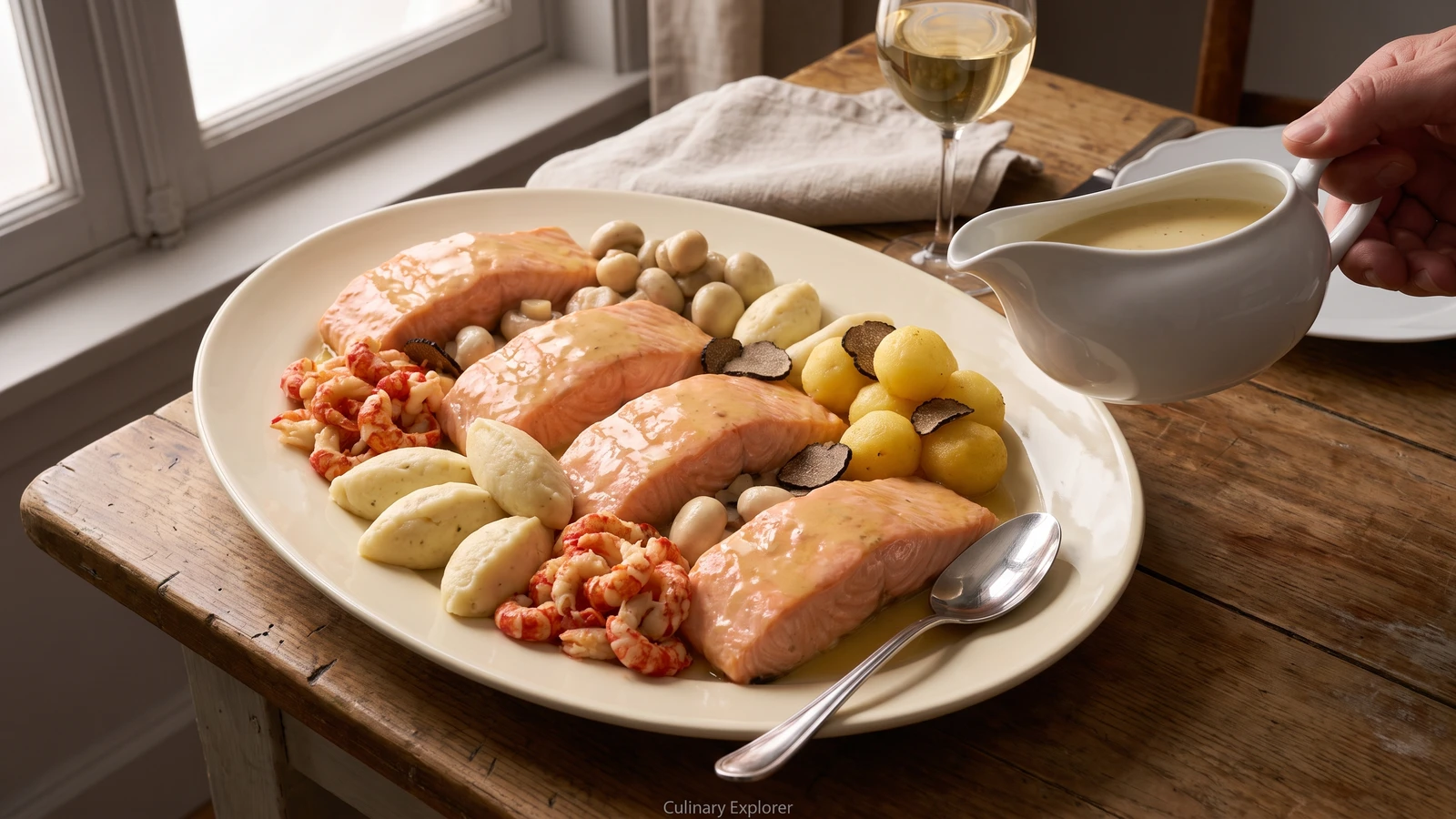
Salmon braised gently in Sauternes, then ringed with crayfish tails, delicate fish mousselines, mushrooms, truffle, and potato pearls, while ivory Sauce Normande waits in its own boat.
Darne de Saumon Royale (royal-style cross-cut salmon steak) teaches orchestration. Its salmon is tender from a gentle Sauternes braise, its garnishes are abundant but distinct, and its ivory Sauce Normande arrives separately so every guest decides how generously to pour. The one true thing to know before touching a pan is simple: the salmon goes in last.
The original formula assumed a saucier on staff, fish stock never off the fire, a mortar and tamis for the mousseline, and spare hands turning identical potato balls. The salamander stays cold because this dish asks for no gratinéed finish. At home, a food processor replaces the mortar, an 18 mm melon baller replaces the round spoon-cutter, and one small saucepan builds the Normande. Separate stations and brigade-sized batches are scaffolding, so they go. The Sauternes braise, cold-worked fish mousselines, grouped crayfish and truffle garnish, and sauce passed separately are the dish, so they stay.
This is opulence managed with sequence, not panic. Make the mousselines, potatoes, mushrooms, and sauce base first; then braise the darnes while everything else waits within easy reach. One cook, one stove, one evening. Before the first pan heats, remember the deciding step: every garnish must be ready before the salmon meets the Sauternes.
Darne de saumon Royale belongs to the Parisian grand-kitchen repertoire, where royale describes an opulent arrangement of costly garnishes rather than a documented royal origin. The darne, a transverse slice from a large round fish that keeps the central bone, moved easily from the fishmonger's block to the formal platter because it braises evenly and presents with authority. Sauce Normande brings Normandy's cream, mushrooms, and shellfish liquor, while Sauternes comes from Bordeaux; their meeting is classical assembly, not evidence that the dish belongs regionally to either place.
Quantity
4, 6 to 7 oz (170 to 200 g) each and 1 1/4 inches (3 cm) thick
Quantity
5 1/4 oz (150 g)
cut into 1-inch (2.5 cm) pieces
Quantity
1 (about 2 tablespoons / 30 ml / 30 g)
kept very cold
Quantity
1/2 cup plus 2 tablespoons (150 ml / 150 g)
Quantity
1 1/4 cups (300 ml / 300 g)
Quantity
2 cups (480 ml / 480 g)
divided
Quantity
1/4 cup (60 ml / 60 g)
Quantity
3/4 cup (180 ml / 180 g)
divided
Quantity
8 tablespoons (120 ml / 113 g)
divided, with 2 tablespoons kept cold
Quantity
2 tablespoons (30 ml / 16 g)
Quantity
2 (about 2 tablespoons / 30 ml / 36 g)
Quantity
1 tablespoon (15 ml / 15 g)
Quantity
1 1/4 cups (300 ml / 180 g)
drained
Quantity
2 cups (480 ml / 225 g)
trimmed and left whole
Quantity
1 small, about 3/4 oz (20 g)
thinly sliced, with jar liquor reserved if applicable
Quantity
4 (about 1 1/3 lb / 600 g)
peeled
Quantity
2 tablespoons (30 ml / 36 g)
divided, most for the cooking water
Quantity
1/2 teaspoon (2.5 ml / 1 g)
divided
| Ingredient | Quantity |
|---|---|
| center-cut salmon darnes (bone-in steaks) | 4, 6 to 7 oz (170 to 200 g) each and 1 1/4 inches (3 cm) thick |
| very cold skinless whiting or other lean white fish filletcut into 1-inch (2.5 cm) pieces | 5 1/4 oz (150 g) |
| large egg whitekept very cold | 1 (about 2 tablespoons / 30 ml / 30 g) |
| very cold heavy cream for the mousseline | 1/2 cup plus 2 tablespoons (150 ml / 150 g) |
| Sauternes | 1 1/4 cups (300 ml / 300 g) |
| unsalted fish stockdivided | 2 cups (480 ml / 480 g) |
| strained oyster liquor | 1/4 cup (60 ml / 60 g) |
| heavy cream for Sauce Normandedivided | 3/4 cup (180 ml / 180 g) |
| unsalted butterdivided, with 2 tablespoons kept cold | 8 tablespoons (120 ml / 113 g) |
| all-purpose flour | 2 tablespoons (30 ml / 16 g) |
| large egg yolks | 2 (about 2 tablespoons / 30 ml / 36 g) |
| fresh lemon juice | 1 tablespoon (15 ml / 15 g) |
| cooked peeled crayfish tailsdrained | 1 1/4 cups (300 ml / 180 g) |
| very small button mushroomstrimmed and left whole | 2 cups (480 ml / 225 g) |
| fresh or whole preserved black trufflethinly sliced, with jar liquor reserved if applicable | 1 small, about 3/4 oz (20 g) |
| medium Yukon Gold potatoespeeled | 4 (about 1 1/3 lb / 600 g) |
| fine sea saltdivided, most for the cooking water | 2 tablespoons (30 ml / 36 g) |
| ground white pepperdivided | 1/2 teaspoon (2.5 ml / 1 g) |
Heat the oven to 325°F (165°C), then chill the food processor bowl and blade for 15 minutes. With an 18 mm melon baller, the honest home equivalent of the large round spoon-cutter, raise 20 to 24 potato balls and hold them in cold water. Trim the mushrooms, drain the crayfish, slice the truffle, and keep each garnish separate. The salmon goes in last, so this preparation is not fussiness; it is what lets one cook land the whole arrangement hot.
Put the cold white fish, 1/2 teaspoon salt, and a pinch of white pepper in the chilled processor. Pulse to a smooth, tacky paste, scrape the bowl, then process in the egg white. Add 1/2 cup (120 ml) of the cold mousseline cream a spoonful at a time, using short pulses and stopping before the bowl warms. Press the mixture once through a fine sieve. The processor replaces the mortar and repeated tamis work of a brigade, while the single sieving keeps the texture worthy of the dish. If the paste turns grainy or oily, stop and nest the bowl over ice for 5 minutes, then stir in a spoonful of the reserved cold cream until it comes together.
Bring a wide saucepan of water to 175 to 180°F (79 to 82°C), a bare tremble, and season it with 2 teaspoons of the salt. Poach a teaspoonful of mousseline for 2 minutes and taste it. If it is firm, work in the remaining cream a teaspoon at a time; if it spreads, chill the paste for 10 minutes and test again. Never stiffen it with flour. Shape 12 small oval mousselines between two wet teaspoons and poach them without boiling for 4 to 5 minutes, turning once, until set and cooked through to 145°F (63°C). Lift them into a shallow pan containing 1/2 cup (120 ml) warm fish stock and 1 tablespoon butter, then cover.
Put the drained potato balls in fresh cold water with 2 teaspoons salt, bring them gently to a simmer, and cook for 8 to 10 minutes until a knife enters without resistance. This is à l'Anglaise, plainly in water, and the word carries the technique. Drain them before their edges crumble, return them to the dry warm pan for 30 seconds, then roll them in 1 tablespoon butter and hold them covered.
Melt 1 tablespoon butter in a small sauté pan over medium-low heat. Add the whole mushrooms with a pinch of salt and 1/4 cup (60 ml) fish stock, cover, and cook for about 5 minutes until tender but still neat and pale. Uncover briefly if necessary to concentrate the liquor without browning the mushrooms. Drain them and reserve every spoonful of their cooking liquor for the sauce.
Melt 2 tablespoons butter in a saucepan, stir in the flour, and cook this roux blanc, a white roux, for 2 minutes without letting it color. Whisk in the remaining 1 1/4 cups (300 ml) fish stock a little at a time, followed by the oyster liquor, reserved mushroom liquor, and 1/2 cup (120 ml) of the Sauce Normande cream. Simmer gently for 8 to 10 minutes, whisking around the corners, until the sauce lightly coats a spoon. Strain it and hold it warm below a simmer. The source sends Sauce Normande separately but supplies no numbered component formula, so this home quantity is built directly and kept whole at service.
Butter a 12-inch (30 cm) shallow braiser with 1 tablespoon butter. Season the salmon darnes with 1 teaspoon salt and 1/4 teaspoon white pepper, then arrange them in one layer and pour in the Sauternes. The wine should reach roughly one-third of the way up the fish; if your pan is too broad, use a smaller vessel rather than diluting the wine. Cover the fish directly with parchment, fit the lid, and braise in the oven for 12 to 16 minutes, basting once, until the wine barely trembles and the centers reach 140°F (60°C). Resting will carry them toward 145°F (63°C). If the wine begins boiling hard, lift the pan from the oven for 2 minutes and return it at 300°F (150°C); a hard boil tightens the flesh.
Transfer the darnes carefully to a platter warmed with hot water and cover them with parchment. Strain the Sauternes braising liquor into a clean pan and boil it down to 1/2 cup (120 ml). Reserve 2 tablespoons for glazing the salmon and whisk the rest into the warm Normande base. Whisk the egg yolks with 2 tablespoons of the remaining cream, temper them with two ladlefuls of hot sauce, then return the liaison to the saucepan. Stir over low heat until the sauce nappes, coating the back of a spoon in an even ivory layer, and never let it boil. Off the heat, whisk in the 2 tablespoons cold butter, the lemon juice, and any reserved truffle liquor. If the liaison curdles or the butter separates, put 1 tablespoon cold cream in a clean bowl and whisk in the broken sauce gradually. Ça se rattrape. Use the last cream to loosen the sauce if it becomes too tight.
Set the covered pan of mousselines and stock over the lowest heat. Add the mushrooms, buttered potato balls, and crayfish tails, then warm everything for 2 to 3 minutes without simmering. The crayfish are already cooked, and boiling makes them rubbery. Lift each element out with a slotted spoon and drain it well so the platter stays composed rather than flooded.
Brush the darnes with the reserved Sauternes reduction. Around each one, arrange distinct little bunches of crayfish tails, three mousselines, whole mushrooms, and potato balls, then lay the truffle slices across the hot salmon and between the garnishes. Do not toss everything into one heap; the grouped abundance is the meaning of royale. Pour the Sauce Normande into a warm sauceboat and send it to the table separately, exactly as the dish requires. À table!
1 serving (about 620g)
Culinary guides, cultural storytelling, and the editorial depth that makes cooking meaningful.
Discover Culinary ExplorerChef Juliette
John Dory has the delicacy of sole and the firmness of turbot. A light flouring, a quick butter sauté, and nut-brown beurre noisette show exactly why looks never mattered.

Chef Juliette
Fresh haddock proves its delicacy in the meunière pan: a fine flour crust, moist pearly flakes, and beurre noisette sharpened with lemon and parsley, ready from one skillet in half an hour.

Chef Juliette
Éperlans à l’Anglaise turns small fish into a lesson in disciplined coating: boned smelts under a close, crisp crumb, pan-fried in clarified butter and finished with bright, half-melted maître d’hôtel butter.

Chef Juliette
Tiny smelts, shallot, mushrooms, white wine, gratin sauce, and fine bread raspings meet a fierce oven, where the fish must turn tender in the same breath the buttered crust bronzes.