
Chef Juliette
John Dory (St. Pierre)
John Dory has the delicacy of sole and the firmness of turbot. A light flouring, a quick butter sauté, and nut-brown beurre noisette show exactly why looks never mattered.
A cooking platform built around craft, culture, and the stories behind what we eat.
Created by Chef Juliette
Based on No. 792, Darne de Saumon Lucullus, from Le Guide Culinaire (1907) by Auguste Escoffier
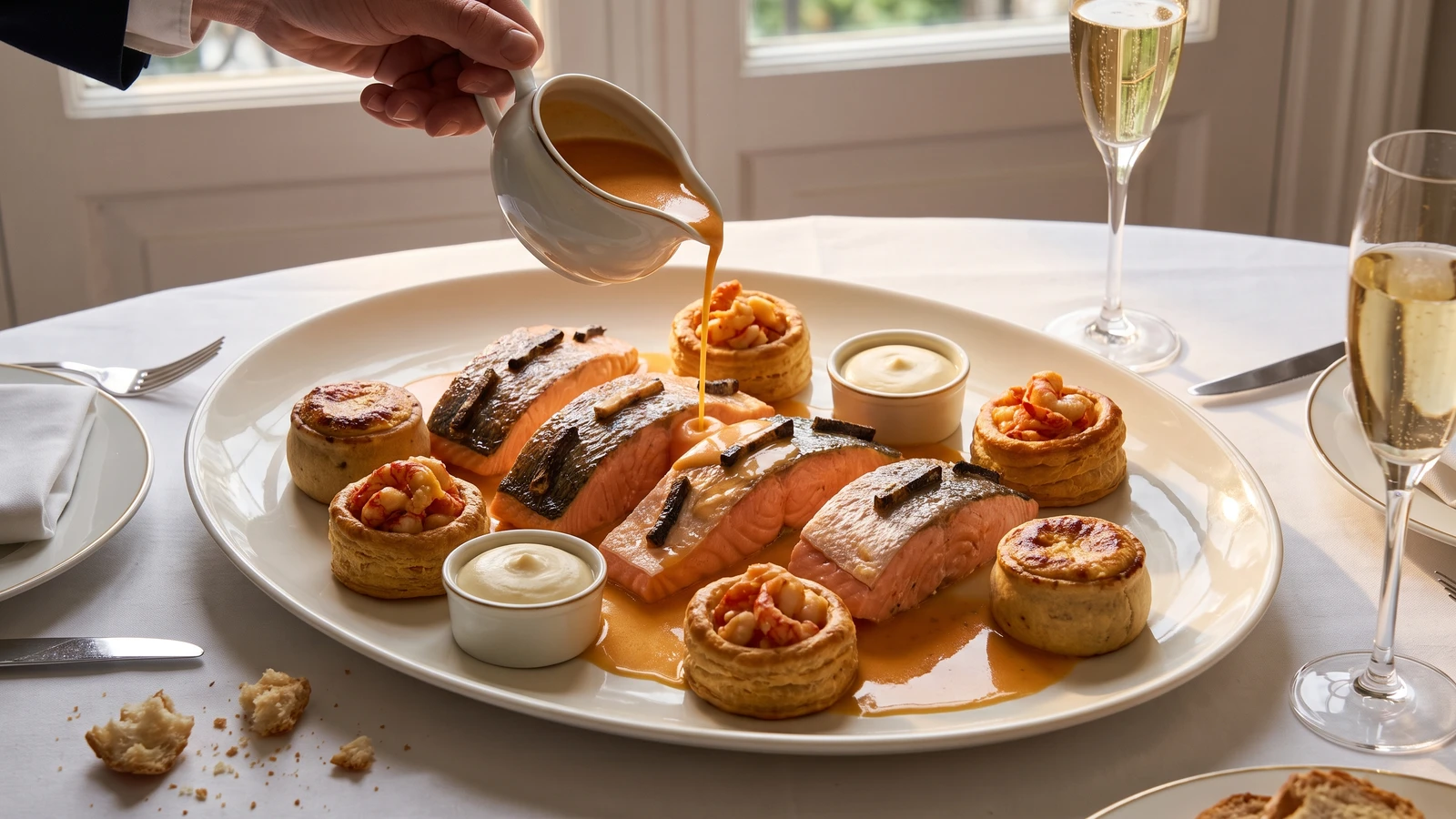
A truffle-larded salmon darne braised gently in Champagne, encircled by crayfish patties, milt cassolettes, and oyster mousselines, with the coral-gold braising liquor mounted in equal parts ordinary and crayfish butter.
Darne de Saumon Lucullus (a truffle-larded cross-cut salmon steak braised in Champagne) teaches the discipline of separating cooking from sauce-making. The salmon must leave its liquor while still moist; only then may that liquor reduce hard enough to carry equal parts ordinary butter and crayfish butter. Leave the fish in while the sauce concentrates and you sacrifice the darne to the sauce. That is the one true thing to know before touching the pan.
The entry assumed a saucier at the reduction, a pastry hand shaping miniature patties and cassolettes, rows of dariole-moulds, a stock never off the fire, and a salamander ready to refresh every little garnish. This particular sauce needs no stock, only its Champagne braising liquor, and your honest equivalents are one wide pan, a saucepan, a mini muffin tin, four small moulds, and a hot oven. Bought all-butter pâte feuilletée (puff pastry) removes the labor of a brigade, not the crayfish patty itself. Dozens of identical pieces and separate hot cupboards were service scaffolding, so those go; the truffle larding, all three garnishes, and equal-butter finish stay because they are the dish. One cook, one stove, one evening.
Scaled to four individual darnes, Lucullus still arrives generously: dark truffle threaded through coral salmon, crisp little patties holding crayfish tails, soft milt cassolettes, oyster mousselines, and a coral-gold sauce sent separately. The work is staged, not rushed. Keep the mousseline cold while mixing, keep the Champagne at a tremble around the salmon, and lift the fish the moment its centre reaches its point.
Darne de Saumon Lucullus belongs to the Parisian repertoire of grande cuisine rather than to a regional fishing table; in that naming language, Lucullus announced truffle, shellfish, and deliberate abundance. A darne is the fishmonger's thick cross-cut slice from a large round fish, and grand kitchens favored it because the bone held the salmon together through braising while the broad flesh accepted larding and an architectural garnish. As the preparation traveled to bourgeois celebration tables, individual darnes replaced the brigade-sized presentation cut, but Champagne, truffle, crayfish, oyster, and butter-mounted braising liquor remained its grammar.
Quantity
4, each about 1¼ inches (3 cm) thick and 6½ ounces (185 g)
Quantity
1 small truffle (about 1 ounce / 28 g)
Quantity
2 cups (475 ml / 475 g)
divided
Quantity
16 to 24 (about 1½ pounds / 680 g), yielding about 3/4 cup (180 ml / 120 g) tail meat
tails removed and deveined; shells reserved
Quantity
1/2 cup (120 ml / 113 g)
Quantity
3 tablespoons (45 ml / 42 g)
cubed
Quantity
2 tablespoons (30 ml / 28 g)
divided
Quantity
1 package (about 14 ounces / 397 g)
kept cold
Quantity
1 tablespoon (15 ml / 8 g)
for rolling
Quantity
1
beaten with 1 teaspoon (5 ml / 5 g) water
Quantity
8 (about 5 ounces / 140 g drained meat)
Quantity
1/2 cup (120 ml / 100 g)
very cold
Quantity
3/4 cup (180 ml / 180 g)
very cold and divided
Quantity
1 (about 2 tablespoons / 30 ml / 30 g)
Quantity
4 lobes (about 7 ounces / 200 g), or 7 ounces / 200 g scallop roe
Quantity
2 teaspoons (10 ml / 12 g)
divided
Quantity
1/2 teaspoon (2.5 ml / 1 g)
divided
| Ingredient | Quantity |
|---|---|
| center-cut, bone-in salmon darnes | 4, each about 1¼ inches (3 cm) thick and 6½ ounces (185 g) |
| whole black truffle, fresh or preserved | 1 small truffle (about 1 ounce / 28 g) |
| brut Champagnedivided | 2 cups (475 ml / 475 g) |
| whole cooked crayfish in shelltails removed and deveined; shells reserved | 16 to 24 (about 1½ pounds / 680 g), yielding about 3/4 cup (180 ml / 120 g) tail meat |
| unsalted butter for crayfish butter | 1/2 cup (120 ml / 113 g) |
| cold unsalted butter for finishing the saucecubed | 3 tablespoons (45 ml / 42 g) |
| softened unsalted butter for the pan and mouldsdivided | 2 tablespoons (30 ml / 28 g) |
| all-butter pâte feuilletée (puff pastry)kept cold | 1 package (about 14 ounces / 397 g) |
| all-purpose flourfor rolling | 1 tablespoon (15 ml / 8 g) |
| large eggbeaten with 1 teaspoon (5 ml / 5 g) water | 1 |
| large oysters with their liquor | 8 (about 5 ounces / 140 g drained meat) |
| dry-packed sea scallopsvery cold | 1/2 cup (120 ml / 100 g) |
| heavy creamvery cold and divided | 3/4 cup (180 ml / 180 g) |
| large egg white | 1 (about 2 tablespoons / 30 ml / 30 g) |
| cod milt lobes, laitance, or coral-bearing scallop roe | 4 lobes (about 7 ounces / 200 g), or 7 ounces / 200 g scallop roe |
| fine sea saltdivided | 2 teaspoons (10 ml / 12 g) |
| ground white pepperdivided | 1/2 teaspoon (2.5 ml / 1 g) |
Remove the crayfish tail meat, pull away the dark intestinal threads, and chill the meat for the patties. Rinse and crush the shells and heads. Melt the 1/2 cup (120 ml / 113 g) butter over medium-low heat, add the shells, and cook for 12 to 15 minutes, crushing them repeatedly with a wooden spoon, until the butter is coral-red and smells distinctly of crayfish without browning. Take the pan off the heat, carefully add 2 tablespoons (30 ml / 30 g) of the Champagne, then return it to a gentle simmer until the sputtering subsides. Strain through a fine sieve lined with cheesecloth, pressing firmly. Chill until solid, lift the colored fat from any liquid underneath, and measure 3 tablespoons (45 ml / 42 g) for the sauce.
Heat the oven to 400°F (200°C). Roll the cold pâte feuilletée on the measured flour to about 1/8 inch (3 mm). For eight very small crayfish patties, cut eight 2½-inch (6 cm) bases and sixteen matching rings, cutting each ring with a 1½-inch (4 cm) cutter. Brush the bases lightly with egg wash, stack two rings on each, and brush only the tops; egg running down the cut edges seals the layers and stops their rise. Bake the small centre cutouts beside them as lids. For the four cassolettes, a cassolette being a small drum-shaped hot case, line four buttered mini muffin wells with 3½-inch (9 cm) pastry rounds, add parchment and pie weights, and chill everything for 15 minutes. Bake the patties and cassolettes until deep butter-gold, about 12 minutes, then remove the weights and bake the cassolettes for another 4 to 6 minutes. If a centre rises or a cup slumps, press it gently back into shape while warm. Let all the pastry cool on a rack.
Lower the oven to 300°F (150°C). Drain the oysters very well, feeling each one for shell, and reserve their liquor for another use. Chill the food processor bowl and blade, then process the cold scallops and oysters with 1/4 teaspoon of the salt and a pinch of white pepper only until smooth. Add the egg white and pulse to combine. Press the paste through a fine sieve, return it to the cold bowl, and process while adding 7 tablespoons (105 ml / 105 g) of the cream in a thin stream. Add the final tablespoon (15 ml / 15 g) only once the mixture is smooth and glossy. If it turns grainy or oily, stop immediately, set the bowl over ice for 10 minutes, then fold in that reserved cold cream by hand. Heat makes a mousseline split; cold brings it back together.
Fry or poach a teaspoonful of mousseline and taste it, then correct the salt and white pepper. Butter four 4-ounce (120 ml) dariole-moulds, small straight-sided moulds, and fill them evenly, tapping each once to release hidden air. Cover with buttered parchment and set them in a roasting pan. Pour hot water around them to halfway up their sides to make a bain-marie (water bath), then bake for 15 to 18 minutes. They are ready when the edges spring lightly, the centres still tremble, and the internal temperature reaches 145°F (63°C). Rest for 2 minutes, loosen carefully, and invert onto a buttered shallow dish. Cover and chill once cool if they will wait longer than 30 minutes.
Rinse the cod milt gently and soak it in lightly salted cold water for 10 minutes. Put 1/4 cup (60 ml / 60 g) Champagne in a small saucepan with enough water to cover the milt, bring it to the barest tremble, and poach for 6 to 8 minutes, until just firm and 145°F (63°C) at the centre. Drain, remove any coarse outer membrane, and break the milt into small tender pieces. If using scallop roe, poach it for only 3 to 4 minutes because its texture is firmer and cooks faster. Cover and refrigerate until the cassolettes are filled.
Pat the salmon dry. Each darne has two curved halves around the central bone; on one half only, slide a flexible knife between skin and flesh and remove that arc of skin, leaving the opposite arc intact to hold the steak together. Cut the truffle into 20 to 24 slim batons. From the exposed curved edge, make five or six narrow tunnels in each darne, running parallel to its broad cut faces, and thread a truffle baton into every tunnel. This is larder, to lard the flesh by threading it with another ingredient, and it must stay. Keep the truffle inside the fish rather than protruding, then season the darnes evenly with salt and white pepper.
Fold the chilled crayfish tail meat with 2 tablespoons (30 ml / 30 g) of the cream, a small pinch of salt, and white pepper. Divide it among the eight pastry patties and set the little lids at an angle so the crayfish remains visible. Fold the cooked milt with the remaining 2 tablespoons (30 ml / 30 g) cream, season cautiously, and divide it among the four cassolettes. Set both kinds of pastry on a baking sheet. Place the oyster mousselines in their covered shallow dish, ready to warm beside the salmon.
Raise the oven to 325°F (165°C). Butter a wide lidded braiser, arrange the darnes in one layer, and pour the remaining Champagne around them so the liquid reaches about halfway up the fish. Cover the surface with a buttered parchment cartouche, then add the lid. Bring the liquid only to a bare tremble on the stove and transfer the pan to the oven. Braise for 10 to 15 minutes, checking early, until the centre reaches 140°F (60°C); carryover heat will bring it to 145°F (63°C). If the Champagne begins to boil hard, take the pan from the oven at once and lower the heat. During the final 8 minutes, place the covered mousselines in the oven; add the filled patties and cassolettes for the final 5 minutes. Lift the salmon to a warm platter as soon as it reaches its point and cover it loosely. Never reduce the liquor with the fish still inside.
Strain the hot braising liquor into a clean saucepan without pressing the sediment, skim any pale protein from the surface, and boil briskly until reduced to about 2/3 cup (160 ml) and lightly syrupy. Take the pan completely off the heat. Monter au beurre means mounting the reduction with cold butter: whisk in the 3 tablespoons (45 ml / 42 g) ordinary butter and the measured 3 tablespoons (45 ml / 42 g) crayfish butter, alternating small pieces so they enter in exactly equal quantities. Never boil the sauce once the butter begins. If oily beads appear, stop. Ça se rattrape: put a teaspoonful of cold water in a clean warm pan and whisk in the broken sauce a spoonful at a time until it becomes glossy again. Taste for salt and hold it beside, not over, the heat.
Set the four darnes on a warmed oval platter or individual warm plates. Around each one, arrange two crayfish patties, one milt cassolette, and one oyster mousseline, alternating the shapes so the garnish forms a generous loose ring rather than a rigid display. Pour the coral-gold sauce into a warmed sauceboat and send it to the table separately, exactly as the preparation intends. Let each person spoon it beside the salmon so the pastry stays crisp. À table!
1 serving (about 500g)
Culinary guides, cultural storytelling, and the editorial depth that makes cooking meaningful.
Discover Culinary ExplorerChef Juliette
John Dory has the delicacy of sole and the firmness of turbot. A light flouring, a quick butter sauté, and nut-brown beurre noisette show exactly why looks never mattered.

Chef Juliette
Fresh haddock proves its delicacy in the meunière pan: a fine flour crust, moist pearly flakes, and beurre noisette sharpened with lemon and parsley, ready from one skillet in half an hour.

Chef Juliette
Éperlans à l’Anglaise turns small fish into a lesson in disciplined coating: boned smelts under a close, crisp crumb, pan-fried in clarified butter and finished with bright, half-melted maître d’hôtel butter.

Chef Juliette
Tiny smelts, shallot, mushrooms, white wine, gratin sauce, and fine bread raspings meet a fierce oven, where the fish must turn tender in the same breath the buttered crust bronzes.