Chef Juliette
Ordinary or White Consommé
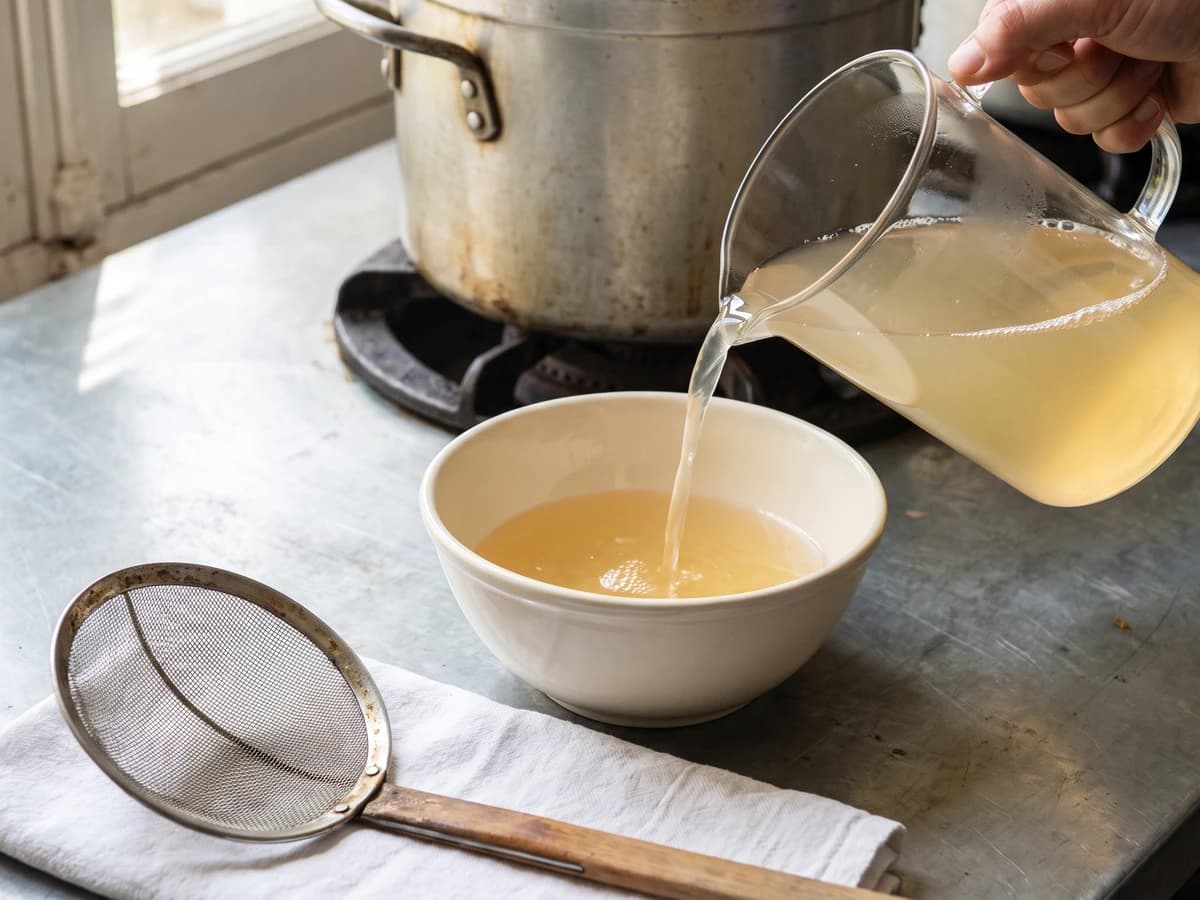
Beef shin, lean beef, and fowl begin in cold water and rise slowly toward a tremble. Skim before the boil, and you learn the quiet discipline that gives every clear French broth its backbone.
A cooking platform built around craft, culture, and the stories behind what we eat.
Created by Chef Juliette
Based on No. 79, Cream Sauce, from Le Guide Culinaire (1907) by Auguste Escoffier
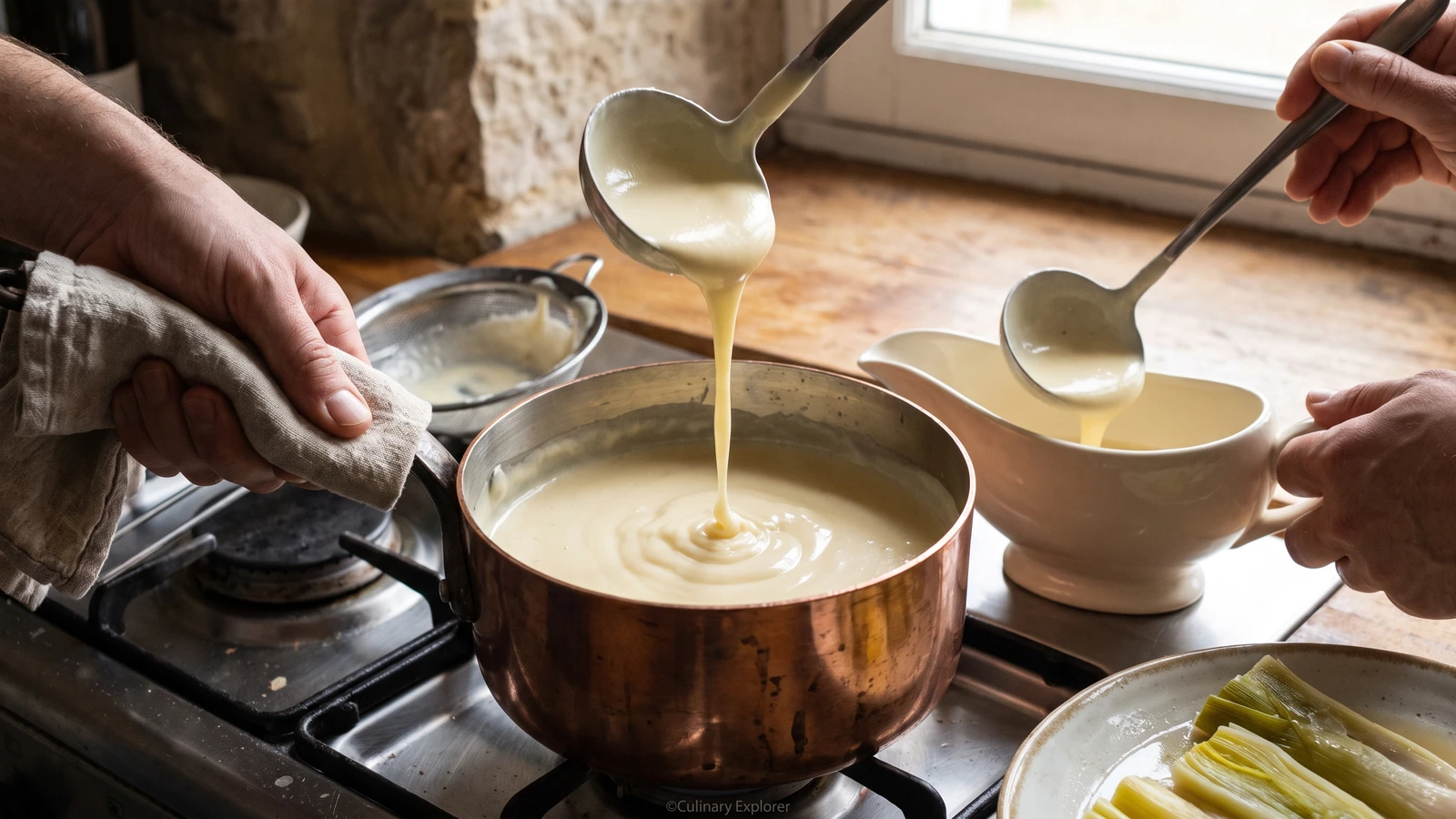
Sauce Crème teaches reduction and finishing in one pan: béchamel cooked down with cream until concentrated, strained to silk, then restored off heat with fresh cream and a few bright drops of lemon.
Sauce Crème (cream sauce) teaches one true thing: reduction creates concentration, while fresh cream restores suppleness. If you merely stir cream into béchamel and stop, you get a pale sauce, but not Sauce Crème. The first cream must boil down with the Béchamel Sauce until the mixture is deliberately too thick; only then does the second cream, added away from the fire, make it flow with a glossy, quiet richness.
The formula assumed a saucier watching an open fire and a cloth tammy waiting beside the stove. At home, one broad, heavy saucepan supplies the steady evaporation, and a fine-mesh sieve gives the same smooth finish. The four-to-one-to-one proportion remains untouched: four parts Béchamel Sauce, one part cream for the reduction, and one part fresh cream to finish. The cloth tammy is brigade equipment and can go; the straining, firm reduction, and off-heat finish must stay.
Keep the bottom of the pan moving. Cream and flour both catch where the metal is hottest, and a scorched sauce cannot be persuaded into innocence. One cook, one stove, one evening. The step that decides everything is the reduction: stir until the sauce is truly too thick, then stop.
Sauce Crème belongs to the classical sauce work of Paris, where it was organized as a derivative of béchamel and served at grand and bourgeois tables with boiled fish, poultry, eggs, and vegetables. Its name invites a common mistake: it is not cream merely stirred into white sauce, but béchamel concentrated with one addition of cream, strained, then returned to serving consistency with another addition away from the fire. Passing it through a tammy reflected the saucier's demand for perfect smoothness, a standard the home kitchen keeps with a fine sieve.
Quantity
8 cups (1.9 L / about 2 kg)
finished
Quantity
4 cups (960 ml / 950 g)
divided into two equal portions
Quantity
4 to 6 drops (about 0.25 ml / 0.25 g)
| Ingredient | Quantity |
|---|---|
| Béchamel Saucefinished | 8 cups (1.9 L / about 2 kg) |
| very fresh heavy creamdivided into two equal portions | 4 cups (960 ml / 950 g) |
| freshly squeezed lemon juice | 4 to 6 drops (about 0.25 ml / 0.25 g) |
Divide the cream into two 2-cup portions. Set a large fine-mesh sieve over a clean heatproof bowl and place a ladle nearby. Once the reduction reaches its proper point, the sauce should move directly through the sieve, not sit in the hot pan and continue thickening.
Put the finished Béchamel Sauce in a broad, heavy-bottomed saucepan with plenty of room above it. Bring it to a controlled boil over medium heat, whisking across the bottom and into every corner. Lower the heat briefly, add the first 2 cups of cream in a steady stream, and whisk until completely smooth, then return the mixture to a lively simmer.
Cook uncovered over medium to medium-low heat, stirring constantly with a flat-edged spatula and whisking whenever the sauce swells. Reduce the original 10 cups of mixture to about 6 cups. It should fall reluctantly from the spatula, and a channel drawn across the pan floor should remain visible for a moment before closing. This is deliberately thicker than serving consistency. If you smell scorching or see tan flecks, stop stirring at once, lift the pan from the heat, and pour the clean upper sauce into a fresh pan or heatproof bowl, leaving the caught layer behind. Continue over lower heat. Ça se rattrape when caught early; fully scorched dairy cannot be rescued.
Take the sauce from the fire and pass it immediately through the fine-mesh sieve, pressing with the back of the ladle without beating air into it. The sieve is the home equivalent of the cloth tammy: it removes any skin or minute floury lumps and leaves the Sauce Crème perfectly smooth.
Keep the strained sauce away from the fire. Whisk in the remaining 2 cups of very fresh cream gradually, allowing each addition to disappear before adding the next. A correctly reduced base will accept the full measure and become supple enough to coat a spoon in a smooth film while still flowing in a continuous ribbon. Add four drops of lemon juice, taste, then add the remaining drops only if needed. The lemon should brighten the cream without announcing itself. If the finished sauce is too loose, it was under-reduced; return it to a spotless pan over low heat and stir only until the coating consistency returns, without letting it boil hard.
Transfer the Sauce Crème to a warmed sauceboat or spoon it directly over boiled fish, poultry, eggs, or simply cooked vegetables. Serve without delay. If it must wait, hold it for no more than twenty minutes in a barely warm bain-marie and whisk occasionally so no skin forms. À table!
1 serving (about 63g)
Culinary guides, cultural storytelling, and the editorial depth that makes cooking meaningful.
Discover Culinary ExplorerChef Juliette
Beef shin, lean beef, and fowl begin in cold water and rise slowly toward a tremble. Skim before the boil, and you learn the quiet discipline that gives every clear French broth its backbone.
Chef Juliette
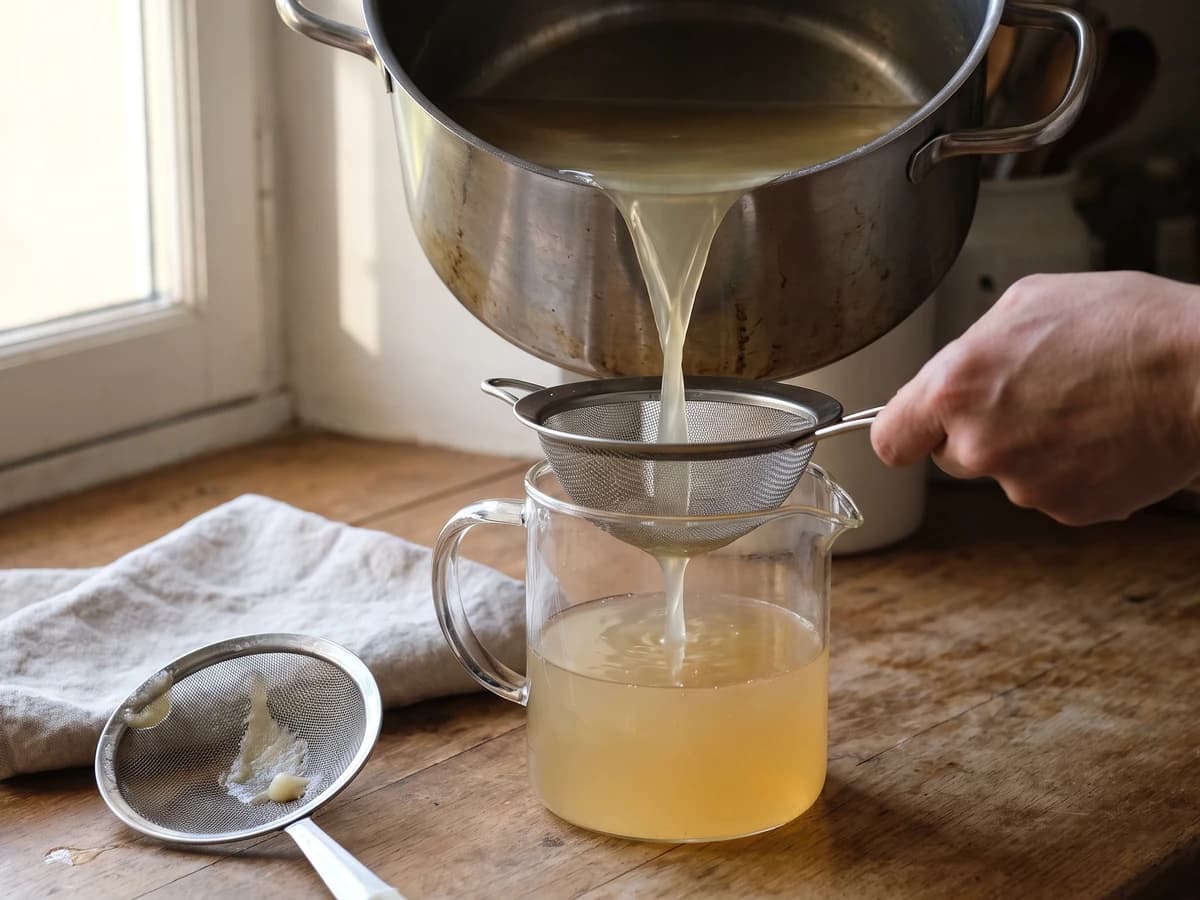
Break the veal bones small, then give them eight hours at a bare tremble. This pale, gelatinous fond becomes the quiet foundation beneath velouté, blanquette, and every sauce that must stay light.
Chef Juliette
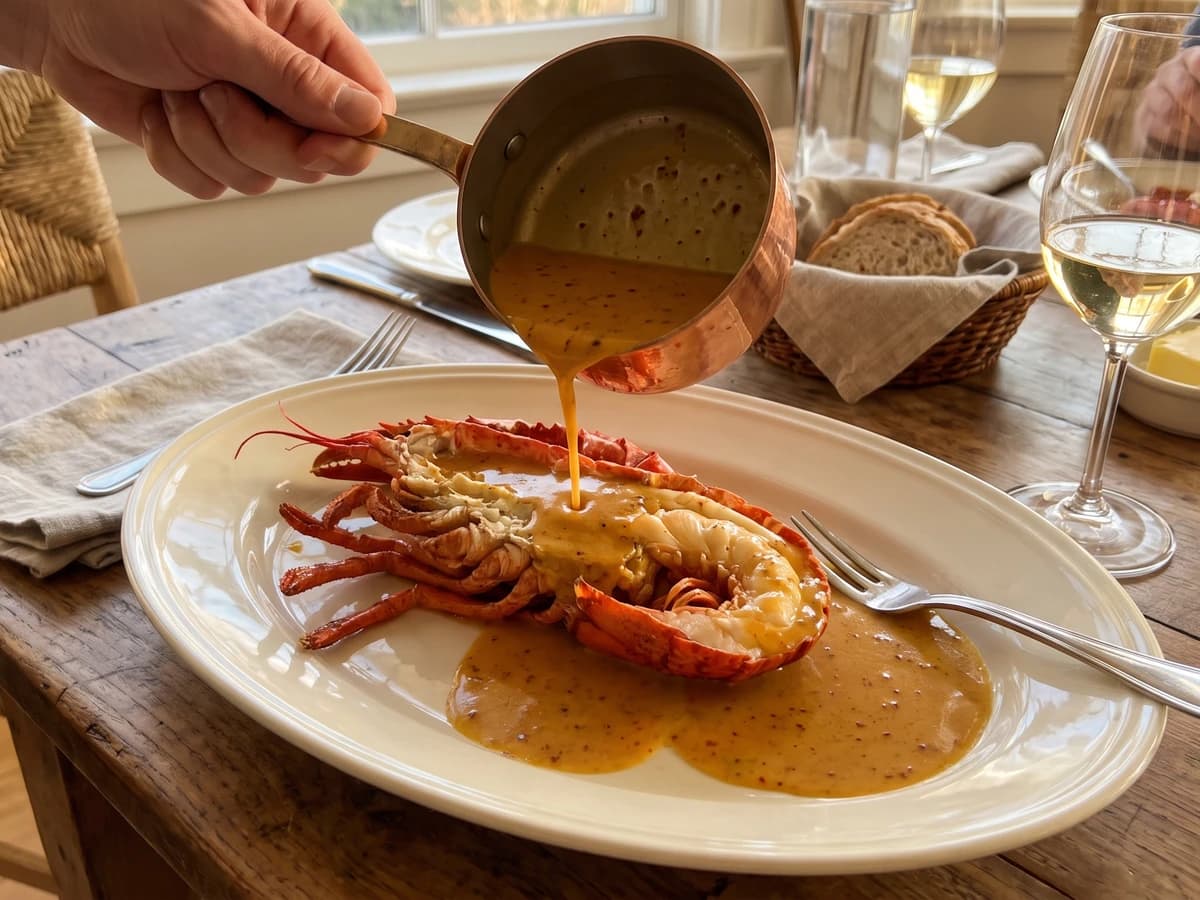
Sauce Orientale concentrates lobster-rich American Sauce with curry, then folds in cream away from the fire: a glossy, gently spiced derivative made for lobster, crayfish, and firm fish.
Chef Juliette
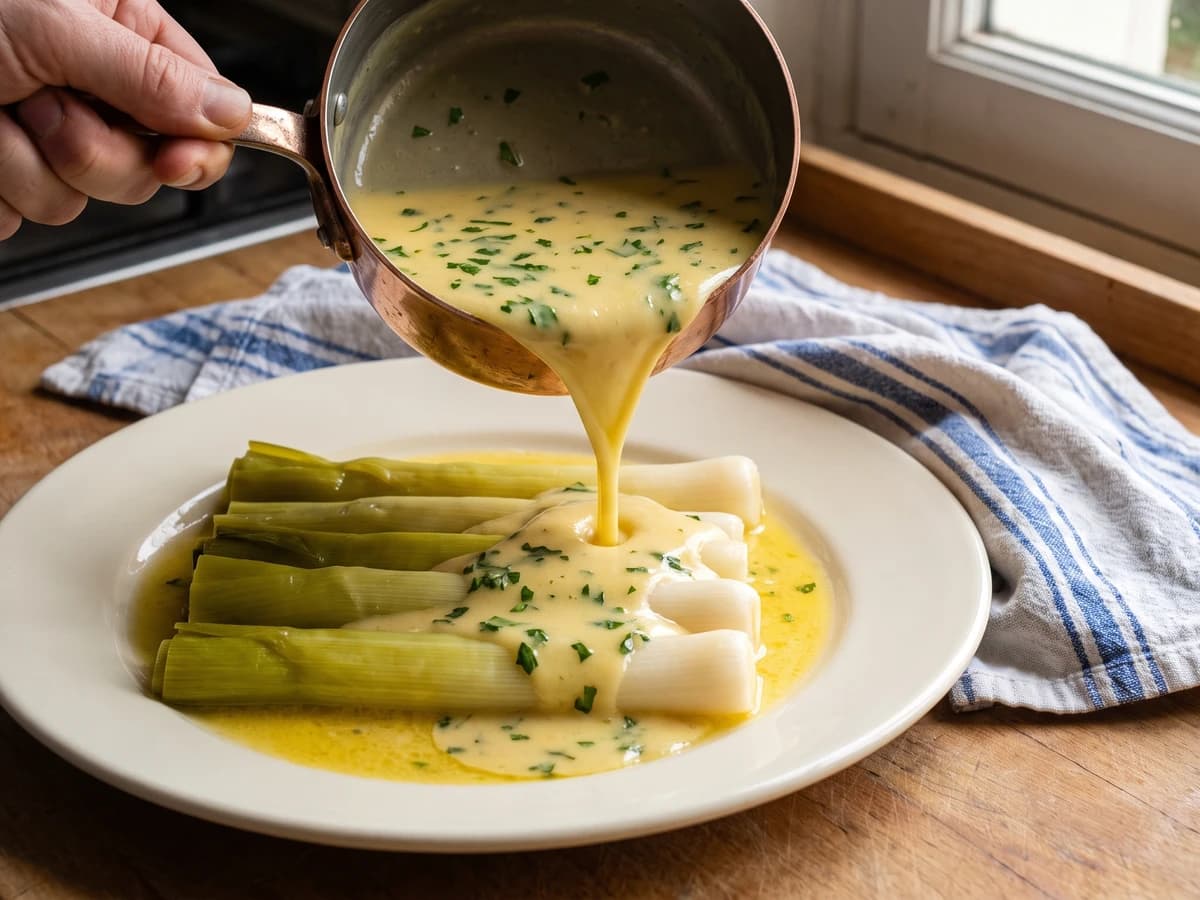
An old lesson in sauce families: Sauce Allemande takes mushroom liquor, then butter, lemon, and parsley, becoming a glossy Poulette for sheep's trotters, leeks, cauliflower, and anything needing gentle richness with a bright edge.