
Chef Juliette
John Dory (St. Pierre)
John Dory has the delicacy of sole and the firmness of turbot. A light flouring, a quick butter sauté, and nut-brown beurre noisette show exactly why looks never mattered.
A cooking platform built around craft, culture, and the stories behind what we eat.
Created by Chef Juliette
Based on No. 787, Cadgerée of Salmon, from Le Guide Culinaire (1907) by Auguste Escoffier
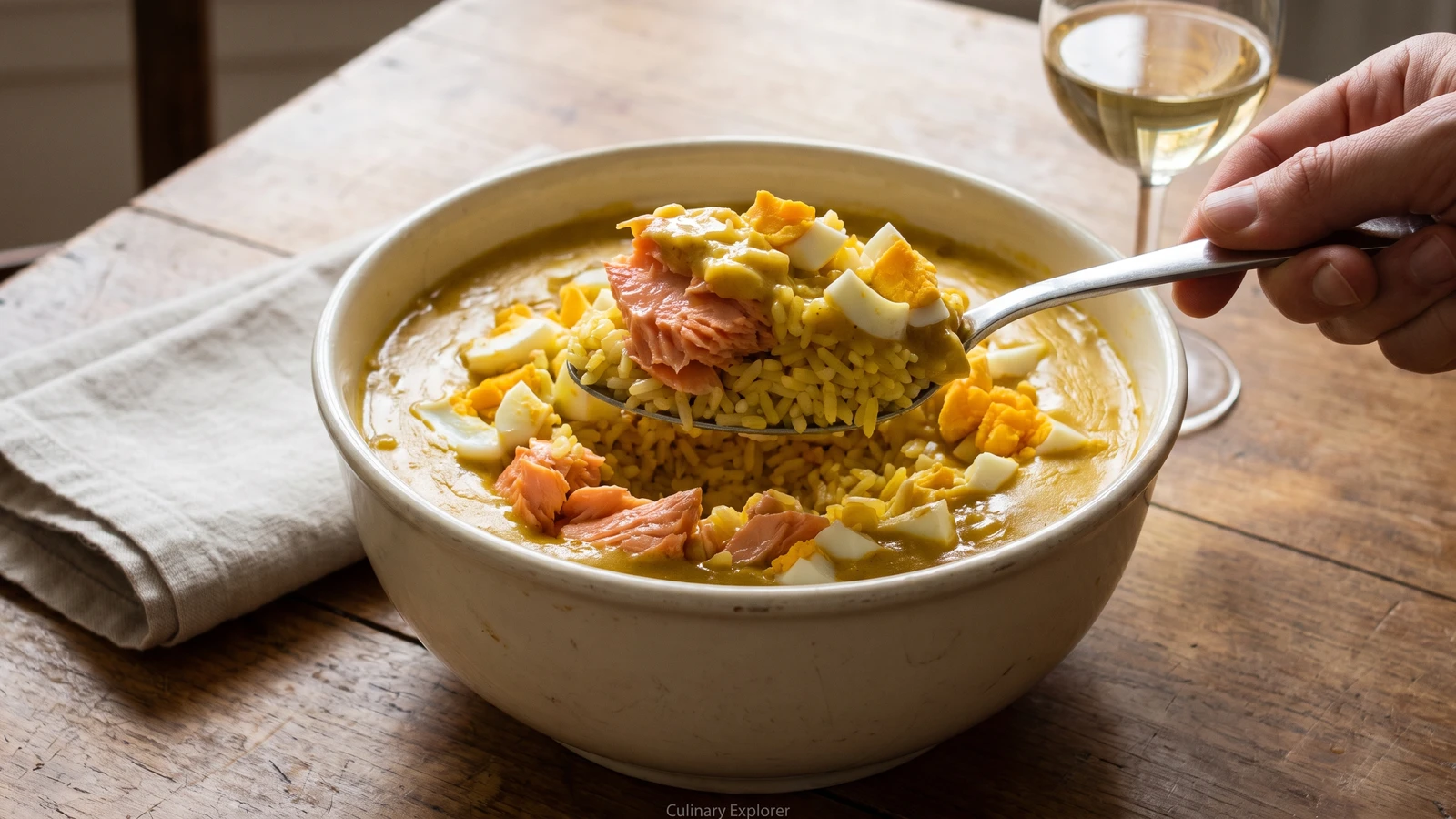
Cadgerée de Saumon brings flaky salmon, buttered pilaff rice, and diced egg together beneath curry-scented Béchamel, a generous hot supper whose success depends on keeping each component moist and distinct.
Cadgerée de Saumon teaches orchestration. Its one true rule is that the salmon, pilaff, eggs, and Béchamel must each be properly cooked before they meet, because the final layering warms and unites them but cannot repair a dry fish or sodden rice. Keep the components distinct, and every spoonful gives you soft egg, separate grains, coral flakes of salmon, and glossy curry-scented sauce.
The original formula assumed cooked salmon waiting at one station, a saucier holding Béchamel at another, pilaff fed from stock never off the fire, and a hot timbale ready for service. Here every source quantity is reduced by one quarter, giving four generous servings from 12 ounces each of cooked salmon and pilaff, three eggs, and 320 ml of sauce. A measured cup of light stock, one freshly made Béchamel, and a warmed deep serving bowl replace the brigade scaffolding. A salamander has no place here because the sauce is a coating, not a gratin. One cook, one stove, one evening.
The dish itself must stay: equal weights of cooked salmon and pilaff, hard-boiled egg in alternating layers, and enough flowing Béchamel to cover the whole. Synchronize the final ten minutes so everything arrives warm, and watch the sauce most closely. If it tightens while it waits, loosen it before pouring. The coating must fall from the spoon in a broad ribbon, not sit like paste.
Cadgerée belongs first to the Anglo-Indian table, where British cooks transformed South Asian khichri, a rice-and-pulse preparation, into kedgeree enriched with fish, eggs, and curry seasoning. French classical kitchens received it through the English repertoire, rendered its name as cadgerée, and recast it here with salmon, pilaff rice, and curry-flavoured Béchamel. It is not regional French fare or a Normandy cream dish; its place in the canon records how a travelled preparation was absorbed and translated through French sauce and rice technique.
Quantity
15 ounces (425 g)
skin-on; cooked to yield 12 ounces (340 g), then cleared of skin and pin bones
Quantity
1 teaspoon (5 ml / 5 g)
Quantity
2 tablespoons (30 ml / 30 g)
Quantity
1 teaspoon (5 ml / 6 g)
divided
Quantity
3
Quantity
2 teaspoons (10 ml / 9 g)
Quantity
3 tablespoons (45 ml / 30 g)
very finely minced
Quantity
2/3 cup (160 ml / 120 g)
Quantity
1 cup (240 ml / 240 g)
Quantity
1
Quantity
2 tablespoons (30 ml / 28 g)
Quantity
1 teaspoon (5 ml / 3 g)
Quantity
1/4 cup (60 ml / 30 g)
Quantity
1 1/4 cups (300 ml / 307 g), plus up to 2 tablespoons (30 ml / 31 g) if needed
Quantity
1/8 teaspoon (0.6 ml / 0.3 g)
| Ingredient | Quantity |
|---|---|
| center-cut salmon filletskin-on; cooked to yield 12 ounces (340 g), then cleared of skin and pin bones | 15 ounces (425 g) |
| unsalted butter, for the salmon | 1 teaspoon (5 ml / 5 g) |
| water | 2 tablespoons (30 ml / 30 g) |
| fine saltdivided | 1 teaspoon (5 ml / 6 g) |
| large eggs | 3 |
| unsalted butter, for the pilaff | 2 teaspoons (10 ml / 9 g) |
| yellow onionvery finely minced | 3 tablespoons (45 ml / 30 g) |
| long-grain white rice | 2/3 cup (160 ml / 120 g) |
| light unsalted chicken stock or water | 1 cup (240 ml / 240 g) |
| bay leaf | 1 |
| unsalted butter, for the Béchamel | 2 tablespoons (30 ml / 28 g) |
| mild curry powder | 1 teaspoon (5 ml / 3 g) |
| all-purpose flour | 1/4 cup (60 ml / 30 g) |
| whole milk | 1 1/4 cups (300 ml / 307 g), plus up to 2 tablespoons (30 ml / 31 g) if needed |
| ground white pepper | 1/8 teaspoon (0.6 ml / 0.3 g) |
Melt the 2 teaspoons butter in a small heavy saucepan over medium-low heat. Add the onion and cook for 3 minutes without colouring, until soft and translucent. Stir in the rice and cook for another minute, turning every grain through the butter until its edges look glassy. Add the stock or water, bay leaf, and 1/4 teaspoon of the salt. Bring it to one full boil, stir once, cover tightly, and cook over the lowest heat for 14 minutes. Remove it from the heat and leave it covered for 10 minutes, then discard the bay leaf and fluff gently. The grains must be fully tender but separate. If they remain firm and the pan is dry, add 2 tablespoons of hot water, cover, and rest over low heat for 5 minutes. If they are wet, uncover them over low heat for a minute, then rest again.
While the rice cooks, lower the eggs into a saucepan of gently boiling water and cook for 10 minutes. Transfer them to cold water for 3 minutes, just long enough to stop the cooking and make peeling manageable. Peel them, then hold them in warm water until assembly so they do not chill the dish. Dice them into pieces about 1/2 inch (1.25 cm) across.
Heat the oven to 325°F (165°C). Butter a shallow baking dish with the 1 teaspoon butter and set the salmon inside, skin-side down. Season with 1/4 teaspoon salt, add the 2 tablespoons water around the fish, and cover the dish tightly with parchment and foil. Bake for 12 to 18 minutes, depending on thickness, until the center reaches 145°F (63°C) and separates into moist flakes. Uncover it immediately. Once cool enough to handle, remove the skin and every pin bone, then break the flesh into small pieces rather than crushing it. Measure 12 ounces (340 g) for the dish. If an edge has cooked too far, keep those drier flakes for the upper layer where the Béchamel will cover them.
Melt the 2 tablespoons butter in a medium saucepan over low heat. Add the curry powder and stir for 20 seconds, only until fragrant, then add the flour. Cook this pale roux for 2 minutes, stirring constantly; it should look sandy but take no brown colour. Remove the pan from the heat and whisk in the milk a little at a time, making each addition smooth before adding the next. Return it to medium-low heat and cook for 5 to 7 minutes, whisking along the base and corners, until the Béchamel reaches nappe, meaning it coats the back of a spoon while still flowing freely. Season with the white pepper and remaining 1/2 teaspoon salt. You need 1 1/3 cups (320 ml) for assembly. If the sauce becomes too thick, whisk in extra milk a spoonful at a time. If lumps remain, take it off the heat, whisk vigorously, and pass it through a fine sieve. Ça se rattrape.
Measure 12 ounces (340 g) of the warm pilaff, reserving any excess for another meal. Fill a 2-quart (2-liter) heatproof serving bowl with very hot water and let it stand for 3 minutes, then empty and dry it thoroughly. This warmed bowl is the honest home equivalent of the source's hot timbale. Keep the salmon in broad flakes and the egg in clean dice; the layering should show what each ingredient is.
Spoon a loose layer of pilaff into the warmed bowl, scatter over salmon and diced egg, then repeat until all three components are used. Do not press them down. Pour the hot curry Béchamel over the surface in a broad, complete coating, encouraging it just slightly into the edges without stirring the layers together. There is no broiling and no browned crust; the source calls for a glossy coating of sauce. Carry it straight to the table and serve with a broad spoon. À table!
1 serving (about 300g)
Culinary guides, cultural storytelling, and the editorial depth that makes cooking meaningful.
Discover Culinary ExplorerChef Juliette
John Dory has the delicacy of sole and the firmness of turbot. A light flouring, a quick butter sauté, and nut-brown beurre noisette show exactly why looks never mattered.

Chef Juliette
Fresh haddock proves its delicacy in the meunière pan: a fine flour crust, moist pearly flakes, and beurre noisette sharpened with lemon and parsley, ready from one skillet in half an hour.

Chef Juliette
Éperlans à l’Anglaise turns small fish into a lesson in disciplined coating: boned smelts under a close, crisp crumb, pan-fried in clarified butter and finished with bright, half-melted maître d’hôtel butter.

Chef Juliette
Tiny smelts, shallot, mushrooms, white wine, gratin sauce, and fine bread raspings meet a fierce oven, where the fish must turn tender in the same breath the buttered crust bronzes.